

Dollar cost averaging is one of the simplest ways to start investing without feeling pressured to pick the perfect day to buy. For UAE-based readers who want a steadier, more disciplined entry into markets, it may be a useful approach because it spreads purchases over time rather than committing all capital at once. That can feel especially helpful if you are new to investing, worried about volatility, or still building confidence. If you are starting from the basics, our guide on how to invest uae can help you place this strategy in a broader plan. Dollar cost averaging does not remove risk, and it does not guarantee gains, but it may help some investors build consistency and avoid emotional decision-making.
What dollar cost averaging means
Dollar cost averaging, often shortened to DCA, is an investing method where you put a fixed amount of money into an asset at regular intervals. That could mean investing $100 every week, $500 every month, or another amount that fits your budget.
The core idea is simple. Instead of trying to predict the best time to buy, you keep buying on schedule. When prices are high, your fixed amount buys fewer units. When prices are lower, it buys more. Over time, this may smooth out your average purchase price.
Many beginners first encounter DCA while researching index funds or broad market ETFs. It is popular because it is easy to understand, easy to automate, and often easier to stick with during volatile markets.
For readers in the UAE, DCA may be relevant whether you are buying stocks, ETFs, or in some cases crypto. The strategy itself is not tied to one asset class. What matters more is using it with assets you understand and a platform that is appropriately regulated for your situation.
How dollar cost averaging works
Here is the basic process:
- Choose the asset or group of assets you want to invest in
- Set a fixed amount, such as $200 per month
- Choose a schedule, such as weekly or monthly
- Keep investing on that schedule regardless of short-term price moves
That structure is what makes the strategy appealing. You do not need to decide whether this week is a good entry point. You simply follow the plan you set in advance.
Some investors pair DCA with long-term themes such as ETFs, diversified equity exposure, or slow portfolio building. If you are still learning the building blocks, our etf explained resource can help clarify why ETFs are often used in recurring investment plans.
You may also see searches for a dca calculator or dollar cost averaging calculator. These tools are usually designed to show how recurring investments would have accumulated over a given period. They can be helpful for planning, but they still rely on assumptions and historical prices. They do not predict future returns.
Common DCA mistakes UAE investors should avoid
Here is the thing. DCA sounds simple, but in real life the results often depend on whether you actually follow the rules you set. Many investors do not fail because the concept is flawed, they fail because execution becomes emotional, inconsistent, or more expensive than expected.
One common mistake is changing the schedule based on headlines. If you only buy when the news feels positive, you are no longer using a fixed plan, you are timing the market in disguise. Another is stopping contributions after a drop. That is usually the moment when DCA would have been buying more units for the same amount, but fear can interrupt the process.
What many people overlook is the difference between DCA and “averaging down” into a weak asset. DCA is typically discussed as a structured approach for long-term investing in assets you actually want to hold through market cycles. Repeatedly buying a low quality stock, a highly speculative token, or an instrument you do not understand can increase risk rather than reduce it. DCA does not make a risky asset safe, and it does not guarantee you will recover losses.
Costs and mechanics matter even more when you are making small recurring purchases. UAE investors may face friction from FX conversion costs if deposits are in AED but the investment is in USD, minimum order sizes, and whether the platform supports fractional shares. If you cannot buy fractions, you may end up holding cash between purchases, which can drag on performance in rising markets. It is also smart to check for non trading costs like withdrawal fees or inactivity fees if you plan to fund the account sporadically.
From a practical standpoint, guardrails help. Pick an interval you can sustain, keep the contribution amount realistic for your cash flow, and consider setting a monthly cap so you do not overextend during volatile periods. Also confirm you are buying the product type you intended. Some platforms offer real stocks and ETFs, while others emphasize CFDs, which can involve leverage and ongoing funding costs. That difference can change risk and cost in a way that matters for long-term recurring investing.

Potential benefits of DCA
Dollar cost averaging is popular for practical reasons, not because it is magic. Its main advantages are tied to behavior, discipline, and risk management.
- It may reduce emotional timing decisions. Many investors struggle with fear after a market drop and overconfidence after a rally. DCA creates a repeatable process.
- It can make investing feel more manageable. A monthly contribution may be easier than waiting until you have a large lump sum.
- It may lower regret. If you invest all at once just before a decline, that can be hard to handle psychologically. Spreading entry points may soften that feeling.
- It supports habit building. Regular investing can work well alongside long-term concepts such as compound interest, especially when contributions continue over many years.
For many first-time investors, these behavioral benefits are the real value. A strategy you can follow calmly may be more useful than a theoretically better strategy you abandon after the first period of volatility.
Where DCA may fall short
DCA is not automatically the best choice in every situation. It has trade-offs, and those matter.
If markets trend upward over long periods, investing a lump sum earlier may outperform investing gradually because more money is exposed to the market sooner. That is one reason the dca vs lump sum debate keeps coming up.
DCA also does not protect you from buying weak assets. If you keep averaging into something fundamentally poor, the strategy itself will not fix that mistake. You still need to choose assets carefully.
Fees can also matter. If your platform charges high trading costs on every small purchase, frequent DCA contributions may become less efficient. This is especially relevant when using brokers or apps with commissions, spreads, or funding fees.
Finally, DCA may create a false sense of safety if investors confuse “less timing pressure” with “less market risk.” Your capital is still at risk, and market values may fall for extended periods.
When DCA may make sense (and when it may not)
Consider this. DCA is often used in very normal, real-life scenarios. If you invest from a monthly salary, DCA may be the natural way you build exposure over time because you do not have the full amount on day one. It can also be helpful if you are a nervous first-time investor and you know that investing all at once would tempt you to panic sell after the first pullback.
DCA may also appeal in volatile markets or when the entry timing feels uncertain. The goal is not to outsmart the market, it is to make the decision process less stressful so you can stay consistent. That said, consistency does not prevent losses. If the market trends down for an extended period, a DCA plan can still lose money, just often in a more gradual way.
Now, when it comes to cases where DCA may be less efficient, the big one is having a lump sum ready today with a long time horizon. If you already have the cash and you would genuinely invest it right away, spreading it out can create “cash drag,” meaning part of your money sits uninvested while the market could be moving higher. In lower volatility portfolios, or during strong sustained rallies, this opportunity cost can be noticeable.
A practical decision framework is to think through a few filters without turning it into personalized advice. First, your time horizon, which is how long you realistically plan to stay invested. Longer horizons often make short-term entry timing less important. Second, your ability to tolerate volatility without changing the plan, which matters because the best strategy on paper is not useful if you abandon it. Third, your cash flow. If contributions come from income, DCA is often the default approach. Fourth, your honesty about behavior: if you have a lump sum but you are likely to procrastinate waiting for a “better price,” a structured DCA schedule may be better than doing nothing for months.
The reality is that DCA is a behavior tool, not a performance guarantee. It can support disciplined investing, but it cannot control market returns, and it does not remove the risk of loss.
A simple DCA example
Imagine you invest $300 per month into the same asset for four months.
| Month | Investment | Price per unit | Units bought |
|---|---|---|---|
| Month 1 | $300 | $30 | 10.00 |
| Month 2 | $300 | $25 | 12.00 |
| Month 3 | $300 | $20 | 15.00 |
| Month 4 | $300 | $24 | 12.50 |
Total invested is $1,200. Total units bought are 49.5. Your average cost per unit would be about $24.24.
This example shows the basic mechanism behind DCA. You bought more units when prices fell and fewer when prices were higher. That may help smooth your entry price, although it does not ensure future profit.

DCA for stocks, ETFs, and crypto
DCA can be used across several asset types, but the suitability may differ.
Dollar cost averaging stocks often appeals to investors building long-term exposure to large companies or diversified baskets. Many people use it with ETFs rather than individual stocks to reduce company-specific risk.
Dollar cost averaging crypto is also common because crypto prices can move sharply. A fixed-schedule approach may reduce the temptation to chase rapid price moves. Still, crypto is highly volatile, and losses can be significant. DCA does not change that underlying risk.
For broad, diversified exposure, some investors focus on ETFs or index-based strategies rather than concentrated positions. You can browse more educational material in our Investing and Wealth Building section if you want to compare different long-term approaches.
Whatever asset you choose, the key question is not whether DCA sounds simple. It is whether the asset fits your risk tolerance, timeline, and understanding.
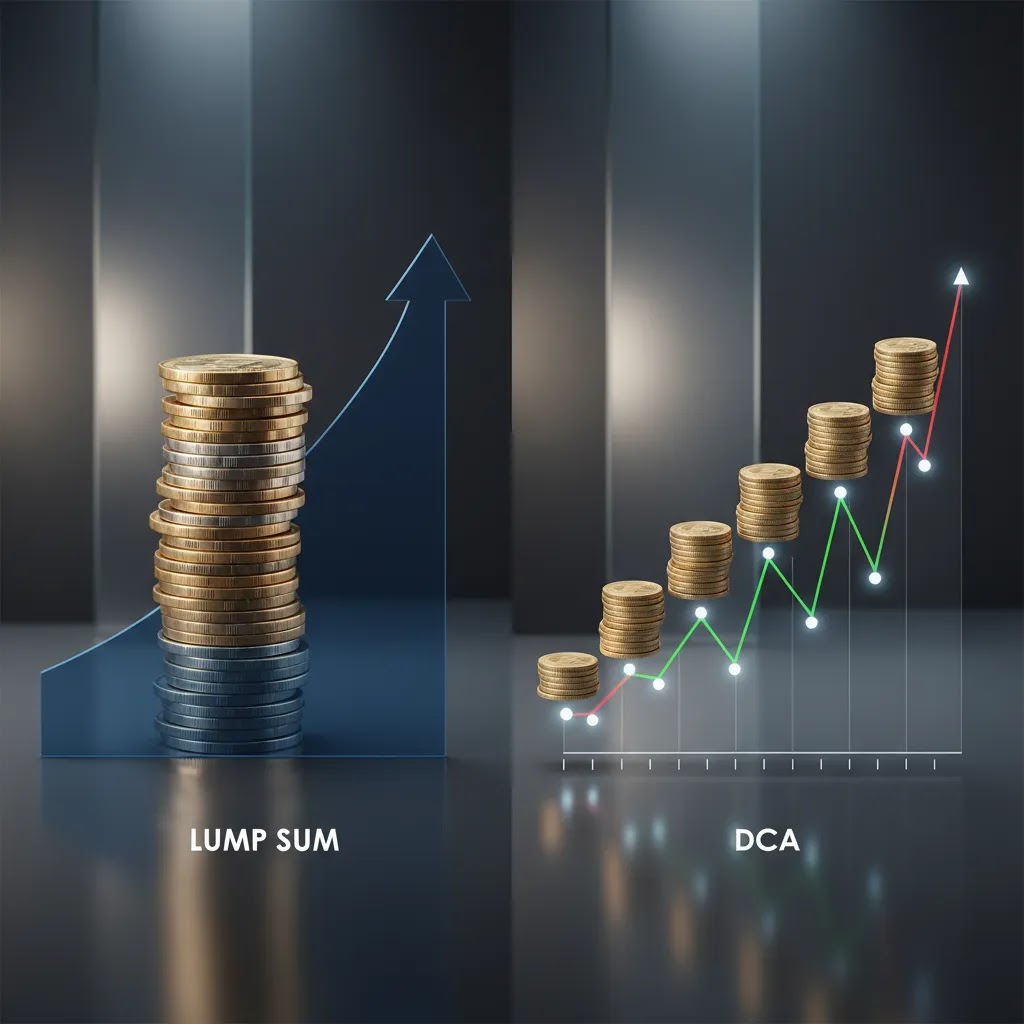
DCA vs lump sum investing
DCA and lump sum investing are both valid approaches, but they solve different problems.
- DCA may suit investors who value consistency and emotional control.
- Lump sum investing may suit investors who already have capital ready and can tolerate volatility.
From a purely mathematical perspective, lump sum investing often has an advantage in rising markets because money is invested earlier. But real people are not spreadsheets. If fear causes you to delay investing for months, a structured DCA plan may be more realistic and easier to maintain.
There is also a middle ground. Some investors split available capital into staged entries over several months. That is not guaranteed to improve outcomes, but it may help them stay committed to a plan they can actually follow.
If you are investing from the UAE, it may also be worth understanding the local legal and regulatory context around financial products, broker access, and account protections. Our UAE Regulation and Tax category can help with that background.
DCA vs lump sum: what research tends to show (in plain English)
Think of it this way. When markets rise over time, having more money invested earlier often leads to a higher ending value, simply because more capital participates in the gains sooner. That is the core reason many studies and long-term comparisons tend to show lump sum investing outperforming DCA on average, particularly in markets with an upward bias.
The trade-off is the experience of volatility and the risk of regret. Lump sum investing can feel straightforward until you invest and the market drops shortly after. DCA may reduce that emotional impact because you are spreading entry points, but it can also lag in fast-rising markets because part of the money remains in cash while you phase in. This is the “cash drag” effect, and it is one of the clearest drawbacks when markets move up quickly.
None of this means DCA is wrong. It means DCA and lump sum are optimizing for different goals. Lump sum tends to maximize the expected return potential when you can commit immediately and stay invested through drawdowns. DCA often aims to reduce timing stress and help investors follow through on a plan. The reality is that DCA does not prevent losses. If the asset declines over a long period, spreading purchases over time can still result in a negative return.
Phased investing is often used as a compromise. Instead of investing a lump sum all at once, an investor may schedule it into the market over a defined window, such as three to twelve months. This approach may help someone avoid the all-or-nothing feeling of a single entry point, and it may reduce procrastination if the schedule is clearly defined. What it cannot do is remove market risk or guarantee a better outcome than investing immediately.
Platforms UAE investors may consider for DCA investing
The DCA strategy is simple, but the platform you use still matters. Based on Business24-7 product data, several platforms offer features that may appeal to investors who want broad access, low minimum deposits, or UAE-relevant regulation.
eToro is rated 4.5/5 and offers stocks, ETFs, forex, crypto, commodities, and indices. It includes 0% commission on real stocks, supports AED deposits, and is regulated by CySEC, FCA, ASIC, and ADGM. For investors who want a user-friendly interface and multi-asset access, it may be a practical starting point, though spreads apply on CFDs and the minimum deposit is $200.
Interactive Brokers is also rated 4.5/5 and may appeal more to experienced investors who want access to 150+ markets, professional-grade tools, and very low pricing for higher volumes. It has no minimum deposit and is regulated by DFSA, SEC, FCA, and SFC. The trade-off is that its tools may feel more complex for a beginner.
XTB carries a 4.0/5 rating, no minimum deposit, and offers 0% commission stocks up to volume limits, plus access to stocks, ETFs, forex, commodities, crypto, and indices. It is regulated by DFSA, FCA, CySEC, and KNF, and may suit investors who value education and a simpler path into recurring investing.
These examples show why platform selection matters. A DCA strategy works best when account minimums, fee structure, market access, and regulation all line up with your goals. If you plan to use a broker for recurring investing, check whether purchases are in real assets or CFDs, what the actual ongoing costs are, and which regulator oversees the entity serving your region.
How to choose a platform for DCA investing
If you want to use dollar cost averaging in practice, focus on platform quality before you focus on convenience. A few core checks can make a big difference.
1. Check regulation first
For UAE readers, regulation is one of the first filters. Depending on the platform, you may see oversight from bodies such as the DFSA, SCA, ADGM, FCA, ASIC, or CySEC. Regulation does not eliminate risk, but it may improve accountability, disclosures, and operating standards.
2. Understand the fee structure
DCA usually means repeated purchases. That makes fees especially important. Look at commissions, spreads, overnight funding fees for CFDs, inactivity fees, and any deposit or withdrawal charges. For example, eToro offers 0% commission on real stocks but uses spreads on CFDs, while XTB also offers 0% commission stocks up to volume limits. Interactive Brokers uses tiered or fixed pricing that may be attractive for higher-volume investors.
3. Confirm access to the assets you actually want
If your DCA plan is built around ETFs or stocks, make sure the broker supports them directly. Some platforms emphasize CFDs, which behave differently and may not suit long-term recurring investing for all users.
4. Consider usability and automation
A good DCA setup should be easy to repeat. Clean mobile access, account funding convenience, and a straightforward interface may matter more than advanced charting if your plan is long-term accumulation rather than active trading.
5. Match the platform to your experience level
A beginner may prefer a simpler platform with clear education, while a more advanced investor may want wider market access and more detailed research tools. Business24-7 generally evaluates platforms through a safety-first lens, looking at regulation, fees, features, market access, support quality, and usability so readers can compare options more clearly before committing capital.
If you later move from learning strategies to comparing providers, Business24-7 can help you research regulated options for the UAE market. You can review our broker comparisons, read full platform reviews, and use our educational resources as a reference point before opening an account.
Pros and Cons
Strengths
- Dollar cost averaging is simple to understand and may be easier for beginners to follow consistently.
- It may reduce the pressure to time the market perfectly.
- It can support disciplined investing through regular contributions.
- It may help smooth your average purchase price over time.
- It can be used with stocks, ETFs, and in some cases crypto, depending on the platform and asset.
Considerations
- It does not guarantee gains or protect you from market losses.
- Lump sum investing may outperform DCA in markets that rise steadily over time.
- Frequent small purchases can become inefficient if platform fees are high.
- DCA does not fix poor asset selection or excessive risk-taking.
Frequently Asked Questions
What is dollar cost averaging in simple terms?
Dollar cost averaging means investing the same amount of money at regular intervals instead of investing everything at once. For example, you might invest $200 every month into the same ETF or stock. This may reduce the pressure of trying to choose the perfect entry point, but your capital is still exposed to market risk.
How does DCA work in practice?
DCA works by using a fixed schedule and a fixed contribution amount. When prices are lower, your money buys more units. When prices are higher, it buys fewer. Over time, this may smooth your average cost. Many investors automate the process through their broker, although features and available assets vary by platform.
Is dollar cost averaging better than lump sum investing?
Not always. Lump sum investing often performs better in rising markets because more money is invested earlier. DCA may still be useful if you are nervous about volatility, investing from monthly income, or more likely to stay disciplined with gradual investing. The better option often depends on behavior, time horizon, and risk tolerance.
Can I use dollar cost averaging for stocks?
Yes, many investors use DCA for stocks, especially diversified holdings or broad funds. It may be more effective when paired with a long-term plan rather than short-term speculation. If you are buying individual stocks, remember that company-specific risk still matters, and DCA does not remove the risk of poor business performance.
Can I use dollar cost averaging for crypto?
Yes, but caution is important. Dollar cost averaging crypto is popular because prices can move sharply, and a recurring schedule may reduce emotional trading. Still, crypto remains highly volatile and can produce steep losses. DCA may help with discipline, but it does not make a risky asset safe or suitable for every investor.
Do I need a large amount of money to start DCA investing?
No, one reason DCA appeals to beginners is that it can start with smaller recurring amounts. The real requirement is choosing a platform where fees do not erode those contributions too heavily. Minimum deposits also vary. Based on current Business24-7 data, some brokers such as XTB and Interactive Brokers list a $0 minimum deposit, while others require more.
What should I look for in a DCA platform in the UAE?
Start with regulation, then review costs, market access, and ease of use. UAE investors often look for firms regulated by bodies such as the DFSA, SCA, or ADGM, or by established international regulators like the FCA, ASIC, or CySEC. Also confirm whether you are buying real assets or CFDs, because that affects cost and suitability.
What is a dollar cost averaging calculator?
A dollar cost averaging calculator is a planning tool that estimates how repeated investments might have performed over time. It can help illustrate the mechanics of recurring investing, but it does not predict future returns. Any output depends on assumptions, timing, and past market data, which may not reflect future market behavior.
Does DCA eliminate investment risk?
No. DCA may reduce timing anxiety, but it does not remove market risk, asset-specific risk, or platform risk. Prices can fall after you invest, sometimes for long periods. That is why asset selection, regulation, fees, and your own time horizon still matter even if you use a disciplined investing schedule.
Is dollar-cost averaging a good idea?
It can be, but it depends on what problem you are trying to solve. DCA may be a good idea for investors who want a structured way to invest from regular income, reduce timing anxiety, and stay consistent through volatility. If you have a lump sum ready to invest immediately and a long time horizon, gradually phasing in can create cash drag, meaning part of your money sits uninvested while markets move. Either way, DCA does not guarantee gains, and you can still lose money if the asset or market declines.
What are the drawbacks of DCA?
The main drawback is opportunity cost. If markets rise quickly, investing gradually may underperform investing earlier because less capital is exposed to the market at the start. DCA can also become inefficient if you pay high fees on frequent small buys, or if FX conversion costs apply each time you fund your account. Another drawback is behavioral. Some people treat DCA as a safety net and take on too much risk, but the strategy does not prevent losses.
What is the 5% rule in investing?
The “5% rule” can mean different things depending on the context, so it is important to clarify how someone is using it. Many investors use a 5% guideline as a position-sizing or diversification rule, such as limiting a single stock or high-risk asset to around 5% of a portfolio to avoid one holding dominating results. In that sense, it can be a simple risk control idea, not a guarantee. If you use DCA, the same concept can apply over time by keeping recurring contributions into any one asset within a limit that matches your risk tolerance and diversification goals.
Key Takeaways
- Dollar cost averaging means investing a fixed amount on a regular schedule instead of all at once.
- The strategy may help reduce emotional timing decisions and build investing discipline.
- DCA does not guarantee profit and does not remove the risk of loss.
- Fees, regulation, and whether you are buying real assets or CFDs matter when choosing a platform.
- For many beginners, DCA may be most useful as part of a broader long-term investment plan.
Conclusion
Dollar cost averaging remains one of the most accessible investment strategies because it is practical, structured, and easier for many people to maintain during uncertain markets. That does not make it superior in every case, and it certainly does not make investing risk-free. Its real strength is that it may help you stay consistent while reducing the urge to make emotional timing decisions. If you are building a long-term plan from the UAE, it makes sense to combine strategy education with careful platform research. Business24-7 is designed to help with exactly that. As your next step, browse our platform reviews, compare broker features and fees, and return to our educational guides whenever you want a clearer, more grounded view before making a financial decision.
Disclaimer: The content published on Business24-7 is intended for informational purposes only and does not constitute financial advice, investment recommendations, or an endorsement of any specific platform or financial product. Trading and investing carry significant risk, including the potential loss of capital. You should conduct your own research and, where appropriate, seek independent financial advice before making any investment decisions. Business24-7 does not accept responsibility for any financial losses incurred as a result of information published on this site.
Disclaimer
eToro is a multi-asset platform which offers both investing in stocks and cryptoassets, as well as trading CFDs.
Please note that CFDs are complex instruments and come with a high risk of losing money rapidly due to leverage. 61% of retail investor accounts lose money when trading CFDs with this provider. You should consider whether you understand how CFDs work, and whether you can afford to take the high risk of losing your money
This communication is intended for information and educational purposes only and should not be considered investment advice or investment recommendation. Past performance is not an indication of future results.
Copy Trading does not amount to investment advice. The value of your investments may go up or down. Your capital is at risk.
Crypto assets are complex and carry a high risk of volatility and loss. Trading or investing in crypto assets may not be suitable for all investors. Take 2 mins to learn more
eToro USA LLC does not offer CFDs and makes no representation and assumes no liability as to the accuracy or completeness of the content of this publication, which has been prepared by our partner utilizing publicly available non-entity specific information about eToro.

Dollar cost averaging is one of the simplest ways to start investing without feeling pressured to pick the perfect day to buy. For UAE-based readers who want a steadier, more disciplined entry into markets, it may be a useful approach because it spreads purchases over time rather than committing all capital at once. That can feel especially helpful if you…