
Any gold price forecast should be treated as a probability exercise, not a certainty. Gold can react sharply to interest rate expectations, U.S. dollar strength, inflation data, central bank buying, and geopolitical stress, which means even a well-grounded outlook can change quickly. For UAE readers, gold remains especially relevant because it sits at the intersection of wealth preservation, commodities exposure, and active trading opportunities. If you are still building context, our guide to gold trading uae is a useful starting point. In this analysis, Business24-7 takes a practical view of the gold outlook for 2026, what may drive XAU/USD higher or lower, what scenarios matter most, and how traders and long-term investors can interpret the gold price trend without relying on hype.
Gold Price Forecast Overview
The base case for 2026 is that gold may remain structurally supported if real interest rates ease, central bank demand stays firm, and recession concerns or geopolitical risks persist. That does not mean the metal moves in a straight line. Gold often advances in waves, then retraces when bond yields rise or the U.S. dollar strengthens.
A balanced gold price prediction needs to separate short-term noise from medium-term trend structure. For short-term traders, daily volatility in XAU/USD can be driven by inflation prints, Federal Reserve messaging, and shifts in market risk appetite. For longer-term investors, the bigger question is whether gold keeps its role as a defensive asset during uncertainty.
Business24-7 approaches this topic from an educational, UAE-focused perspective. The goal is not to call an exact top or bottom. It is to help readers judge whether the current gold price trend supports accumulation, caution, or a wait-and-see approach. If you are comparing gold with other asset classes, our breakdown of gold vs stocks gives useful context.
Gold Price Forecast 2026 to 2027: What Institutional Research Watches
Here’s the thing: a lot of big-picture gold outlooks for 2026 to 2027 are less about picking a single number and more about monitoring a short list of inputs that can shift the balance of supply and demand. For most institutional-style research, three areas tend to matter alongside rates and the dollar.
The first is ETF flows. When gold-backed ETFs see consistent inflows, it can reinforce the “new high” narrative because it suggests broad investor participation beyond short-term futures positioning. When ETF holdings shrink, it can be a headwind even if the macro story still sounds supportive.
The second is central bank buying volumes. Official-sector purchases can support the long-term bid for gold, but the market also reacts to whether buying appears persistent or episodic. In other words, headlines matter, but the underlying pace of accumulation can matter more than any single announcement.
The third is trade-policy uncertainty, including tariffs. Tariff headlines can be a discrete catalyst for safe-haven demand because they raise uncertainty around growth, inflation, and global supply chains. This can show up as a risk-off move that lifts gold even when other drivers look mixed.
Now, when it comes to “targets,” institutional forecasts often work in conditional ranges rather than one fixed call. Think of it this way: if rate cuts begin earlier than markets expect and real yields trend lower, upside ranges may expand. If inflation cools and policy stays restrictive, base case ranges can compress or shift lower. For UAE readers, you can track these inputs without treating them as guarantees by watching the trend in ETF holdings, the tone of official-sector purchase coverage, and how gold reacts to major trade-policy headlines. The goal is to update probabilities as the evidence changes, not to chase certainty.

Key Drivers Behind the Gold Outlook
Gold usually responds to a small set of macro drivers more than to company-specific news, unlike equities. The most important factor is often real interest rates, which means nominal rates adjusted for inflation. When real yields rise, gold can come under pressure because it does not generate income. When real yields fall, gold may look more attractive as a store of value.
The U.S. dollar is another major influence. Since gold is typically priced in dollars, a stronger dollar can weigh on XAU/USD, while a weaker dollar can offer support. This inverse relationship is not perfect, but it remains one of the clearest inputs in gold market analysis.
Inflation expectations also matter, though not always in a simple way. Gold may benefit when inflation is high and central banks appear behind the curve. But if inflation leads to aggressively higher rates, the effect can reverse.
Central bank purchases have become an increasingly important support factor in recent years. Persistent official-sector demand can strengthen the long-term gold outlook, especially when reserve diversification becomes a priority.
Geopolitics and recession fears tend to create episodic demand spikes. In those periods, gold may act as a defensive holding, though it should never be assumed to protect capital in every market environment. Readers exploring broader commodities trading should keep in mind that gold behaves differently from energy and many industrial commodities.
Gold Price Prediction 2026 Scenarios
A useful way to think about a gold price prediction 2026 is through scenarios rather than a single fixed target.
Bullish scenario: Gold could move higher if inflation stays sticky while growth slows, central banks begin cutting rates, or global uncertainty intensifies. In that environment, lower real yields and demand for defensive assets may support fresh highs or extended upside momentum.
Neutral scenario: Gold may consolidate in a broad range if inflation cools gradually, growth avoids a deep contraction, and the Federal Reserve keeps policy relatively steady. This kind of backdrop can lead to choppy price action rather than a decisive trend.
Bearish scenario: Gold could weaken if growth remains firm, yields move up, and the U.S. dollar regains strength. If markets rotate toward risk assets and inflation risks fade, gold may struggle to sustain rallies.
For UAE-based readers, this matters because many follow gold both as a physical asset and as a tradable market. A practical forecast should account for both perspectives. Physical buyers may care more about broad price direction and timing, while active traders tend to focus on XAU/USD momentum, volatility, and event risk.
Gold Price Targets and Scenarios: How to Think in Ranges (Not One Number)
What many people overlook is that gold price targets are typically more useful as ranges tied to conditions, not as a single “will happen” number. From a practical standpoint, you can think in three layers: a base case range, an upside extension, and a downside extension.
A base case range is what you might expect if the core drivers stay broadly consistent with current expectations, for example a gradual easing in inflation, a steady to slightly lower path for real yields, and no major shock that forces a rush into safe havens. Upside extensions often depend on real yields falling faster than expected, the U.S. dollar trending weaker for longer, or a risk-off event that changes positioning quickly. Downside extensions often show up when markets reprice “higher for longer” policy, yields push up, and the dollar strengthens at the same time.
The “new high” narrative usually needs persistent ETF inflows alongside sustained central bank demand. That combination can signal both investor participation and official-sector support. The same narrative often breaks when the market turns hawkish on rates, real yields rise, and the U.S. dollar regains momentum, even if the long-term story still sounds constructive.
Consider this simple “what would change my mind” checklist to keep your 2026 outlook honest as new data comes in. Has the market materially repriced the Federal Reserve path? Is inflation trending in a way that keeps real yields elevated, or does it allow them to fall? Are recession indicators strengthening or fading? Are ETF holdings rising consistently, or leaking lower? If two or three of those inputs flip direction, it is usually a sign your probability ranges should be updated rather than defended.
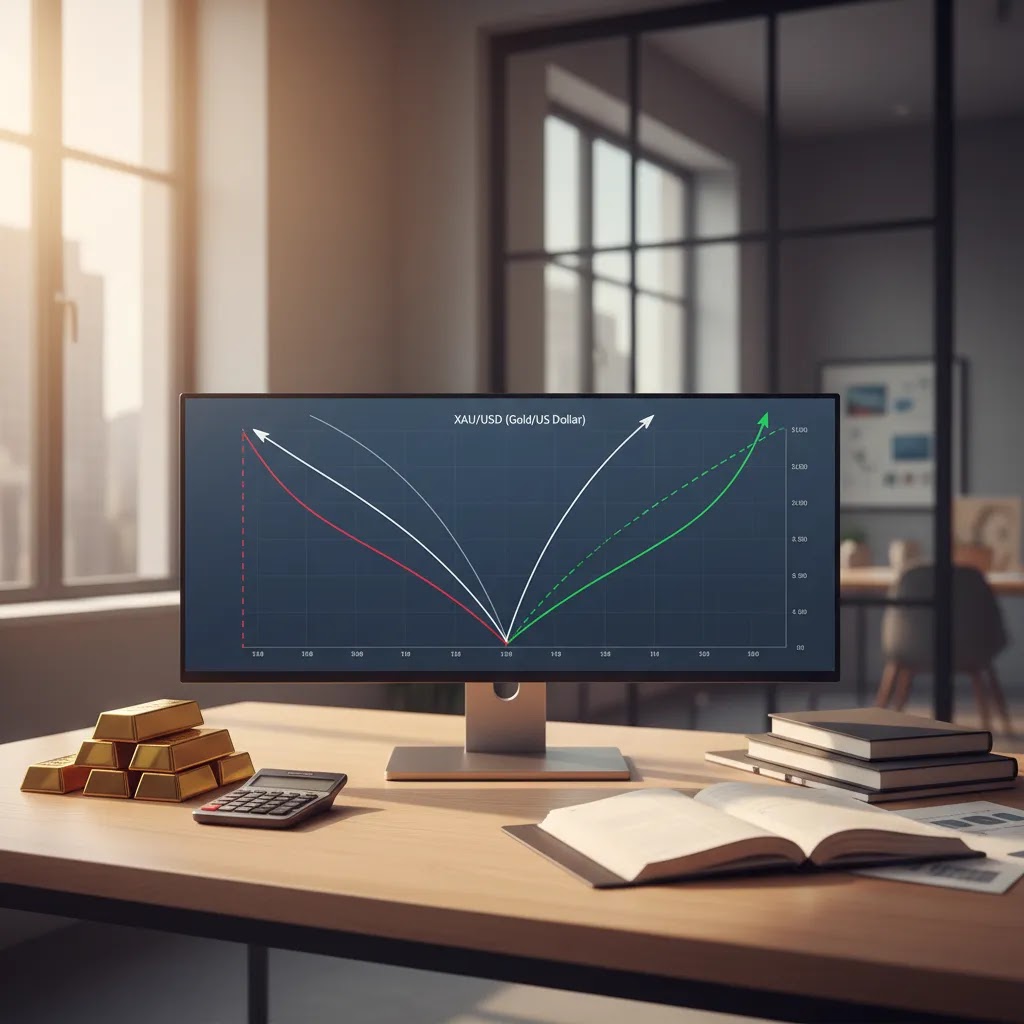
Gold Forecast Today vs Long-Term Outlook
A gold forecast today is usually event-driven. It may depend on one inflation release, a U.S. jobs report, or a central bank speech. That kind of prediction can be useful for short-term traders, but it should not be confused with a strategic gold outlook for 2026.
The short-term view asks: is gold overbought, oversold, or trapped in a range? The long-term view asks: are the macro conditions still supportive for gold over the next 6 to 18 months?
This distinction matters because traders often make poor decisions when they mix timeframes. A long-term bullish thesis can still include deep short-term pullbacks. A short-term bearish setup does not automatically invalidate a constructive 2026 gold price trend.
If you are using chart-based methods, our guide to gold technical analysis can help you connect macro views with practical price structure.
Longer-Term Gold Price Predictions (5-Year View): What Changes, What Stays the Same
Some readers are less focused on a 2026 gold price prediction and more interested in the next five years. The reality is that a 5-year view often emphasizes different forces than a 6 to 18 month forecast, and it also comes with wider error bands.
Cyclical drivers are the ones that tend to dominate shorter horizons: real yields, the U.S. dollar, and the growth and inflation cycle. Structural drivers are the ones that can matter more over multiple years: reserve diversification themes, the pace and consistency of central bank accumulation, and broader concerns about fiscal trajectories that can increase demand for long-run hedges.
This is why the 2026 outlook can look choppy even if the multi-year thesis remains constructive. A 5-year gold outlook might still be positive, but a temporary regime where real yields stay high, or global growth re-accelerates with a stronger dollar, can interrupt that path for long stretches. Long-term forecasts can be directionally useful, but they are vulnerable to regime shifts, especially in real rates and global growth, so it is usually better to treat them as scenario ranges that evolve rather than a fixed promise.
Gold Analysis and XAU/USD Structure
From a chart perspective, XAU/USD forecast work usually begins with trend, support, resistance, and momentum. Traders often start with higher timeframes, then move lower for execution. If gold is making higher highs and higher lows on weekly and daily charts, the broader trend is generally constructive. If it starts breaking key support levels and failing to recover, the market may be shifting into consolidation or reversal.
Useful tools include moving averages, horizontal support and resistance zones, trendlines, and momentum indicators such as RSI. None of these tools should be treated as predictive on their own. They work better as a way to organize probabilities.
A strong gold market analysis also watches correlation. If U.S. yields rise sharply and gold still holds up, that may signal underlying strength. If yields are stable or falling and gold still cannot rally, that could point to demand weakness.
For readers who may later want execution-focused research rather than pure analysis, Business24-7 also tracks best gold trading platforms uae so you can compare access, costs, and regulation before trading the metal.

Pros and Cons
Strengths
- Gold often benefits when markets become defensive, which can make it relevant during geopolitical or macro uncertainty.
- It responds to global macro drivers that are widely tracked, making the market easier to follow than some niche commodities.
- XAU/USD is highly liquid in most trading sessions, which may support tighter pricing and smoother execution on well-regulated platforms.
- Gold can serve different purposes, including short-term trading, portfolio diversification, or inflation-sensitive exposure.
Considerations
- Gold produces no income, so rising real yields can reduce its appeal relative to interest-bearing assets.
- Short-term moves can be violent around data releases, which may catch newer traders off guard.
- Forecasts are especially sensitive to central bank policy shifts, and those shifts can change faster than market consensus expects.
- A bullish long-term thesis does not prevent sharp drawdowns, so risk management still matters.
Who Should Follow Gold Closely?
This topic is most relevant for three groups. First, active traders who monitor XAU/USD and need a structured view on trend and volatility. Second, long-term investors who want to understand whether gold still deserves a place in a diversified portfolio. Third, UAE readers who follow local bullion pricing and want context for global gold rate prediction trends.
It may be less useful for readers looking for a single guaranteed gold price target. Gold forecasting works best as scenario planning, not certainty. If you are still learning how commodities fit into a wider market framework, the Gold and Commodities section and Trading Fundamentals category are good next steps.
How to Track Gold More Effectively
If you want to follow gold with more discipline, start with a simple process.
First, define your timeframe. A trader looking at intraday volatility needs a very different routine from an investor assessing a 12-month gold outlook.
Second, monitor the main drivers consistently: U.S. dollar direction, Treasury yields, inflation expectations, central bank commentary, and major geopolitical developments.
Third, mark key support and resistance zones on the chart rather than reacting emotionally to every move. This helps turn a vague gold price today forecast into a more actionable framework.
Fourth, compare gold with alternatives. Some investors may find that the right decision is not just whether gold will rise, but how it compares with equities, cash, or broader commodity exposure.
Finally, use regulated market access if you decide to trade. Costs, leverage, and platform quality can materially affect outcomes, especially for retail traders in the UAE.
Frequently Asked Questions
Will gold price go up in 2026?
Gold may rise in 2026 if real interest rates fall, the U.S. dollar weakens, or geopolitical and recession risks increase. It could also trade sideways or pull back if yields stay elevated and risk appetite improves. A realistic answer is scenario-based rather than absolute, because gold reacts quickly to changing macro conditions.
How high will gold go in 2026?
No forecast can reliably name a single number, because gold often trades in ranges that expand or contract based on real yields, the U.S. dollar, and demand from central banks and ETFs. If policy expectations shift toward lower real rates and risk-off conditions increase, gold could test higher levels. If yields stay elevated and the dollar strengthens, upside can be capped and pullbacks can deepen. For most readers, it is more realistic to track the conditions behind the move than to rely on one fixed target.
What is the gold price forecast for the next 30 days?
A 30-day gold forecast is usually driven by scheduled macro events, such as inflation releases, U.S. labor data, and central bank messaging, plus how the bond market reprices those outcomes. In that window, gold can swing sharply in either direction, especially if real yields and the U.S. dollar move together. Treat short-horizon forecasts as a probability range tied to upcoming catalysts, not as a promise.
What is the gold price forecast for the next week?
Weekly forecasts tend to depend on near-term positioning and the calendar of data releases. If yields jump on stronger data or hawkish commentary, gold can pull back quickly. If yields ease and risk sentiment deteriorates, gold can rebound just as fast. The most practical approach is to identify key support and resistance levels and map them to the week’s major events.
Will the gold rate decrease in the coming days?
It could, especially if markets reprice interest rates higher, the U.S. dollar strengthens, or risk appetite improves. Gold can also fall even in a broadly bullish long-term trend, because it often retraces after strong rallies. If you are watching the next few days, focus on how gold reacts to moves in real yields and the dollar, and keep in mind that short-term direction is inherently uncertain.
What is the difference between a gold price forecast and a gold price prediction?
In practice, the two terms are often used interchangeably. A forecast usually implies a broader analytical view based on macro and technical factors, while a prediction may sound more like a directional call. The more useful approach is to build a probability range and identify key conditions that would support a bullish, neutral, or bearish outcome.
What affects the gold price trend the most?
The biggest recurring drivers are real interest rates, U.S. dollar strength, inflation expectations, central bank purchases, and geopolitical risk. Market positioning and technical levels also matter in the short term. No single variable explains every move, so strong gold analysis usually combines macro data with chart structure.
Is gold a safe investment for UAE investors?
Gold is often viewed as a defensive asset, but it is not risk-free. Prices can be volatile, especially over shorter periods. UAE investors may use gold for diversification or trading, but they should still consider timing risk, storage or spread costs in physical markets, and the regulatory status of any platform used for online trading.
How should beginners use an XAU/USD forecast?
Beginners should use an XAU/USD forecast as a planning tool, not as a signal to trade automatically. It helps to identify trend direction, important levels, and major event risks. A forecast becomes more useful when paired with position sizing rules, stop-loss discipline, and an understanding that capital is at risk.
Does inflation always push gold higher?
No. Gold may benefit from inflation if markets believe central banks will struggle to control it. But if inflation leads to much higher interest rates and stronger real yields, gold can come under pressure. That is why inflation should be assessed alongside bond yields and central bank policy, not in isolation.
Should I compare gold with stocks before investing?
Yes, because the decision is often relative rather than absolute. Gold and equities respond differently to growth, inflation, and risk sentiment. Comparing the two can clarify whether you are seeking defense, growth, or diversification. Business24-7 covers this directly in its gold versus stock comparison content for readers weighing both options.
Key Takeaways
- Gold may stay supported in 2026 if real yields soften, the U.S. dollar weakens, or uncertainty remains elevated.
- Short-term gold forecast today signals should not be confused with a long-term gold price prediction 2026.
- Key inputs include real rates, inflation, central bank demand, geopolitics, and XAU/USD technical structure.
- Gold can play a defensive role, but it still carries price risk and may experience sharp drawdowns.
- UAE readers should focus on both market analysis and regulated access if they plan to trade gold online.
Conclusion
The most credible gold price forecast for 2026 is neither blindly bullish nor dismissive. Gold has clear support factors, especially if policy loosens, uncertainty rises, or reserve diversification remains strong. At the same time, a stronger dollar and higher real yields could cap upside or trigger meaningful pullbacks. For most readers, the right approach is to treat gold as a market shaped by probabilities, not promises. Business24-7 publishes this kind of analysis to help UAE readers evaluate markets with more clarity and less noise. If you want to build from outlook to action, explore our related guides on gold trading, chart analysis, and platform comparisons before making any trading or investment decision.
This article is for informational purposes only and does not constitute personalized financial or investment advice. Trading and investing in gold, commodities, CFDs, and other financial instruments involve risk. Capital is at risk, and losses may exceed deposits where leveraged products apply. Readers in the UAE should consider the relevant regulatory context, including oversight by bodies such as the Securities and Commodities Authority (SCA) and the Dubai Financial Services Authority (DFSA), and assess whether any product or platform is appropriate for their own circumstances.
Disclaimer
eToro is a multi-asset platform which offers both investing in stocks and cryptoassets, as well as trading CFDs.
Please note that CFDs are complex instruments and come with a high risk of losing money rapidly due to leverage. 61% of retail investor accounts lose money when trading CFDs with this provider. You should consider whether you understand how CFDs work, and whether you can afford to take the high risk of losing your money
This communication is intended for information and educational purposes only and should not be considered investment advice or investment recommendation. Past performance is not an indication of future results.
Copy Trading does not amount to investment advice. The value of your investments may go up or down. Your capital is at risk.
Crypto assets are complex and carry a high risk of volatility and loss. Trading or investing in crypto assets may not be suitable for all investors. Take 2 mins to learn more
eToro USA LLC does not offer CFDs and makes no representation and assumes no liability as to the accuracy or completeness of the content of this publication, which has been prepared by our partner utilizing publicly available non-entity specific information about eToro.

Any gold price forecast should be treated as a probability exercise, not a certainty. Gold can react sharply to interest rate expectations, U.S. dollar strength, inflation data, central bank buying, and geopolitical stress, which means even a well-grounded outlook can change quickly. For UAE readers, gold remains especially relevant because it sits at the intersection of wealth preservation, commodities exposure,…