

Gold technical analysis matters most when price is moving quickly and traders need a structured way to read the XAUUSD chart instead of reacting emotionally. For UAE-based traders and investors, gold remains one of the most watched markets because it often responds to U.S. dollar strength, inflation expectations, interest rates, and geopolitical stress. This guide explains how to assess trend direction, momentum, and key turning points on the gold price chart using practical chart-reading methods. If you want broader chart-reading context first, start with our technical analysis guide. The short verdict is simple: gold charts can be highly useful for timing entries and exits, but they work best when combined with risk control, clear support and resistance levels, and realistic expectations about volatility.
What Gold Technical Analysis Covers
Gold technical analysis focuses on the behavior of price itself. Rather than predicting gold from headlines alone, traders study the XAUUSD chart to identify recurring market structure, trend strength, reversal zones, and likely reaction levels. In practical terms, that means watching whether gold is making higher highs and higher lows, whether momentum is fading, and whether price is approaching a level that previously attracted strong buying or selling.
The market itself can be accessed through several broker types covered by Business24-7, including CFD and multi-asset brokers such as eToro, AvaTrade, Pepperstone, Plus500, XTB, Capital.com, ADSS, Exness, Interactive Brokers, and Saxo Bank. The exact trading cost and platform experience will vary. For example, Pepperstone lists spreads from 0.0 pips on Razor with a $7 per lot commission, while Plus500 and Capital.com use spread-only pricing models on many instruments. That matters because a sound xauusd forecast can still fail to translate into a good trade if execution costs are too high.
Readers who also want market-specific context can explore our coverage on gold trading uae and the wider Gold and Commodities section.
XAUUSD Key Levels Framework: Pivots, Round Numbers, and Session Structure
What many people overlook is that most “gold price analysis” starts and ends with levels. Not just any levels, but a repeatable set of references traders use to map where the next decision is most likely to happen. You will still draw classic support and resistance zones, but adding a level framework helps you stay consistent from day to day.
A practical way to build that framework on XAUUSD is to combine: daily and weekly pivot points, the prior day high and low, the prior week high and low, and psychologically important round numbers. Pivot points are calculated levels that many traders watch as potential intraday support or resistance. They do not force price to react, but they can become common “meeting points” where buying and selling interest concentrates.
Round numbers matter in gold because a large share of order flow tends to cluster near clean prices. Think of them as psychological checkpoints where traders reassess. If multiple references overlap, for example a weekly pivot and a prior week high near a round number, that area can become a more meaningful decision zone than a single line on its own.
Session structure is the other piece. Gold trades around the clock, but liquidity and volatility are not evenly distributed. Asia can set the early tone, London can expand ranges, and the New York session can accelerate moves, especially near the overlap with London. From a practical standpoint, false breaks and sharp reversals often cluster around major opens or scheduled data releases, because liquidity shifts and risk positioning changes quickly.
To turn these reference points into a plan, keep it simple: select the few levels that are most “obvious” on the daily chart, watch how price behaves as it approaches them on the four-hour or one-hour chart, and define what would confirm a reaction versus invalidate it. Confirmation could be repeated rejection candles, a clean break and hold, or a shift in swing structure. Invalidation is the point where your level is no longer acting as expected. This is not about predicting a direction. It is about knowing where you would be wrong, which is often more important than trying to be precisely right.
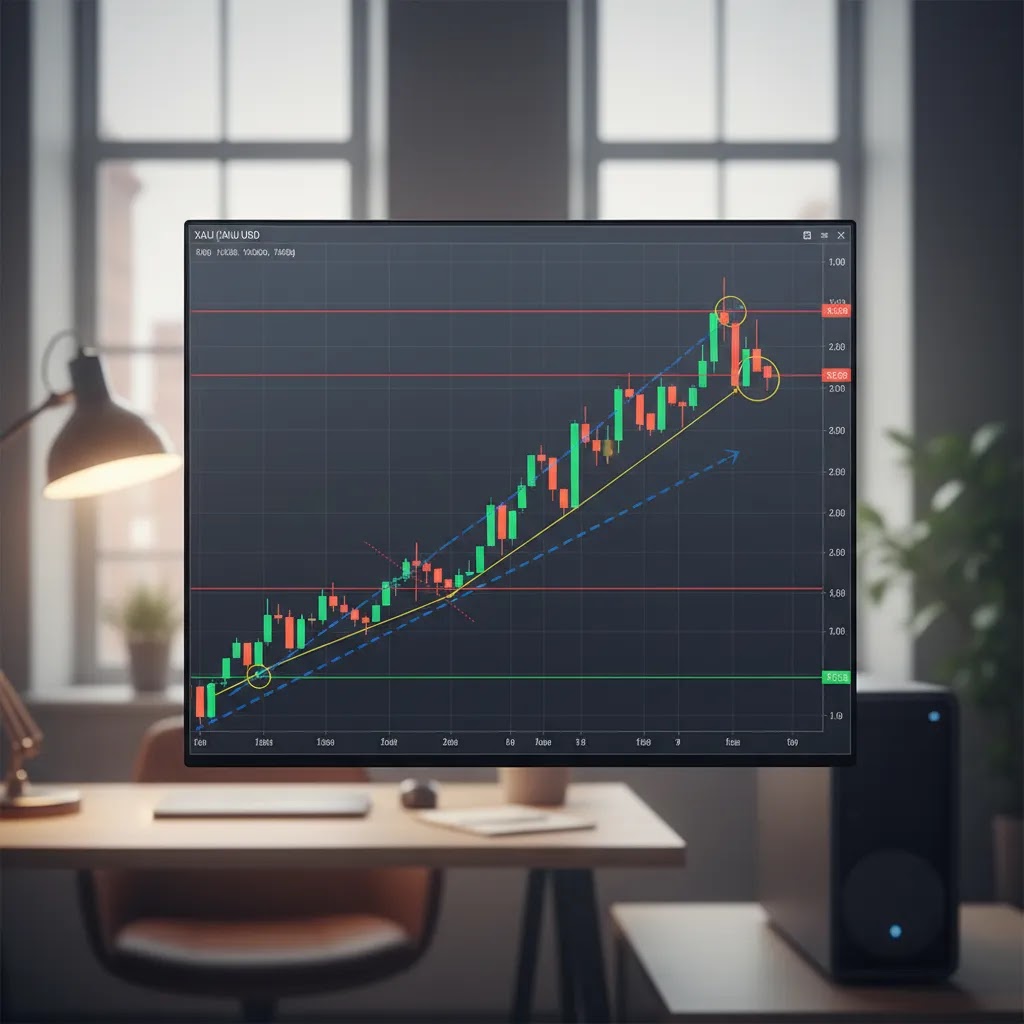
Key Tools for Reading the XAUUSD Chart
The most useful gold chart analysis usually starts with simple structure before adding indicators. A clean gold trading chart can tell you whether the market is trending, ranging, or entering a breakout phase. Start with these core tools:
Trend structure. Mark swing highs and swing lows. If gold keeps holding higher lows, the broader bias may remain bullish. If lower highs begin to form after an extended rise, momentum could be weakening.
Support and resistance. Gold often reacts sharply at prior turning points, round numbers, and previous weekly highs or lows. If you need a refresher, our guide to support and resistance explains how these zones are identified and why they matter.
Candlestick behavior. Long rejection wicks, strong engulfing candles, and repeated failures to break a level may reveal whether buyers or sellers are losing conviction. This helps refine a gold technical analysis today setup on lower time frames.
Moving averages. Many traders use moving averages to smooth out noise and track trend direction. Price holding above a rising average may suggest ongoing strength, but this should not be treated as a signal by itself.
Momentum indicators. Tools such as RSI or MACD may help confirm whether a move is accelerating or becoming stretched. In gold, overbought or oversold readings can persist longer than many beginners expect, so they work best as confirmation rather than as a standalone reason to trade.
Business24-7 generally favors a layered approach: price structure first, momentum second, and macro context third. That creates a more realistic framework for an xauusd prediction than relying on a single indicator.
Gold Technical Indicators Summary (How to Read “Buy, Sell, Neutral” Signals)
Many charting platforms display a quick technical “summary” that labels XAUUSD as Buy, Sell, or Neutral. Here’s the thing: those summaries are usually not a single indicator. They are an average of indicator groups, and gold can easily produce mixed readings across time frames because it trends strongly at times and mean-reverts sharply at others.
In most cases, the dashboard is built from three buckets: moving averages (trend-following), oscillators like RSI or Stochastic (often mean-reversion oriented), and pivot point levels (price location relative to common support and resistance references). A simplified interpretation is that moving averages tend to describe direction and structure, oscillators tend to describe stretch and momentum, and pivots tend to describe where price sits within the day or week’s map.
Mixed signals are common. You might see a bullish read on the daily chart because price is above key moving averages, while the one-hour chart looks bearish because momentum is fading and oscillators are rolling over. That does not mean the tools are “wrong.” It usually means the market is in a pullback within a broader trend, or it is transitioning into a range.
Think of it this way: treat the higher time frame as context and the lower time frame as timing. A top-down process can help you reconcile conflicts without treating any single gauge as a trade trigger. Start on the weekly and daily chart to define the dominant structure. Then move to the four-hour and one-hour chart to see whether momentum is aligning with that structure or pushing against it. If the daily is bullish but the one-hour is bearish, the practical question becomes whether the one-hour weakness is breaking daily structure, or simply moving toward a higher time frame support zone.
There are a few practical rules that can keep these summaries in perspective. If moving averages and structure are aligned, trends can persist even when oscillators flash overbought or oversold. If oscillators and price action show repeated failure near resistance, “buy” summaries can flip quickly because trend strength is weakening. Pivot-based readings can change rapidly intraday, especially around London and New York opens, so they often work best as location context, not as a forecast.
Most importantly, these summaries do not predict outcomes. They describe current conditions using lagging tools. Gold can still reverse on macro headlines, data surprises, or shifts in yields. If you use summary dashboards at all, treat them as a checklist to support your level and structure work, not as a decision engine.
What Affects Gold Price Moves
A strong gold price analysis should always account for the forces behind the chart. Gold is quoted against the U.S. dollar as XAUUSD, so dollar strength often matters. If the dollar rises sharply, gold may face pressure. If expectations for U.S. interest rate cuts increase, gold may gain support because the opportunity cost of holding non-yielding assets can fall.
Inflation, central bank tone, bond yields, and geopolitical risk also shape the gold price chart. For that reason, technical levels are most reliable when they align with a broader market narrative. A breakout above resistance during heavy risk-off sentiment may carry more weight than the same breakout during a quiet session with low volume.
If you are comparing the technical setup with a broader directional view, our gold price forecast coverage can help frame the bigger picture. Traders should also remember that platform costs matter. AvaTrade lists spreads from 0.9 pips and notes an inactivity fee after 3 months. Exness lists Raw Spread pricing with a $3.50 per lot commission, while ADSS notes no deposit or withdrawal fees. Those differences can influence how viable short-term gold trading becomes, especially for active traders.

Short-Term Outlook vs Next-Week Outlook: How to Build a Gold Technical “Forecast” Without Guessing
Search intent around gold is often framed as “gold forecast today” or “xauusd forecast next week.” The reality is that a technical forecast is rarely a single-number call. A more realistic forecast is a set of scenarios tied to key levels and conditions, with a plan for how you will update that view as price evolves.
A useful template starts with the trend state on the daily chart: trending up, trending down, or ranging. Then identify the nearest meaningful support and resistance zones, ideally levels that are obvious on the daily and also align with your key level framework. After that, check momentum conditions on the time frame you trade, for example whether the one-hour chart is making higher highs and higher lows, or compressing into a range that could break.
Now, when it comes to time horizons, “today” tends to be about execution and risk control, while “next week” tends to be about structure and event risk. For a short-term outlook, your focus is whether price is approaching an intraday decision level and whether it is rejecting, breaking, or consolidating. For a next-week outlook, your focus shifts to whether price is near a weekly pivot, prior week high or low, or a major daily zone that could define the week’s range.
Event risk is the overlay that keeps the forecast grounded. Gold can react strongly to inflation data, central bank messaging, and yield moves. Many traders track scheduled releases such as CPI, central bank rate decisions, employment data, and major speeches. You do not need to predict the news. You do need to know when volatility could spike and when a technically clean setup might be more fragile than usual.
One more practical detail: be clear about the chart you are analyzing. XAUUSD is spot gold pricing, while gold futures charts reflect a specific contract month. They often track closely, but they are not identical because futures have contract structure, expiration cycles, and sometimes slightly different liquidity patterns. In many cases, the major levels and trend direction will align, but you can see small differences around precise highs, lows, or gaps. If you follow futures for context, it can help to confirm that your key levels on spot gold still make sense, rather than copying levels line for line.
Used correctly, a technical “forecast” is simply a structured way to avoid guessing. You define your scenarios, you define what would support or invalidate them, and you stay flexible as levels break or hold. That approach will not eliminate risk, but it can keep your decision-making consistent when gold volatility rises.
Trading Gold Safely in the UAE
Gold technical analysis is only one part of the decision. The other part is where you trade. UAE residents should pay close attention to broker regulation, platform transparency, and whether the firm offers suitable account features for their needs. Relevant regulators in the market data available to Business24-7 include the Securities and Commodities Authority (SCA), the Dubai Financial Services Authority (DFSA), and the Abu Dhabi Global Market Financial Services Regulatory Authority (ADGM FSRA), alongside international regulators such as the Financial Conduct Authority (FCA), the Cyprus Securities and Exchange Commission (CySEC), and the Australian Securities and Investments Commission (ASIC).
Examples from current platform coverage include Capital.com with SCA regulation, Pepperstone with DFSA regulation, and AvaTrade with ADGM FSRA regulation. For traders who need Sharia-compliant features, several covered brokers list Islamic or swap-free accounts, including eToro, AvaTrade, Pepperstone, Plus500, XTB, Capital.com, ADSS, and Exness. Regulation does not remove market risk, but it may improve transparency, complaint handling, and account oversight compared with unregulated alternatives.
For broker research beyond chart study, see our Technical Analysis and best gold trading platforms in UAE resources.
Pros and Cons
Strengths
- Gold charts often respect clear reaction zones, which makes support, resistance, and breakout analysis especially useful.
- XAUUSD is widely available across regulated brokers covered by Business24-7, giving UAE traders multiple platform options.
- Technical analysis can help turn broad macro views into actionable price levels for entries, stops, and targets.
- Gold is highly liquid in most sessions, so chart patterns may develop more cleanly than in thinner markets.
- Many UAE-relevant brokers offer swap-free accounts, which can matter for longer holding periods.
Considerations
- Gold can become extremely volatile around inflation data, central bank announcements, and geopolitical news, causing false breakouts.
- Technical setups may fail quickly if macro catalysts override chart structure.
- Short-term gold trading can become expensive if spreads, commissions, or overnight charges are not factored in.
- Indicators often lag price, so relying on them without structure can lead to late entries.

Who This Approach Is For
This approach suits traders and investors who want a disciplined way to read the gold price chart without treating every move as a random headline reaction. It is particularly useful for beginner to intermediate UAE-based traders who follow XAUUSD regularly and want clearer timing around entries and exits. It may also help investors who do not trade actively but still want to understand whether gold is trending, consolidating, or testing major support. It is less suitable for readers looking for exact price predictions with certainty. Technical analysis can improve decision-making, but it does not eliminate risk or guarantee that an xauusd forecast will play out.
How to Start Analyzing Gold Charts
Begin with the weekly and daily chart before moving to lower time frames. Mark the major swing highs, swing lows, and obvious horizontal levels where gold previously reversed. Then identify whether price is trending or ranging. After that, move to the four-hour or one-hour chart to refine entry zones.
Next, compare the technical picture with upcoming macro events such as U.S. inflation releases, Federal Reserve commentary, or major geopolitical developments. A chart setup that forms immediately before a major event may carry more risk than usual.
Finally, choose a broker carefully if you plan to act on your analysis. Business24-7 reviews show meaningful differences in minimum deposits and pricing. For example, Capital.com starts from $20, Plus500 from $100, and Pepperstone from $0, while Saxo Bank starts from $2,000. If you want to move from analysis to broker selection, our guide to the best gold trading platforms in UAE is a practical next step. Business24-7’s editorial approach is to pair chart education with broker transparency so readers can evaluate both the setup and the execution environment.
Frequently Asked Questions
What is XAUUSD in gold technical analysis?
XAUUSD is the market symbol for gold priced against the U.S. dollar. In chart analysis, traders use it to track how gold is moving relative to the dollar and to identify trend direction, support, resistance, and momentum. It is one of the most commonly traded commodity-related instruments on retail trading platforms.
How reliable is gold technical analysis?
Gold technical analysis can be useful for identifying high-interest price zones and trend conditions, but it is not perfectly reliable. Gold responds to macroeconomic events, yields, inflation expectations, and geopolitical stress, so chart patterns may fail suddenly. It is generally most effective when combined with strict risk management and awareness of scheduled market events.
What time frame is best for a gold trading chart?
The best time frame depends on your trading style. Daily and four-hour charts are often more useful for spotting broader structure and major turning points. Lower time frames such as one-hour or fifteen-minute charts may help refine entries, but they usually contain more noise and can produce more false signals.
How do I find gold support and resistance levels?
Look for areas where price has previously reversed, stalled, or broken out with strong momentum. Weekly highs and lows, daily turning points, and round numbers often matter on the gold price chart. The more times a zone has influenced price in the past, the more traders may pay attention to it in future sessions.
Can UAE traders access gold markets through regulated brokers?
Yes, based on Business24-7 platform data, UAE traders can access gold markets through brokers regulated by authorities such as the Securities and Commodities Authority (SCA), Dubai Financial Services Authority (DFSA), and Abu Dhabi Global Market Financial Services Regulatory Authority (ADGM FSRA). Traders should still review product type, fees, and account conditions before opening an account.
Do trading fees matter for short-term gold analysis?
Yes. Even a good chart setup can become unattractive if spreads, commissions, or overnight funding charges are high. For example, some brokers use spread-only pricing, while others combine raw spreads with per-lot commissions. Short-term traders should pay particular attention to execution costs because frequent entries and exits can add up quickly.
Are Islamic accounts available for gold trading?
In many cases, yes. Current Business24-7 platform data shows Islamic or swap-free account availability at several covered brokers, including eToro, AvaTrade, Pepperstone, Plus500, XTB, Capital.com, ADSS, and Exness. Availability can depend on jurisdiction and account conditions, so traders should confirm the exact terms directly before relying on them.
What is the latest prediction for gold?
There is no single “latest prediction” that can be treated as certain. Most actionable gold price analysis is a set of scenarios based on trend context, nearby support and resistance, momentum, and upcoming event risk. If key levels hold, one scenario stays valid. If they break, the higher-probability scenario can change quickly, especially around major U.S. data releases and shifts in yields.
How to do technical analysis of gold?
Start top-down: review the weekly and daily XAUUSD chart to define trend structure and the major zones where gold has previously reacted. Mark support and resistance, then refine those levels on the four-hour and one-hour chart using candlesticks and momentum tools like RSI or MACD. Many traders also track prior day and prior week highs and lows, along with pivot points, to map likely decision areas. Technical analysis does not guarantee outcomes, but it can help you stay consistent and risk-aware.
Is gold going bullish or bearish?
Gold can appear bullish on one time frame and bearish on another, especially during pullbacks or range conditions. A practical way to answer this is to define the daily trend first, then check whether lower time frames are aligning or diverging. If price is holding higher lows on the daily chart, the broader bias may remain bullish even if short-term momentum is bearish. If daily structure breaks, the broader view may shift.
Will gold prices go down in 2026?
No analysis can reliably state whether gold will go down in 2026 with certainty. Gold can be influenced by inflation expectations, central bank policy, real yields, U.S. dollar strength, and geopolitical developments, and those inputs can change. From a technical standpoint, traders typically focus on whether the market is making higher highs and higher lows or breaking key long-term support levels, then update that view as conditions evolve rather than locking into a single-year prediction.
Key Takeaways
- Gold technical analysis works best when trend structure, momentum, and key levels are assessed together.
- XAUUSD reacts strongly to U.S. dollar moves, rates, inflation expectations, and geopolitical risk.
- Support and resistance remain central to reading the gold price chart effectively.
- UAE traders should pair chart analysis with broker due diligence, especially on regulation, costs, and Islamic account availability.
- Technical analysis may improve timing, but it does not remove risk or guarantee market direction.
Conclusion
Gold remains one of the clearest markets for technical traders, but clear does not mean easy. The xauusd chart can offer strong structure, visible reaction zones, and tradable momentum, yet it can also reverse sharply when macro conditions change. For most readers, the sensible approach is to use gold technical analysis as a framework, not as certainty. Focus on trend, support and resistance, and event risk, then match that analysis with a broker whose costs and regulation fit your needs. Business24-7 exists to help UAE readers make that decision with more confidence by combining platform research with practical market education. From here, you may want to compare our broker reviews and category guides before deciding how to trade gold in practice.
This article is for informational purposes only and does not constitute personalized financial or investment advice. Trading gold, CFDs, forex, and other financial instruments involves significant risk. Capital is at risk, and losses may exceed deposits where leveraged products apply. UAE readers should consider whether a platform is regulated by the Securities and Commodities Authority (SCA), Dubai Financial Services Authority (DFSA), or Abu Dhabi Global Market Financial Services Regulatory Authority (ADGM FSRA), as relevant, before opening an account.
Disclaimer
eToro is a multi-asset platform which offers both investing in stocks and cryptoassets, as well as trading CFDs.
Please note that CFDs are complex instruments and come with a high risk of losing money rapidly due to leverage. 61% of retail investor accounts lose money when trading CFDs with this provider. You should consider whether you understand how CFDs work, and whether you can afford to take the high risk of losing your money
This communication is intended for information and educational purposes only and should not be considered investment advice or investment recommendation. Past performance is not an indication of future results.
Copy Trading does not amount to investment advice. The value of your investments may go up or down. Your capital is at risk.
Crypto assets are complex and carry a high risk of volatility and loss. Trading or investing in crypto assets may not be suitable for all investors. Take 2 mins to learn more
eToro USA LLC does not offer CFDs and makes no representation and assumes no liability as to the accuracy or completeness of the content of this publication, which has been prepared by our partner utilizing publicly available non-entity specific information about eToro.

Gold technical analysis matters most when price is moving quickly and traders need a structured way to read the XAUUSD chart instead of reacting emotionally. For UAE-based traders and investors, gold remains one of the most watched markets because it often responds to U.S. dollar strength, inflation expectations, interest rates, and geopolitical stress. This guide explains how to assess trend…