

If you are building an investment plan in the UAE, your first question should not be which asset might rise next. It should be how much risk you can realistically handle without making poor decisions under pressure. Your risk tolerance shapes how you respond to market swings, how much volatility you may accept, and what kind of portfolio could suit your goals. Many beginners skip this step and focus only on returns, which can lead to taking on more risk than they are comfortable with. Before choosing investments, it helps to start with a solid foundation such as this guide on how to invest uae. For UAE-based readers comparing savings, investing, and trading options, understanding your investor profile may help you make steadier, more informed decisions.
What risk tolerance means
Risk tolerance is the level of uncertainty, short-term loss, and market volatility you may be willing and able to accept while investing. In simple terms, it is your comfort level with the possibility that your portfolio could fall in value for a period of time.
This is not just an emotional question. It is also practical. Someone with stable income, low debt, and a long time horizon may be able to tolerate more risk than someone nearing retirement or planning to use the money within a few years.
In investing, risk tolerance typically affects your mix of assets, your expected volatility, and the kinds of products you should consider carefully. For example, a cautious investor may lean toward diversified long-term holdings, while a more aggressive investor may accept larger swings in pursuit of higher potential returns. Neither approach guarantees results, and both involve risk to capital.
Your risk profile should sit alongside your goals, time horizon, liquidity needs, and financial obligations. That is why this topic connects closely with asset allocation, which helps translate your comfort with risk into a real portfolio structure.
Why risk tolerance matters in investing
Many investment mistakes happen because the portfolio does not match the investor. A person may build an aggressive portfolio during a strong market, then panic and sell after a sharp decline. Another may stay too conservative for too long and fail to meet long-term goals because the portfolio never had enough growth potential.
Knowing your risk tolerance may help you avoid both extremes. It can improve consistency, reduce emotionally driven decisions, and give you a clearer basis for comparing products.
For UAE-based investors, this matters even more because there are many platform choices, cross-border investment options, and varied regulatory setups. If you are comparing investment or trading providers, you should evaluate not only the product range but also whether the account type matches your actual risk profile. Regulatory oversight from bodies such as the UAE Securities and Commodities Authority (SCA) or the Dubai Financial Services Authority (DFSA) may also matter when you assess platform safety and suitability.
A good risk framework also supports diversification. If you have not reviewed this concept yet, our diversification guide explains why spreading exposure across assets may reduce concentration risk, though it does not remove the possibility of losses.

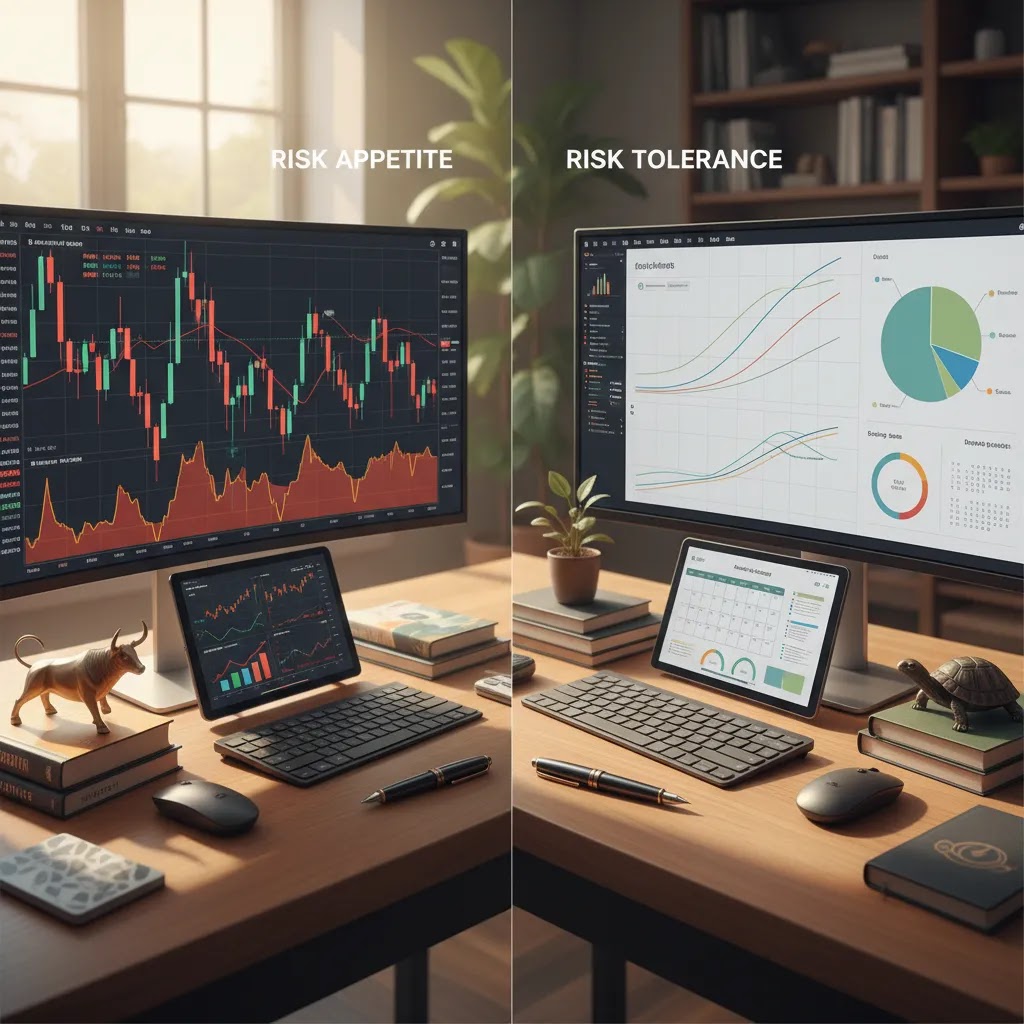
Risk appetite vs risk tolerance
People often use these terms as if they mean the same thing, but there is a useful difference.
Risk appetite is the amount of risk you want to take. It reflects your ambition, return expectations, and willingness to pursue more volatile opportunities.
Risk tolerance is the amount of risk you can emotionally and financially handle without abandoning your plan.
There is also a third concept that many investors overlook: risk capacity. This refers to your actual financial ability to absorb losses. A person might have a high appetite for risk but low capacity for loss because they need the money in the near term.
Here is a simple example. You may like the idea of aggressive growth investing, which suggests a high appetite. But if a 20% decline would cause you to panic or disrupt major financial goals, your true tolerance may be lower. In most cases, your portfolio should be built around tolerance and capacity, not optimism alone.
Risk capacity vs risk tolerance (why both matter)
Here is the thing. Many investors treat risk tolerance as the main measurement, but risk capacity can be the real limiting factor. Risk tolerance is about willingness, your emotional comfort with volatility and temporary losses. Risk capacity is about ability, whether your finances and timeline allow you to stay invested if markets fall.
These two can conflict. You might feel comfortable with volatility, but still lack the financial buffer to ride it out. Or you might have the financial ability to take risk, but dislike uncertainty so much that you end up selling at the worst possible time. Either mismatch can lead to inconsistent decisions, which may matter more than the investment you pick.
From a practical standpoint, risk capacity often comes down to a few concrete factors:
- Emergency fund: Whether you have cash reserves to handle job loss, medical costs, or unexpected expenses without selling investments at a loss.
- Income stability: Whether your income is predictable or variable, and how easily you could replace it if your situation changes.
- Debt obligations: High-interest or high monthly payments can reduce your flexibility during market downturns.
- Dependents and responsibilities: Family support, education costs, and caregiving can reduce your ability to tolerate long drawdowns.
- Upcoming large purchases: If you plan to use the money for a home purchase, relocation, or business expense, capacity is typically lower, even if appetite is high.
- Time horizon: A longer time horizon can increase capacity, but only if you can truly leave the money invested.
Consider this in a UAE context. Many residents are expats with career moves, visa changes, or relocation risk. If you may need liquidity for a move, a gap between jobs, or a sudden change in housing costs, your capacity to handle market declines could be lower than your appetite suggests. Multi-currency commitments can matter too. If your income is in AED but future goals are tied to another currency, or you send regular remittances abroad, liquidity needs can tighten quickly during periods of volatility.
This is also why risk discussions should always include a simple reality check. Even if you believe you can handle a 20% drawdown emotionally, you still need to ask whether you could afford to wait out the recovery without selling. Trading and investing always carry risk, and markets do not follow your schedule.
How to determine your risk tolerance
A risk tolerance questionnaire can be a useful starting point, but it should not be your only method. Many online questionnaires are too simplistic. They may classify you as conservative, balanced, or aggressive without fully considering your time horizon, emergency savings, debt load, or reaction to real losses.
A better approach is to assess five areas:
- Time horizon: How long before you may need the money. Longer horizons may support greater risk, though losses are still possible.
- Financial stability: Your income reliability, debt obligations, cash reserves, and emergency fund.
- Loss response: How you would react if your portfolio fell by 10%, 20%, or more.
- Goal importance: Whether the money is for retirement, home purchase, education, or short-term use.
- Experience level: Investors with limited market experience may overestimate how much volatility they can handle.
Ask yourself practical questions, not just theoretical ones:
- Would I stay invested during a major market decline?
- How much of a temporary loss could I tolerate before I changed course?
- Do I need easy access to this capital?
- Am I investing for long-term wealth building or short-term gains?
- Would market volatility affect my sleep, stress levels, or broader financial security?
If you also trade leveraged products, the issue becomes more serious. Short-term trading can expose you to amplified losses, especially in CFDs or forex. That is why understanding portfolio risk belongs alongside trading discipline and risk management principles.
How to use a risk tolerance questionnaire responsibly
A simple risk tolerance questionnaire is useful because it forces structure. It gets you to think about time horizon, reaction to losses, and what you are actually investing for. For many beginners, that is a meaningful first step.
The reality is that questionnaires also have blind spots. Most are based on what you think you will do, not what you will actually do when your portfolio is down and headlines are negative. In rising markets, people often overestimate their tolerance because recent performance feels reassuring. When conditions reverse, the same investor may discover their real threshold is lower.
What many people overlook is how easy it is to answer as your “ideal self.” Common mistakes include:
- Confusing knowledge with tolerance: Understanding markets does not automatically mean you are comfortable with drawdowns.
- Ignoring liquidity and near-term obligations: If you may need the money soon, capacity can be lower even if your answers sound aggressive.
- Underestimating stress behavior: It is one thing to accept risk on paper, and another to hold through a real decline without changing course.
- Anchoring to past gains: If your reference point is a strong year, you may assume that declines will be short or mild, which is not guaranteed.
Think of a questionnaire result as a starting hypothesis, not a final verdict. A practical next step is to stress-test your assumptions. Ask what you would do if your portfolio fell by 20% and stayed down for a year, and whether you could still meet near-term obligations without selling. Then connect the result back to real portfolio choices through asset allocation and diversification. If your plan depends on selling during a downturn to cover expenses, the risk level may not be aligned with your capacity, even if you feel confident today.
Finally, revisit your assessment when life changes. A new job, a move, a mortgage, or a growing family can shift your liquidity needs and reduce your ability to accept volatility. Reassessment is not a sign of weakness. It is part of staying realistic in a market that does not adapt to your timeline.
Common investor profiles
Most investors fall somewhere along a spectrum rather than into a perfect box. Still, these general profiles can help you interpret your results.
Conservative
A conservative investor usually prioritizes capital preservation and lower volatility. This profile may suit someone with a short time horizon, limited investing experience, or low comfort with losses. Conservative investors often prefer steadier returns over higher-risk growth opportunities.
Moderate
A moderate investor is usually willing to accept some market fluctuation in exchange for long-term growth potential. This profile often balances growth assets with more defensive holdings. For many people, this is the middle ground between caution and ambition.
Growth-oriented
A growth investor may accept larger swings to seek stronger long-term returns. This profile often has a longer time horizon and higher emotional tolerance for volatility. Even so, large drawdowns can still be difficult in practice.
Aggressive
An aggressive investor may pursue high-growth strategies and accept sharp short-term losses. This profile is often associated with long time horizons, higher financial capacity, and greater market experience. But aggressive does not mean reckless. A suitable strategy still needs limits, diversification, and realistic expectations.
Three levels of risk tolerance (low, medium, high)
Some readers find it easier to think in simpler categories, low, medium, or high risk tolerance. These labels are not perfect, but they can help you self-identify before you get into more detailed portfolio planning.
Low risk tolerance often maps to the conservative profile. You may prefer steadier outcomes and may feel uncomfortable when your portfolio drops, even if the long-term plan still makes sense.
Medium risk tolerance
High risk tolerance often maps to growth-oriented and aggressive profiles. You may accept higher volatility and larger drawdowns, usually because you have a longer time horizon, higher capacity, or strong conviction in long-term growth. Even then, high tolerance does not remove the need for diversification or risk limits.
To make this more concrete, consider how different levels may react during drawdowns. These examples are general, and your real response can depend on why you are investing and whether you need the money soon:
- At -10%: Low tolerance investors may feel immediate regret and look for ways to reduce exposure. Medium tolerance investors may feel uneasy but stay invested if the plan is clear. High tolerance investors may view it as normal volatility.
- At -20%: Low tolerance investors may feel strong pressure to sell or stop investing. Medium tolerance investors may reassess, and some may reduce risk if the decline threatens near-term goals. High tolerance investors may be able to hold, but it can still test discipline.
- At -30%: Many investors, including confident ones, discover this is where theory becomes real. Low tolerance investors often exit. Medium tolerance investors may only stay invested if they have strong capacity and a clear timeline. High tolerance investors may continue holding, but even then, the emotional impact can be significant.
Labels should not be treated as permanent. Your risk tolerance can shift with market conditions, but more importantly, it can shift with life. A person who could accept high volatility while single and highly liquid may need to move toward medium or low tolerance after taking on a mortgage or planning a major purchase. This is why revisiting your profile periodically is more realistic than trying to “pick a label” once and never update it.
How Business24-7 helps you move from theory to action
At Business24-7, the goal is to help you evaluate financial decisions with more clarity and less noise. That matters if you are moving from learning about investor profiles to choosing a real platform, account type, or market approach. Our content reflects the research-led style associated with Braden Chase, whose background as a former research specialist at Forex.com supports the site’s focus on evidence, transparency, and reader safety.
If your next step is platform research, you can compare regulated names covered on the site, including brokers with oversight from bodies such as the SCA, DFSA, FCA, ASIC, and CySEC. Examples include Capital.com, which lists SCA regulation and a $20 minimum deposit, and eToro, which lists ADGM oversight, AED deposits, and social investing features. For active traders focused on ultra-low spreads, Pepperstone may appeal because it lists 0.0 pip Razor spreads with a $7 per lot commission and DFSA regulation. Before opening any account, compare platforms side by side on Business24-7, use our broker resources, and read the full review to see whether the product fits your risk profile rather than just your return hopes.
A practical framework for safer investing decisions
Once you understand your risk tolerance, the next step is to apply it in a disciplined way. A simple framework may help.
1. Match risk to your goal
Money for short-term needs typically should not be exposed to the same level of volatility as money intended for long-term growth. If your time horizon is short, high-risk allocations may create pressure at exactly the wrong time.
2. Build around capacity, not confidence
It is easy to feel confident during rising markets. Your portfolio should be based on what you could withstand during a downturn, not on how optimistic you feel when prices are climbing.
3. Use allocation before product selection
Many investors pick products first and think about portfolio balance later. A better sequence is to decide on your target mix of assets, then choose products that fit that structure. This reduces impulsive decisions and keeps your portfolio aligned with your actual risk profile.
4. Check platform fit and regulation
If you use a broker or investment platform, make sure the offering fits your experience level and goals. A beginner may prefer clearer interfaces, educational materials, and transparent fee structures. A more experienced investor may care more about advanced tools or wider market access. In the UAE context, reviewing whether a provider falls under regulators such as the SCA or DFSA may be an important safety check.
5. Review your profile periodically
Risk tolerance is not fixed forever. Changes in income, family responsibilities, debt, and life goals may shift how much risk is appropriate. Reassessing once or twice a year may help keep your portfolio realistic.
If you want broader educational context, the site’s Investing and Wealth Building section and UAE Regulation and Tax category can help you continue your research before making investment decisions.
Pros and Cons
Strengths
- Understanding risk tolerance may help you avoid choosing investments that are too stressful or too volatile for your real circumstances.
- A clear investor profile can improve portfolio discipline and reduce emotional decision-making during market downturns.
- It provides a practical basis for asset allocation, diversification, and platform selection.
- Risk assessment can help beginners set more realistic expectations about returns, volatility, and possible losses.
- It supports safer decision-making when comparing regulated platforms, especially in a market with many options available to UAE residents.
Considerations
- Risk tolerance questionnaires may oversimplify your situation if they ignore time horizon, debt, or liquidity needs.
- Your stated tolerance may differ from how you react during an actual market drop.
- Risk tolerance can change over time, so an old assessment may no longer be accurate.
- Even a well-matched portfolio does not eliminate losses, especially during broad market declines.

Frequently Asked Questions
What is risk tolerance in investing?
Risk tolerance is the amount of market uncertainty and potential loss you may be able and willing to accept when investing. It usually reflects your emotions, finances, goals, and time horizon. A person with high risk tolerance may accept bigger swings in portfolio value, while a cautious investor may prefer lower volatility. Neither approach guarantees results or prevents losses.
How do I know if I am a conservative or aggressive investor?
You can start by looking at how you would respond to a meaningful decline in your portfolio. If sharp losses would likely cause you to sell quickly, your tolerance may be lower. If you can accept volatility for long-term growth, it may be higher. Your time horizon, income stability, and need for liquidity should also influence your investor profile.
What is the difference between risk appetite and risk tolerance?
Risk appetite is how much risk you want to take, often based on ambition or return goals. Risk tolerance is how much risk you can practically and emotionally handle. These are not always the same. Many investors have a higher appetite than tolerance, especially before they experience real market volatility. That gap can lead to poor decisions if ignored.
Should beginners take less risk?
Not always, but beginners should usually be cautious about taking risks they do not fully understand. Limited market experience can make volatility feel more severe in practice than it seems on paper. A beginner may benefit from a simpler, diversified approach and a regulated platform with transparent pricing, educational tools, and clear support resources.
Can my risk tolerance change over time?
Yes. Risk tolerance may change as your income, responsibilities, debt levels, and financial goals change. A young professional with stable income may feel comfortable with more volatility than someone planning a home purchase within two years. Reviewing your investor profile regularly may help keep your strategy aligned with your current situation rather than your past assumptions.
Does a higher risk tolerance mean better returns?
No. Higher risk may create the possibility of higher returns, but it also increases the potential for larger losses. There is no guarantee that taking more risk will lead to better outcomes. What matters is whether the level of risk is suitable for your goals, time horizon, and ability to remain consistent through difficult markets.
Why does regulation matter when choosing a platform?
Regulation may provide an added layer of accountability, client protection standards, and operating oversight. In the UAE, bodies such as the SCA and DFSA are relevant in certain contexts. International regulators like the FCA, ASIC, and CySEC may also matter depending on the provider. Regulation does not remove investment risk, but it may help you assess platform credibility.
Is risk tolerance important for trading as well as investing?
Yes. It may be even more important in trading, especially if leverage is involved. Short-term price movements can be sharp, and products such as CFDs may magnify both gains and losses. If your emotional tolerance is low, a trading approach may be harder to sustain. That is why risk controls and position sizing are essential.
Can diversification reduce risk?
Diversification may reduce concentration risk by spreading exposure across asset classes, sectors, or regions. It can help smooth portfolio volatility in some cases, but it does not eliminate the risk of loss. Broad market declines can still affect diversified portfolios. It is best viewed as a risk management tool, not a guarantee of protection.
What are the three levels of risk tolerance?
The most common framing is low, medium, and high risk tolerance. Low risk tolerance usually aligns with a conservative investor profile, medium often aligns with a moderate profile, and high tends to align with growth-oriented or aggressive profiles. These labels are meant to guide your decisions, not lock you into a permanent category.
What does it mean to have a low risk tolerance?
Low risk tolerance means you are typically less comfortable with volatility and temporary losses. In practice, this may mean you prefer steadier investment approaches and may feel pressure to sell when markets fall. For many investors, low tolerance is also linked to shorter time horizons or higher need for liquidity, which can reduce the ability to wait out a downturn.
What is my risk tolerance?
Your risk tolerance depends on both willingness and ability. Willingness is your emotional comfort with drawdowns, and ability includes factors like income stability, emergency savings, debt, and time horizon. A questionnaire can be a starting point, but it is usually more accurate when you combine it with a realistic look at your financial obligations and how you behaved during past periods of volatility.
What is Warren Buffett’s 90/10 rule?
Warren Buffett has discussed a simple idea often called the 90/10 rule, allocating 90% to a low-cost broad stock index fund and 10% to short-term government bonds or cash equivalents. The concept is aimed at long-term investing discipline, not short-term performance. It may suit some investors with long time horizons and the ability to tolerate equity market drawdowns, but it is not a universal rule and should be considered in the context of your own goals, risk capacity, and liquidity needs.
Key Takeaways
- Risk tolerance is your practical and emotional ability to handle losses and volatility, not just your desire for higher returns.
- Risk appetite, risk tolerance, and risk capacity are related but different, and all three matter when building a portfolio.
- Your investor profile should shape your asset allocation, diversification, and platform selection.
- UAE-based investors should also consider platform regulation, including whether oversight exists through bodies such as the SCA or DFSA.
- Understanding your risk profile may help you make steadier, safer decisions, but it does not remove the possibility of capital loss.
Conclusion
Risk tolerance is one of the most important parts of building an investment plan, yet it is often ignored until markets become volatile. If you take the time to understand your investor profile before choosing products or platforms, you may be better positioned to stay consistent and avoid decisions driven by fear or overconfidence. For readers in the UAE, that also means checking regulation, comparing fee structures, and choosing platforms that fit your actual goals and experience level. Business24-7 is designed to be that reference point, offering impartial reviews, comparison resources, and practical education for retail investors who want clearer answers before they commit capital. Browse our platform reviews and investing guides before making your next move.
Disclaimer: The content published on Business24-7 is intended for informational purposes only and does not constitute financial advice, investment recommendations, or an endorsement of any specific platform or financial product. Trading and investing carry significant risk, including the potential loss of capital. You should conduct your own research and, where appropriate, seek independent financial advice before making any investment decisions. Business24-7 does not accept responsibility for any financial losses incurred as a result of information published on this site.
Disclaimer
eToro is a multi-asset platform which offers both investing in stocks and cryptoassets, as well as trading CFDs.
Please note that CFDs are complex instruments and come with a high risk of losing money rapidly due to leverage. 61% of retail investor accounts lose money when trading CFDs with this provider. You should consider whether you understand how CFDs work, and whether you can afford to take the high risk of losing your money
This communication is intended for information and educational purposes only and should not be considered investment advice or investment recommendation. Past performance is not an indication of future results.
Copy Trading does not amount to investment advice. The value of your investments may go up or down. Your capital is at risk.
Crypto assets are complex and carry a high risk of volatility and loss. Trading or investing in crypto assets may not be suitable for all investors. Take 2 mins to learn more
eToro USA LLC does not offer CFDs and makes no representation and assumes no liability as to the accuracy or completeness of the content of this publication, which has been prepared by our partner utilizing publicly available non-entity specific information about eToro.

If you are building an investment plan in the UAE, your first question should not be which asset might rise next. It should be how much risk you can realistically handle without making poor decisions under pressure. Your risk tolerance shapes how you respond to market swings, how much volatility you may accept, and what kind of portfolio could suit…