

If you trade without a clear risk framework, even a few poor decisions may damage your account faster than most beginners expect. That is especially important for UAE-based traders sorting through leveraged products, CFD brokers, forex platforms, and conflicting online advice. Risk management trading is not about avoiding losses entirely. It is about controlling them so one trade, one bad week, or one emotional mistake does not wipe out months of progress. In practical terms, that means setting limits on position size, using exits consistently, and choosing regulated platforms where rules and disclosures are easier to verify. If you are building your foundation, start with the broader trading strategies hub, then use this guide to create a repeatable plan focused on capital preservation first.
Why risk management matters
Many traders spend too much time on entries and not enough on downside control. In most cases, that is the wrong priority. A solid trading idea may still lose money if the position is too large, if leverage is used carelessly, or if exits are ignored when markets move quickly.
Risk management in trading is the process of limiting how much capital you expose on each trade, across open positions, and over a given period. That may include setting a fixed risk per trade, defining a maximum daily or weekly loss, and avoiding concentrated exposure to the same market theme.
For forex and CFD traders in the UAE, this matters even more because many brokers offer leveraged products. Regulators such as the DFSA and SCA exist to improve oversight, but regulation does not remove market risk. Capital is still at risk, and past performance does not guarantee future results.
A useful starting point is to decide your maximum acceptable loss before you enter any position. Then build the trade around that limit, not the other way around. This is where position sizing becomes one of the most important skills you can learn.
Core rules every trader should know
Good risk control is usually simple on paper and hard in practice. The challenge is consistency. The rules below may help you create a risk management plan that is realistic enough to follow in live conditions.
1. Set a fixed risk per trade
Many retail traders use a small percentage of account equity as their risk per trade. For example, risking 0.5% to 1% on a single setup may help limit damage during a losing streak. If your account falls, the dollar amount at risk falls too, which can naturally slow drawdowns.
2. Use a pre-defined exit
A trade should have an invalidation point before you enter. For many strategies, that means using a stop loss strategy rather than relying on hope or manual reaction speed. A stop loss does not guarantee a perfect exit price in volatile conditions, but it may help reduce uncontrolled losses.
Risk management math in practice: position sizing and a quick “calculator” method
Here’s the thing: most risk management mistakes show up in sizing, not in the trading idea itself. If you want one repeatable workflow you can apply across markets, focus on the same four inputs every time: account size, percent risk per trade, stop distance, and the value of each pip or point for the instrument you are trading. The goal is not to guess how much margin you can open. It is to match your position size to a pre-defined loss limit if your stop is hit.
Start with the dollar risk you are willing to lose on the trade. If your account is $10,000 and you risk 1%, your risk budget is $100. If you risk 0.5%, it is $50. Next, define your stop distance in pips or points based on your strategy. If your stop is 25 pips away, you now need a position size where 25 pips equals your $ risk budget.
From a practical standpoint, a quick manual “calculator” looks like this: divide your dollar risk by your stop distance to get the maximum value you can lose per pip or point. Using the example above, $100 risk divided by 25 pips equals $4 per pip. That means your position size should be small enough that each pip is worth about $4, not $10, not $20. This helps prevent oversizing even if you do not have a built-in position size tool.
Now, when it comes to forex and CFDs, contract specs can confuse beginners because lot sizes and pip values vary. Major FX pairs often have a pip value that changes with lot size, and some CFDs move in “points” rather than pips. Many platforms show the pip or point value in the ticket before you place the trade. If you can see your estimated loss at the stop level, compare it to your risk budget and reduce size until the numbers line up. If your platform does not show this clearly, that is a usability signal worth taking seriously.
What many people overlook is friction cost. Spread, commissions, and slippage can affect your real loss, especially on short-term trades. A simple way to account for this is to treat your stop as slightly wider for sizing purposes. For example, if your technical stop is 25 pips and the spread is 2 pips, you may size as if the stop is 27 pips so your risk budget is less likely to be exceeded in normal conditions. This is not a guarantee, but it is a more realistic approach than sizing to the exact pip count and assuming perfect execution.
Common sizing mistakes tend to repeat: mixing up pip value, ignoring spreads and fees, or sizing based on available margin instead of pre-defined risk. Margin tells you how much you can open. Risk rules tell you how much you can afford to lose. If those two are not clearly separated in your process, leverage can quietly push you into a risk level you did not intend.
3. Check reward relative to risk
Not every trade needs a large target, but every trade should make sense relative to the amount you could lose. Reviewing your risk reward ratio may help filter low-quality setups where the upside is too small to justify the downside.
4. Cap your drawdown
Max drawdown is the decline from your account peak to the lowest point before recovery. Once a drawdown becomes severe, recovering usually requires disproportionately large gains. Many traders set rules such as pausing after a 5% to 10% drawdown, or reducing trade size after several consecutive losses.
5. Manage correlated exposure
If you are long several USD pairs or multiple tech-heavy share CFDs, your total risk may be larger than it looks. Separate positions are not always independent. Portfolio risk matters, even for smaller retail accounts.
6. Control the emotional side
Overtrading, revenge trading, and moving stops farther away are often psychological failures, not analytical ones. Your results may improve when your process includes clear rules from the start. That is why trading psychology and risk management should usually be treated as connected topics.

Simple risk rules traders ask about (1% rule, 3-5-7 rule)
A lot of beginners search for named “rules of thumb” because they want something easy to follow under pressure. That is understandable. The risk is that a simple rule can be treated like a magic number instead of a guardrail. These rules can be useful if you connect them back to the same framework covered above: risk per trade, max drawdown, and emotional control.
The 1% rule in plain terms
The 1% rule is commonly described as risking no more than 1% of your account equity on any single trade. If you have $5,000, that is $50. If you have $20,000, that is $200. The point is not that 1% is perfect. The point is to prevent one trade from doing disproportionate damage, which is especially important in leveraged products where price moves can translate into larger P and L swings.
Consider this: traders sometimes choose an even lower number, such as 0.25% to 0.5%, when volatility is high, when they are trading around major events, or when they are using higher leverage. If your stop distances tend to be wide or your strategy produces clusters of losses, a smaller risk number may be more realistic for staying consistent. A lower risk per trade can feel slow, but it may reduce the chance that a short losing streak becomes an account-level problem.
The 3-5-7 rule and how to translate it into your own limits
The “3-5-7 rule” is often discussed online as a simple loss limit system, usually tied to a daily loss cap, a weekly loss cap, or a maximum losing sequence before you step away. The exact meaning varies by community. Some versions refer to a maximum number of losing trades in a row before pausing. Other versions use percentages, such as stopping for the day after a 3% loss, reducing size or stopping for the week after a 5% loss, and taking a longer break or a full strategy review after a 7% loss.
The reality is that there is no universal standard, and the numbers are not what makes it work. The value is in having a pre-committed pause rule that stops you from trying to “win it back” in the same session. Think of it this way: translate the rule into a maximum loss you can tolerate over a day or week, then write down what you will do when you hit it. That could mean stopping trading, cutting size in half, or switching to review mode only. This is where drawdown control and psychology overlap, because the best rule is the one you can follow when you are frustrated.
These rules are guardrails, not performance guarantees. They do not increase the odds that any single trade will work. What they can do is reduce the chance that one impulsive decision or an unusually volatile session becomes a blow-up event.
Broker and platform tools that may help
Your broker cannot remove trading risk, but certain platform features may make risk control easier to apply. Based on Business24-7 product data, several brokers available to UAE readers offer tools or structures that may support disciplined trading.
| Platform | Relevant feature | Fees or entry point | Regulatory notes |
|---|---|---|---|
| AvaTrade | AvaProtect risk management, education | Min deposit $100, spreads from 0.9 pips | ADGM FSRA, ASIC and others |
| Plus500 | Risk management tools, guaranteed stop-loss available | Min deposit $100, spreads from 0.8 pips | DFSA, FCA, CySEC, ASIC, MAS |
| Pepperstone | Fast execution, advanced charting, copy trading | Min deposit $0, Razor from 0.0 pips plus $7/lot | DFSA, FCA, ASIC, CySEC, BaFin |
| Capital.com | AI-powered insights, TradingView integration | Min deposit $20, spreads from 0.6 pips | SCA, FCA, CySEC, ASIC |
| eToro | Copy trading, Smart Portfolios, social features | Min deposit $200, spreads from 1.0 pips | CySEC, FCA, ASIC, ADGM |
These features may be helpful, but they are not substitutes for a personal risk management plan. For example, copy trading can simplify access to strategies, yet it may also create a false sense of safety if you do not understand drawdown, leverage, or concentration risk. Guaranteed stop-loss tools may reduce certain execution risks, but overnight funding or wider spreads could still affect net results.
If you are comparing providers, it is sensible to review the broker’s regulator, fee structure, account minimum, and available protections together. Business24-7 readers can also browse the Trading Platforms and Brokers section and the UAE Regulation and Tax category for broader context before choosing a platform.
Pros and Cons
Strengths
- Risk management trading may help preserve capital during losing streaks and volatile market conditions.
- It gives you a repeatable framework for position sizing, stop placement, and drawdown control rather than relying on emotion.
- It can improve decision quality by forcing you to evaluate reward relative to risk before placing a trade.
- It may reduce the damage caused by leverage, especially in forex and CFD trading where losses can move quickly.
- It makes performance easier to review because every trade follows a more consistent set of rules.
Considerations
- Risk management does not prevent losses. Even well-structured trades may lose money.
- Strict rules may feel frustrating in strong markets because they can limit trade size and slow account growth.
- Stop losses may be affected by slippage or gapping, particularly around major news events or thin liquidity.
- Some platform tools that support risk control may come with added costs, such as overnight funding or commissions.
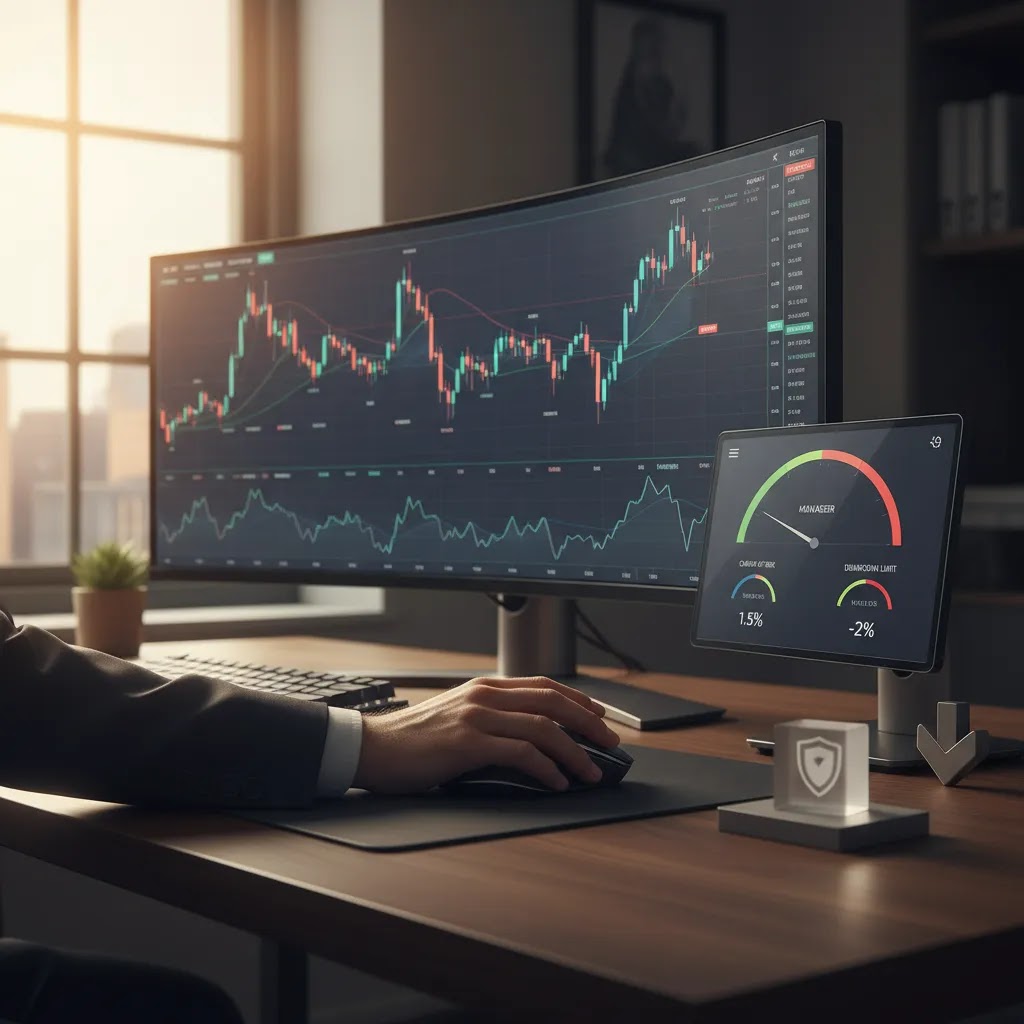
Who should focus on this most
This topic matters to almost every active trader, but it is especially important for beginners, forex traders using leverage, and intermediate traders trying to recover from inconsistent results. If you have ever increased size after a loss, held a position without a clear exit, or opened several similar trades at once, you are exactly the kind of reader who may benefit from a structured risk management plan.
It is also relevant if you are currently evaluating brokers. Features such as guaranteed stops, low minimum deposits, educational tools, and transparent pricing may help, but only if they fit your own process and risk tolerance. The goal is not to find a perfect platform. It is to use a suitable platform within a disciplined framework.
Business24-7 editorial view
Business24-7 approaches this topic from a safety-first perspective shaped by Braden Chase’s background as a former research specialist at Forex.com and the site’s UAE-focused editorial mission. The practical takeaway is simple: before you compare indicators, strategies, or signal providers, make sure your downside controls are clear. For many retail traders, that may do more for long-term survival than finding a better entry pattern.
If risk control is also influencing your broker choice, use Business24-7 as a reference point rather than a shortcut. Compare regulation, pricing, and platform features carefully. A DFSA-, SCA-, FCA-, ASIC-, or CySEC-regulated broker may offer stronger oversight, but you still need to check whether the account structure and tools fit your own plan. Browse our platform resources and evaluation content before making a final decision.
Common myths and unrealistic expectations (including “$1,000 a day” claims and win-rate obsession)
A major part of risk management in trading is protecting yourself from your own expectations. Online trading content often focuses on income targets, aggressive compounding, and highlight-reel wins. The problem is that these ideas can push you toward excessive leverage, oversized positions, and ignoring drawdown rules. Even if a strategy has an edge, the path can be uneven, and losses are part of normal trading outcomes.
Is it realistic to make $1,000 a day day trading?
Some traders may have periods where they make $1,000 in a day, but treating that number as a consistent daily goal is where risk typically escalates. The dollar amount you can make or lose is tied to position size and volatility. If your account is not large enough to support that objective with reasonable risk per trade, the usual workaround is higher leverage or looser stops. That can increase the chance of large drawdowns or fast account damage, especially in CFDs and forex where price swings can be sharp.
Think of it this way: risk management is easier when your goal is to execute a process, not to hit a fixed income number. Measuring success by consistency, drawdown control, and avoiding “blow-up” weeks is often more protective than focusing on a daily profit target that markets do not owe you.
Win-rate obsession and why it can be misleading
Many beginners assume a higher win rate automatically means a safer strategy. The reality is that win rate and average win versus average loss both matter. A high win-rate approach can still be fragile if losses are occasional but very large, such as when stops are widened or losses are held. A lower win-rate approach can still be viable if losses are controlled and winners are meaningfully larger than losers. This is why risk per trade and stop discipline usually matter more than trying to “force” your win rate higher.
Viral statistics like “97% of day traders lose money”
You will often see claims that a specific percentage of day traders lose money, sometimes framed as 90% or 95% or 97%. The specific number varies by study, by timeframe, and by what counts as “day trading.” Some datasets focus on very active traders, some include costs differently, and some analyze short time windows where results can be skewed. The takeaway is not to memorize a number. It is to understand what drives failure for many retail traders: too much leverage, inconsistent sizing, high costs relative to edge, and emotional decision-making.
If you take one practical lesson from those statistics, it should be this: prioritize risk of ruin thinking. Your first job is to survive normal losing streaks and difficult market conditions without taking a hit that you cannot realistically recover from. That is why fixed risk per trade, a maximum loss pause rule, and realistic expectations tend to work together.

How to evaluate a platform for safer trading
If you are choosing a broker with risk management in mind, focus on practical details rather than marketing claims. Here are five areas worth checking.
1. Regulation and legal oversight
For UAE-based readers, local or recognized oversight matters. Brokers in Business24-7’s product data include regulation from bodies such as the DFSA, SCA, and ADGM FSRA, along with international regulators like the FCA, ASIC, and CySEC. Regulation does not remove market risk, but it may improve client protection standards, disclosures, and complaint procedures.
2. Fees that affect your exit discipline
Costs influence risk management more than many traders realize. Spread-only accounts may look simple, while raw-spread accounts may add commissions. Pepperstone’s Razor account, for instance, starts from 0.0 pips with a $7/lot commission, while Plus500 uses spread-only pricing and applies overnight funding fees. AvaTrade notes an inactivity fee after 3 months. These details may affect whether short-term or longer-term positions remain cost-efficient.
3. Tools that support execution control
Look for order types and features that match your strategy. Plus500 offers guaranteed stop-loss availability. AvaTrade highlights AvaProtect. Pepperstone provides advanced charting and fast execution. Capital.com includes TradingView integration and AI-powered insights. A good feature set may support better discipline, but only if you understand how and when to use it.
4. Minimum deposit and account accessibility
A lower entry point may help newer traders control account risk by starting small. Capital.com lists a $20 minimum deposit, Exness $10, and Pepperstone $0, while Saxo Bank starts at $2,000. Lower minimums do not always mean lower trading risk, but they may make it easier to test a process without overcommitting capital.
5. Product range and exposure management
More markets are not always better. Interactive Brokers offers access to 150+ markets and Saxo Bank to 72,000+ instruments, which may suit advanced users. Beginners may prefer a simpler setup with fewer moving parts. Whatever the platform, make sure you can monitor total exposure across asset classes so your portfolio risk does not quietly build.
A final point is that broker quality and personal discipline work together. A regulated broker with transparent fees may support better decisions, but it cannot enforce your max drawdown rule or stop you from overtrading. Your written plan still matters most.
Frequently Asked Questions
What is risk management trading in simple terms?
It is the process of controlling how much you can lose on a trade, across several trades, and over time. In practice, that usually means setting a risk per trade, using stop losses, limiting leverage, and tracking drawdown. The aim is not to eliminate losses. It is to keep losses manageable so you can continue trading responsibly.
How much should I risk per trade?
There is no single rule that fits everyone, but many retail traders use a small percentage of account equity, often around 0.5% to 1% per trade. The right number depends on your strategy, account size, volatility, and tolerance for drawdown. Smaller risk may feel slower, but it can help protect capital during difficult periods.
What is the 1% rule in trading?
The 1% rule is a common guideline that means risking no more than 1% of your account equity on a single trade. It is designed to prevent one position from causing outsized damage, especially during volatile conditions or when leverage is involved. Some traders use an even lower number, such as 0.25% to 0.5%, if their strategy has wider stops, higher volatility exposure, or a history of clustered losses.
What is the 3-5-7 rule in trading?
The 3-5-7 rule is often described online as a loss limit framework, typically tied to a daily loss cap, a weekly loss cap, or a maximum losing sequence before you pause trading. The exact definition varies, so it is best treated as a template: set a clear maximum loss threshold, define what you do when you hit it, and step away long enough to avoid emotional decision-making. It is a guardrail, not a guarantee of better results.
Why is position sizing so important?
Position sizing determines the actual financial impact of a losing trade. Even a strong setup can become dangerous if the trade size is too large. Good sizing connects your stop distance to a pre-defined dollar risk, which may keep losses consistent and prevent one mistake from causing outsized damage.
Do stop losses always protect me fully?
No. Stop losses may help limit downside, but they do not guarantee a perfect exit price. In fast or illiquid markets, slippage and gapping can occur. Some brokers offer guaranteed stop-loss tools on certain products, but those protections may come with conditions or higher costs, so always review the broker’s terms carefully.
Is risk management different in forex trading?
The principles are similar, but forex often involves leverage and fast price movement, which can increase the need for discipline. Risk management forex practices usually place extra emphasis on lot size, margin use, event risk, and correlated currency exposure. A small move in the market can still have a meaningful effect on a leveraged position.
What is max drawdown?
Max drawdown is the largest drop from your account peak to its lowest point before recovery. It is one of the clearest ways to measure strategy pain and account stress. Monitoring max drawdown may help you decide when to reduce size, pause trading, or review whether your current approach is exposing too much capital.
How do I know if a broker supports safer trading?
Start with regulation, fee transparency, and order tools. Brokers in Business24-7 data show different strengths, such as Plus500’s guaranteed stop-loss availability, AvaTrade’s AvaProtect, and Pepperstone’s low-spread account options. These features may help, but safer trading still depends on your own rules and whether the platform fits your process.
Should beginners use low minimum deposit brokers?
In many cases, starting with a smaller funded account may reduce pressure while you test your process. Brokers such as Capital.com, Exness, and Pepperstone have relatively accessible minimum deposits based on available data. Even so, a smaller deposit does not make trading safe by itself. The real protection comes from disciplined risk limits.
Can you make $1,000 a day with day trading?
Some traders may have days where they make $1,000, but treating $1,000 as a consistent daily target can push traders into excessive leverage, oversized positions, and weaker decision-making. What is realistic depends on account size, strategy, volatility, trading costs, and risk limits. Many readers find it safer to focus on process consistency and drawdown control rather than daily income goals that markets do not reliably provide.
Is it true that 97% of day traders lose money?
You will see figures like 90%, 95%, or 97% used online, but the exact number varies by study design, timeframe, and how “day trader” is defined. The more useful lesson is that many retail losses tend to come from controllable factors such as overuse of leverage, poor position sizing, high costs relative to edge, and emotional trading. If you build rules around risk per trade, maximum loss thresholds, and disciplined exits, you may reduce the chance of the most common failure patterns.
Does regulation in the UAE remove trading risk?
No. Bodies such as the DFSA and SCA may improve oversight, disclosures, and operating standards, but they do not protect you from market losses. Regulation is an important trust factor when selecting a broker, yet trading outcomes still depend on market conditions, costs, leverage, and the quality of your own risk management plan.
Key Takeaways
- Risk management trading is mainly about capital preservation, not avoiding all losses.
- Position sizing, stop placement, and drawdown limits are the core building blocks of a practical plan.
- Broker features such as guaranteed stops, risk tools, and transparent fees may help, but they do not replace discipline.
- For UAE readers, checking regulation through bodies such as the DFSA, SCA, or ADGM FSRA is an important part of broker evaluation.
- A written plan may reduce emotional mistakes and make performance easier to review over time.
Conclusion
Risk management is rarely the most exciting part of trading, but it is often the part that keeps you in the game long enough to improve. If you control risk per trade, use exits consistently, and monitor drawdown honestly, you may put yourself in a stronger position than traders who focus only on entries. For UAE-based readers, it also makes sense to pair that discipline with careful broker selection, especially where leverage and CFD products are involved. Business24-7 is built to help you make those decisions with more clarity. Use our educational resources, compare regulated platforms carefully, and return to our broker and strategy guides whenever you need a more reliable reference point before committing capital.
Disclaimer: The content published on Business24-7 is intended for informational purposes only and does not constitute financial advice, investment recommendations, or an endorsement of any specific platform or financial product. Trading and investing carry significant risk, including the potential loss of capital. You should conduct your own research and, where appropriate, seek independent financial advice before making any investment decisions. Business24-7 does not accept responsibility for any financial losses incurred as a result of information published on this site.
Disclaimer
eToro is a multi-asset platform which offers both investing in stocks and cryptoassets, as well as trading CFDs.
Please note that CFDs are complex instruments and come with a high risk of losing money rapidly due to leverage. 61% of retail investor accounts lose money when trading CFDs with this provider. You should consider whether you understand how CFDs work, and whether you can afford to take the high risk of losing your money
This communication is intended for information and educational purposes only and should not be considered investment advice or investment recommendation. Past performance is not an indication of future results.
Copy Trading does not amount to investment advice. The value of your investments may go up or down. Your capital is at risk.
Crypto assets are complex and carry a high risk of volatility and loss. Trading or investing in crypto assets may not be suitable for all investors. Take 2 mins to learn more
eToro USA LLC does not offer CFDs and makes no representation and assumes no liability as to the accuracy or completeness of the content of this publication, which has been prepared by our partner utilizing publicly available non-entity specific information about eToro.

If you trade without a clear risk framework, even a few poor decisions may damage your account faster than most beginners expect. That is especially important for UAE-based traders sorting through leveraged products, CFD brokers, forex platforms, and conflicting online advice. Risk management trading is not about avoiding losses entirely. It is about controlling them so one trade, one bad…