
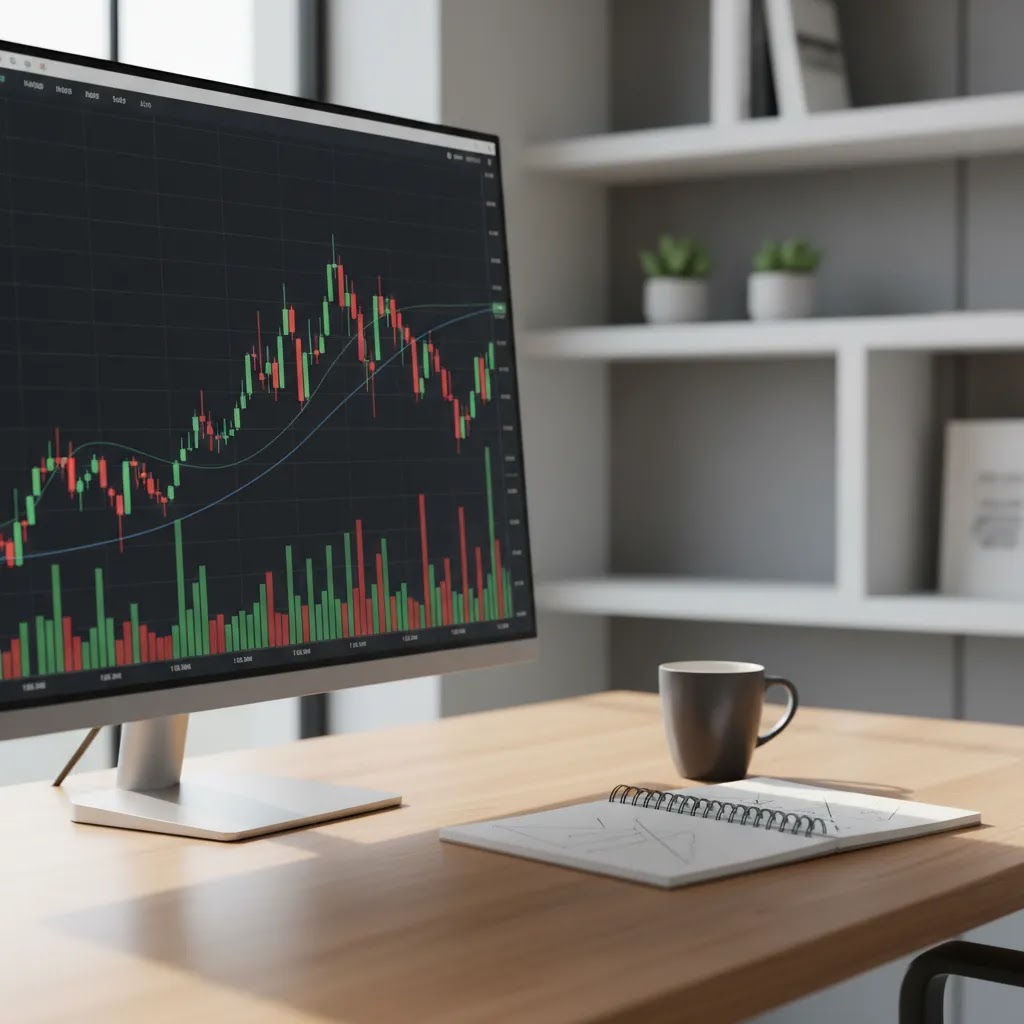
VWAP is one of the most widely used intraday indicators because it combines both price and volume into a single reference line. For day traders in the UAE and wider MENA region, that can make it useful when you want a clearer view of whether price is trading above or below the average level where most volume has changed hands. It is not a shortcut to profits, and it does not remove risk, but it may help you structure entries, exits, and trade filters with more discipline. If you are still building your chart-reading skills, our technical analysis guide provides the broader context for using indicators responsibly alongside risk management and market structure.
What VWAP means and why traders use it
VWAP stands for Volume Weighted Average Price. In plain language, it shows the average price an asset has traded at during the session, adjusted for volume. That matters because not all trades carry the same weight. A price move that happens on heavy volume may tell you more than one that appears during a thin period.
For day traders, VWAP is usually reset at the start of each trading day. That makes it an intraday benchmark rather than a long-term trend indicator. Many traders use it to judge whether buyers or sellers appear to be in control during the session.
If price is holding above VWAP, some traders interpret that as a sign of intraday strength. If price remains below it, they may view that as relative weakness. This is not a rule that always works. Markets can stay above or below VWAP and still reverse sharply, especially around news releases or low-liquidity periods.
VWAP is often discussed alongside moving averages, but the two are not identical. A moving average smooths price over a selected period, while VWAP includes volume and is commonly tied to the current session. That difference may make VWAP especially relevant for intraday decisions.
Is VWAP bullish or bearish?
Here’s the thing: VWAP is not inherently bullish or bearish. It is a benchmark, the session’s volume-weighted “average” price, and traders infer bias from how price behaves around it.
From a practical standpoint, traders often treat these behaviors as context clues:
- If price is above VWAP and continues to hold above it after pullbacks, that is often read as a healthier intraday bid.
- If price repeatedly fails at VWAP from below and rolls over, some traders see that as sellers defending the average.
- If price reclaims VWAP and then holds it on a retest, that can look like a shift in session control, but it still needs confirmation.
- If price chops through VWAP repeatedly with no follow-through, many traders reduce position size or avoid VWAP-based trades entirely because the “signal” quality can be low.
What many people overlook is when these reads break down. News spikes can cause price to gap far from VWAP with no clean retest. Low-liquidity periods can produce false holds and quick failures. Midday ranges can create constant touch-and-go behavior around the line that looks tradable but tends to be noisy.
Think of it this way: even if price is “above VWAP,” a long idea can still fail quickly. That is why confirmation and invalidation matter more than the line itself. Traders typically define what would prove them wrong, for example a clean loss of VWAP after a reclaim, or repeated rejection at VWAP that invalidates a pullback thesis.
How VWAP is calculated
The standard VWAP calculation multiplies the typical price for each period by volume, then divides the cumulative total by cumulative volume.
A simplified formula looks like this:
- Typical Price = (High + Low + Close) / 3
- VWAP = Cumulative (Typical Price × Volume) / Cumulative Volume
This means larger-volume candles have more influence on the line than lower-volume candles. In most charting platforms, the indicator is calculated automatically, so you usually do not need to perform the math by hand. Still, understanding the calculation helps you see why VWAP reacts differently from a simple moving average.
Because it is volume-based, VWAP tends to be most useful in markets and instruments where volume data is meaningful and available. In equities, this is straightforward. In forex, the picture can be more complicated because spot forex is decentralized. Some platforms use tick volume as a proxy, which may still be useful, but it is not exactly the same as centralized exchange volume.
VWAP bands, standard deviation, and practical settings (including TradingView)
Many charting platforms offer VWAP bands, sometimes called upper and lower bands. These are zones plotted above and below VWAP to give you a sense of how far price has moved away from the session’s volume-weighted average. Traders often use bands as a quick way to judge extension, mean reversion risk, and potential intraday “fair value” areas.
In most cases, bands are derived in one of two ways:
- Standard deviation bands: the platform calculates how widely price has dispersed around VWAP and plots bands at set deviations, often 1, 2, and 3. This approach adapts more naturally as volatility changes.
- Percentage-based bands: the bands are set at fixed percentage offsets from VWAP, for example 0.5% or 1%. This can be simple, but it may not reflect real intraday volatility shifts.
Now, when it comes to settings, traders commonly care about a few practical choices:
- Session VWAP vs anchored VWAP: session VWAP resets at the start of the trading day, which is what many day traders expect. Anchored VWAP starts from a chosen point and is more event-focused.
- Price source: many platforms default to typical price (HLC3). Some allow close or another source. In many cases, the default is fine unless you have a tested reason to change it.
- Number of bands: one or two bands can be enough for many traders. More bands can add clutter, especially if you already use key levels and structure.
- Volatility adjustments: in faster markets, standard deviation bands often make more sense than fixed percentages because the “normal” distance from VWAP can expand and contract through the session.
Platform implementation can also change what you see. In TradingView, for example, VWAP behavior depends on the session settings and the chart’s exchange and time zone configuration. A session VWAP typically resets based on the instrument’s trading session, so two traders can see slightly different VWAP lines if they are using different sessions, extended hours settings, or time zones. If your VWAP looks “off” compared to someone else’s chart, checking those session parameters is often the first step.

How to use the VWAP indicator in real trading
The VWAP indicator is often used as a decision filter rather than a standalone trading signal. Instead of buying or selling every time price touches the line, many traders use it to add context to a setup that already includes price action, support and resistance, or other forex indicators.
Common ways traders use VWAP include:
- Trend filter: looking for long setups above VWAP and short setups below VWAP
- Mean reversion reference: watching whether an overextended move may pull back toward VWAP
- Support and resistance guide: treating the line as a dynamic area where price could react
- Execution benchmark: comparing trade entries to the session average price
For example, if a stock opens strongly, pulls back toward VWAP, and then starts to hold above it with rising volume, some day traders may see that as a higher-quality long setup than chasing the open. On the other hand, if price breaks below VWAP and repeated retests fail, that could suggest weakness rather than support.
VWAP usually works best when paired with a clear plan for entry, stop-loss placement, and invalidation. If you trade without that structure, the indicator may encourage reactive decisions instead of disciplined ones.
A worked VWAP example and how to read it on a chart
Consider this simplified example using typical price (HLC3) to show why VWAP is “volume-weighted.” Imagine three 1-minute candles after the open:
- Candle 1: Typical Price = 100, Volume = 200. Cumulative (TP × Vol) = 20,000, Cumulative Volume = 200, so VWAP = 100.
- Candle 2: Typical Price = 102, Volume = 50. New cumulative (TP × Vol) = 20,000 + 5,100 = 25,100. New cumulative volume = 250. VWAP = 25,100 / 250 = 100.4.
- Candle 3: Typical Price = 98, Volume = 300. New cumulative (TP × Vol) = 25,100 + 29,400 = 54,500. New cumulative volume = 550. VWAP = 54,500 / 550 = 99.09 (approximately).
Even though Candle 2 traded at a higher price, it had low volume, so it did not move VWAP much. Candle 3 had heavier volume at a lower price, so VWAP shifted down more meaningfully. That is the core idea: VWAP tends to “follow” the prices where the bulk of volume is trading.
On a chart, you will often see a few common behaviors:
- Trend above VWAP: price holds above the line, pullbacks stall near VWAP, and rebounds show follow-through. Some traders treat this as a higher-quality environment for long setups, but it can still fail if momentum fades.
- Chop around VWAP: price crosses the line repeatedly and neither side holds it for long. This is where touch-and-go signals can become unreliable and where traders may reduce frequency or rely more on structure than on VWAP.
- Extended far from VWAP: price moves well above or below VWAP, sometimes toward outer bands if you use them. This can hint at mean reversion risk, but strong trend days can stay extended for longer than expected.
What many beginners find confusing is the way VWAP can “catch up” later in the session. Early high-volume activity can heavily influence the line, so VWAP may move slowly afterward unless new high-volume trading occurs at meaningfully different prices. This is also why a single tap of VWAP does not automatically mean the market will reverse. In choppy conditions, VWAP can act more like a magnet than a barrier, and quick flips around the line are common.
VWAP trading strategies for day traders
There is no single VWAP method that suits every market condition. What matters is matching the strategy to volatility, liquidity, and your level of experience. If you are comparing short-term approaches, it may also help to review the broader context around day trading vs swing trading before committing to an intraday routine.
1. Pullback to VWAP in a trend
This is one of the most common VWAP day trading approaches. The idea is simple: identify an asset trending above or below VWAP, then wait for price to retrace toward the line instead of chasing momentum. Traders may look for confirmation from candle structure, higher lows, or rising volume before entering.
This setup may reduce poor entries, but it can also fail quickly if the trend is weakening or if a market is transitioning into a range.
2. VWAP rejection trade
In this setup, price approaches VWAP from one side, tests it, and then rejects it. Some traders view this as evidence that the session bias remains intact. A bearish example would be price trading below VWAP, rallying into it, then rolling over.
The risk here is false rejection. Markets often probe around VWAP before choosing direction, so confirmation matters.
3. VWAP crossover as a caution signal
Some traders monitor whether price crosses above or below VWAP as a sign of changing intraday sentiment. This can be useful, but crossover signals alone may be noisy. In most cases, it is better treated as an alert to reassess the market rather than an automatic trade trigger.
4. Mean reversion back to VWAP
When price becomes stretched far from VWAP, some traders anticipate a return toward the average. This can work in slower or range-bound sessions, but it can be dangerous in strong trend days. A market can remain extended longer than many traders expect.
Risk warning: VWAP strategies may help with structure, but they do not predict direction with certainty. Intraday trading involves substantial risk, including slippage, fast reversals, and loss of capital.
Anchored VWAP and VWAP support resistance
Anchored VWAP is a variation that starts the calculation from a specific point rather than from the start of the current day. Traders might anchor it to a major swing high, swing low, earnings event, breakout candle, or macro news release. This can make it useful for analyzing how price behaves relative to an important event or turning point.
Some traders use anchored VWAP to identify dynamic support or resistance. If price repeatedly respects an anchored VWAP from a major low, that line may become a reference area for trend continuation. If price loses it decisively, it could suggest weakening momentum.
This method can be powerful in the right context, but it introduces subjectivity because the anchor point matters. Two traders may choose different anchors and get different interpretations. That is why anchored VWAP tends to work better as a framework tool than as a rigid signal generator.
VWAP support resistance also works best when combined with obvious chart structure, not in isolation. A line on its own is rarely enough reason to take a trade.
Platforms that may suit VWAP-focused traders
If you plan to use VWAP regularly, your platform matters almost as much as the indicator itself. You may want charting flexibility, fast execution, mobile access, and clear pricing. Based on Business24-7 product data, several brokers cover different trader needs.
Pepperstone has a 4.5/5 rating, no minimum deposit, and supports MT4, MT5, cTrader, and TradingView. Its Razor account offers spreads from 0.0 pips with a $7/lot commission, which may appeal to active intraday traders who need flexible charting and low-latency tools.
Interactive Brokers, rated 4.5/5, offers professional-grade tools, access to 150+ markets, and platforms including TWS and IBKR Mobile. With spreads from 0.25 pips and $0 minimum deposit, it may suit more experienced traders who want broader market access and detailed execution controls.
XTB has a 4.0/5 rating, no minimum deposit, and an xStation 5 platform with strong educational support. Spreads start from 0.1 pips. For readers who value a cleaner interface and want to build chart-reading discipline over time, that may be a practical middle ground.
Capital.com is rated 4.0/5, has a low $20 minimum deposit, spreads from 0.6 pips, and includes TradingView integration. It is also SCA regulated in the UAE, which may matter to readers who prioritize local regulatory alignment.
AvaTrade, rated 4.5/5, supports MT4, MT5, AvaTradeGO, and WebTrader, with spreads from 0.9 pips and a $100 minimum deposit. It is regulated by ADGM FSRA and offers educational content that may help less experienced traders use indicators more cautiously.
At Business24-7, we suggest treating chart indicators and platform selection as connected decisions. A good platform may improve execution and usability, but it still cannot remove market risk. You can browse our Trading Platforms and Brokers resources or compare broker features against your trading style before opening an account.
Pros and Cons
Strengths
- VWAP combines price and volume, which may offer more context than price-only indicators.
- It is easy to apply as an intraday trend filter for long and short bias.
- Many traders use it as a practical reference for pullbacks, support, and resistance during the session.
- Anchored VWAP can add useful context around earnings, breakouts, or major swing points.
- It is available on many trading platforms used by retail traders, especially those with advanced charting.
Considerations
- VWAP is primarily an intraday tool, so it may be less useful for longer-term analysis on its own.
- In forex, volume inputs may rely on tick volume rather than centralized exchange volume.
- Price can cross VWAP repeatedly in choppy markets, creating false or low-quality signals.
- Anchored VWAP can become subjective because results depend on where the trader sets the anchor.
- Using VWAP without a stop-loss or broader risk plan may lead to poor trade decisions.
How to choose a platform for VWAP trading
If VWAP will be part of your daily process, the right platform should support that workflow clearly. This is especially important for UAE-based readers who may also care about regulation, account funding options, and support quality.
1. Check regulatory status first
Before anything else, verify whether the broker is regulated by a recognized authority. In the UAE, that could include the DFSA or SCA depending on the firm and jurisdiction. In broader international contexts, traders often look for regulators such as the FCA, ASIC, or CySEC. Regulation does not remove trading risk, but it may improve standards around client protection and operational oversight.
2. Make sure the platform supports your charting style
VWAP is simple in concept, but serious intraday traders often want more than a default line on a chart. They may need custom timeframes, anchored VWAP, multiple layouts, mobile access, or integration with tools like TradingView. If the platform feels restrictive, your execution discipline may suffer.
3. Understand the full cost of trading
Spreads, commissions, and overnight charges can all affect short-term strategies. For instance, Pepperstone lists 0.0 pips on Razor with a $7/lot commission, while Capital.com uses spread-only pricing on most instruments from 0.6 pips. AvaTrade starts from 0.9 pips and applies an inactivity fee after 3 months. These differences matter if you trade frequently.
4. Match the platform to your experience level
Some traders need simplicity, while others want depth. XTB may appeal to traders who want education and a cleaner interface. Interactive Brokers may suit advanced users who can handle a more complex platform in exchange for broader market access and professional tools. There is no single right answer. The fit depends on your process.
5. Look at practical UAE usability
Features such as AED funding, Arabic support, and regional regulation may make a meaningful difference. Capital.com is SCA regulated, Pepperstone and XTB have DFSA regulation, and AvaTrade is regulated by ADGM FSRA. Those details may matter if local oversight is part of your decision framework.
If you are still comparing indicator-based trading methods, you can also browse the wider Technical Analysis section for more charting education before choosing a broker.
Frequently Asked Questions
What is the VWAP indicator in simple terms?
VWAP is the average price of an asset during the trading session, adjusted by volume. Traders use it to see whether current price is trading above or below a volume-weighted benchmark. It may help with intraday context, but it should not be treated as a guarantee of future direction.
What does the VWAP tell you?
VWAP tells you where the session’s average trading activity is concentrated after accounting for volume. If price is above VWAP, it suggests the market is trading above the session’s volume-weighted average, which some traders read as intraday strength. If price is below VWAP, it suggests the market is trading below that average, which can be read as weakness. The reality is that VWAP is best treated as context, not a prediction. How price reacts around VWAP, such as acceptance above it or rejection at it, usually matters more than a single touch.
Is VWAP bullish or bearish?
VWAP is not bullish or bearish by itself. It is a benchmark. Traders infer a bullish or bearish bias from price location and behavior relative to VWAP, such as holding above it after pullbacks or repeatedly failing at it from below. Those reads can break down during news spikes, low-liquidity periods, or choppy midday ranges, so confirmation and clear invalidation points still matter.
Is VWAP better than a moving average?
Not necessarily. VWAP and moving averages serve different purposes. VWAP is usually session-based and volume-weighted, while moving averages smooth price over time without volume weighting. For intraday traders, VWAP may offer more context. For trend analysis across longer periods, moving averages may be more practical.
How do day traders use VWAP?
Day traders often use VWAP as a trend filter, pullback reference, or dynamic support and resistance line. Some look for long setups above VWAP and short setups below it. Others monitor whether price reclaims or loses VWAP after the open. Confirmation from price action and risk controls is usually important.
Is VWAP good for day trading?
VWAP is widely used in day trading because it resets each session and provides a volume-weighted reference level that can help structure intraday decisions. It may be useful for filtering trades, assessing whether a move is extended, and framing pullbacks. Still, it can perform poorly in choppy conditions where price whipsaws around the line, and it does not remove the risks of fast reversals, slippage, or losses. Many traders get better results when they treat VWAP as a context tool and not a standalone signal.
Does VWAP work in forex trading?
VWAP can be used in forex, but there is a limitation. Spot forex does not have a single centralized volume source, so some platforms calculate VWAP using tick volume. That may still provide useful context, but it is not identical to exchange-traded volume data seen in stocks or futures.
What is anchored VWAP?
Anchored VWAP is a version of VWAP that begins from a specific chart point, such as a swing low, breakout candle, or major news event. Traders use it to measure how price behaves relative to an important event. It can be helpful, but results depend on where the anchor is placed.
Can VWAP be used for support and resistance?
Yes, many traders use VWAP as a dynamic support or resistance area. Price may react around it during the session, especially if other chart levels align with it. Still, no support or resistance level is certain. False breaks and failed retests are common, particularly in volatile conditions.
What are the best VWAP settings (for example on TradingView)?
Many traders start with default session VWAP settings because they are designed to match common institutional benchmarks. Typical price (HLC3) is a common default input. If you use VWAP bands, standard deviation-based bands often adapt better to changing intraday volatility than fixed percentage bands, but the right choice depends on the instrument and session behavior.
On TradingView, your VWAP can look different depending on session settings, extended hours, and time zone configuration. If you are comparing your VWAP to another chart, make sure you are using the same session definitions and instrument trading hours. If you switch to anchored VWAP, the “best” setting becomes less about the indicator and more about whether the anchor point is logically tied to an event that other traders are likely watching.
Which brokers may suit traders who use VWAP frequently?
Based on Business24-7 data, Pepperstone, Interactive Brokers, XTB, Capital.com, and AvaTrade may be worth comparing depending on your needs. The differences include charting access, minimum deposit, fee model, and regulation. It is usually wise to compare platform usability and costs before you fund an account.
Should beginners rely on VWAP alone?
No. Beginners may find VWAP useful because it is visually clear, but relying on a single indicator can lead to weak decisions. In most cases, it is better used with price structure, risk management rules, and a basic understanding of volatility, session timing, and trade invalidation.
Is VWAP useful for long-term investing?
Usually less so than for intraday trading. VWAP is most commonly used as a session-based benchmark, although anchored VWAP can extend its usefulness over longer periods. Long-term investors may still find it interesting, but trend tools and broader valuation analysis often play a larger role.
Key Takeaways
- VWAP shows the session’s average price weighted by volume, making it a popular intraday benchmark.
- It may help with trend filtering, pullback entries, and dynamic support or resistance, but it is not a standalone system.
- Anchored VWAP adds flexibility, though it introduces subjectivity based on the chosen starting point.
- Platform choice matters if you rely on VWAP regularly, especially for charting quality, fees, and regulation.
- For UAE-based traders, it is sensible to weigh platform features alongside oversight from bodies such as the DFSA or SCA where relevant.
Conclusion
VWAP remains a practical indicator for day traders because it brings price and volume into one clear intraday reference point. Used well, it may help you avoid impulsive entries and read session strength more objectively. Used poorly, it can become just another line that encourages overtrading. The difference usually comes down to context, discipline, and platform fit. If you are evaluating where to trade, focus on regulation, charting quality, fee transparency, and execution tools rather than the indicator alone. Business24-7 aims to give UAE-based readers a calmer, more evidence-based way to compare brokers and trading tools. Browse our platform resources and review pages before making a final decision about any broker or trading setup.
Disclaimer: The content published on Business24-7 is intended for informational purposes only and does not constitute financial advice, investment recommendations, or an endorsement of any specific platform or financial product. Trading and investing carry significant risk, including the potential loss of capital. You should conduct your own research and, where appropriate, seek independent financial advice before making any investment decisions. Business24-7 does not accept responsibility for any financial losses incurred as a result of information published on this site.
Disclaimer
eToro is a multi-asset platform which offers both investing in stocks and cryptoassets, as well as trading CFDs.
Please note that CFDs are complex instruments and come with a high risk of losing money rapidly due to leverage. 61% of retail investor accounts lose money when trading CFDs with this provider. You should consider whether you understand how CFDs work, and whether you can afford to take the high risk of losing your money
This communication is intended for information and educational purposes only and should not be considered investment advice or investment recommendation. Past performance is not an indication of future results.
Copy Trading does not amount to investment advice. The value of your investments may go up or down. Your capital is at risk.
Crypto assets are complex and carry a high risk of volatility and loss. Trading or investing in crypto assets may not be suitable for all investors. Take 2 mins to learn more
eToro USA LLC does not offer CFDs and makes no representation and assumes no liability as to the accuracy or completeness of the content of this publication, which has been prepared by our partner utilizing publicly available non-entity specific information about eToro.

VWAP is one of the most widely used intraday indicators because it combines both price and volume into a single reference line. For day traders in the UAE and wider MENA region, that can make it useful when you want a clearer view of whether price is trading above or below the average level where most volume has changed hands.…