
If you are new to currency trading, forex indicators can seem far more complicated than they need to be. Many beginners in the UAE and wider MENA region start with crowded charts, too many signals, and unrealistic expectations about accuracy. In practice, the best forex indicators are usually the ones you can understand, apply consistently, and combine with basic risk management. This article explains which indicators beginners may want to start with, what each one is designed to measure, and where they can fall short. It also places indicators in a broader learning path, so you can use them as part of a structured technical analysis guide rather than as standalone buy or sell signals. Trading carries risk, and indicators may help with decision-making, but they cannot remove uncertainty from the market.
What forex indicators actually do
Forex indicators are mathematical tools applied to price, volume, or volatility data. They are designed to help you spot patterns that may be harder to recognize with the naked eye. Some indicators focus on trend direction, some look for momentum shifts, and others measure volatility or potential overbought and oversold conditions.
For beginners, the main point is not to find the most accurate forex indicators in an absolute sense. No indicator is accurate all the time. A better goal is to understand what type of information an indicator gives you and what market condition it may be useful in. A trend indicator may work better in directional markets, while an oscillator may be more helpful in ranging conditions.
It also helps to understand the difference between leading vs lagging indicators. Leading indicators try to flag possible turning points before a move is fully confirmed. Lagging indicators react after a move is already underway and may help confirm the trend. Neither category is automatically better. In most cases, beginners may get better results by combining one trend-following tool with one momentum or volatility tool rather than stacking several versions of the same idea.
If you want a structured place to continue learning, Business24-7 also organizes educational resources in its Technical Analysis section and broader Trading Fundamentals coverage.
5 forex indicators beginners should know
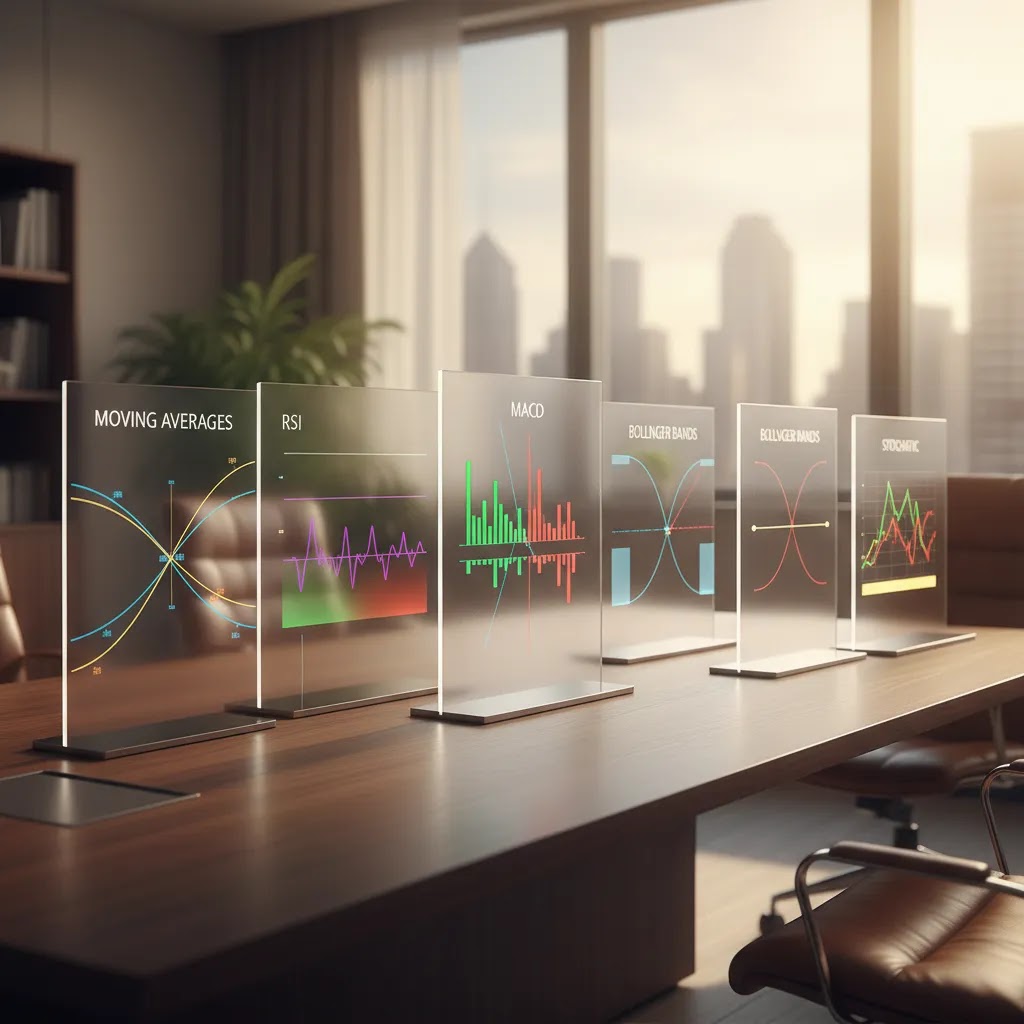
Because this article title does not specify a number, we are using five core indicators as the default set. These are not the only useful forex trading indicators, but they are among the most beginner-friendly because each one serves a distinct purpose.
1. Moving Averages
Moving averages smooth out price data to help you identify the general direction of the market. A rising moving average may suggest upward momentum, while a falling one may suggest weakness. Beginners often start with a simple 50-period or 200-period moving average because these can make trend direction easier to read.
This is one of the most widely used forex trend indicators. Its weakness is that it lags price, which means signals may come after part of the move has already happened. Still, for a beginner, that trade-off may be acceptable because clarity often matters more than speed.
2. Relative Strength Index
The rsi indicator is a momentum oscillator that moves between 0 and 100. It is often used to identify overbought or oversold conditions. Readings above 70 may suggest a market is stretched to the upside, while readings below 30 may suggest downside exhaustion.
For beginners, RSI can be useful because it is visually simple. The main limitation is that overbought does not always mean price will fall immediately, and oversold does not always mean price will rise immediately. In a strong trend, RSI can stay elevated or depressed for longer than new traders expect.
3. MACD
The macd indicator helps traders assess trend direction and momentum together. It uses the relationship between two moving averages and displays a histogram that may show momentum accelerating or weakening.
MACD is popular because it can help beginners confirm whether a trend still has strength behind it. Like moving averages, though, it is not an early-warning system in every case. It may react more slowly during sharp reversals.
4. Bollinger Bands
Bollinger Bands place an upper and lower band around price, based on volatility. When the bands widen, volatility may be increasing. When they narrow, markets may be quiet and potentially preparing for a larger move.
This is one of the more practical tools for beginners because it shows price in context rather than as a simple line. Still, touching an outer band is not a standalone reversal signal. It may indicate strength just as easily as exhaustion, depending on the market structure.
5. Stochastic Oscillator
The stochastic oscillator is another momentum tool commonly used to identify overbought and oversold conditions. It compares the current closing price to a recent trading range. Beginners may find it useful in slower, range-bound markets where price tends to swing from one side of a range to the other.
Its drawback is similar to RSI. In trending conditions, stochastic signals may arrive too early. That is why it is usually better to pair it with a trend filter rather than use it alone.
How to set indicator parameters (and when to change them)
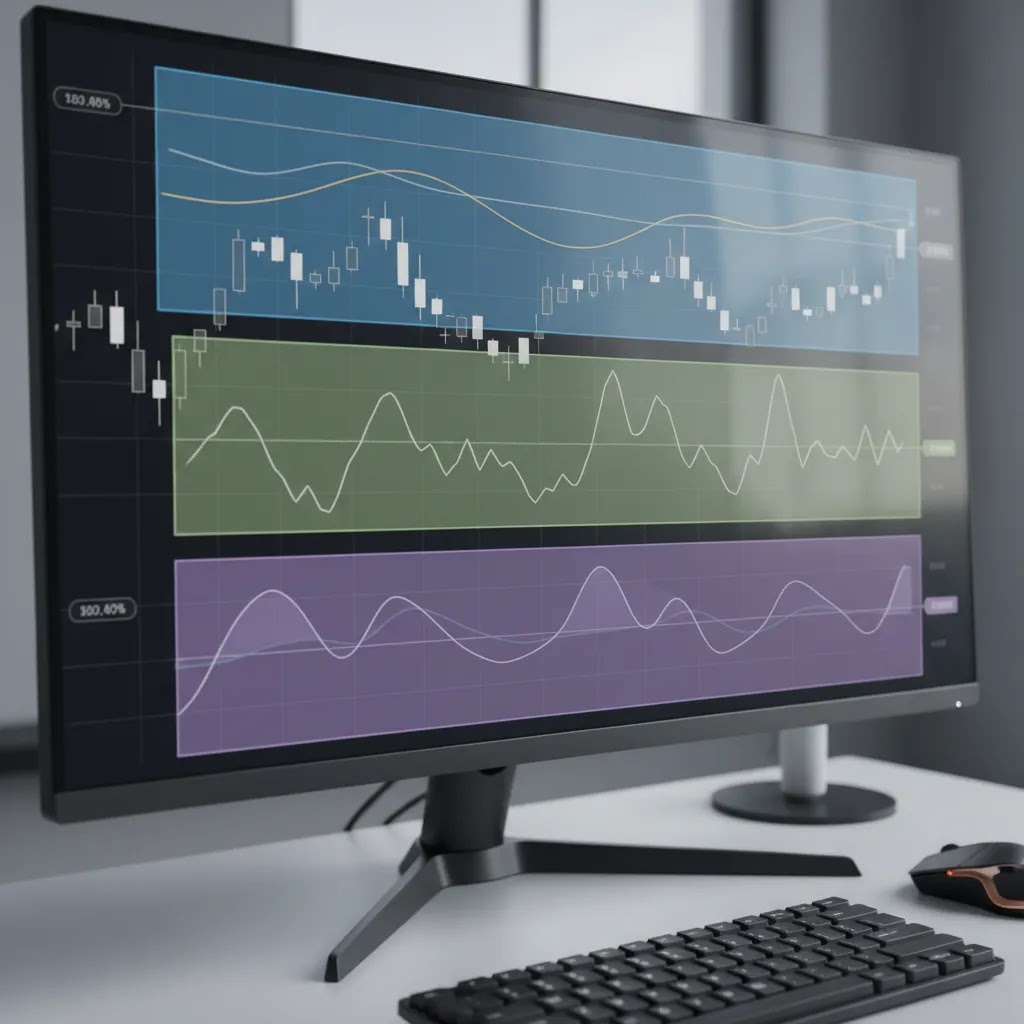
What many people overlook is that indicators are not only about which tool you choose. Your settings can change how quickly an indicator reacts, how many signals it produces, and how noisy those signals may look on your chart. Beginners often switch settings constantly after a loss, which can make any forex indicator strategy feel inconsistent.
From a practical standpoint, it usually helps to start with widely used defaults, then make changes only if you can explain what the change is meant to fix. Common default settings you will see on many platforms include RSI 14, MACD 12-26-9, and standard moving average periods like 20, 50, and 200. Bollinger Bands are commonly shown with a 20-period basis and bands set around 2 standard deviations. Stochastic often defaults to 14-3-3 on many charting packages.
Here is the trade-off to keep in mind: shorter periods typically react faster, but they can produce more false signals. Longer periods usually react more slowly, but they can filter out some noise. Think of it this way: if you shorten a moving average period, you are asking it to track price more closely, which can be useful for very short-term decisions, but it may also flip direction more often.
Time frame matters as well. A scalper watching very short charts may prefer faster settings than a swing trader using daily or four-hour charts, but there is no guaranteed best setup. The goal is alignment. Your indicator settings should match how long you expect trades to last and how much price movement you can realistically tolerate before exiting. You also need to consider costs, because frequent entries may be more sensitive to spreads, commissions, and slippage.
If you want a simple way to test settings without turning it into endless tweaking, start on a demo account and define a small, repeatable test. For example, you might track 30 to 50 trade setups using one set of parameters, then review whether the signals made sense in the market conditions you traded. The key is to avoid changing settings every few trades. Constant adjustment can become curve-fitting, where the indicator is optimized for what already happened rather than what may happen next. Trading always involves uncertainty, so your process should focus on consistency and risk control, not on finding settings that look perfect in hindsight.
How to combine indicators without overloading your chart
One of the most common beginner mistakes is using too many indicators that all measure the same thing. For example, combining MACD, RSI, and stochastic may look sophisticated, but all three are momentum-focused to some degree. That may create duplicate information rather than clearer trade decisions.
A more practical forex indicator combination often follows a simple structure:
- One trend tool, such as moving averages
- One momentum tool, such as RSI or MACD
- One volatility tool, such as Bollinger Bands
This kind of setup may help you answer three useful questions before entering a trade:
- Is the market trending or ranging?
- Is momentum supporting the move or fading?
- Is volatility expanding or shrinking?
For example, if price is above a rising moving average, RSI is holding above 50, and Bollinger Bands are widening, that may suggest a trend with momentum and increasing activity. It still would not guarantee the trade will work, but it may give you a more balanced framework than relying on one signal alone.
The same principle applies whether you are looking for the best indicator for day trading or the best indicator for scalping. Shorter-term traders usually need faster settings and stricter risk controls, but the logic of combining different indicator types remains similar. In most cases, beginners should test any forex indicator strategy in a demo environment before risking real money.
Common forex indicator mistakes beginners make
Here is the thing: most indicator problems are not caused by the indicator itself. They come from how beginners interpret it, how many tools they stack on one chart, and how quickly they change rules after a loss. If you want to use indicators well, it helps to know the most common traps up front.
The first mistake is indicator stacking, where you add multiple indicators that all tell you roughly the same thing. Momentum oscillators are a classic example. If RSI, MACD, and stochastic are all flashing similar signals, it can feel like confirmation, but you may just be seeing the same calculation expressed in three different ways. That can create false confidence and may encourage larger position sizes than you planned.
The second mistake is curve-fitting settings. Beginners often adjust periods, thresholds, and smoothing until the indicator would have caught the last big move perfectly. The reality is that indicators can look far better in hindsight than they perform in real time, because your eye naturally focuses on the cleanest examples and ignores the messy, sideways periods where false signals cluster.
A simple sanity-check is to zoom out and confirm the bigger context. If your indicator is giving a reversal signal on a five-minute chart, take a moment to check a higher time frame and the broader market structure. Is price still trending strongly? Are you trading into a major support or resistance zone? Do multiple time frames show the same direction, or are you trying to fade a trend because one oscillator hit an extreme reading? This does not make a trade safe, but it can reduce the chance you are reacting to noise.
A third mistake is treating indicators as prediction tools instead of decision-support tools. Indicators do not know why the market is moving, and they do not account for news shocks or sudden liquidity changes. During high-volatility events, indicators can lag, overshoot, or produce whipsaws that look irrational if you expected a clean textbook signal.
Finally, beginners often underestimate how leverage interacts with indicator entries. Even if your read is correct on direction, leverage can magnify losses if your entry timing is off, your stop is too tight, or volatility expands suddenly. A small move against you can have an outsized impact on your account when leveraged products are involved. That is why indicators should be paired with position sizing rules and predefined risk limits, not used as a reason to increase exposure.
Platforms and tools that support indicator-based trading
The quality of your charting platform matters almost as much as the indicators themselves. Business24-7 covers several brokers that provide tools beginners may consider if they want to use indicator-based analysis.
| Broker | Platforms | Spreads From | Minimum Deposit | Regulation | Notable Strength |
|---|---|---|---|---|---|
| Pepperstone | MT4, MT5, cTrader, TradingView | 0.0 pips (Razor) | $0 | DFSA, FCA, ASIC, CySEC, BaFin | Advanced charting and ultra-low spreads |
| AvaTrade | MT4, MT5, AvaTradeGO, WebTrader | 0.9 pips | $100 | ADGM FSRA, CBI, ASIC, FSA Japan | Education and risk management tools |
| XTB | xStation 5, Mobile App | 0.1 pips | $0 | DFSA, FCA, CySEC, KNF | Strong education and beginner-friendly platform |
| Capital.com | Capital.com Web, Mobile App, MT4 | 0.6 pips | $20 | SCA, FCA, CySEC, ASIC | Low minimum deposit and AI-powered insights |
| Plus500 | Plus500 WebTrader, Mobile App | 0.8 pips | $100 | DFSA, FCA, CySEC, ASIC, MAS | Simple interface and risk tools |
For UAE-based readers, regulation remains a major filter. Depending on the broker, this may include oversight from the DFSA, SCA, or ADGM FSRA, alongside international regulators such as the FCA, ASIC, or CySEC. Regulation does not remove trading risk, but it may provide stronger safeguards around client money handling, disclosures, and operating standards.
Business24-7 also reviews brokers such as eToro, Interactive Brokers, ADSS, Exness, and Saxo Bank. If your focus is charting and execution, Pepperstone stands out for platform variety, while XTB and AvaTrade may appeal more to beginners who value education. Capital.com may suit traders looking for a low starting deposit, and Plus500 may appeal to users who prefer a simpler interface. The right fit depends on your goals, trading frequency, and tolerance for complexity.
Pros and Cons
Strengths
- Forex indicators may help beginners structure decision-making instead of trading on impulse alone.
- Tools like moving averages, RSI, MACD, and Bollinger Bands each serve different roles, which makes them easier to combine logically.
- Several brokers covered by Business24-7 offer charting platforms that support indicator-based analysis, including MT4, MT5, cTrader, TradingView, xStation 5, and proprietary web platforms.
- UAE-based readers can compare brokers with locally relevant regulation, including DFSA, SCA, and ADGM FSRA oversight where available.
- Some beginner-friendly brokers also offer educational support, such as AvaTrade and XTB, which may help traders understand how indicators work before using real capital.
Considerations
- No indicator can predict price direction with certainty, and false signals are common in changing market conditions.
- Many popular forex trading indicators are lagging by design, so entries may come after a move has already started.
- Using too many indicators at once may create conflicting signals and lead to hesitation or overtrading.
- Short-term uses such as scalping or intraday trading may increase the impact of spreads, commissions, and execution quality.
- Even with a regulated broker and a clear indicator setup, trading still involves meaningful risk to capital.
Who indicator-based trading suits
Indicator-based trading may suit beginners who want a more structured approach to reading charts. If you prefer having rules, visual references, and repeatable setups, indicators can be a practical starting point. They may also help intermediate traders compare momentum, trend strength, and volatility more consistently across currency pairs.
That said, indicators may be less suitable for traders who expect certainty or instant signals. They work better as decision-support tools than as automatic answers. If you are just getting started, it is usually smarter to master one or two tools well rather than chase the top forex indicators all at once.

Business24-7 perspective
Business24-7 approaches forex education with a safety-first, evidence-based mindset shaped by Braden Chase’s background as a former research specialist at Forex.com. The goal is not to present indicators as a shortcut to profit, but to help you understand how they fit into disciplined trading decisions.
If you are moving from education into platform research, it may help to browse Business24-7’s broker resources before choosing where to trade. You can review regulated options in Broker Reviews, compare UAE-focused choices in the Best Forex Brokers guide, and then read full broker reviews to see how charting tools, fees, and regulation line up with your needs.
Indicators vs forex signals and AI tools (what they can and cannot do)
Consider this: indicators are tools you control. You can see the inputs, you can change the settings, and you can decide how to use them within a clear trading plan. Forex signals are different. They are typically trade ideas delivered by a third party, sometimes manually and sometimes through automation. That difference matters because transparency and accountability are not the same.
If you are comparing indicator-based trading to signal services, look for clarity on how the signals are created, what markets and time frames they target, and what risk assumptions are baked in. Vague marketing, selective screenshots, and claims of near-perfect win rates are common red flags. A legitimate provider should be able to explain the method in plain terms, show realistic performance expectations, and be clear that losses are possible.
Now, when it comes to AI tools such as ChatGPT, it helps to be realistic about what they are designed to do. AI can be useful for learning concepts, building checklists, summarizing indicator logic, and helping you structure a trading journal so you can review your decisions over time. What it cannot do reliably is provide verified, real-time forex signals or guaranteed trade setups. It may generate confident-sounding answers that are not connected to live market conditions, pricing feeds, or your broker’s execution reality.
Safety matters here. Avoid sharing account credentials or giving any third-party tool access to your brokerage account. If a signal provider claims to be regulated, verify what that regulation actually covers, for example oversight from the SCA, DFSA, or ADGM FSRA in the UAE context, or international bodies such as the FCA, ASIC, or CySEC. Finally, be cautious of marketing that promises to turn a small deposit into a large balance quickly. Forex and CFDs involve significant risk, and leverage can magnify losses just as easily as it can magnify gains. For most beginners, the safest path is usually slow skill-building, careful position sizing, and a focus on process over prediction.
How to choose a broker if you rely on indicators
If indicators are central to how you plan to trade, choosing the right broker is not only about spreads. It also involves platform quality, regulation, and execution standards.
1. Check regulation first
For UAE residents, regulation should be one of the first filters. Depending on the firm, this may include the SCA, DFSA, or ADGM FSRA locally, as well as international regulators such as the FCA, ASIC, or CySEC. Regulation does not protect you from market losses, but it may reduce some operational risks tied to platform oversight.
2. Match the platform to your strategy
If you expect to use custom indicators, multi-chart layouts, or advanced execution tools, a broker offering MT4, MT5, cTrader, or TradingView support may be more suitable. Pepperstone is a strong example here, while XTB and Capital.com may appeal to traders who prefer a simpler modern interface.
3. Understand the fee structure
Indicator-heavy trading styles, especially shorter-term ones, can be sensitive to transaction costs. Pepperstone’s Razor account includes a $7 per lot commission with spreads from 0.0 pips, while some others use spread-only pricing. AvaTrade lists competitive spreads but also notes an inactivity fee after 3 months. Plus500 uses spread-only pricing, though overnight funding fees may apply. These details can affect real trading costs more than beginners expect.
4. Consider your starting capital
Minimum deposit requirements vary. Capital.com starts from $20, Exness from $10, AvaTrade and Plus500 from $100, while some brokers such as Pepperstone and XTB list $0 minimum deposits. A low minimum may help with access, but it should not be the only factor. Platform quality and regulation usually matter more over time.
5. Look for education and support
Beginners often underestimate the value of educational material and responsive support. XTB highlights extensive education, and AvaTrade emphasizes comprehensive learning tools and risk management features. If you are still refining your forex indicator strategy, a broker with strong educational support may be more helpful than one built mainly for experienced users.
Frequently Asked Questions
What are the best forex indicators for beginners?
For most beginners, moving averages, RSI, MACD, Bollinger Bands, and stochastic are a reasonable starting group. Each covers a different aspect of the market, such as trend, momentum, or volatility. The best choice depends on how you trade, but most new traders may benefit more from learning a few indicators well than using many at once.
What is the most accurate forex indicator?
There is no single most accurate forex indicator in every market condition. Some tools may perform better in trends, while others may be more useful in ranging markets. Accuracy also depends on time frame, settings, and risk management. Any claim that one indicator works all the time should be treated cautiously.
Are leading indicators better than lagging indicators?
Not necessarily. Leading indicators may signal potential turning points earlier, but they can also produce more false signals. Lagging indicators may confirm trends more slowly, but they can be easier for beginners to interpret. In many cases, using one of each type may provide a better balance than choosing only one camp.
What is a good forex indicator combination?
A common beginner-friendly combination is one trend indicator, one momentum indicator, and one volatility indicator. For example, you might use moving averages for trend direction, RSI for momentum, and Bollinger Bands for volatility. This may help reduce duplicate signals and create a more complete view of market conditions.
What is the best indicator for day trading forex?
There is no universal best indicator for day trading. Many short-term traders use moving averages, VWAP alternatives where available, RSI, MACD, or Bollinger Bands, often on lower time frames. What matters most is whether the indicator fits your market conditions, trading hours, and cost structure, especially spreads and commissions.
What is the best indicator for scalping?
Scalpers often prefer fast-reacting tools such as short-period moving averages, RSI, MACD, or Bollinger Bands, but execution speed and trading costs are just as important as the indicator itself. A strategy that looks effective on a chart may perform differently once spreads, slippage, and commissions are factored in.
Can beginners trade forex using indicators alone?
Beginners can use indicators as part of their process, but relying on them alone may be risky. Indicators work best alongside market structure, support and resistance, and risk management rules. Even a clear signal may fail, especially during news events or sharp changes in volatility. Capital remains at risk in every trade.
Do forex indicators work better on some platforms than others?
The underlying indicator logic is generally similar across platforms, but usability can differ a lot. Platform design, charting flexibility, custom settings, and order execution all affect the trading experience. Brokers covered by Business24-7 offer different strengths, from Pepperstone’s broad platform support to XTB’s beginner-friendly xStation 5.
Should UAE traders care about broker regulation when using indicators?
Yes. Indicators may help with chart analysis, but broker regulation relates to operational trust and client protections. UAE traders may want to look for oversight from bodies such as the SCA, DFSA, or ADGM FSRA where relevant. International regulators like the FCA, ASIC, and CySEC may also add another layer of credibility.
Which is the best forex indicator?
There is no single best forex indicator for everyone. The best indicator is usually the one that matches your market condition and decision-making style, and that you can apply consistently. Many beginners start with moving averages for trend direction and RSI or MACD for momentum, then add a volatility tool such as Bollinger Bands if needed. Be cautious with claims that one indicator is universally superior, because performance can vary by pair, time frame, and volatility.
What is the 3 5 7 rule in forex?
The “3 5 7 rule” does not have one universally accepted definition in forex, and it is often presented as a simplified rule-of-thumb in trading communities rather than a formal market standard. In some contexts, it refers to using short moving average periods, such as 3, 5, and 7, to monitor very short-term momentum. If you see this rule promoted, treat it as a starting idea to test carefully in a demo environment, not as a proven edge. Very fast settings can increase noise and may lead to more false signals, especially when spreads and execution costs are considered.
How to turn $100 into $1000 in forex?
Marketing that promises turning $100 into $1000 quickly is usually a red flag, because it often relies on high leverage, oversized risk, or unrealistic expectations. Forex trading outcomes are uncertain, and leverage can amplify losses as well as gains. If you are starting with a small balance, a more realistic focus is learning execution, controlling risk per trade, and building consistency over time. Any approach that requires risking a large portion of your account to reach a target quickly can lead to rapid drawdowns.
Can ChatGPT give forex signals?
ChatGPT can help explain indicators, outline trading checklists, and support journaling, but it is not a verified real-time forex signal service. It may not have access to live market data, and it can generate answers that sound confident without being accurate for current conditions. If you use AI in your process, treat it as an educational aid rather than a source of trade entries. You should also avoid sharing personal or brokerage login details with any tool or service.
Key Takeaways
- The best forex indicators for beginners are usually simple, visual, and easy to combine, not necessarily the most complex.
- Moving averages, RSI, MACD, Bollinger Bands, and stochastic cover trend, momentum, and volatility well enough for most new traders.
- A balanced forex indicator combination often works better than stacking several similar momentum tools on one chart.
- Your broker and platform matter because charting quality, fees, and regulation can affect how indicator-based trading works in practice.
- Indicators may improve structure and discipline, but they do not remove trading risk or guarantee profitable outcomes.
Conclusion
Forex indicators can be useful for beginners, but only if you treat them as tools for analysis rather than promises of accuracy. A small set of well-understood indicators is usually more effective than a crowded chart full of conflicting signals. For most new traders, the real edge may come from consistency, risk control, and using a regulated broker with a platform that fits your learning stage. Business24-7 is built to help UAE-based readers sort through that process with a clear, independent approach. If you are ready to move from chart education into broker research, browse our platform comparisons, review the broker resources on the site, and return to Business24-7 whenever you want a second look before making a decision.
Disclaimer: The content published on Business24-7 is intended for informational purposes only and does not constitute financial advice, investment recommendations, or an endorsement of any specific platform or financial product. Trading and investing carry significant risk, including the potential loss of capital. You should conduct your own research and, where appropriate, seek independent financial advice before making any investment decisions. Business24-7 does not accept responsibility for any financial losses incurred as a result of information published on this site.
Disclaimer
eToro is a multi-asset platform which offers both investing in stocks and cryptoassets, as well as trading CFDs.
Please note that CFDs are complex instruments and come with a high risk of losing money rapidly due to leverage. 61% of retail investor accounts lose money when trading CFDs with this provider. You should consider whether you understand how CFDs work, and whether you can afford to take the high risk of losing your money
This communication is intended for information and educational purposes only and should not be considered investment advice or investment recommendation. Past performance is not an indication of future results.
Copy Trading does not amount to investment advice. The value of your investments may go up or down. Your capital is at risk.
Crypto assets are complex and carry a high risk of volatility and loss. Trading or investing in crypto assets may not be suitable for all investors. Take 2 mins to learn more
eToro USA LLC does not offer CFDs and makes no representation and assumes no liability as to the accuracy or completeness of the content of this publication, which has been prepared by our partner utilizing publicly available non-entity specific information about eToro.

If you are new to currency trading, forex indicators can seem far more complicated than they need to be. Many beginners in the UAE and wider MENA region start with crowded charts, too many signals, and unrealistic expectations about accuracy. In practice, the best forex indicators are usually the ones you can understand, apply consistently, and combine with basic risk…