

If you trade forex, stocks, or CFDs, one of the fastest ways to lose consistency is to focus only on whether a trade wins or loses. A better question is whether the potential reward justifies the amount you are putting at risk. That is the core idea behind the risk reward ratio. For newer traders in the UAE and wider MENA region, this concept may help bring structure to entries, stop-loss placement, and profit targets before capital is exposed. It also fits naturally within a broader trading strategies framework, where each setup is judged by rules rather than emotion. Used properly, the risk reward ratio will not guarantee profits, but it may help you filter poor trades, stay disciplined, and think in probabilities instead of isolated outcomes.
What the risk reward ratio means
The risk reward ratio compares how much you could lose on a trade with how much you could gain if the trade reaches your target. In simple terms, if you risk $100 to potentially make $200, your ratio is 1:2. If you risk $100 to potentially make $300, your ratio is 1:3.
This matters because traders do not need to win every time to stay profitable. A trader with a strong risk to reward ratio may still come out ahead even with a modest win rate. That is why the ratio is often discussed alongside risk management, position sizing, and trade selection.
It is also important to understand what the ratio does not do. It does not measure the probability of success, and it does not tell you whether the setup itself is good. A 1:5 target may look attractive on paper, but if price rarely reaches that level, the trade may still be poor. The ratio is one decision tool, not a complete strategy.
For UAE-based retail traders using regulated brokers under bodies such as the DFSA or SCA, this concept may be especially useful because it encourages planning before execution. That planning can reduce impulsive decisions, which are often more damaging than any single losing trade.
How to calculate risk reward
The basic formula is straightforward:
- Risk reward ratio = potential loss / potential profit
To calculate it, you need three numbers:
- Your entry price
- Your stop-loss price
- Your take-profit target
Suppose you buy EUR/USD at 1.1000. Your stop-loss is at 1.0950, which means you are risking 50 pips. Your take-profit is at 1.1100, which means you are targeting 100 pips. The ratio is 50/100, or 1:2.
Here is the same logic in money terms. If your position size means 50 pips equals $80 of risk, and 100 pips equals $160 of possible reward, the ratio is still 1:2. The ratio stays the same whether you measure in pips, points, or dollars, as long as you compare the same trade consistently.
Many platforms and charting tools provide a built-in risk reward calculator, but you should still know the math yourself. If you rely entirely on platform automation, mistakes in order placement may go unnoticed. A manual double-check often helps, especially if you are trading leveraged products where small price moves can have a larger effect on your capital.
Before you place any trade, define the invalidation point first. That means asking where the setup is no longer valid, then setting the stop accordingly. After that, estimate a realistic target based on market structure, resistance, support, or trend continuation. This method is usually more reliable than choosing a target first and forcing the stop to fit.
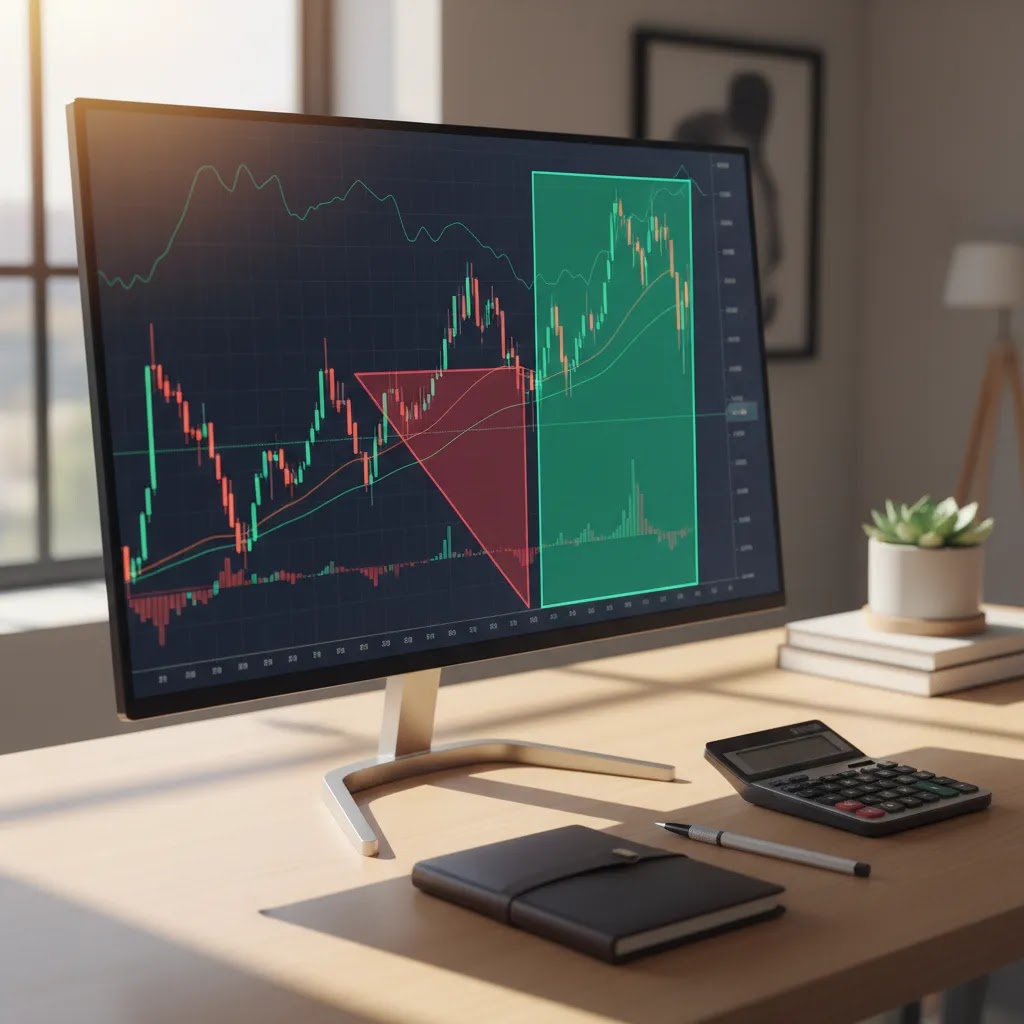
Risk reward ratio formula and quick calculations (including 3:1)
Here is the thing: traders often use the same phrase to mean two different calculations. Some people calculate risk divided by reward, then express it as 1:x. Others calculate reward divided by risk, then express it as x:1. Both can be valid, but if you mix them up, you can think you have a 1:3 setup when you actually have the opposite.
The article formula above uses the common planning view: potential loss divided by potential profit. If your risk is $100 and your reward is $300, the ratio is 100/300 = 0.33. Traders typically convert that into the cleaner format of 1:3, since you are risking 1 unit to make 3 units.
If your platform displays reward divided by risk instead, that same trade would show 300/100 = 3. In that display style, it may be labeled 3:1. From a practical standpoint, the key is to confirm what the numbers represent, and then translate them into plain language: “If I lose, I lose about X. If I win, I make about Y.”
A worked 3:1 example using price distance helps make this concrete. Suppose you buy an index CFD at 5,000. Your stop-loss is 4,980, so your risk is 20 points. Your take-profit is 5,060, so your reward is 60 points. Risk/reward is 20/60 = 0.33, which is commonly expressed as 1:3.
You can do the same quick check in dollars. If those 20 points equal $100 of risk because of your position size, then 60 points would be $300 of potential reward. The ratio stays 1:3 because the relationship does not change, only the units do.
A 1.5-style example is also common in real trading because markets do not always provide clean 1:2 or 1:3 opportunities. If you risk 40 pips on EUR/USD and target 60 pips, risk/reward is 40/60 = 0.67. That is often expressed as 1:1.5, meaning you are aiming to make 1.5 units for every 1 unit you risk.
If you see people searching for “risk reward ratio calculator” or asking how to do this quickly on a charting platform like TradingView, the use case is usually the same. They want a fast way to measure stop distance versus target distance before placing orders. Even then, it helps to do a quick mental check so you know you are reading the tool correctly, especially when spreads and slippage could slightly change real entry and exit prices.
Examples: 1:2 and 1:3 risk reward
A 1:2 risk reward means you aim to make two units for every one unit you risk. If you risk $50, your target is $100. If you risk $200, your target is $400.
A 1:3 risk reward means you aim to make three units for every one unit you risk. If you risk $100, your target is $300.
Neither ratio is automatically better. A 1:3 setup may appear more attractive, but it could be harder to achieve consistently. In many market conditions, a 1:2 target may be more realistic. What matters is the balance between reward potential and the actual probability of reaching that target.
For example:
- If your strategy wins 50% of the time with a 1:2 ratio, it may be profitable before costs.
- If your strategy wins only 25% of the time with a 1:3 ratio, results could still be borderline once spreads, commissions, and slippage are included.
- If your targets are too ambitious, you may watch winning trades reverse before reaching take profit.
This is why traders should connect risk reward planning with stop loss take profit rules. Your stop needs to make structural sense, and your target should be realistic for the instrument and timeframe you trade.
Why it matters in real trading
The main advantage of the risk reward ratio is that it forces discipline before a trade is opened. Instead of reacting emotionally after entry, you set your exposure in advance. That can help reduce revenge trading, overtrading, and the habit of widening stops after price moves against you.
It also helps traders judge whether a setup is worth taking at all. If a chart offers only 20 pips of upside before resistance but requires a 30-pip stop, the trade may not offer a favorable ratio. Passing on that trade can be as important as taking a good one.
Another benefit is consistency in performance review. Once you log your trades, you can compare average reward, average loss, and win rate over time. This gives you a much clearer picture of strategy quality than simply counting wins and losses.
There is also a psychological benefit. Traders often become too attached to being right. The ratio shifts focus away from ego and toward expectancy. A strategy can still work even with several losing trades in a row, provided the losses are controlled and the winners are large enough relative to risk. That principle links closely with trading psychology, because poor emotional control often leads traders to ignore the ratio once a trade is live.
None of this removes risk. Trading forex, CFDs, stocks, crypto, or commodities involves uncertainty, and capital is at risk. Past performance does not guarantee future results, and even a well-tested risk reward ratio strategy may fail during changing market conditions.

What is a good risk reward ratio (and what it depends on)
What many people overlook is that there is no single “good” risk reward ratio that fits every trader. A ratio only becomes meaningful when you pair it with three realities: your win rate, the type of strategy you run, and your trading costs.
Think of it this way: a risk reward ratio is one side of the expectancy equation. Expectancy is simply your average outcome over many trades, not the result of one trade. In plain English, you can lose more often than you win and still be net positive if your average win is meaningfully larger than your average loss. On the other hand, you can have a great-looking ratio on paper and still struggle if the target is hit too rarely, or if spreads and commissions eat most of the edge.
Competitors often highlight simple benchmarks because they are easy to remember. A 1:2 ratio is common because it can provide room for normal market noise while still offering enough upside to make an average win count. A 1:1.5 ratio can still be workable for some strategies, particularly if they are designed to capture smaller, more frequent moves and have a higher hit rate. A 1:3 ratio can be attractive, but it is not automatically “better,” and in some market conditions it can be unrealistic if price rarely trends cleanly from entry to target without pulling back.
Consider this: if you keep trying to force 1:3 on every trade, you may end up placing targets in areas where there is no real market reason for price to go. That can turn a solid setup into a low-probability bet. The reality is that different environments reward different expectations. Range-bound markets may offer fewer clean 1:3 opportunities than trending markets. Lower timeframes can produce more noise, which can make wide targets and tight stops harder to combine consistently.
A quick reality check for 1:3 is to ask what needs to be true for that target to make sense. You typically want a market structure that supports continuation, such as a clear trend, a breakout with follow-through, or a strong support or resistance rotation that gives price room to run. You also want enough volatility for the instrument and timeframe. If the average daily move is small, expecting a 3R target on a short-term trade can be optimistic unless you are willing to hold longer or accept lower hit rates.
Costs matter more than many traders expect, especially on tighter targets. If you trade a 1:1.5 or 1:2 setup with a small stop and target, spreads, commissions, and slippage can materially change your effective ratio. For some traders, that makes higher timeframes or instruments with consistently tighter spreads easier to manage. For others, it simply means building costs into the plan from the start, rather than judging setups based on “ideal” numbers that are unlikely to be achieved in live execution.
Using it with trading platforms and brokers
The risk reward ratio is a trading concept, not a platform feature by itself. Still, your broker and platform can affect how easily you apply it. This is one reason platform evaluation matters.
For example, spreads and commissions can reduce actual reward relative to planned reward. If you target a small move but trade through wide spreads, the effective ratio may be worse than it first appears. On available Business24-7 product data, fee structures vary meaningfully:
- Pepperstone offers spreads from 0.0 pips on Razor, with a $7 per lot commission.
- Exness offers Raw Spread pricing from 0.0 pips, with $3.50 per lot commission.
- Capital.com uses spread-only pricing, with spreads from 0.6 pips and no commissions on most instruments.
- Plus500 also uses spread-only pricing, with spreads from 0.8 pips and overnight funding fees.
- XTB offers spreads from 0.1 pips and 0% commission on real stocks up to volume, while CFDs are spread-based.
Platform tools matter too. Pepperstone supports MT4, MT5, cTrader, and TradingView, which may appeal to traders who want detailed charting and planning tools. AvaTrade supports MT4, MT5, AvaTradeGO, and WebTrader, and includes AvaProtect risk management features. eToro focuses more on social and copy trading through WebTrader and its mobile app. Capital.com includes TradingView integration and AI-powered insights. These differences may affect how easily you can map entries, stops, and targets in practice.
For UAE readers, regulation should remain central. Based on Business24-7 product data, some covered brokers operate under UAE-relevant regulators such as the DFSA, SCA, ADGM FSRA, or ADGM listing context, while others also hold international licenses from the FCA, ASIC, or CySEC. That does not remove market risk, but it may help reduce platform-level concerns around oversight and conduct. If you are comparing broker options before applying any risk management method, you can browse the Trading Strategies section for educational guidance and the Trading Fundamentals section for broader foundational concepts.
Business24-7 takes an educational, safety-first approach to this process. Drawing on Braden Chase’s background as a former research specialist at Forex.com, the site reviews platforms with attention to regulation, fees, usability, and real-world suitability for UAE-based readers. If you are moving from theory into broker selection, it is worth checking detailed platform reviews and comparison resources before opening an account.
Pros and Cons
Strengths
- The risk reward ratio gives you a clear framework for judging whether a trade is worth taking before you enter.
- It helps connect your entry, stop-loss, and take-profit into one structured plan rather than three separate decisions.
- It may reduce emotionally driven trading by forcing you to define potential loss in advance.
- It makes performance review more useful because you can assess expectancy, not just raw win rate.
- It works across multiple asset classes, including forex, stocks, commodities, and CFDs.
- It can be applied on most modern platforms, especially those with charting and order-planning tools.
Considerations
- A favorable ratio alone does not mean a setup has a high probability of success.
- Trading costs such as spreads, commissions, and overnight fees may worsen the effective ratio.
- Some traders set unrealistic profit targets just to make the ratio look better on paper.
- Fast-moving markets may introduce slippage, meaning actual exits could differ from planned levels.
- Used without broader strategy testing, the ratio may create false confidence.
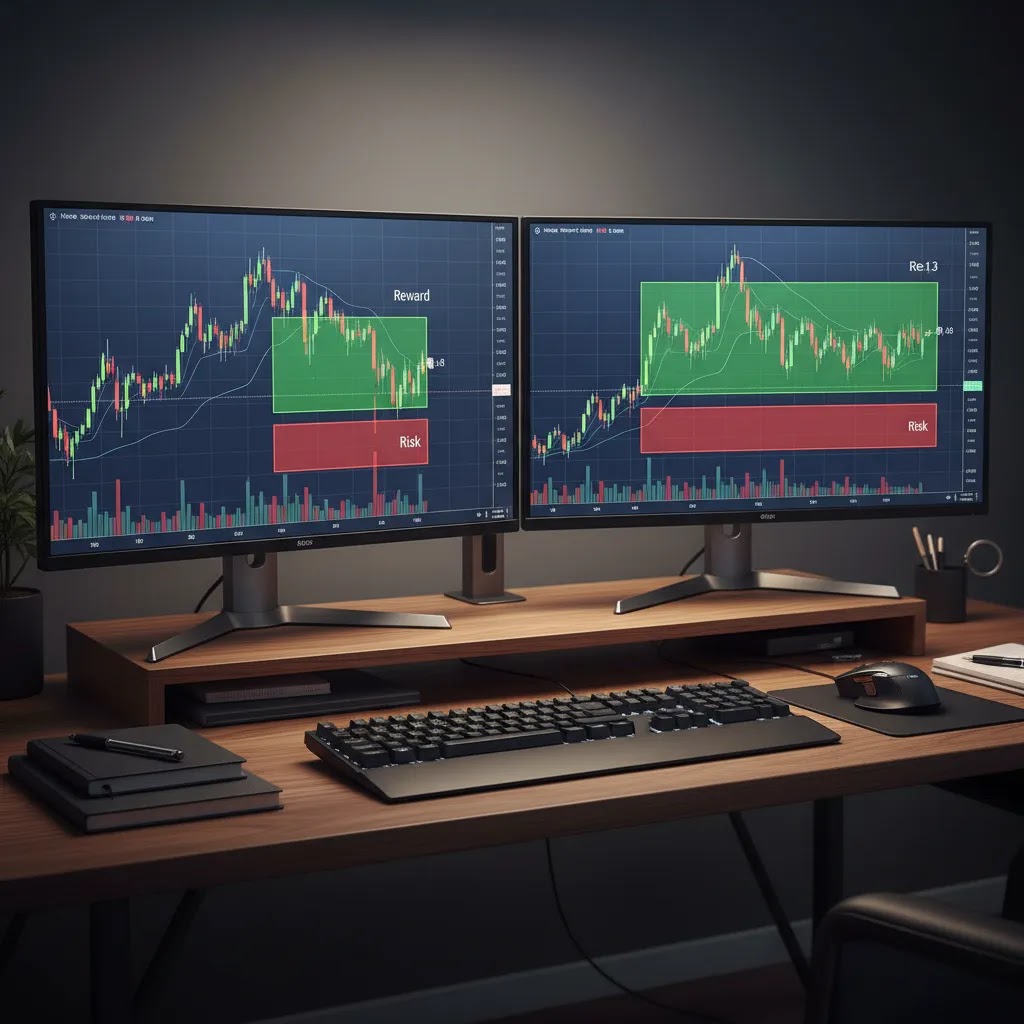
How to apply it responsibly
If you want to use the risk reward ratio well, treat it as part of a larger process rather than a stand-alone formula. A practical checklist may help:
- Start with the chart structure. Place your stop where the trade idea is invalidated, not at a random distance.
- Set a realistic target. Use support, resistance, volatility, and timeframe context. Do not stretch the target only to force a 1:3 setup.
- Include fees and spread. This is especially important in forex and CFD trading, where transaction costs can materially affect short-term trades.
- Size the position properly. Even a strong ratio can lead to heavy losses if the position is too large relative to your account.
- Track results over time. Review whether your strategy actually delivers the ratio you planned and whether the target is realistic in live conditions.
A good risk reward ratio depends on the strategy, timeframe, asset class, and trader behavior. In many cases, traders look for at least 1:2, but that is not a universal rule. A lower ratio with a high win rate may still work. A higher ratio with a low win rate may not. The only reliable way to know is through testing, disciplined execution, and consistent trade review.
If you are still building your approach, focus first on process quality. That means regulated broker selection, sensible leverage, clear stop placement, and realistic targets. The ratio should support decision-making, not create false certainty. For leveraged products in particular, losses can exceed expectations if risk controls are weak, so caution matters more than optimism.
Common mistakes when using risk reward ratio
The risk reward ratio is simple, which is exactly why it can be misused. Most problems do not come from the math. They come from forcing the ratio to look attractive instead of using it to describe a realistic trade plan.
One common mistake is tightening the stop too much just to “improve” the ratio. On paper, a smaller stop makes it easier to get to 1:2 or 1:3, but in live markets a stop still needs to reflect normal volatility and the point where your idea is invalidated. If the stop is inside typical market noise, you may get stopped out repeatedly even if the general direction was correct.
Another mistake is placing profit targets where price rarely trades. A target should be supported by structure, trend behavior, or prior liquidity zones. If the market has no reason to move there, a 1:3 ratio can turn into a long series of small losses while you wait for a move that does not happen often enough.
Execution issues also matter more than many traders expect. Slippage can occur in fast markets or around major news releases, and it can worsen both your stop and your fill price. Partial fills can also change the real outcome, particularly in less liquid instruments or volatile conditions. Even if the planned ratio looks strong, the realized ratio may be lower once real execution is included.
Then there is the behavioral side. Traders sometimes move stops farther away to avoid taking a loss, or they pull targets closer out of fear of giving back profits. Both behaviors can destroy the original risk reward profile. The ratio you planned only helps if you can follow it consistently, which is why it connects closely to process discipline and review.
A practical correction loop is to plan the trade in advance, execute it without changing the rules mid-trade unless your strategy explicitly allows it, and then review what you actually achieved in R multiples. “R” is simply your initial risk. If you risked $100 and made $200, that is +2R. If you risked $100 and lost $100, that is -1R. Over a sample of trades, tracking real R outcomes often reveals whether your chosen ratios are realistic, and whether costs or trade management are quietly reducing performance. The goal is not to chase prettier ratios. It is to refine rules so the ratio you plan is closer to the ratio you can actually achieve.
Frequently Asked Questions
What is risk reward ratio in trading?
The risk reward ratio measures how much you are willing to lose compared with how much you hope to gain on a trade. If you risk $100 to target $200, the ratio is 1:2. It is commonly used in forex, stocks, and CFD trading to help traders plan exits before entering a position.
What is considered a good risk reward ratio?
A good risk reward ratio depends on your strategy and win rate. Many traders look for 1:2 or better, but that is not a rule that fits every approach. A lower ratio may still work if your win rate is high enough, while a higher ratio may fail if your targets are too difficult to reach consistently.
How do you calculate risk reward ratio?
Subtract your stop-loss from your entry to find the amount at risk, then subtract your entry from your target to find potential reward. Divide risk by reward. For example, if you risk 40 pips and aim for 80 pips, the ratio is 1:2. The same method works in dollars or points.
Is a 1:3 risk reward ratio better than 1:2?
Not always. A 1:3 ratio may look more attractive, but it can be less practical if the market rarely reaches your target. A 1:2 setup with a stronger hit rate may produce better real-world results. The better ratio is usually the one that fits your tested strategy and market conditions.
Can I use a risk reward calculator instead of doing the math myself?
Yes, many platforms and charting tools include a risk reward calculator. It can save time and reduce manual errors. Still, it is wise to understand the calculation yourself so you can verify order levels, spot mistakes, and make better decisions when platforms display values in pips, points, or cash terms.
Does risk reward ratio guarantee profitable trading?
No. The ratio is useful, but it does not guarantee profits. It does not measure trade probability, market conditions, or execution quality. A trader can still lose money with a strong-looking ratio if the strategy is weak, costs are high, or discipline breaks down. Capital remains at risk in all trading activity.
Why do spreads and commissions matter for risk reward ratio forex trading?
In forex trading, spreads and commissions can reduce your net reward and increase the effective cost of each position. For shorter-term trades, that impact may be significant. A setup that appears to offer 1:2 before costs could be less favorable after transaction expenses are included, especially on tighter targets.
Should beginners use the risk reward ratio?
Yes, beginners may benefit from it because it encourages planning and discipline. It can help prevent random entries and oversized losses. That said, it should be used together with broader education on stops, position sizing, and broker safety. It is a helpful framework, but not a complete trading system by itself.
What is a 3:1 risk-reward ratio?
A 3:1 risk-reward ratio usually means the potential reward is three times the potential risk. For example, if your stop-loss represents a $100 loss, your take-profit would represent a $300 gain. Some tools display the inverse as 1:3, so it helps to confirm whether the tool is showing reward-to-risk or risk-to-reward before you rely on the number.
What is a 1.5 risk-reward ratio?
A 1.5 risk-reward ratio typically means you are targeting 1.5 units of reward for every 1 unit of risk, often shown as 1:1.5. If you risk $100, you would target about $150. This type of ratio can be more realistic in many market conditions, but it still needs to be evaluated with your win rate and trading costs in mind.
What is the 3 6 9 rule in trading?
The “3 6 9 rule” is not a single standardized rule used across regulated trading education, and it can mean different things depending on who is using the phrase. In some contexts, it is discussed as a money management or scaling concept, but the details vary widely. If you encounter it, treat it as a general framework idea rather than a proven standard, and test any related rules carefully in a demo or small-size environment before risking meaningful capital.
Is a 3:1 risk reward ratio good?
It can be good if your strategy can realistically hit the target often enough after costs. A 3:1 target may require stronger trend follow-through, a higher timeframe, or specific market conditions. If the target is too ambitious for the instrument’s volatility, or if slippage and spreads materially reduce results, a 3:1 plan can look good on paper but perform poorly in real trading.
Key Takeaways
- The risk reward ratio compares potential loss with potential gain before a trade is placed.
- Common examples include 1:2 risk reward and 1:3 risk reward, but higher is not always better.
- A favorable ratio does not guarantee success because probability, fees, and execution still matter.
- Spreads, commissions, and overnight charges can reduce the real reward on leveraged trades.
- For UAE traders, combining this concept with regulated broker selection and disciplined risk controls may lead to better decision-making.
Conclusion
The risk reward ratio is one of the simplest concepts in trading, but also one of the most useful when applied with discipline. It helps you think in terms of process, not impulse, and it can make trade selection more consistent across forex, stocks, and CFDs. Still, it works best when paired with realistic targets, proper stop placement, sensible position sizing, and a broker whose fees and platform tools fit your style. For UAE-based readers researching the broader picture, Business24-7 aims to be a reliable reference point with educational guides, platform reviews, and comparison resources grounded in regulation, costs, and usability. Before you commit capital, browse our broker resources and review platform details carefully.
Disclaimer: The content published on Business24-7 is intended for informational purposes only and does not constitute financial advice, investment recommendations, or an endorsement of any specific platform or financial product. Trading and investing carry significant risk, including the potential loss of capital. You should conduct your own research and, where appropriate, seek independent financial advice before making any investment decisions. Business24-7 does not accept responsibility for any financial losses incurred as a result of information published on this site.
Disclaimer
eToro is a multi-asset platform which offers both investing in stocks and cryptoassets, as well as trading CFDs.
Please note that CFDs are complex instruments and come with a high risk of losing money rapidly due to leverage. 61% of retail investor accounts lose money when trading CFDs with this provider. You should consider whether you understand how CFDs work, and whether you can afford to take the high risk of losing your money
This communication is intended for information and educational purposes only and should not be considered investment advice or investment recommendation. Past performance is not an indication of future results.
Copy Trading does not amount to investment advice. The value of your investments may go up or down. Your capital is at risk.
Crypto assets are complex and carry a high risk of volatility and loss. Trading or investing in crypto assets may not be suitable for all investors. Take 2 mins to learn more
eToro USA LLC does not offer CFDs and makes no representation and assumes no liability as to the accuracy or completeness of the content of this publication, which has been prepared by our partner utilizing publicly available non-entity specific information about eToro.

If you trade forex, stocks, or CFDs, one of the fastest ways to lose consistency is to focus only on whether a trade wins or loses. A better question is whether the potential reward justifies the amount you are putting at risk. That is the core idea behind the risk reward ratio. For newer traders in the UAE and wider…