

A trading plan gives structure to decisions that might otherwise be driven by emotion, guesswork, or internet noise. If you are new to markets, writing one may feel unnecessary at first, but in most cases it is one of the simplest ways to reduce avoidable mistakes. A clear plan can help you define what you trade, when you trade, how much you risk, and what would make you stop. For UAE-based traders comparing brokers, tools, and strategies, that structure matters even more because regulation, platform features, and product access can vary. This article shows you how to build your first trading plan template in plain English, with a practical format you can actually use. If you want broader context first, start with our trading strategies hub for related planning and execution guides.
What a trading plan is and why it matters
A trading plan is a written set of rules for how you approach the market. It is not a prediction document and it does not guarantee profit. Instead, it acts as a decision framework you can return to before, during, and after each trade.
For beginners, the biggest value is consistency. A plan may help you avoid entering trades just because price is moving quickly, social media is excited, or a recent win has made you overconfident. That is especially relevant in forex and CFD trading, where leverage can magnify gains and losses. Capital is at risk, and past performance does not guarantee future results.
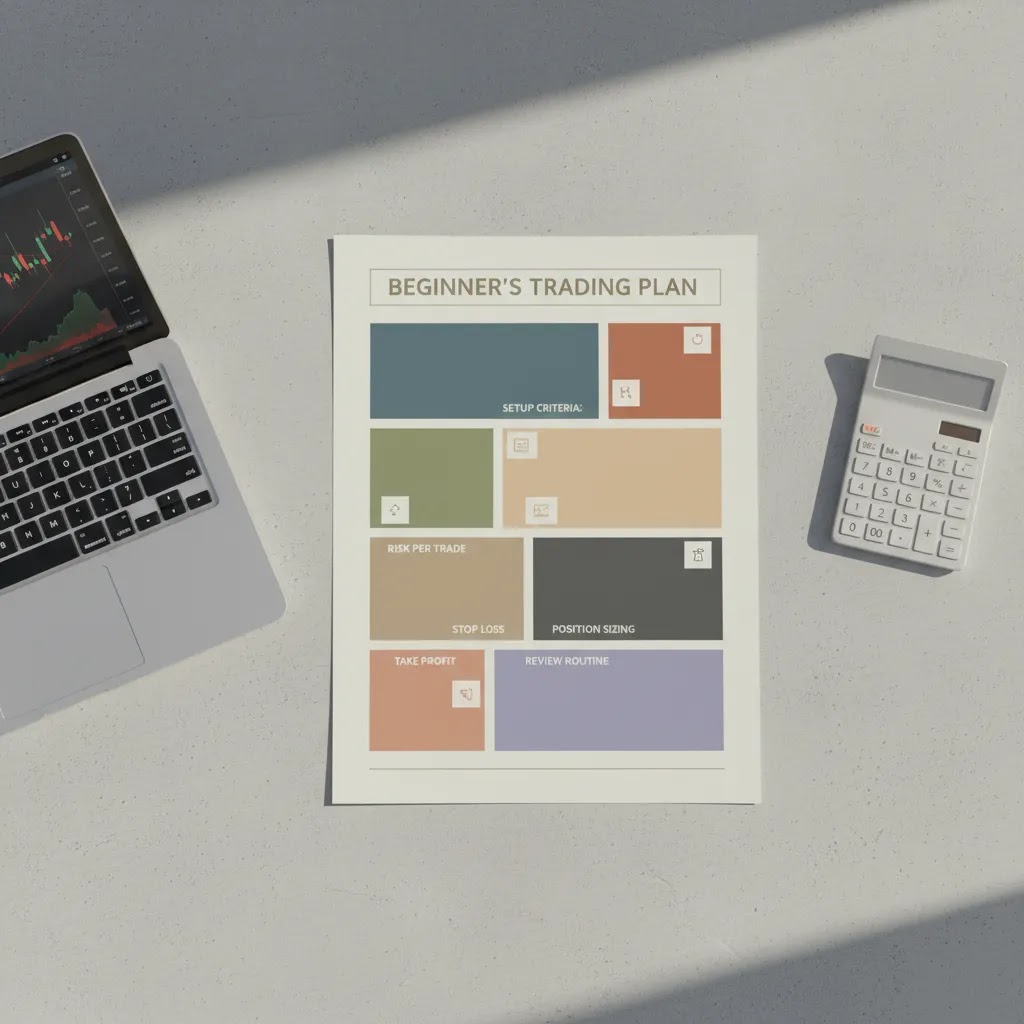
Your plan should cover your market focus, setup criteria, risk per trade, position sizing, exit rules, and review process. It should also include practical limits, such as how many trades you take per day and what conditions would make you sit out. If your discipline is a weak point, pairing your plan with a trading journal often makes it easier to spot repeated errors.
The core parts of a trading plan template
A useful trading plan is usually shorter and more specific than beginners expect. You do not need a 20-page document. You need rules you can follow under pressure.
1. Your market and instrument focus
Start by defining what you trade. This could be major forex pairs, stock CFDs, gold, or index products. Avoid trying to trade everything. A narrow focus usually makes it easier to build skill and review performance.
2. Your trading style
State whether your approach is a day trading plan, swing trading plan, or longer-term strategy. Your style affects chart timeframes, holding periods, and the type of broker tools you may need.
3. Entry rules
Your plan should describe exactly what must happen before you enter a trade. That might include trend direction, a support or resistance test, a breakout confirmation, or a moving average condition. If you cannot explain your setup clearly, it may be too vague to test.
4. Risk rules
This is one of the most important sections. Your plan should define maximum risk per trade, daily loss limits, and whether you use stop-loss orders. If you want to strengthen this section, our guide to risk management covers the basics that many new traders overlook.
5. Exit rules
Decide in advance how you take profits, where you place stops, and whether you scale out of positions. Exit logic matters just as much as entry logic.
6. Routine and review
Include your pre-market routine, trading hours, post-trade notes, and weekly review process. These habits often shape consistency more than any single indicator.

Trading Plan Rules You Can Use
Here’s the thing: most beginners do not blow up their results because they lack indicators. They usually struggle with behavior, such as overtrading after a winning streak, revenge trading after a loss, or bending entry rules when they feel they are “missing” a move.
That is where rules-based guardrails come in. Guardrails are simple limits that reduce the number of decisions you can make in the heat of the moment. They do not eliminate trading risk, and they do not guarantee performance, but they can make your plan easier to follow consistently.
What the “3-5-7 rule” usually means
Many traders search for the “3-5-7 rule in trading” because it sounds like a shortcut to discipline. The reality is that there is no single official definition. People use it as a flexible framework, typically to set numeric limits for trades, losses, and routine.
One common way beginners apply it is as a daily structure, such as:
- 3 trades max per day (to reduce overtrading)
- 5 quality checks before entry (a short pre-trade checklist)
- 7 minutes of post-trade notes (to reinforce review habits)
Another variation you may see is risk-focused, such as 3 trades maximum, stop after 5 consecutive losses, and review after 7 days. The details vary, which is why you should treat it as a starting point for your own plan, not a universal standard.
From a practical standpoint, the best “number rules” connect directly to the sections you already wrote in your plan, especially your risk rules, trade limit, no-trade conditions, and routine and review. If a rule is not tied to a specific behavior problem, it is less likely to help.
Other simple guardrails that often help beginners
Consider this: you can improve discipline without changing your strategy at all, just by adding clear limits. Examples that traders often use include a maximum number of losing trades in a day before stopping, a time-based rule such as no trades after your planned session ends, or a “cooldown” rule after a loss before you can take another entry.
The goal is not to restrict you forever. It is to keep your early learning phase controlled enough that you can review what is working and what is not, without noise from impulsive decisions.
How to choose your numbers without guessing
What many people overlook is that the “right” numbers depend on your account size, what you trade, and how volatile your market is. If you trade higher-volatility products, it may be more realistic to set tighter daily limits or fewer trades. If you only have a short trading window each day, a low trade cap can reduce the temptation to force mediocre setups.
A simple way to pick numbers is to work backward from your risk rules. Start with your risk per trade and maximum daily loss, then choose a trade limit that makes sense. For example, if your daily loss limit is 2% and your risk per trade is 1%, your plan is already telling you that two full stop-losses could end your day. In that case, a “three trades max” rule might still be fine, but only if you are willing to stop earlier when the loss limit is reached.
Think of it this way: numeric rules are there to protect you from your worst days, not to create an illusion of control. Even with strong guardrails, losses are possible, and market conditions can still produce drawdowns. That is why these rules should sit inside your broader risk management framework, not replace it.
A simple trading plan template you can copy
Below is a beginner-friendly trading plan example. You can adapt it into a document, a trading plan PDF, or a trading plan spreadsheet.
- Goal: Build consistent execution and protect capital while learning.
- Markets traded: Example: EUR/USD, GBP/USD, gold, or one stock index.
- Trading style: Example: Day trading on the 15-minute and 1-hour charts.
- Trading session: Example: London open to early New York session.
- Setup criteria: Trade only in trend direction after a pullback and confirmation candle.
- Entry trigger: Example: Break above prior candle high after support holds.
- Stop-loss rule: Place stop beyond recent swing low or structure level.
- Risk per trade: Example: 1% of account balance or less.
- Maximum daily loss: Example: 2% of account balance, then stop trading for the day.
- Profit target: Example: minimum 1:2 risk-reward ratio unless structure suggests otherwise.
- Trade limit: Example: Maximum 3 trades per day.
- No-trade conditions: High-impact news, poor sleep, emotional frustration, or unclear setup.
- Record keeping: Screenshot, entry reason, exit reason, emotions, and result.
- Weekly review: Identify rule breaks, recurring mistakes, and best-performing setups.
This kind of template works because it is specific enough to follow and simple enough to review. If you notice that emotions keep interfering with your execution, our guide to trading psychology may help you tighten the behavior side of your plan.
How to Turn This Template Into a Usable Document
A template only becomes useful when it is easy to follow on a normal trading day. Most traders end up using more than one format because rules and tracking serve different purposes.
Word or PDF for your fixed rules
A document format works best for your “non-negotiables,” such as what you trade, your setup criteria, risk per trade, maximum daily loss, and no-trade conditions. It is harder to accidentally edit, which can be a benefit if you have a habit of changing rules mid-week after a win or loss.
If you want your plan to fit on one page, keep only the rules you are willing to follow under pressure. If a rule is not clear enough to check quickly, rewrite it until it is.
Excel for tracking, stats, and review
A spreadsheet is usually better for what competitors often call the “working” side of the plan, meaning trade logging, performance tracking, and your weekly review notes. This format also matches what many readers mean when they search for a “trading plan template excel,” since it can hold both the plan and the numbers behind it.
A simple structure you can copy is:
- Rules: a clean version of your entry, exit, and risk rules so you see them while logging trades
- Trade log: date, instrument, session, setup name, entry, stop, target, position size, result, and whether you followed the rules
- Stats: win rate, average win, average loss, expectancy estimate, and a simple count of rule breaks
- Weekly review notes: what you did well, what you repeated, and one change to test next week
This does not have to be complicated. The most useful “calculator” function of a spreadsheet is usually position sizing based on your risk per trade and stop distance, but even then, you should sanity-check any output. Markets can gap, spreads can widen, and execution can differ from what you modeled, especially around volatile events.
A journaling workflow so review is actually meaningful
A trading plan and a trading journal are not the same thing. Your plan is what you intend to do. Your journal is what you actually did and why. Your plan can stay mostly stable for weeks, while your journal should update after every trading session.
If you are already using our trading journal guide, pair it with this plan by capturing a few consistent data points each time: the setup you traded, the reason it qualified, the reason you exited, whether you followed your stop-loss rule, and what you were feeling before you clicked. That is often enough to reveal patterns like entering too early, moving stops, or increasing size after a loss.
From a practical standpoint, the goal is simple: your plan tells you what “good execution” looks like, and your journal gives you evidence of how often you meet that standard.
Pros and Cons
Strengths
- A written trading plan may reduce impulsive decisions by giving you fixed entry, exit, and risk rules.
- It makes performance easier to review because you can separate bad outcomes from bad execution.
- A clear plan may improve broker selection since you can match platform features to your actual needs.
- It helps beginners focus on process rather than short-term profit expectations.
- A trading plan checklist can create consistency across different market conditions.
- It may support better emotional control, especially after losing trades or fast market moves.
Considerations
- A plan only works if you follow it consistently, which is often harder than writing it.
- Early versions may be too vague, making them difficult to test or improve.
- Market conditions change, so your plan may need periodic updates rather than fixed rules forever.
- Even a strong plan cannot remove trading risk, slippage, or the possibility of losses.
A Quick Reality Check on Expectations
What many people overlook is how much day-to-day variance affects trading outcomes. A lot of online content frames trading as a way to make a fixed amount every day, such as “$1000 a day,” but that framing is usually misleading, especially for beginners.
Even if you have an edge, results can be uneven. You can have a week where your setups barely appear, or a stretch where normal losing trades cluster together. Spreads, slippage, and changing volatility can also impact performance, and those factors are not fully controllable.
A trading plan is not meant to “force” a daily income target. In most cases, it is meant to protect you from decisions that create preventable losses, such as increasing size to chase a number, trading outside your session, or taking lower-quality setups just to be active.
A more realistic way to set goals is to focus on process metrics, such as how often you followed your entry criteria, whether you respected your maximum daily loss, how many rule breaks appeared in your journal, and whether your risk per trade stayed consistent. Those are measurable, and they align with what a plan is designed to improve.
The reality is that trading involves significant risk, including the loss of capital. No plan can guarantee outcomes, and daily profit expectations can push traders into behavior that increases risk. If you keep your goals tied to execution and risk control, your plan is more likely to help you build a repeatable process over time.
How to write your first plan step by step
If you are wondering how to write a trading plan without overcomplicating it, use this sequence.
- Choose one market and one style. A forex trading plan and a stock swing plan may require different rules. Keep your first version narrow.
- Define one setup. Do not mix multiple systems at the start. One setup is easier to review and improve.
- Set risk limits first. Decide your maximum loss per trade and per day before thinking about targets.
- Write exact entry and exit conditions. If the rule cannot be checked on a chart, it is probably too subjective.
- Add routine rules. Include when you prepare, when you trade, and when you stop.
- Backtest and review. Your first plan should be tested on historical charts before you trust it with real money. Our guide to backtesting strategies explains why this step matters.
- Track mistakes separately. A losing trade that followed your plan is different from a losing trade caused by breaking your own rules. Reviewing common beginner mistakes can help you identify that difference more quickly.
In most cases, a beginner plan should fit on one page. The goal is not complexity. The goal is repeatable behavior.

Choosing tools and platforms that match your plan
Your trading plan should influence the type of broker and platform you consider. A day trader focused on execution speed and charting may value different features than a beginner investing in stocks over longer periods.
For example, some platforms in the UAE market offer strengths that may suit different planning needs:
- Pepperstone offers MT4, MT5, cTrader, and TradingView, with spreads from 0.0 pips on Razor and no minimum deposit. It is regulated by DFSA, FCA, ASIC, CySEC, and BaFin. That broad platform choice may appeal to active traders who want charting flexibility and low-spread execution, though Razor includes a $7/lot commission.
- Capital.com has a low minimum deposit of $20, spread-only pricing from 0.6 pips, and SCA regulation in the UAE. Its web and mobile experience may suit beginners building a simple routine, though it is primarily a CFD broker and trading risk remains significant.
- XTB has no minimum deposit, spreads from 0.1 pips, xStation 5, strong education, and DFSA regulation. That may fit traders who want learning resources alongside a defined plan.
- eToro offers Copy Trading, Smart Portfolios, and 0% commission on real stocks, with a $200 minimum deposit and regulation that includes ADGM, FCA, ASIC, and CySEC. It may suit users focused on multi-asset access, but social features can also tempt less disciplined traders to override their own rules.
No platform can make an undisciplined plan work. Your checklist should include regulation, pricing, instruments, platform usability, and whether the broker supports your strategy and risk controls. In the UAE context, looking for oversight from bodies such as the SCA or DFSA may be a useful starting point, while international regulators like the FCA, ASIC, or CySEC can add another layer of context depending on the entity you use.
How Business24-7 can help
At Business24-7, our goal is to help you evaluate platforms and trading tools with more clarity and less noise. That editorial approach reflects the site’s UAE focus and the research background of Braden Chase, a former research specialist at Forex.com. Rather than treating a trading plan as a theory exercise, it makes more sense to connect it to real platform choices, fee structures, and regulatory status.
If you are building your first plan and comparing brokers at the same time, browse our Trading Strategies resources for planning guidance and our Trading Fundamentals section for core concepts. Once your rules are clearer, you can also review broker-specific features such as minimum deposits, platform types, and regulatory coverage before making a decision.
Frequently Asked Questions
What is a trading plan template?
A trading plan template is a structured outline you can use to document your market focus, trade setups, risk rules, routine, and review process. It gives you a repeatable framework rather than forcing you to make every decision in real time. For most beginners, a simple one-page template is enough to start.
Why do you need a trading plan?
You may need a trading plan because markets move quickly and emotional decisions can become expensive. A written plan creates consistency and makes it easier to review mistakes. It does not remove risk or guarantee better results, but it may help you trade with more discipline and clearer boundaries.
How do I write a trading plan for beginners?
Start with one market, one setup, and one set of risk rules. Define when you enter, where you exit, how much you risk, and when you stop trading. Keep the first version short and testable. If your rules are too subjective, it may be difficult to review and improve your process later.
What should a forex trading plan include?
A forex trading plan should typically include the currency pairs you trade, your preferred session, chart timeframes, setup conditions, risk per trade, stop-loss placement, take-profit rules, and maximum daily loss. It may also include news filters because macro events can affect volatility and execution quality in forex markets.
Can I use the same plan for day trading and swing trading?
Usually not without adjustments. A day trading plan often focuses on intraday timing, shorter holding periods, and stricter session rules. A swing plan may require wider stops, multi-day holding logic, and different position sizing. The structure can stay similar, but the actual rules should match the style.
Should a trading plan include a checklist?
Yes, in most cases a checklist is one of the most practical parts of a plan. It can help you confirm setup quality before entering and reduce rushed decisions. A pre-trade checklist might include trend direction, support or resistance, news risk, stop placement, and whether the trade fits your daily limit.
Is a trading plan spreadsheet better than a PDF?
They serve different purposes. A PDF or document works well for your fixed rules, while a spreadsheet may be better for logging trades, tracking statistics, and reviewing consistency. Many traders use both: one file for the plan itself and another for performance tracking and post-trade notes.
How often should I update my trading plan?
You should usually avoid changing it after every win or loss. Instead, review it after a meaningful sample of trades or at a scheduled weekly or monthly interval. If repeated data shows a rule is unclear or ineffective, an update may be justified. Frequent random changes can make performance hard to evaluate.
Does a trading plan help with broker selection?
Yes. Once you know your strategy, you can assess whether a broker’s spreads, commissions, platform tools, and regulatory status fit your needs. For UAE-based readers, reviewing oversight from authorities such as the DFSA or SCA may be part of that process, alongside platform usability and cost transparency.
What is the 3-5-7 rule in trading?
The “3-5-7 rule” is not a single official trading standard. It is usually a simple discipline framework traders use to set guardrails, such as a maximum number of trades per day, a short checklist to confirm setup quality, and a routine for review. The best version is the one that matches your strategy, time available, and risk limits, and it should not be treated as a guarantee of performance.
What is the 3 6 9 rule in trading?
The “3 6 9 rule” is another named numeric framework that shows up in trading discussions, but there is no universal definition. Some traders use it to structure trade frequency, session timing, or risk limits, while others apply it as a habit-building routine. If you use any numbered rule, it should support your written plan, especially your risk rules and stop conditions, rather than replace them.
Can you make $1000 a day with day trading?
Some traders may have days that exceed a specific dollar amount, but targeting a fixed daily income is usually a poor fit for trading because results can vary widely with volatility, opportunity, and drawdowns. For beginners, a daily target can increase the temptation to overtrade or increase risk after losses. A trading plan is generally more effective when it focuses on process goals like rule adherence and consistent risk, and it cannot remove the possibility of losses.
How do you create a trading plan?
Create a trading plan by defining what you trade, your style and session, the exact conditions that qualify a setup, your exit logic, and your risk limits per trade and per day. Add a routine for preparation and review, then test your rules on historical charts and track your live results in a journal. The plan should be clear enough to follow under pressure and short enough that you actually use it.
Key Takeaways
- A trading plan template helps turn vague ideas into clear, repeatable rules.
- Your first plan should cover market focus, entry rules, exits, risk limits, and review habits.
- Simple plans are often more useful than complex ones, especially for beginners.
- Backtesting, journaling, and psychology review may improve how well your plan holds up in live conditions.
- Broker choice should match your plan, not the other way around, with attention to regulation, fees, and platform features.
Conclusion
A trading plan template is not just paperwork. It is a practical way to define how you will act when markets are moving and emotions are high. For beginners, that structure may be the difference between random participation and a process you can measure, refine, and control over time. Your first version does not need to be perfect. It needs to be clear enough to follow and specific enough to review honestly. If you are still shaping your routine or comparing brokers that fit your style, return to Business24-7 for strategy guides, risk education, and platform research built for UAE-based readers. The more your plan, platform, and risk controls align, the more informed your next step is likely to be.
Disclaimer: The content published on Business24-7 is intended for informational purposes only and does not constitute financial advice, investment recommendations, or an endorsement of any specific platform or financial product. Trading and investing carry significant risk, including the potential loss of capital. You should conduct your own research and, where appropriate, seek independent financial advice before making any investment decisions. Business24-7 does not accept responsibility for any financial losses incurred as a result of information published on this site.
Disclaimer
eToro is a multi-asset platform which offers both investing in stocks and cryptoassets, as well as trading CFDs.
Please note that CFDs are complex instruments and come with a high risk of losing money rapidly due to leverage. 61% of retail investor accounts lose money when trading CFDs with this provider. You should consider whether you understand how CFDs work, and whether you can afford to take the high risk of losing your money
This communication is intended for information and educational purposes only and should not be considered investment advice or investment recommendation. Past performance is not an indication of future results.
Copy Trading does not amount to investment advice. The value of your investments may go up or down. Your capital is at risk.
Crypto assets are complex and carry a high risk of volatility and loss. Trading or investing in crypto assets may not be suitable for all investors. Take 2 mins to learn more
eToro USA LLC does not offer CFDs and makes no representation and assumes no liability as to the accuracy or completeness of the content of this publication, which has been prepared by our partner utilizing publicly available non-entity specific information about eToro.

A trading plan gives structure to decisions that might otherwise be driven by emotion, guesswork, or internet noise. If you are new to markets, writing one may feel unnecessary at first, but in most cases it is one of the simplest ways to reduce avoidable mistakes. A clear plan can help you define what you trade, when you trade, how…