

If you are researching a broker or trading platform in the UAE, understanding sca uae rules may help you avoid one of the most common mistakes retail investors make: funding an account before checking who regulates it. The UAE has more than one financial regulator, and the Securities and Commodities Authority plays an important role in supervising securities markets, licensing certain financial activities, and setting conduct standards that may affect your protection as an investor. For many readers, the real challenge is not finding a platform, but judging whether it is properly licensed, transparent on fees, and suitable for the products being offered. This guide explains what the SCA does, how it differs from other regulators, and what to check before you commit funds. You can also browse our UAE Regulation and Tax resources for related regulatory topics.
What SCA UAE regulates
The Securities and Commodities Authority UAE is one of the main financial regulators retail investors may encounter when reviewing brokers, investment firms, and capital markets activity in the country. In practical terms, the SCA is associated with oversight of securities-related activity and conduct standards in the UAE mainland environment.
For a retail trader, the key point is simple: if a broker says it is SCA regulated or holds an SCA license, that claim should be verifiable, specific, and consistent with the services being offered. A credible firm should be clear about which legal entity serves UAE clients, what products it provides, and whether any restrictions apply to retail accounts.
SCA supervision exists alongside other relevant UAE authorities. For example, some firms operate under the Dubai Financial Services Authority within the DIFC. If you want to understand that framework as well, see our guide to dfsa regulation. This distinction matters because a broker may be licensed in the UAE, but not necessarily under the same rulebook in every jurisdiction.
In most cases, regulation does not eliminate risk. Trading CFDs, forex, stocks, or crypto-linked products may still expose you to market volatility, liquidity issues, and losses. What regulation may do is improve transparency, raise conduct standards, and create a clearer process for supervision and complaints.
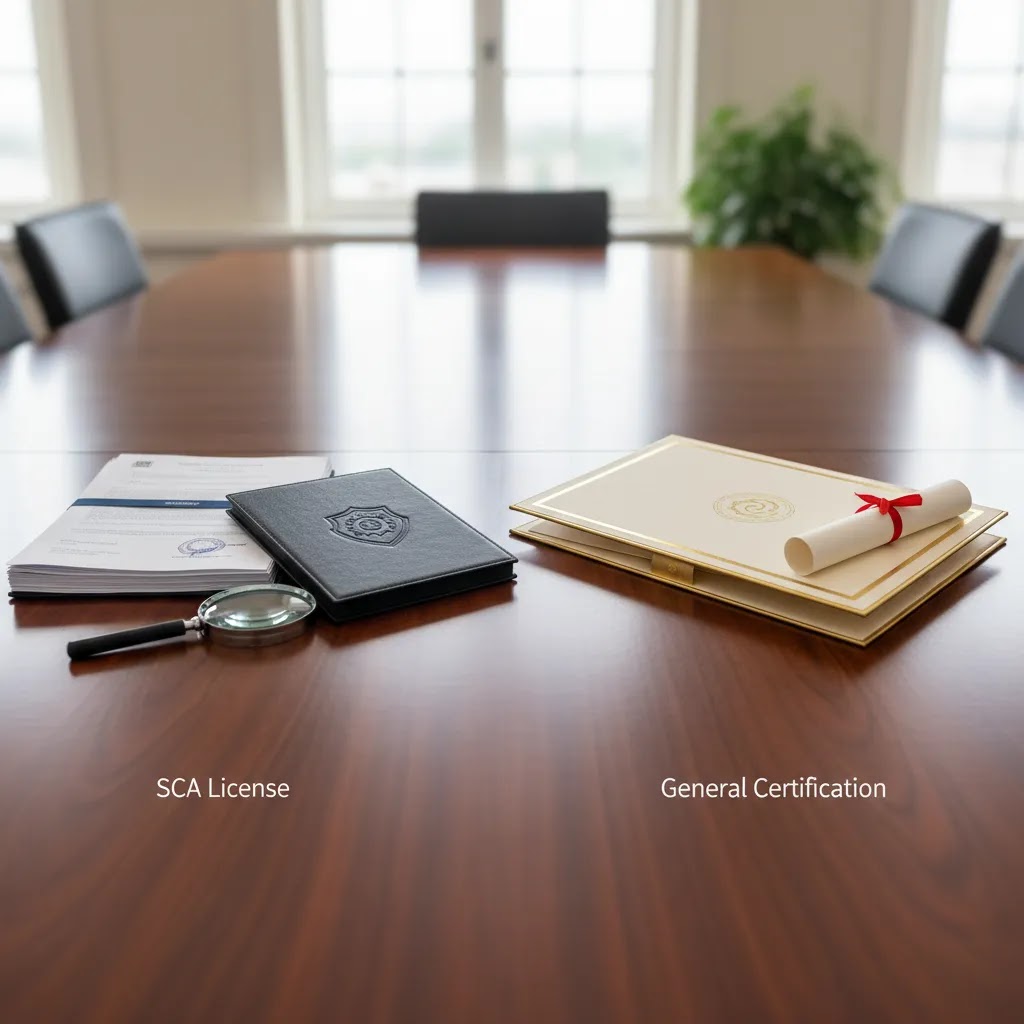
SCA license vs SCA certification, what the terms mean in practice
What many people overlook is that readers often search for “SCA license” and “SCA certification” as if they mean the same thing. In practice, they can refer to different concepts, and mixing them up can lead to false confidence when you are evaluating a broker.
An SCA license typically refers to authorization for a firm to conduct specific regulated financial activities. That matters because licensing is not always a blanket approval for everything a brand markets. A firm may be authorized for certain services, but not necessarily for every product line it advertises online, especially if the brand operates multiple entities in different jurisdictions.
SCA certification is a phrase that is sometimes used more loosely. In some contexts, “certification” language may relate to individual-level accreditation, training, or market-related certification rather than firm-level authorization to offer brokerage services. The practical takeaway is that a “certification” claim does not automatically tell you that the company itself is licensed to take your deposit and provide the service you think you are signing up for.
Consider this: licensing should be activity-specific and consistent with what you are offered in your client agreement. If a broker is promoting trading in leveraged products like CFDs or forex, you want to see clarity on the licensed activity and the entity you are contracting with. If the documentation is vague, or if the regulated activity described does not match the product being sold to you, that is a sign you should slow down and verify more carefully.
There is also a common confusion around which regulator applies. The SCA is the UAE securities regulator for the mainland environment, and it is not the same authority as the DFSA in the DIFC. At the same time, not every UAE-facing broker must be SCA-licensed to be legitimate. Some credible firms serve UAE residents through other recognized frameworks, but you still need to confirm which entity actually holds your account and which rulebook governs your relationship.

Why SCA regulation matters to investors
Readers often search for “sca approved brokers” because they want a simple yes-or-no safety signal. That is understandable, but it is only part of the picture. Regulation matters because it may help you assess whether a broker is operating under recognized rules, discloses its services properly, and can be held accountable by an authority.
For UAE-based investors, this could be especially important if you are comparing local firms with offshore entities that market aggressively online. A licensed firm may be more transparent about client onboarding, product classification, risk warnings, and complaint handling. It may also be easier to confirm the company’s legal presence in the UAE.
SCA oversight may be most relevant when you are assessing:
- Whether a broker or investment firm is authorized to serve clients in the UAE
- Whether product disclosures and trading terms are clearly presented
- Whether investor-facing communications appear compliant rather than misleading
- Whether the firm has a local or regionally accountable structure
This is also where tax and account structure questions come up. If you are opening an investment account, you may want to review how local reporting and tax issues could apply in your case. Our guides on uae trading tax and corporate tax uae may help you separate regulatory status from tax treatment, since they are not the same thing.
SCA complaints and investor recourse in the UAE
The reality is that many people only discover how regulation works when something goes wrong, for example a delayed withdrawal, a dispute over fees, or confusion about the product they were onboarded into. SCA oversight can matter here because it may create clearer expectations for how a regulated firm handles complaints and communicates with clients. Still, it is important to be realistic about what regulation can and cannot do.
In a regulated context, investor protection usually means standards around disclosure, marketing conduct, complaint handling, and supervision of authorized activities. It typically does not mean a guarantee against losses, and it does not mean you are automatically entitled to reimbursement if your trades lose money. Trading outcomes are still driven by market conditions, leverage, and individual decision-making, and past performance does not guarantee future results.
From a practical standpoint, your first step in most disputes should be to escalate within the firm using its formal complaints process. In many cases, this is also what a regulator will expect you to do before taking the issue further. If the issue is not resolved, you may then consider contacting the relevant authority, but which authority is relevant depends on the entity listed on your client agreement and where the service is regulated.
Preparation makes a difference. If you ever need to raise a complaint, try to keep a clean record of what happened, including account statements, deposit and withdrawal confirmations, chat logs or email threads with support, KYC submission messages, and any terms you accepted at signup. If a broker changes its terms or risk disclosures after you have opened the account, saving copies or screenshots of the documents you agreed to can help you explain your case clearly.
Now, when it comes to jurisdiction, do not assume “UAE-based” automatically means SCA is the right authority. If your account is under a DIFC entity, the DFSA framework may be the relevant path. If the broker serves you through an offshore entity, the regulator named on your client agreement could be outside the UAE, such as the FCA, CySEC, or ASIC, even if the brand has a UAE presence or local marketing. This is one reason entity verification is not just a formality, it affects who can supervise the relationship and what dispute channels exist.
Examples of SCA-regulated brokers covered by Business24-7
Based on current Business24-7 platform data, not every major broker available to UAE readers is SCA regulated. Some are regulated instead by authorities such as the DFSA, FCA, ASIC, or CySEC. That is why you should check the specific entity and not rely on broad marketing language.
Two examples in our current broker coverage list specifically reference SCA regulation:
| Broker | Type | Minimum Deposit | Key SCA-Relevant Detail | Other Notes |
|---|---|---|---|---|
| Capital.com | CFD Broker | $20 | Regulation includes SCA | Spread-only pricing, 6,000+ markets, Islamic account available |
| ADSS | Forex/CFD Broker | $100 | Regulation listed as SCA | UAE-headquartered, AED accounts, local support, no deposit/withdrawal fees |
That does not automatically mean these brokers are right for every trader. It means their regulatory status is a meaningful part of the due diligence process. ADSS may appeal to readers who value a UAE-headquartered broker and local support. Capital.com may interest readers looking for a lower $20 minimum deposit and spread-only pricing. Each still needs to be assessed for product fit, costs, and risk.
Many other brokers in our database are regulated by other recognized authorities. For instance, Pepperstone, XTB, Plus500, Interactive Brokers, and Saxo Bank reference DFSA regulation, while some also hold FCA, ASIC, or CySEC licenses. If you are comparing several options, our roundup of forex brokers uae may be a useful next step, along with our broader Broker Reviews section.
Pros and Cons
Strengths
- SCA regulation may give UAE investors a clearer local framework for assessing whether a broker is authorized to provide certain services.
- It may improve accountability, since firms presenting themselves as SCA licensed should have verifiable registration and compliance obligations.
- For readers who prefer dealing with UAE-based or UAE-focused firms, SCA oversight may feel easier to understand than relying only on offshore regulation.
- Some SCA-regulated options in Business24-7 data offer practical advantages beyond regulation, such as ADSS being UAE-headquartered and Capital.com having a low $20 minimum deposit.
- Checking for SCA status may reduce the risk of mistaking aggressive marketing for genuine authorization, especially in high-risk trading categories.
Considerations
- SCA regulation is not a promise of profitability, and it does not remove the risk of losing money when trading leveraged products.
- Not every credible broker serving UAE residents is SCA regulated, since some operate under other recognized frameworks such as the DFSA, FCA, ASIC, or CySEC.
- A broker mentioning the SCA in its marketing is not enough on its own. You still need to confirm the legal entity, offered products, and client terms.
- Regulation says little about whether a broker is cost-effective for your style of trading, so spreads, commissions, inactivity fees, and platform usability still matter.
Who should pay attention to SCA rules
SCA regulation is especially relevant if you are a first-time investor in the UAE, someone comparing local versus offshore brokers, or a cautious trader who wants a clearer regulatory trail before depositing funds. It may also matter more if you prefer AED account options, local support, or a provider with a visible UAE operating presence.
If you are opening your first account, checking licensing should be one of your first steps, not your last. Administrative requirements may also come up during onboarding, so some readers may want to review topics such as nin number uae if identity and account documentation are part of the setup process.
How Business24-7 uses regulation in broker evaluations
At Business24-7, regulation is one of the first filters we use when reviewing a broker, but it is never the only one. Our platform evaluations are written for readers who want a practical answer to a simple question: is this broker appropriately regulated for the market it serves, and are its costs and product terms clearly explained?
This editorial approach reflects the background and safety-first perspective associated with Business24-7, including Braden Chase’s experience as a former research specialist at Forex.com as confirmed in our brand context. In practice, that means we look at regulatory status alongside fees, account minimums, platform access, Islamic account availability, and whether the broker appears suitable for beginner or intermediate traders.
If you are actively comparing providers, it often helps to pair regulation research with a broker-by-broker review. You can explore our detailed platform write-ups, compare fee structures, and use Business24-7 as a reference point before making a final decision. A regulated broker may be a stronger starting point, but the right choice still depends on the products you plan to trade, the costs you may face, and the level of risk you are prepared to accept.

How to evaluate a broker beyond the SCA label
A broker’s regulatory badge matters, but it should be part of a wider checklist. In most cases, a safer decision process includes at least five criteria.
1. Confirm the exact regulator and legal entity
Do not stop at a homepage claim. Check which entity serves UAE clients. A brand may have several regulated entities globally, but your account could be opened under a different jurisdiction than you expect. If the broker cites the SCA, DFSA, FCA, ASIC, or CySEC, the client agreement should usually make that clear.
2. Review fees, not just spreads
Some firms compete on headline spreads but charge elsewhere. For example, product data on Business24-7 shows that ADSS notes competitive spreads and no deposit or withdrawal fees, while Capital.com uses spread-only pricing with no commissions on most instruments. Elsewhere in our database, AvaTrade has an inactivity fee after three months, Pepperstone’s Razor account lists a $7 per lot commission, and Plus500 applies overnight funding fees. These details may matter more than a marketing claim about low costs.
3. Match the platform to your experience level
Beginners may prefer a simpler interface and clearer education. More advanced traders may want MT4, MT5, cTrader, TradingView, or professional desktop tools. A broker can be regulated and still feel unsuitable if the platform is too basic or too complex for your needs.
4. Check product range and account features
If you want stocks and ETFs, your shortlist may look different than if you trade forex or CFDs only. Islamic account availability also matters for many UAE readers. In Business24-7 product data, several brokers offer swap-free accounts, while some multi-asset firms such as Interactive Brokers and Saxo Bank do not.
5. Treat risk controls as essential, not optional
Even under recognized regulation, trading leveraged products can lead to losses. Features such as guaranteed stop-losses, risk management tools, and transparent margin policies may help, but they do not remove risk. For example, Plus500 offers guaranteed stop-loss functionality, and AvaTrade highlights AvaProtect as a risk management feature. These tools may help some users manage exposure, but outcomes still depend on market conditions and user decisions.
The broader lesson is straightforward: use SCA compliance as a screening tool, not as your only decision rule. A careful comparison of regulation, costs, platform design, market access, and support will usually tell you more than a single label on a landing page.
How to verify an SCA-regulated company, and what to document before you deposit
Here’s the thing: if you are trying to stay safe, verification is not just checking for a logo or a sentence that says “regulated.” It is confirming that the legal entity you are signing with matches a real regulatory record, and that the regulated activity aligns with the product you are being offered.
A practical way to approach this is to follow the same flow you would use if you needed to explain your decision later, for example to a bank, a compliance team, or in a dispute.
Step 1: Identify the legal entity, not the brand name
Start with the broker’s legal documentation, typically the client agreement, terms and conditions, or product disclosure. You are looking for the registered company name and where it is established. A trading brand can be a marketing name, and some groups operate multiple entities.
Step 2: Find the specific license or registration reference
If a firm claims SCA regulation, it should normally provide identifying information that can be cross-checked, such as a license number, registered name, or a clear statement of authorization. If the broker only provides vague “regulated in the UAE” language without entity details, treat that as a reason to verify more carefully.
Step 3: Confirm the regulated activity matches what you are being sold
Regulatory authorization is often tied to categories of activity. What you want to avoid is a mismatch where a firm is authorized for one type of service, but the product you are opening is different, or the account is actually placed under an offshore entity with separate terms. If you are being offered leveraged products, pay close attention to risk disclosures, margin terms, and the entity named on your onboarding flow.
Step 4: Check the regulator record for status and naming accuracy
When you check any regulator listing, focus on basics: does the company name match exactly, is the status active, and do the details align with the service you are about to use? If public warnings or enforcement notices are available, those can also be relevant context for your risk assessment.
Step 5: Save documentation before you fund the account
Before you deposit, consider saving copies of key pages and documents, such as the fee schedule, withdrawal policy, risk disclosures, and the client agreement that names the entity. Screenshots or downloaded PDFs may feel unnecessary when everything goes smoothly, but they can be useful if terms change later or if you need to support a complaint.
Think of it this way: your goal is to remove ambiguity. Red flags tend to cluster around unclear entity information, a brand name that does not match the legal entity, missing license references, pressure to deposit before you have documentation, or inconsistent language about where the account is regulated. If you see those patterns, slowing down is usually the safer move.
Frequently Asked Questions
What does SCA stand for in the UAE?
SCA stands for the Securities and Commodities Authority UAE. It is one of the financial regulators relevant to capital markets and securities-related activity in the country. For retail investors, the practical value of the SCA is that it may provide a recognizable regulatory framework when assessing whether a firm is authorized and accountable in the UAE market.
What is the SCA in the UAE?
The SCA is the Securities and Commodities Authority UAE. It is a regulatory authority associated with oversight of securities markets and certain financial activities in the UAE mainland environment. For retail investors, it is most relevant as a reference point for verifying whether a broker or investment firm’s regulatory claims are specific, verifiable, and aligned with the service being offered.
What is an SCA license?
An SCA license generally refers to authorization for a firm to conduct specific regulated activities in the UAE under the SCA framework. In practical terms, the important detail is that licensing is typically activity-specific, so you should confirm that the licensed activity matches the product you are actually opening, and that the legal entity named on your client agreement is the one that holds the authorization.
What is SCA certification in Dubai?
SCA certification is a phrase that can be used in different ways. In many cases, it may refer to certification or accreditation related to individuals, training, or market participation rather than firm-level authorization to provide brokerage services. If your goal is to verify a broker, focus on the regulated legal entity and its authorization to provide the specific financial service, not just broad “certification” language.
Who is the regulator of SCA in the UAE?
The SCA is itself a UAE regulatory authority. For retail investors, the more practical question is usually which authority regulates the specific entity you are signing with, since some UAE-facing firms may be supervised by the SCA, while others operate under the DFSA in the DIFC or under an offshore regulator such as the FCA, CySEC, or ASIC depending on the client agreement entity.
Is an SCA-regulated broker always safer than other brokers?
Not necessarily in every case. SCA regulation may be a positive trust signal, but some credible brokers serving UAE residents are regulated by other recognized authorities such as the DFSA, FCA, ASIC, or CySEC. What matters is verifying the exact entity, understanding the services offered, and reviewing fees, platform terms, and product risk before opening an account.
How can I check if a broker really has an SCA license?
You should look for the broker’s full legal entity name, not just the brand name used in marketing. The broker should state clearly which entity serves UAE clients and what regulation applies. If this information is vague or hard to verify, that may be a warning sign. You should also compare the broker’s regulatory claims with independent review sources before funding an account.
Which brokers in Business24-7 data mention SCA regulation?
Based on the current product data provided to Business24-7, Capital.com and ADSS reference SCA regulation. Capital.com is listed as an SCA-regulated CFD broker with a $20 minimum deposit. ADSS is listed as SCA regulated, UAE-headquartered, and offering AED accounts with local support. Their suitability still depends on your goals, fees, and product preferences.
Does SCA regulation mean my capital is fully protected?
No. Regulation may improve standards of conduct, transparency, and oversight, but it does not remove trading risk or guarantee that you will not lose money. If you trade forex, CFDs, stocks, or crypto-related products, your capital remains at risk. Past performance does not guarantee future results, and leveraged trading can increase losses as well as gains.
How is the SCA different from the DFSA?
They are different UAE regulatory authorities operating in different contexts. The SCA is associated with UAE mainland securities regulation, while the DFSA supervises financial services in the Dubai International Financial Centre. A broker may reference one or the other depending on its structure and client onboarding entity, so you should not assume the two are interchangeable.
Should beginners in the UAE prioritize SCA-regulated brokers?
For many beginners, starting with a clearly regulated broker may be sensible because it gives you a more structured basis for due diligence. Still, beginners should also review minimum deposit levels, fee policies, platform simplicity, educational support, and whether the broker offers features such as Islamic accounts or AED funding. Regulation is a starting point, not the full decision.
Do SCA-regulated brokers offer Islamic accounts?
Some do, but not all brokers structure accounts the same way. In current Business24-7 product data, both ADSS and Capital.com are listed as offering Islamic or swap-free accounts. If this feature matters to you, confirm the exact terms, because swap-free status may come with conditions, product exclusions, or account-specific policies depending on the broker.
Does regulation affect taxes in the UAE?
Regulation and tax are related only indirectly. A broker being regulated by the SCA or DFSA does not automatically determine your tax treatment. Your position may depend on your residency, legal structure, and trading activity. If tax questions are part of your planning, review local guidance carefully and consider independent professional advice where appropriate.
Key Takeaways
- SCA UAE regulation may help you verify whether a broker is authorized and accountable in the local market, but it is not a guarantee against trading losses.
- Current Business24-7 platform data identifies ADSS and Capital.com as examples of brokers that reference SCA regulation.
- Many credible brokers serving UAE clients are regulated instead by other recognized bodies such as the DFSA, FCA, ASIC, or CySEC.
- A strong broker evaluation should combine regulation checks with fee analysis, platform review, asset availability, and account features such as Islamic options.
- Business24-7 is most useful as a pre-decision research resource, especially if you want to compare broker terms before committing capital.
Conclusion
If you are comparing brokers in the UAE, understanding the role of the Securities and Commodities Authority is a practical first step. SCA regulation may help you screen out weaker options and focus on firms with a clearer legal and supervisory footing, but it should not replace broader due diligence. You still need to evaluate fees, product risk, account terms, trading platforms, and support quality before opening an account.
Business24-7 exists to make that process easier for UAE-based readers who want a careful, unbiased reference point. If you are moving from regulation research into broker comparison, explore our broker reviews, compare regulated platforms side by side, and return to our guides whenever you need a clearer view of how a platform fits your goals and risk tolerance.
Disclaimer: The content published on Business24-7 is intended for informational purposes only and does not constitute financial advice, investment recommendations, or an endorsement of any specific platform or financial product. Trading and investing carry significant risk, including the potential loss of capital. You should conduct your own research and, where appropriate, seek independent financial advice before making any investment decisions. Business24-7 does not accept responsibility for any financial losses incurred as a result of information published on this site.
Disclaimer
eToro is a multi-asset platform which offers both investing in stocks and cryptoassets, as well as trading CFDs.
Please note that CFDs are complex instruments and come with a high risk of losing money rapidly due to leverage. 61% of retail investor accounts lose money when trading CFDs with this provider. You should consider whether you understand how CFDs work, and whether you can afford to take the high risk of losing your money
This communication is intended for information and educational purposes only and should not be considered investment advice or investment recommendation. Past performance is not an indication of future results.
Copy Trading does not amount to investment advice. The value of your investments may go up or down. Your capital is at risk.
Crypto assets are complex and carry a high risk of volatility and loss. Trading or investing in crypto assets may not be suitable for all investors. Take 2 mins to learn more
eToro USA LLC does not offer CFDs and makes no representation and assumes no liability as to the accuracy or completeness of the content of this publication, which has been prepared by our partner utilizing publicly available non-entity specific information about eToro.

If you are researching a broker or trading platform in the UAE, understanding sca uae rules may help you avoid one of the most common mistakes retail investors make: funding an account before checking who regulates it. The UAE has more than one financial regulator, and the Securities and Commodities Authority plays an important role in supervising securities markets, licensing…