

Crypto trading in the UAE attracts a wide range of investors, from first-time buyers looking for Bitcoin exposure to active traders comparing fees, regulation, and account options. The challenge is that many readers still struggle to separate legal access from marketing hype. If you are researching crypto trading uae options, it helps to start with the basics: what is permitted, which regulators matter, and whether you want a crypto exchange or a multi-asset broker offering crypto CFDs. That distinction affects costs, custody, and risk. If you are building a broader investing plan, our guide on how to invest uae may help you place crypto in context rather than treating it as a stand-alone decision.
Is Crypto Trading Legal in the UAE?
In broad terms, crypto activity is permitted in parts of the UAE, but the legal and operational framework depends on where the service is offered, what product you are using, and which authority oversees it. Readers often ask, “is crypto legal in uae?” The practical answer is that crypto-related activity may be available through properly supervised channels, but not every platform marketing to UAE residents is regulated in the same way.
In the UAE, financial oversight may involve bodies such as the Securities and Commodities Authority and the Dubai Financial Services Authority, depending on the activity and jurisdiction. Dubai has also become closely associated with virtual asset oversight, which is why many readers search for vara uae. Before opening any account, you should verify whether the company is regulated for the exact service being offered, not just regulated somewhere for something else. Our explainer on sca uae regulation can help you understand why local oversight matters.
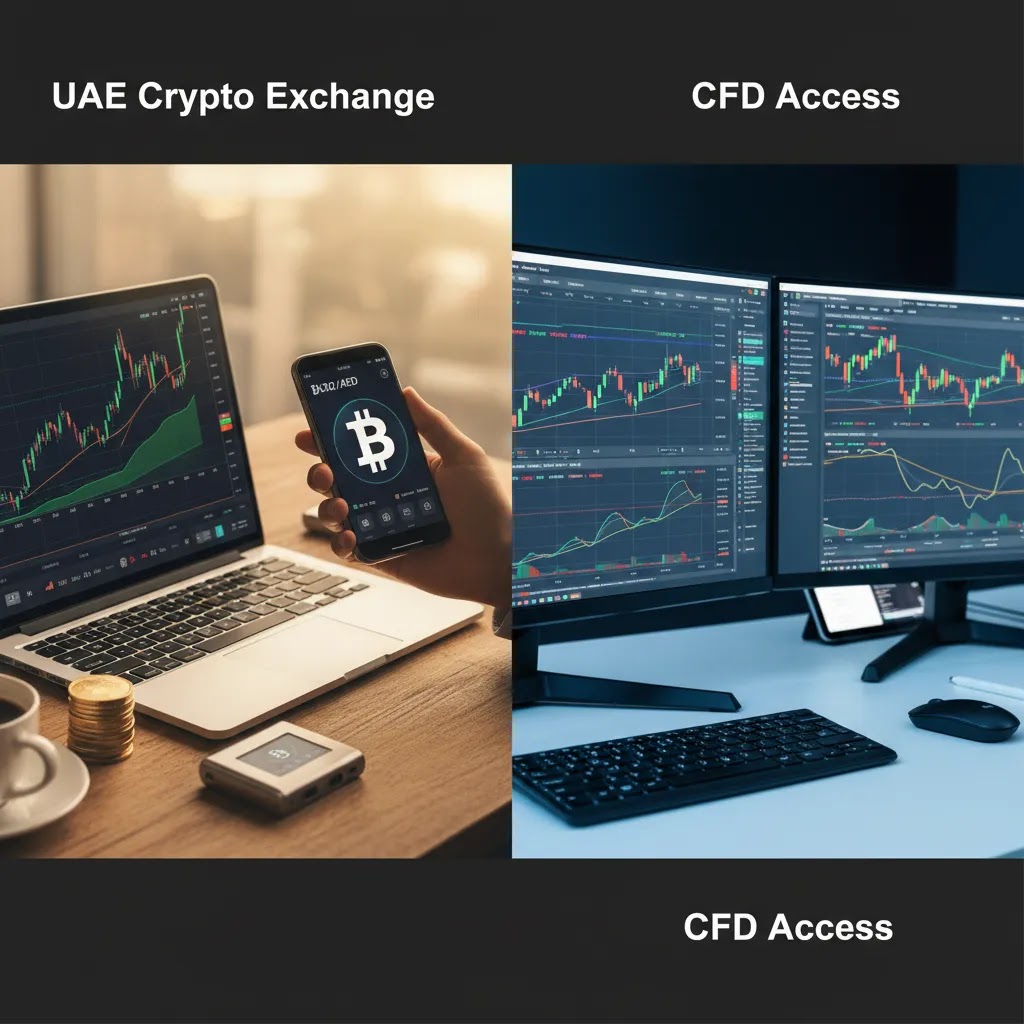
There is also an important difference between buying spot crypto on an exchange and trading crypto CFDs through a broker. With spot crypto, you typically own the asset directly or hold it through platform custody. With CFDs, you are speculating on price movements rather than taking direct ownership. That distinction affects tax considerations, transfer rights, leverage risk, and whether you can move assets off-platform.
Crypto Regulation in the UAE: VARA, ADGM, and Mainland Rules (What Changes by Location)
Here’s the thing about crypto regulation uae research: “the UAE” is not one single rulebook for every crypto activity and every address. The practical experience can change depending on whether the provider is operating in Dubai under VARA, in Abu Dhabi Global Market under the FSRA, or in other parts of the country under different oversight routes. On top of that, some platforms are primarily brokers offering derivatives such as crypto CFDs, where frameworks like the DFSA may be relevant if the entity is based in the DIFC, and the SCA may matter for certain regulated activities and licensing onshore.
For many UAE residents, the confusing part is that a brand can legitimately be “regulated,” but you still need to confirm what is regulated, where, and under which legal entity your account sits. Authorization can be product-specific. A firm may be approved for certain virtual asset activities, while leveraged derivatives, margin products, or CFD-style exposure could fall under different permissions, or be offered by a separate group entity outside the UAE.
What many people overlook is how marketing language can blur these boundaries. A website might highlight a well-known license in one jurisdiction, but your terms and conditions may show you are contracting with a different entity, sometimes in a different country, with a different regulator and different protections. This is one of the reasons “regulated” should be treated as a starting point, not a conclusion.
From a practical standpoint, a basic verification process usually helps you avoid mismatches between what you think you are opening and what you are actually signing up for. Before you deposit, review the platform’s legal entity and disclosures and confirm:
- Which exact company name you are contracting with, not just the brand name on the app.
- Which regulator is listed for that entity, and whether it matches the product you intend to use (spot exchange services versus derivatives such as CFDs).
- Whether a license or registration number is shown in the legal section, and whether it clearly applies to UAE clients, or only to clients in another region.
- Whether the terms specify where the account is governed and how disputes are handled, since this can affect practical recourse if something goes wrong.
This is not about assuming every offshore entity is automatically unsafe, but you should understand the trade-off you are accepting. If a platform cannot clearly explain which entity you are dealing with, which regulator oversees that entity, and which product you are trading, that lack of transparency is a meaningful red flag in crypto.
Your Main Ways to Get Crypto Exposure
For most UAE-based readers, there are three common routes to crypto exposure.
- Spot crypto exchanges: These are typically used when you want to buy crypto in uae and hold the asset itself. This article does not name spot exchanges because no crypto exchange entries were available in the current Business24-7 product dataset.
- Multi-asset brokers with crypto CFDs: These may suit readers who want to trade price movements alongside forex, stocks, indices, or commodities in one account.
- Indirect market exposure: Some readers look for a bitcoin etf or crypto etf. Availability depends on jurisdiction and product access, and not every UAE-accessible broker offers those instruments in the same way.
If your goal is active trading rather than long-term ownership, brokers can be attractive because they often combine charting, risk controls, and other markets in one interface. If your goal is self-custody or on-chain transfers, a traditional broker may not meet that need.

Exchange vs CFD Broker: Custody, Wallet Transfers, and What You Can (and Cannot) Do With Your Crypto
Consider this before you choose between a crypto exchange uae route and a CFD broker route: the difference is not just how you place a trade. It changes what you actually hold, how you can move it, and what risks you are taking.
With spot crypto on an exchange, you are typically buying the underlying asset. In many cases, the exchange holds custody for you inside the platform, and some exchanges allow you to withdraw crypto to an external wallet, which is how on-chain transfers happen. That matters if you care about self-custody, moving coins to a personal wallet, sending crypto to another party, or participating in on-chain activity. Some platforms also offer staking or “earn” programs, but the terms, lockups, and risks differ widely, so you should treat those features as separate products, not automatic add-ons.
With crypto CFDs through a broker, you are not buying the coin itself. You are usually trading a derivative contract that tracks price movements. That can be useful for traders who primarily want to speculate on shorter-term moves or manage exposure alongside other markets. The trade-off is that you typically cannot withdraw crypto to a wallet because you do not have on-chain ownership. Your position exists inside the broker account and is usually closed in cash terms.
Now, when it comes to risk, leveraged crypto CFDs deserve special caution. Leverage can magnify gains and losses, and crypto price moves can be sharp. That means CFD positions can lose value quickly, and in some cases liquidation can occur if margin requirements are not maintained. Brokers may also charge overnight funding when you hold CFD positions beyond the trading day, which is a cost that does not apply in the same way to simply holding spot crypto. Pricing can differ too, since CFD quotes may reflect the broker’s pricing model and liquidity sources rather than the exact spot price on a particular exchange at that moment.
Think of it this way: spot exchange access often fits readers who care about ownership, transfers, and long-term holding, while CFD broker access often fits readers who care about trading tools and multi-asset access, and who understand the specific risks of leveraged derivatives. Neither route removes volatility, and both require you to understand fees, custody setup, and the legal entity behind the account.
Platforms Business24-7 Currently Covers for Crypto-Related Trading
Based on current Business24-7 product data, the site presently covers several brokers that offer crypto exposure through CFDs rather than spot exchange ownership. That means they may suit traders looking for short-term speculation, hedging, or multi-asset access, but they are not the same as a dedicated crypto exchange dubai or crypto exchange uae provider.
Examples include Capital.com, eToro, AvaTrade, Pepperstone, Plus500, XTB, ADSS, Exness, and Saxo Bank. Each has a different strengths profile.
- Capital.com: SCA regulated, $20 minimum deposit, spread-only pricing, and 6,000+ markets. This may appeal to beginners who want low entry costs and a broad product range.
- eToro: Rated 4.5/5 with copy trading, social trading, Smart Portfolios, AED deposits, and Arabic support. It may suit readers who value a simpler interface and community-driven features.
- AvaTrade: ADGM FSRA regulated with a $100 minimum deposit and risk tools such as AvaProtect. It may fit readers who prioritize structured education and platform variety.
- Pepperstone: DFSA regulated in the UAE, no minimum deposit, and very low Razor spreads with a $7 per lot commission. It may suit active traders focused on execution and advanced platforms.
- Plus500: DFSA regulated, beginner-friendly interface, guaranteed stop-loss available, and spread-only pricing. Overnight funding fees still apply.
Because crypto can be highly volatile, platform choice should never be based on marketing alone. Compare product type, local relevance, account costs, and risk controls before deciding how to access cryptocurrency uae markets.
Fees, Spreads, and Trading Costs to Watch
Fees can have a meaningful impact on outcomes, especially for short-term crypto trading. On broker platforms, the main cost may come from spreads, commissions, or overnight funding.
- Capital.com uses spread-only pricing and states no commissions on most instruments.
- eToro notes spreads on CFDs, while real stocks carry 0% commission. That stock pricing does not necessarily apply to crypto-related products.
- Pepperstone offers Razor pricing from 0.0 pips with a $7 per lot commission, or Standard spread-only pricing.
- Exness lists Raw Spread pricing at $3.50 per lot, while Standard accounts are spread-only.
- Plus500 uses spread-only pricing, but overnight funding fees apply.
- AvaTrade lists competitive spreads and an inactivity fee after 3 months.
If you are comparing bitcoin trading uae options, do not focus only on advertised low spreads. Check whether the product is a CFD, whether overnight charges apply, whether conversion costs may appear when funding in AED, and whether withdrawal conditions are clear. For newer investors, a lower headline spread may still lead to higher actual cost if you trade frequently or hold positions for longer periods.
Funding and Withdrawals in the UAE: AED Deposits, Bank Transfers, and Common Friction Points
Fees are not the only cost factor UAE residents run into. Funding and withdrawals are where many people discover friction after they have already opened an account. Even when a platform supports AED deposits, the underlying rails can still introduce costs, delays, or unexpected steps.
One common cost driver is currency conversion. If your account is effectively held in USD or another base currency, an AED deposit may be converted at a rate that includes a spread, and banks or card issuers may apply their own conversion fees. Bank transfers can also involve intermediary bank charges depending on the route, and those fees are not always shown upfront inside the trading app.
Processing time matters too. Cards and local transfer methods can be fast, but bank withdrawals may take longer depending on the provider, compliance checks, and your bank. If you are comparing platforms, think of withdrawal reliability and response time as part of your due diligence, not an afterthought.
Verification is another practical hurdle. Most regulated platforms require KYC checks, and UAE residents are typically asked for proof of identity and proof of address, and in some cases additional source-of-funds details for higher limits. If your profile is incomplete, withdrawals can be delayed, or you may be asked for extra documents after you request a payout. Completing verification early, before you fund heavily, can reduce last-minute issues.
There are also withdrawal-related red flags worth taking seriously. If a platform’s fee schedule is unclear, if support becomes difficult to reach once you request a withdrawal, or if you are pressured to deposit more or “upgrade” in order to access your funds, that is not normal behavior for a transparent provider. In crypto especially, the reality is that poor withdrawal practices can be an early sign that the platform is not operating to an acceptable standard, regardless of how attractive the marketing looks on the front end.
How to Start Crypto Trading in the UAE
If you are starting from scratch, a cautious process usually works better than rushing into the first app you see.
- Decide what you want to do. Are you trying to own crypto directly, or trade price movements through CFDs? This is the first filter.
- Check regulation. Look for relevant oversight such as SCA or DFSA where applicable, and verify the entity behind the account you would actually open.
- Review total costs. Compare spreads, commissions, funding fees, inactivity fees, and any conversion costs.
- Assess risk tools. Stop-loss features, position sizing controls, and educational resources matter more in volatile markets. Our guide to risk management is a useful next step before placing a first trade.
- Start small. Even if a broker offers low minimums such as $10 or $20, it may still make sense to begin with an amount you can afford to lose.
- Keep crypto within a wider portfolio plan. Concentrating too much in one volatile asset class can increase risk, which is why a diversification guide can be helpful.
For readers asking about bitcoin to aed conversions, most platforms will show market pricing inside the app, but rates may differ depending on spread, liquidity, and the exact product being traded.
Pros and Cons
Strengths
- The UAE has a more developed regulatory conversation around digital assets than many markets, which may give readers clearer reference points when evaluating providers.
- Business24-7 currently covers several regulated brokers with crypto CFD access, including firms supervised by SCA, DFSA, FCA, ASIC, CySEC, and ADGM FSRA.
- There are low-entry options for beginners, with minimum deposits as low as $10 at Exness, $20 at Capital.com, and $0 at some brokers such as Pepperstone and XTB.
- Many covered brokers also offer Islamic accounts, AED support, Arabic support, or local UAE relevance, which may make onboarding easier for regional users.
- Multi-asset access can be convenient if you want to trade crypto alongside forex, stocks, ETFs, commodities, or indices rather than opening several accounts.
Considerations
- The current Business24-7 product dataset does not include dedicated spot crypto exchanges, so readers looking for direct coin ownership need to confirm exchange-specific details separately.
- Many platforms covered here offer crypto CFDs, not direct ownership. That may not suit investors who want wallets, transfers, or on-chain use.
- Crypto products can be volatile, and leveraged products may magnify losses as well as gains. Capital is at risk.
- Low minimum deposits do not remove trading risk, and headline spreads do not always reflect full holding or funding costs.
Who Crypto Trading May Suit, and Who Should Be Careful
Crypto trading may suit readers who understand volatility, can tolerate sharp price moves, and want either speculative exposure or a small satellite allocation within a broader portfolio. It may also appeal to active traders who prefer broker platforms with charting, stop tools, and access to multiple asset classes in one place.
It may be less suitable for anyone who needs stable short-term capital, is uncomfortable with rapid losses, or does not yet understand the difference between spot ownership and CFDs. If you are new to investing, it can help to treat crypto as one part of a wider plan rather than the whole plan.
How Business24-7 Can Help You Compare Crypto Options
Business24-7 is designed for readers who want an evidence-based starting point before committing funds. The site’s editorial approach emphasizes clear fee disclosure, regulation checks, product-type differences, and honest trade-offs rather than one-sided platform promotion. That matters in crypto, where readers often face conflicting claims online.
If you are narrowing your options, browse the Investing and Wealth Building section for broader context, and review the UAE Regulation and Tax category for regulation-related reading. Business24-7 may be especially useful if you are deciding between a regulated broker with crypto CFDs and a dedicated crypto exchange, or if you want to compare local relevance, minimum deposits, and fee structure before opening an account.

How to Evaluate Any Crypto Platform Before You Open an Account
A careful evaluation framework can save you from avoidable mistakes. In most cases, these five checks matter more than marketing slogans.
1. Regulation and legal setup
Look at which entity you will contract with and which regulator oversees it. A platform may advertise global licenses, but your account could fall under a different entity. UAE readers should pay close attention to SCA and DFSA relevance where applicable.
2. Product type
Ask whether you are buying spot cryptocurrency or trading a derivative such as a CFD. If you want direct ownership, transfer capability, or long-term custody, a CFD broker may not match your needs. If you want short-term trading tools, a broker may be more practical.
3. Total cost, not just headline spreads
Compare spread, commission, overnight funding, inactivity fees, and conversion costs. A platform with no commission may still be expensive if the spread is wide or holding charges are frequent.
4. Risk controls and usability
Volatile markets make practical tools important. Check whether the app offers stop-losses, guaranteed stop features, watchlists, alerts, mobile access, and a layout you can understand under pressure. Simpler is often better for beginners.
5. Portfolio fit
Do not evaluate crypto in isolation. Consider how much of your total capital you are exposing, whether you are overconcentrated, and whether your time horizon matches the volatility of the product. A platform might be perfectly legitimate yet still be unsuitable for your own risk tolerance or goals.
No single platform will be right for every reader. The best crypto app uae search often leads to generic rankings, but your safer choice usually depends on whether you prioritize direct ownership, lower costs, local regulation, or multi-asset access.
Frequently Asked Questions
Is crypto trading legal in the UAE?
Crypto-related activity may be legal through appropriate channels in the UAE, but the answer depends on the product, jurisdiction, and entity involved. Readers should verify whether the provider is authorized for the service it offers and whether local or relevant international regulation applies. Legal availability does not remove market risk.
What is the difference between a crypto exchange and a broker?
A crypto exchange typically allows you to buy and hold digital assets directly, while a broker may offer crypto CFDs for price speculation without direct ownership. This affects custody, transfer rights, fee structure, and how you manage risk. Many platforms covered by Business24-7 currently fall into the broker category for crypto exposure.
Can I buy Bitcoin in AED?
Some UAE-facing platforms and brokers support AED deposits or local funding options. eToro lists AED deposits, AvaTrade offers AED accounts, and ADSS also supports AED accounts based on current product data. Availability for direct Bitcoin ownership versus CFD exposure still depends on the specific platform and product type.
What regulators matter most for UAE readers?
For UAE-based readers, SCA and DFSA are especially important reference points where relevant. Some providers also operate under international regulators such as the FCA, ASIC, or CySEC. Strong regulation may improve trust, but you should still assess product risk, costs, and whether the specific account entity fits your location.
Is crypto taxed in the UAE?
Tax treatment can depend on your residency, activity type, and any future policy changes. This article does not provide tax advice. If crypto tax uae implications are relevant to you, it is sensible to review current official guidance and seek qualified tax advice where needed before making material transactions.
What is the safest way to start crypto trading?
The safer approach usually starts with verifying regulation, choosing the right product type, understanding fees, and using strict position sizing. Starting small may help limit early mistakes. No approach removes risk entirely, and crypto remains highly volatile. Past market performance does not guarantee future results.
Are low minimum deposit platforms better for beginners?
Not always, but they may reduce the amount of capital exposed while you learn. For example, current product data shows minimums as low as $10 at Exness and $20 at Capital.com. A lower deposit requirement should never replace checks on regulation, fees, platform quality, and your own risk tolerance.
Can I trade crypto on an Islamic account?
Several covered brokers list Islamic or swap-free accounts, including eToro, AvaTrade, Pepperstone, Plus500, XTB, Capital.com, ADSS, and Exness. Whether a specific crypto product is suitable for your requirements may still depend on account terms and your interpretation of Sharia considerations, so extra review may be needed.
Are crypto ETFs available in the UAE?
Some readers search for bitcoin etf or crypto etf access through international brokers. Availability depends on product listing, jurisdiction, and the broker’s market access. Interactive Brokers and Saxo Bank offer broad market access generally, but you should verify specific ETF availability and local eligibility before relying on that route.
Can you trade crypto in the UAE?
In many cases, UAE residents can access crypto-related products through properly offered and appropriately supervised channels, but what you can trade depends on the platform, the entity you sign up under, and whether you are buying spot crypto or trading a derivative such as a CFD. You should confirm the product type and the regulatory setup for your specific account before funding, and remember that crypto markets can be highly volatile.
Is the UAE crypto friendly?
The UAE is often seen as supportive of financial innovation, including virtual assets, but “crypto friendly” should not be confused with “no rules.” The reality is that oversight can vary by jurisdiction and activity, and providers are still expected to meet licensing, compliance, and consumer protection requirements where applicable. For traders, the practical question is whether the specific platform and entity serving you is transparent, authorized for the service offered, and clear about risks and fees.
What is the best crypto trading platform in the UAE?
There is no single best option for every reader. A better way to approach this question is to decide whether you want spot ownership through an exchange or crypto CFDs through a broker, then compare regulation, total costs, funding and withdrawal reliability, and risk tools. Business24-7 currently covers several brokers that offer crypto exposure via CFDs, such as Capital.com, eToro, AvaTrade, Pepperstone, Plus500, XTB, ADSS, Exness, and Saxo Bank, but these are not the same as spot exchanges for direct coin ownership.
Which crypto is legal in the UAE?
In practice, the question is usually less about a universal list of “legal coins” and more about whether a particular asset is offered through a provider that is authorized for the relevant activity, and whether the product is structured and marketed in a compliant way for the user’s jurisdiction. Different platforms may list different assets, and availability can change. If this matters to you, confirm the platform’s authorization status, the product type (spot versus derivatives), and the specific asset listing inside the platform before you assume it is available or appropriate.
Key Takeaways
- Crypto trading in the UAE may be accessible through regulated channels, but the exact legal and practical framework depends on the product and provider.
- Many Business24-7-covered platforms offer crypto CFDs rather than direct spot ownership, so product type should be your first filter.
- Regulation, total fees, risk tools, and AED or UAE-specific support often matter more than headline marketing claims.
- Low minimum deposits can help with accessibility, but they do not reduce the underlying volatility of crypto markets.
- Business24-7 is most useful as a comparison reference point before you decide which route fits your goals and risk tolerance.
Conclusion
Crypto can be accessible in the UAE, but access alone is not the same as suitability. Before you choose a platform, decide whether you want direct coin ownership or broker-based crypto trading, verify the regulatory setup, and review the full cost structure. For many readers, the most important step is slowing down enough to compare options clearly rather than chasing the first platform that appears popular online. Business24-7 aims to make that process easier with plain-English evaluations built for UAE-based investors and traders. If you are still comparing routes, browse our category resources, platform reviews, and regulation-focused guides before making a final decision.
Disclaimer: The content published on Business24-7 is intended for informational purposes only and does not constitute financial advice, investment recommendations, or an endorsement of any specific platform or financial product. Trading and investing carry significant risk, including the potential loss of capital. You should conduct your own research and, where appropriate, seek independent financial advice before making any investment decisions. Business24-7 does not accept responsibility for any financial losses incurred as a result of information published on this site.
Disclaimer
eToro is a multi-asset platform which offers both investing in stocks and cryptoassets, as well as trading CFDs.
Please note that CFDs are complex instruments and come with a high risk of losing money rapidly due to leverage. 61% of retail investor accounts lose money when trading CFDs with this provider. You should consider whether you understand how CFDs work, and whether you can afford to take the high risk of losing your money
This communication is intended for information and educational purposes only and should not be considered investment advice or investment recommendation. Past performance is not an indication of future results.
Copy Trading does not amount to investment advice. The value of your investments may go up or down. Your capital is at risk.
Crypto assets are complex and carry a high risk of volatility and loss. Trading or investing in crypto assets may not be suitable for all investors. Take 2 mins to learn more
eToro USA LLC does not offer CFDs and makes no representation and assumes no liability as to the accuracy or completeness of the content of this publication, which has been prepared by our partner utilizing publicly available non-entity specific information about eToro.

Crypto trading in the UAE attracts a wide range of investors, from first-time buyers looking for Bitcoin exposure to active traders comparing fees, regulation, and account options. The challenge is that many readers still struggle to separate legal access from marketing hype. If you are researching crypto trading uae options, it helps to start with the basics: what is permitted,…