
The atr indicator is one of the simplest tools for understanding how much a market typically moves over a given period. For UAE-based traders comparing forex, indices, commodities, or stocks, that matters because a stop loss placed too close may be hit by normal price noise, while one placed too far may expose more capital than intended. ATR does not predict direction. Instead, it measures volatility, which can make it useful for trade planning, stop placement, and position sizing. If you are building your chart-reading foundation, our technical analysis guide gives broader context on how indicators fit into a disciplined trading process. This article explains atr meaning, how to use average true range, common settings, and where the tool helps most, along with its practical limits.
What the ATR indicator measures
ATR stands for average true range. In plain terms, it shows how much an asset typically moves over a selected number of periods. Traders often use it to judge whether current price movement is relatively quiet or relatively active.
The key point is that ATR measures volatility, not trend direction. A rising ATR may mean price swings are getting larger, but it does not tell you whether the market is likely to move up or down next. That is why many traders combine it with chart structure, trend analysis, or other forex indicators rather than using it alone.
For example, if EUR/USD has an ATR of 0.0080 on a daily chart, that suggests the pair has recently moved about 80 pips per day on average. In most cases, this helps you judge whether your target and stop loss are realistic for that market environment.
ATR may be especially useful for traders who struggle with inconsistent stop placement. Instead of picking an arbitrary number of pips or dollars, you can use current volatility as a reference point. That approach may support better risk management, although it still does not remove the possibility of loss.
How average true range works
The average true range calculation starts with something called the true range. For each candle or bar, true range is the greatest of these three values:
- Current high minus current low
- Absolute value of current high minus previous close
- Absolute value of current low minus previous close
This matters because markets can gap. If you only measured the high-low range of the current candle, you could miss overnight or session-to-session movement. True range tries to capture that more accurately.
ATR then averages those true range values over a chosen period, often 14 candles. A 14-period ATR on a 1-hour chart reflects recent hourly volatility. A 14-period ATR on a daily chart reflects recent daily volatility.
Because ATR is based on historical movement, it is a lagging indicator. It reacts to what has already happened. If volatility expands sharply after a news event, ATR may rise only after several large candles have already formed. That does not make it useless, but it means you should treat it as a context tool rather than a predictive one.
Many charting platforms also allow an ATR calculator or built-in display, so you do not need to compute it manually. What matters more is understanding how the reading changes across assets and timeframes.
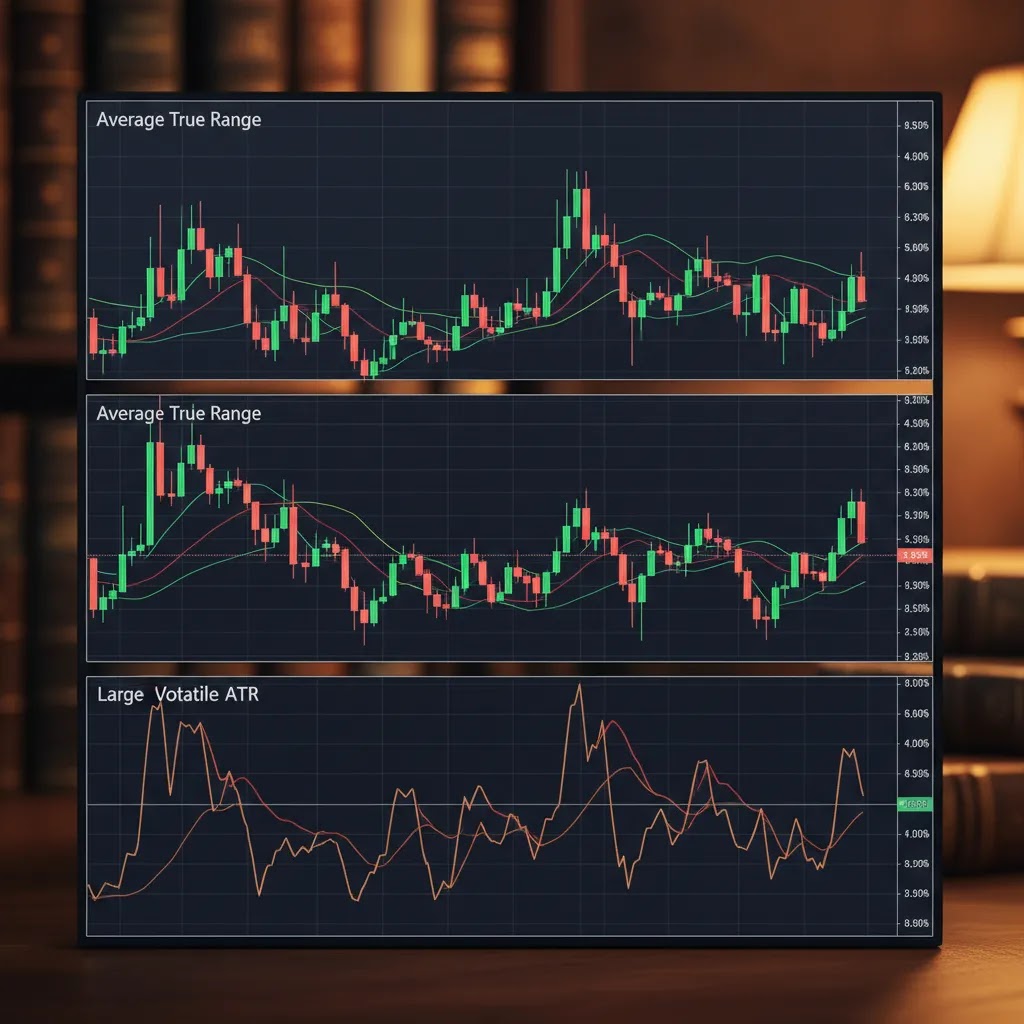
ATR timeframes and period selection (2 to 50)
Here’s the thing: the ATR number only makes sense in relation to two choices you control, the chart timeframe and the ATR period length. Traders sometimes hear “use 14 ATR” as if it is universal, but a 14-period ATR can describe very different behavior depending on whether you are looking at a 5-minute, 1-hour, daily, or weekly chart.
From a practical standpoint, you can think of the ATR period as the “memory” of the indicator. Shorter settings, often in the 2 to 10 range, put more weight on the most recent candles. This may suit very short-term trading where you want ATR to react quickly to a volatility burst, but it can also make the line jumpy. The default 14 is a common baseline because it tends to balance responsiveness and stability across many markets. Longer settings, often around 20 to 50, smooth the line further and may be helpful if you want a broader volatility context for swing trading or position trading.
What many people overlook is that timeframe alignment matters as much as period length. A 14-period ATR on a 15-minute chart measures the typical movement of a 15-minute candle over the last 14 candles. A 14-period ATR on a daily chart measures the typical daily movement over the last 14 sessions. If your holding period is hours, using daily ATR for stop placement might create stops that are wider than your trade concept supports. If your holding period is days, using a very short intraday ATR might understate what the market can do overnight, especially around gaps or major news.
Expanding ATR usually signals a shift into higher volatility conditions. That can happen during trend acceleration, during a breakdown, or during a news-driven spike. The key is that it is still context, not direction. An expanding ATR can warn you that your usual stop distance or position size may no longer match conditions, but it does not validate a long or short bias on its own.
How to use ATR in trading
The most common use of atr trading is stop-loss placement. If a market normally moves 40 pips in a short period, a 10-pip stop may be too tight in many situations. Traders often use a multiple of ATR, such as 1x, 1.5x, or 2x ATR, to place stops outside normal price fluctuation.
This can be especially helpful when working with a stop loss take profit plan. For instance, if your ATR reading is 50 pips and you choose a 1.5 ATR stop, your stop distance would be 75 pips. You can then size the trade so that the dollar amount at risk still fits your rules.
A second use is position sizing. ATR for position sizing helps you adapt trade size to changing volatility. When ATR is high, price swings are larger, so many traders reduce position size. When ATR is lower, some traders may use a slightly larger size while keeping the same percentage risk per trade.
A third use is setting trailing stops. An atr trailing stop may move behind price by a multiple of ATR, widening in volatile markets and tightening in calmer ones. This may keep you in a trend longer than a fixed stop would, although it can also give back more open profit in fast reversals.
ATR day trading can also be useful for setting realistic profit expectations. If an asset has already moved close to its typical intraday range, chasing a late breakout may carry different odds than entering earlier in the session. ATR does not answer every question, but it can improve context.
How to use ATR for take profit and realistic targets
Consider this: ATR can be used for take profit planning in the same way it is used for stops, by translating volatility into a distance that is more likely to be reachable within your chosen timeframe. Traders often express targets as ATR multiples, such as 1x to 3x ATR from entry. The goal is not to force a “perfect” number, it is to sanity-check whether your target matches current conditions.
A simple framework is to start with your stop distance, then compare it to an ATR-based target range. If you are using a 1.5x ATR stop, a 1x ATR take profit may create a risk-reward profile that is not favorable for many strategies. A 2x or 3x ATR target may improve the math, but only if the market structure supports it and the instrument typically moves enough within your holding period. ATR helps you avoid targets that are completely disconnected from the current environment, but it does not guarantee that price will travel that distance.
Think of it this way: on an intraday trade, if the current ATR on your timeframe is small and you set a target that is 5x ATR away, you may be expecting a move that typically requires an exceptional session, not a normal one. On the other side, if volatility is elevated and ATR has expanded, you may need to accept that wider swings are normal and that tighter targets can be hit and reversed quickly. That is where pairing ATR with a clear exit rule, such as scaling out at predefined levels or trailing a portion, can help some traders stay systematic.
Common mistakes show up in two places. The first is setting targets too far relative to ATR, then blaming the strategy when the market simply does not have enough range to reach the level most days. The second is ignoring how news and session changes can distort ATR-based expectations. For UAE-based traders, volatility can shift sharply around major US data releases, central bank decisions, and commodity headlines. When a large spike enters the lookback window, ATR can rise and remain elevated for several candles, which can make both stops and targets look wider than you expected. In those conditions, it may be sensible to treat ATR as a warning that conditions have changed and to reduce exposure or wait for volatility to normalize, depending on your plan.
ATR indicator settings and practical examples
The default ATR setting on many platforms is 14 periods. That is common because it offers a balance between responsiveness and smoothness. Shorter settings, such as 5 or 7, react faster but may be noisier. Longer settings, such as 20 or 21, smooth volatility more but may respond more slowly to changing market conditions.
There is no single best ATR settings choice for every trader. In most cases:
- Day traders may prefer shorter settings for faster feedback.
- Swing traders may use 14 or 20 periods on 4-hour or daily charts.
- Trend traders may combine ATR with market structure and trailing stop rules.
Example 1: ATR stop loss in forex. If GBP/USD shows a daily ATR of 0.0100, that suggests about 100 pips of average daily movement. A stop of 20 pips may be unrealistically tight unless your strategy is built for very short-term entries.
Example 2: ATR for position sizing. Suppose your risk limit is $100 and your stop based on ATR is $2 away from entry on a stock CFD. You could divide your maximum risk by the stop distance to estimate trade size. This is where an ATR calculator can be useful, although the exact formula may vary by asset, contract size, and broker.
Example 3: ATR volatility filter. If ATR is unusually low, some traders avoid breakout setups because the market may be too quiet. If ATR is extremely high, they may widen stops or reduce exposure because conditions could be unstable.
No matter the setting, ATR should be tested within your own strategy. It may improve consistency, but it will not make a weak trading method reliable on its own.
Platforms that offer ATR tools for UAE traders
If you want to apply an atr indicator strategy in live markets, platform quality matters. ATR is widely available on popular trading platforms, but charting depth, order controls, pricing structure, and regulation can differ meaningfully.
Pepperstone, rated 4.5/5 by Business24-7, supports MT4, MT5, cTrader, and TradingView. It offers spreads from 0.0 pips on Razor accounts, with a $7 per lot commission, and is regulated by DFSA, FCA, ASIC, CySEC, and BaFin. For traders who use ATR with detailed charting or active execution, that platform mix may be attractive. Its UAE relevance is strengthened by DFSA regulation and no minimum deposit.
AvaTrade, also rated 4.5/5, supports MT4, MT5, AvaTradeGO, and WebTrader. Spreads start from 0.9 pips, minimum deposit is $100, and regulation includes ADGM FSRA, CBI, ASIC, and FSA Japan. It also offers AvaProtect risk management features and Islamic accounts. That may appeal to newer traders who want ATR alongside educational support, though inactivity fees apply after 3 months.
Capital.com, rated 4.0/5, offers web, mobile, and MT4 platforms, with spreads from 0.6 pips and a low minimum deposit of $20. Regulation includes the UAE SCA, FCA, CySEC, and ASIC. For readers in the UAE who want a lower entry point and mobile-friendly charting, it may be a practical place to test ATR-based planning in a controlled way.
Business24-7 covers these platforms in more detail through its broker resources. You can browse the Technical Analysis section for charting education and the Trading Strategies section for broader trade management concepts before choosing a platform.
Remember that platform tools do not reduce market risk. Regulation by bodies such as the DFSA, SCA, FCA, ASIC, or CySEC may improve oversight, but it does not prevent losses from poor execution, overleveraging, or volatile conditions.
Pros and Cons
Strengths
- ATR is simple to understand once you know it measures volatility rather than direction.
- It may help traders place stop losses based on market conditions instead of arbitrary distances.
- ATR can support position sizing by aligning trade size with current volatility.
- It works across multiple asset classes, including forex, stocks, commodities, and indices.
- ATR trailing stops can adapt to changing market activity better than fixed-distance stops in some cases.
- Most major trading platforms include ATR by default, so it is widely accessible.
Considerations
- ATR does not predict price direction, so it should not be used as a standalone entry signal.
- Because it is based on past price movement, ATR is a lagging indicator.
- Short ATR settings may become noisy, especially in fast intraday markets.
- High ATR readings can lead to wide stops, which may reduce position size significantly.
- Different assets behave differently, so the same ATR multiple may not suit every market or strategy.
ATR profitability expectations and what ATR can (and cannot) validate
A common question is whether ATR is “profitable.” The reality is that ATR is not designed to be profitable on its own because it is not an entry or direction indicator. It is a volatility measurement tool. Used properly, it can support risk control, help standardize stops, and keep position sizing more consistent across different markets and volatility regimes. Those improvements may help some traders reduce preventable mistakes, but they are not the same as having a tested edge.
What ATR can validate is whether your trade plan is proportional to current movement. If your stop is far tighter than the market typically moves, you may be getting stopped out by normal fluctuations. If your target is several multiples of ATR away with no structural reason, you may be expecting an unusually large move. ATR can help you spot those mismatches early, but it cannot tell you whether your setup has positive expectancy.
If you want ATR to be part of a tradable approach, it usually needs to sit alongside a complete framework. In plain terms, that typically includes a clear entry logic (what conditions must exist to enter), a clear exit logic (where you reduce risk or take profit), risk limits (how much you can lose per trade or per day), and some form of testing on your timeframe and market. Without those pieces, ATR can make your charts look more organized while your results remain inconsistent.
Who ATR suits best
The atr indicator may suit beginner and intermediate traders who want a more structured way to think about volatility. It is especially useful for people who place stops too tightly, ignore changing market conditions, or use the same position size in every trade regardless of volatility.
ATR may also fit swing traders and forex traders who need a repeatable framework for stop placement and trade sizing. Day traders can use it as well, but they may need shorter settings and stricter testing. If you prefer highly predictive indicators, ATR may feel limited because its job is measurement, not forecasting.
How to choose a platform for ATR-based trading
If ATR is part of your process, the platform you choose should support more than just basic chart display. In the UAE, it is sensible to judge platforms using a combination of regulation, pricing, usability, and trade management tools.
1. Check regulation first
For UAE-based readers, local or recognized international regulation may be one of the first filters. Platforms in Business24-7’s coverage include oversight from the DFSA, SCA, ADGM FSRA, FCA, ASIC, and CySEC. That may not guarantee a good experience, but it usually matters for conduct standards, client protections, and complaint pathways.
2. Review the real trading cost
ATR-based strategies often depend on disciplined exits, which means costs can add up. Compare spreads, commissions, overnight charges, and inactivity fees. Pepperstone lists spreads from 0.0 pips on Razor with a $7 per lot commission. AvaTrade starts from 0.9 pips and charges an inactivity fee after 3 months. Capital.com uses spread-only pricing on most instruments, with spreads from 0.6 pips. The right choice depends on how frequently you trade and which assets you use.
3. Look at platform and charting depth
If you use ATR for stop placement, trailing logic, or position sizing, platform flexibility matters. MT4, MT5, cTrader, TradingView, and proprietary apps all handle indicators slightly differently. Some traders value simple mobile execution, while others need advanced chart layouts and faster order management.
4. Match the platform to your account size and experience
A low minimum deposit may help newer traders test methods more carefully. Capital.com starts at $20, AvaTrade at $100, and Pepperstone has no minimum deposit. That said, a lower deposit should not encourage overtrading. It is usually better to start small and focus on process rather than trying to force returns.
5. Consider education and support
If you are still learning indicators, educational resources can matter almost as much as pricing. AvaTrade highlights comprehensive education, while some platforms lean more toward experienced traders. A good broker interface may make ATR easier to apply, but your results will still depend on discipline, testing, and risk control.
At Business24-7, the goal is to help you compare these trade-offs without the usual hype. If you are moving from indicator learning into broker evaluation, browse our platform reviews and category resources before opening an account. That extra step may help you avoid choosing a broker that looks attractive at first glance but does not fit your trading style or regulatory comfort level.
Frequently Asked Questions
What is the atr indicator in simple terms?
The atr indicator, or average true range, measures how much an asset typically moves over a chosen number of periods. It tracks volatility rather than direction. Traders often use it to place stop losses, estimate normal price movement, and adjust position size based on changing market conditions.
Is ATR a good indicator for forex trading?
ATR may be useful in atr forex trading because currency pairs often move at different volatility levels across sessions and events. It can help you avoid placing stops too close to normal price movement. Still, it does not tell you whether price is likely to rise or fall, so many traders combine it with trend or structure analysis.
What is the best ATR setting?
There is no universal best atr settings value. Many platforms use 14 by default, which is a reasonable starting point. Shorter settings may react faster but can be noisier. Longer settings may be smoother but slower. The right setting usually depends on your timeframe, asset, and whether you are day trading or swing trading.
How do you know if you should use a shorter ATR setting like 5 or 10?
A shorter ATR setting like 5 or 10 may make sense if you trade very short timeframes and want the indicator to respond quickly to recent volatility changes. The trade-off is that it can become noisier and may overreact to a single spike. Many traders choose the setting by matching the chart timeframe to their holding period, then testing whether ATR-based stops and targets remain stable across different market conditions.
What does an expanding ATR mean?
An expanding ATR usually means volatility is increasing and price swings are getting larger on your chosen timeframe. This can happen during strong trends, sharp reversals, or news-driven moves. It is not a directional signal, but it can be a warning that your usual stop distance, position size, or expectations may need adjustment because the market is moving more than it did recently.
How do traders use ATR for stop loss placement?
Many traders use an atr stop loss by placing the stop a multiple of ATR away from entry, such as 1x or 1.5x ATR. This may place the stop beyond ordinary market noise. The method can improve consistency, but it still needs to be combined with sensible position sizing and overall risk rules.
How do you use ATR for take profit?
One common method is to set a take profit at an ATR multiple from entry, often in the 1x to 3x ATR range, depending on the market and timeframe. Traders may use ATR as a realism check so targets are not far beyond what the instrument typically moves during the expected holding period. Even with ATR-based targets, market structure, liquidity, and news can still prevent price from reaching a level.
Can ATR help with position sizing?
Yes, atr for position sizing is a common use. If ATR suggests a wider stop is needed because volatility is high, traders often reduce trade size to keep their dollar risk steady. When volatility is lower, they may be able to use a slightly larger size while following the same percentage risk rule.
Does ATR work for day trading?
ATR day trading can be useful for judging intraday volatility, setting realistic targets, and avoiding stops that are too tight. Day traders often use shorter ATR settings than swing traders. Even so, fast markets can change quickly, so ATR should be part of a broader plan rather than the only basis for a trade.
What is an ATR trailing stop?
An atr trailing stop is a stop that follows price at a set multiple of ATR. As volatility changes, the stop distance adjusts. This may help traders stay in trends longer than a fixed trailing stop would. The trade-off is that wider stops can sometimes give back more open profit during reversals.
Do all brokers offer ATR on their platforms?
Many major brokers and charting platforms offer ATR, especially those using MT4, MT5, cTrader, TradingView, or established proprietary platforms. Availability is not usually the main issue. Charting quality, execution tools, fees, and regulation may matter more when choosing where to use ATR in live trading.
Is the ATR indicator profitable?
ATR is not a profitability indicator and it does not create an edge by itself. It measures volatility, which traders may use to place stops, set targets, and size positions more consistently. Whether a trading approach is profitable typically depends on the full strategy, including entry logic, exit rules, costs, and risk limits, and results can vary by market and conditions.
Is ATR enough to build a full strategy?
Usually no. An atr indicator strategy may help with volatility measurement, stop placement, and position sizing, but ATR alone does not provide reliable direction or timing. Most traders combine it with trend analysis, support and resistance, price action, or other indicators to create a more complete trading framework.
Key Takeaways
- ATR measures volatility, not direction, so it is most useful for context rather than prediction.
- Many traders use ATR for stop-loss placement, trailing stops, and position sizing.
- The default 14-period setting is a common starting point, but the ideal setup varies by market and timeframe.
- ATR works best when combined with broader risk management and chart analysis.
- For UAE traders, choosing a regulated platform with suitable charting and transparent pricing is just as important as understanding the indicator itself.
Conclusion
The atr indicator remains one of the more practical volatility tools because it helps translate market movement into clearer decisions about stop distance, trade size, and realistic expectations. Its value is not in forecasting price direction. Its value is in helping you respond more systematically to changing conditions. For cautious traders in the UAE, that can be a meaningful improvement over fixed stops and inconsistent sizing. If you are still building your framework, return to Business24-7 to compare regulated brokers, review platform features, and strengthen your chart-reading process. Our educational resources are designed to help you assess tools and platforms with more confidence before you commit capital.
Disclaimer: The content published on Business24-7 is intended for informational purposes only and does not constitute financial advice, investment recommendations, or an endorsement of any specific platform or financial product. Trading and investing carry significant risk, including the potential loss of capital. You should conduct your own research and, where appropriate, seek independent financial advice before making any investment decisions. Business24-7 does not accept responsibility for any financial losses incurred as a result of information published on this site.
Disclaimer
eToro is a multi-asset platform which offers both investing in stocks and cryptoassets, as well as trading CFDs.
Please note that CFDs are complex instruments and come with a high risk of losing money rapidly due to leverage. 61% of retail investor accounts lose money when trading CFDs with this provider. You should consider whether you understand how CFDs work, and whether you can afford to take the high risk of losing your money
This communication is intended for information and educational purposes only and should not be considered investment advice or investment recommendation. Past performance is not an indication of future results.
Copy Trading does not amount to investment advice. The value of your investments may go up or down. Your capital is at risk.
Crypto assets are complex and carry a high risk of volatility and loss. Trading or investing in crypto assets may not be suitable for all investors. Take 2 mins to learn more
eToro USA LLC does not offer CFDs and makes no representation and assumes no liability as to the accuracy or completeness of the content of this publication, which has been prepared by our partner utilizing publicly available non-entity specific information about eToro.

The atr indicator is one of the simplest tools for understanding how much a market typically moves over a given period. For UAE-based traders comparing forex, indices, commodities, or stocks, that matters because a stop loss placed too close may be hit by normal price noise, while one placed too far may expose more capital than intended. ATR does not…