

Breakout trading is popular because it aims to catch price moves as momentum starts building, not after most of the move has already happened. For UAE-based traders, that can sound appealing, but breakout setups also come with a major problem: many apparent breakouts fail quickly and turn into a false breakout. That is why a rules-based approach matters. In this guide, you will learn what breakout trading is, how breakout entry works, how to spot common breakout patterns, and how to reduce fakeout risk with better confirmation. If you want broader context first, our technical analysis guide explains how price structure, momentum, and market context fit together before you apply any breakout trading strategy.
What breakout trading means
Breakout trading is the practice of entering a trade when price moves beyond an important level or pattern boundary. In most cases, traders focus on resistance breaks for potential upside momentum and support breaks for potential downside momentum.
The idea is simple. Markets often spend time moving sideways, compressing into a narrowing pattern, or repeatedly reacting to a visible price level. If price breaks that structure with enough participation, the move may continue as more traders respond to the change in market conditions.
A breakout can happen in stocks, forex, indices, commodities, and crypto. In breakout forex trading, traders often watch session highs and lows, consolidation ranges, and major support or resistance zones. If you are still building your foundation, understanding support and resistance is essential because most breakout setups begin with those levels.
That said, breakout trading is not just about buying above resistance or selling below support. You also need context. A level that has been tested multiple times may matter more. A breakout that occurs during active market hours may carry more weight than one that happens in thin liquidity. Volume, momentum, and retests can help, but none of them guarantee follow-through.
Risk warning: breakout strategies can lead to losses, especially during volatile conditions or when false breakouts are common. Capital is at risk, and past market behavior does not guarantee future outcomes.
Common breakout setups to watch
Most breakout patterns fall into a few broad categories. Learning them helps you identify whether price is expanding from a range, escaping compression, or reacting to a trend continuation setup.
1. Range breakout
A range breakout happens after price trades between a clear ceiling and floor for a period of time. Traders then watch for a decisive move beyond that range. This setup can be effective because many stop orders and momentum entries may cluster around obvious boundaries.
2. Triangle breakout
A triangle breakout forms when price compresses into converging boundaries. This can happen in symmetrical, ascending, or descending triangles. Compression often suggests indecision, and a break may signal that one side has taken control. Our guide to chart patterns can help you distinguish between triangle breakouts and other price formations.
3. Trend line breakout
Trend-based breakouts occur when price breaks a rising or falling structure line that has guided the move. This may point to a weakening trend, a reversal attempt, or a change in momentum. If you use this approach, make sure you understand how traders draw and interpret trend lines, because inconsistent charting can lead to poor signals.
4. Session or news-driven breakout
Some breakouts happen around major economic releases or market opens. Forex traders often monitor London and New York session transitions because volatility may increase at those times. These setups can move fast, but slippage and whipsaws may also increase.

How to plan a breakout entry
A breakout entry should be based on rules, not emotion. Chasing a fast candle without a plan can lead to poor pricing and inconsistent results.
Many traders use one of these approaches:
- Immediate break entry: Enter as price moves through the level. This may capture momentum early, but it can expose you to more fakeouts.
- Close confirmation entry: Wait for the candle to close beyond the level. This can reduce noise, though it may mean entering later.
- Retest entry: Wait for price to break, pull back, and retest the old level. This often offers a clearer structure for stop-loss placement, but retests do not always happen.
Your stop-loss placement matters just as much as the entry. In most cases, traders place stops below the broken resistance in bullish setups or above the broken support in bearish setups. Others use recent swing highs or lows, or an ATR-based method to account for volatility.
A practical breakout trading strategy usually includes:
- A clearly defined level or pattern boundary
- A confirmation rule such as candle close, momentum, or retest
- A stop-loss rule based on structure or volatility
- A target method, such as measured move, prior swing, or fixed risk-reward ratio
- A filter for time of day or major events
No breakout indicator should be treated as a stand-alone signal. Indicators may support the setup, but price structure remains the core decision point.
Breakout vs fakeout: how to reduce false signals
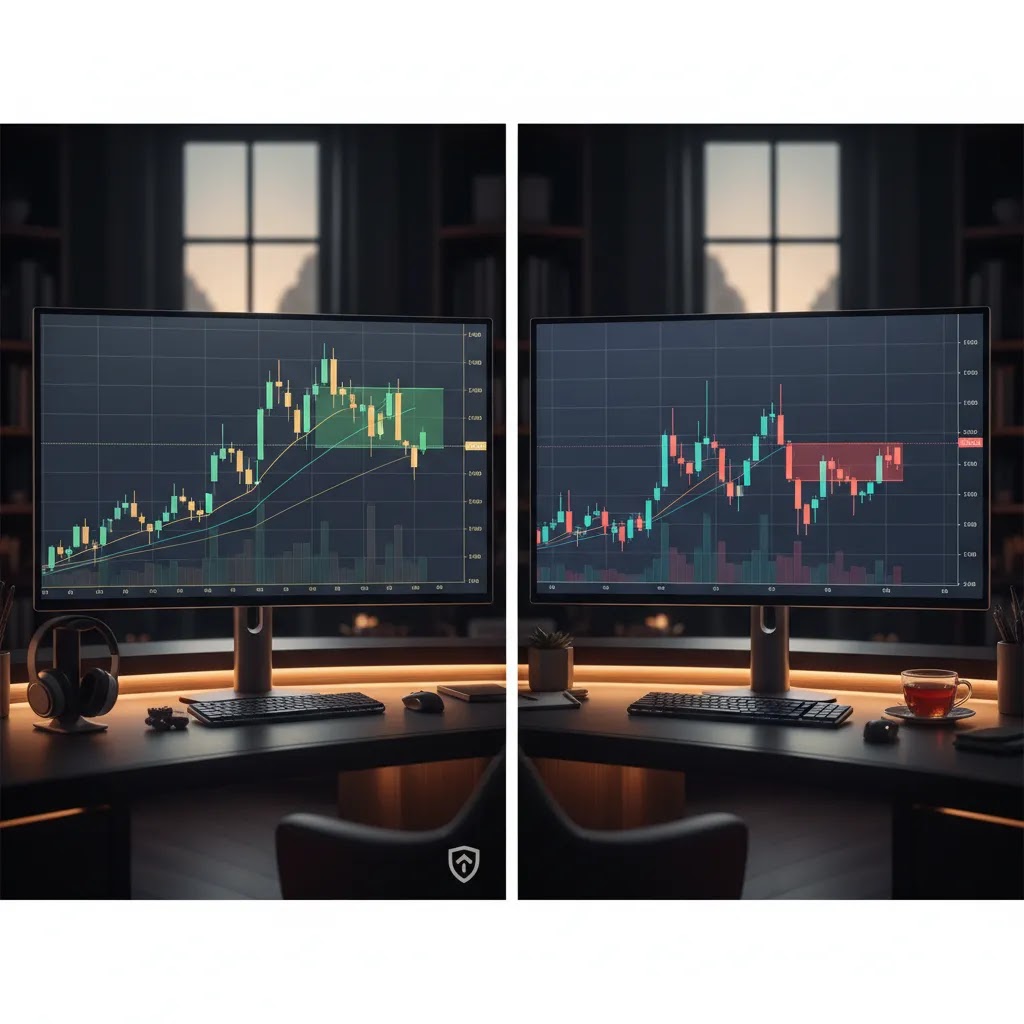
The biggest challenge in breakout trading is the false breakout, sometimes called a fakeout. This happens when price briefly moves beyond a key level, attracts breakout traders, and then reverses back into the prior range or pattern.
False breakouts are common because markets often test liquidity around obvious levels. That does not mean breakout trading fails as a concept. It means your filters need to be realistic.
Ways traders may try to reduce fakeout risk include:
- Waiting for a candle close beyond the level rather than reacting to an intrabar spike
- Looking for higher volume or stronger momentum where that data is available
- Avoiding low-liquidity hours that may produce erratic movement
- Requiring a retest and hold before entry
- Checking whether the breakout aligns with the broader market trend
Even with filters, some valid-looking breakouts will fail. That is normal. The goal is not to avoid every losing trade. The goal is to manage risk so one failed breakout does not do outsized damage to your account.
If you are reviewing this strategy as part of a broader learning path, Business24-7 organizes educational material in its Technical Analysis section, which can help you connect breakout logic with wider chart-reading skills.
Why breakouts fail (and what that tells you)
Here is the thing about breakouts: the level you are watching is usually obvious to many other traders. That is why it matters, and it is also why price often behaves in a way that feels frustrating. A failed breakout is not always a random mistake. In many cases, it is how markets test where real buying or selling interest exists.
One common mechanic is a liquidity grab around a clear support or resistance zone. Think of it this way: when many traders place stop-loss orders just beyond an obvious level, that area becomes a pool of orders. Price can push through, trigger those orders, and then reverse once the immediate buying or selling pressure is used up. On a chart, this often appears as a quick break and reverse behavior, sometimes with a long wick.
Another reason breakouts fail is participation. A breakout that happens when fewer participants are active can be easier to fade. In forex, for example, a small push beyond a level during thin hours can look like a clean signal, but the follow-through may not be there when liquidity is low and order books are thinner. The same idea can apply in other markets when volume drops or when the move is driven by a small group of traders rather than broad interest.
Trend context also matters. Many false breakouts happen when traders try to force a reversal breakout against the prevailing trend, especially after a strong directional move. A countertrend breakout can work, but it typically needs stronger evidence than a simple level break. When the broader trend remains intact, breakouts in the opposite direction may turn into traps as trend participants use the move to re-enter at better prices.
Confirmation rules, like waiting for a candle close or requiring a retest, can improve probabilities, but they never guarantee follow-through. The reality is that no filter removes uncertainty. Your main defense is still risk control: position sizing, consistent stop placement, and accepting that some breakouts will fail even when your process is solid.

Stop-loss and profit target frameworks for breakout trades
Once you have an entry model, your next job is to make the trade measurable. From a practical standpoint, that comes down to two decisions: where you admit the breakout failed, and how you define a reasonable profit target without guessing.
Stop-loss placement: structure vs volatility
A common approach is the structural stop. In a bullish breakout, that usually means placing the stop on the other side of the breakout level, with enough room that a small retest does not stop you out immediately. For example, if price breaks above resistance, a structural stop may go below that prior resistance zone once it is treated as support. This method fits traders who rely on clean levels and retests because the stop logic is simple: if price is back below the level and holds there, the breakout premise may no longer be valid.
A second approach is a volatility-based stop, often using ATR. The idea is to size the stop to current market movement rather than a single line on the chart. In higher-volatility conditions, breakouts may need more room to breathe. In lower-volatility conditions, a tighter stop may be more realistic. This can be useful when levels are less clean, when you are trading faster session moves, or when you want a consistent framework across different markets. The tradeoff is that ATR-based stops can sometimes be wider than you expect, which affects position sizing and risk.
Neither method is automatically better. What many people overlook is that your stop method and your entry method should match. If you only enter on a retest and hold, a structural stop often aligns naturally. If you enter on momentum and expect noise, volatility-based logic may be more consistent, as long as you control risk per trade.
Profit targets: measured moves, structure, and risk-reward
For targets, measured moves can give you a clear, repeatable model. In a range breakout, traders often project the height of the range from the breakout point as a possible target area. In a triangle breakout, some traders use the widest part of the triangle as a reference for a potential move, while others use prior swing structure as more conservative targets. These methods do not predict the future. They give you a structured way to avoid holding forever or exiting randomly.
Structure-based targets are another common framework. Instead of projecting a distance, you identify the next major supply or demand zone, such as a prior swing high in a bullish breakout or a prior swing low in a bearish breakout. This fits well when the market has clear historical levels. It can also help you avoid targeting directly into nearby resistance where price may stall.
Risk-reward planning ties it together. Many traders set a minimum risk-reward requirement, such as looking for a setup where the first target is at least 1R or 2R relative to the stop distance. The exact number varies by strategy and market conditions, but the core concept is consistency. A breakout system can still have losing trades, so your winners typically need to pay for your losers over a series of trades.
Trade management: optional tools, not a requirement
Some breakout traders manage positions with rules like partial exits, moving the stop to break-even after price reaches a certain distance, or trailing a stop behind swing structure. These can reduce the emotional pressure of holding a winner, but they can also reduce your average win size if you apply them too aggressively. If you use management rules, it usually helps to keep them simple and test them over enough trades to avoid over-optimizing based on a short sample.
Whatever framework you choose, keep the focus on survivability. Breakout trading can be volatile, and even well-planned trades can fail quickly. Defining your stop and target before entry helps you avoid making those decisions in the middle of a fast move.
Platforms that may suit breakout traders
Your strategy matters, but execution conditions matter too. Breakout traders usually care about spread stability, platform speed, charting quality, and regulatory standing. For UAE readers, regulation under bodies such as the DFSA or SCA may be especially relevant when evaluating broker safety, while international oversight from the FCA, ASIC, or CySEC may add another layer of accountability depending on the broker entity.
Based on Business24-7 product data, a few examples stand out for breakout-focused traders:
- Pepperstone has a 4.5/5 rating, no minimum deposit, Razor spreads from 0.0 pips, and platform access through MT4, MT5, cTrader, and TradingView. It is regulated by the DFSA, FCA, ASIC, CySEC, and BaFin. Razor pricing includes a $7 per lot commission.
- XTB has a 4.0/5 rating, no minimum deposit, spreads from 0.1 pips, and access to xStation 5 and mobile trading. It is regulated by the DFSA, FCA, CySEC, and KNF, with strong educational support.
- Capital.com has a 4.0/5 rating, a low $20 minimum deposit, spreads from 0.6 pips, TradingView integration, and SCA regulation in the UAE, alongside FCA, CySEC, and ASIC regulation.
- AvaTrade has a 4.5/5 rating, a $100 minimum deposit, spreads from 0.9 pips, MT4, MT5, and WebTrader support, plus ADGM FSRA regulation and AED account availability.
No platform is ideal for every breakout trader. A beginner may prioritize education and simple execution. A more active trader may care more about low spreads and charting flexibility. If you are comparing broker features before applying any strategy, browse Business24-7’s Trading Platforms and Brokers resources and broker reviews to check fees, regulation, and platform differences in more detail.
Pros and Cons
Strengths
- Breakout trading offers a clear, rule-based structure centered on visible price levels and patterns.
- It can work across multiple markets, including breakout forex, indices, stocks, and commodities.
- Entry, stop-loss, and target planning are usually easier to define than in more discretionary strategies.
- It may help traders participate in momentum moves earlier rather than reacting after a trend is already extended.
- Breakout setups can be combined with support and resistance, trend analysis, and chart pattern confirmation.
Considerations
- False breakout setups are common, especially around obvious levels and during thin liquidity.
- Fast-moving breakouts may involve slippage or poor fills, which can materially affect results.
- Waiting for confirmation may reduce fakeouts but can also lead to later entries and wider stop distances.
- News-driven breakouts can be highly volatile and may not suit inexperienced traders.
- No breakout indicator or entry method can reliably eliminate losses.
Breakout trading expectations: what is realistic and what is not
Many people researching breakout trading eventually ask a version of the same question: can you make $200 a day, or even $1000 a day, day trading breakouts? The honest answer is that daily profit targets are not a reliable way to think about trading results. Markets do not pay on a schedule, and breakout opportunities vary based on volatility, trend conditions, and news flow.
Even experienced traders may go through periods where clean breakouts are rare, or where conditions favor mean reversion instead. On other days, volatility can be high but unpredictable, with more slippage and more false breakouts. If you try to force a fixed daily income target, it can push you toward overtrading, taking marginal setups, or increasing size to make the numbers work. That is usually where risk escalates.
Consider this: a breakout strategy is typically judged over a series of trades, not one day. A realistic way to measure progress is to focus on process metrics you can control, such as whether you followed your entry rules, whether your stops were placed consistently, and whether your average outcome per trade makes sense relative to your risk. Some traders track performance in R multiples, meaning results measured as a multiple of the amount risked on each trade. That can be a clearer way to see whether your approach is improving without anchoring to a daily dollar amount.
For UAE-based traders, leverage is an extra piece of the expectation problem. Many leveraged products can amplify both gains and losses, and aggressive targets combined with high leverage can lead to rapid drawdowns. The point is not that breakout trading cannot work. The point is that survivability comes first. A strategy can only be evaluated if you keep risk controlled enough to stay in the game through losing streaks and changing market conditions.
Breakout trading can be a structured approach, but it is still trading. Outcomes are uncertain, drawdowns are possible, and past performance does not guarantee future results. If you set expectations around discipline and repeatability rather than daily profit targets, you are usually thinking about the problem in a healthier, more sustainable way.
How to choose a trading platform for breakout trading
If you plan to trade breakouts, platform selection should be practical rather than brand-driven. A flashy interface matters far less than execution, transparency, and regulation.
1. Check regulation first
For UAE-based readers, regulation under the DFSA, SCA, or ADGM FSRA may be an important starting point, depending on the broker entity and offering. International oversight from regulators such as the FCA, ASIC, or CySEC may also strengthen trust, but you should still verify which legal entity will hold your account.
2. Review spreads and commissions
Breakout trading is sensitive to trading costs because you are often entering during expansion. Wide spreads can make marginal setups much harder to manage. Compare whether the broker uses spread-only pricing or a low-spread plus commission model. For example, Pepperstone lists Razor spreads from 0.0 pips with a $7 per lot commission, while Capital.com uses spread-only pricing from 0.6 pips on most instruments.
3. Compare charting and execution tools
Some traders prefer MT4 or MT5 for familiarity. Others may prefer cTrader, TradingView integration, or proprietary platforms like xStation 5. Your platform should let you mark breakout zones quickly, monitor multiple markets, and place orders without unnecessary friction.
4. Match the platform to your experience level
Beginner traders may benefit from simpler interfaces and better educational support. More advanced traders may want tighter pricing and deeper charting options. A platform with excellent tools is not automatically the right fit if its workflow feels too complex for your current level.
5. Look at funding, support, and account features
Small details matter. UAE-friendly touches such as AED deposits, Arabic support, or Islamic accounts may improve the experience depending on your needs. Some traders may also prioritize low minimum deposits. For example, Capital.com starts at $20, AvaTrade at $100, while Pepperstone and XTB list $0 minimum deposits based on available Business24-7 data.
Business24-7 approaches these comparisons with an educational, safety-first lens shaped by Braden Chase’s background as a former research specialist at Forex.com. If you are moving from strategy research into broker evaluation, it may help to explore the site’s broker comparison guides and individual reviews before opening an account.
Frequently Asked Questions
What is breakout trading in simple terms?
Breakout trading means entering a trade when price moves beyond a well-defined support, resistance, range, or pattern boundary. The idea is that a move outside that structure may lead to stronger momentum. It can be useful, but it also carries risk because many apparent breakouts fail and reverse quickly.
What is a breakout in trading?
A breakout in trading is when price moves beyond a key level on the chart, such as support, resistance, or the boundary of a pattern like a range or triangle. Traders watch breakouts because they may signal a shift in supply and demand. Still, breakouts can fail, so confirmation rules and risk control are important.
What is a false breakout?
A false breakout happens when price briefly pushes beyond an important level and then moves back inside the prior range or pattern. This can trap traders who entered too early. Waiting for a candle close, a retest, or stronger momentum confirmation may help reduce false signals, though it will not eliminate them completely.
Is breakout trading good for beginners?
It can be approachable because the setup is visually clear and rule-based. Still, beginners often underestimate how common fakeouts are. If you are new, it may be wise to practice on a demo account first, use modest position sizing, and focus on simple support resistance breakout setups before trying faster news-driven moves.
Is breakout trading a good strategy?
It can be a workable strategy for traders who prefer clear rules built around support, resistance, and chart patterns. Its main challenge is the false breakout, which means you typically need realistic confirmation filters and consistent stop-loss rules. Whether it is a good fit depends on your market, trading hours, and how well you control risk, since no strategy performs well in every condition.
Which markets are commonly used for breakout trading?
Breakout trading is used in forex, stocks, indices, commodities, and crypto. Breakout forex setups are especially popular around session opens and economic events. The market you choose should match your risk tolerance, trading hours, and platform costs, since spread changes and volatility can affect breakout entries significantly.
What is the best breakout strategy?
There is no single best breakout strategy for every trader or market. In most cases, a workable approach includes a clear level, a confirmation rule, disciplined stop-loss placement, and realistic profit targets. What performs acceptably in one market condition may underperform in another, so testing and risk control remain important.
What indicators are useful for breakout trading?
Many traders use ATR, moving averages, RSI, or volume-based tools to support breakout decisions. These may help you judge volatility, momentum, or trend alignment. Still, no breakout indicator should replace direct analysis of price structure. Indicators are usually most effective when they confirm a well-defined chart setup rather than create one on their own.
How do I avoid fakeouts in breakout trading?
You may reduce fakeouts by waiting for candle closes, trading during active market sessions, requiring retests, and avoiding low-quality levels with little market history. It may also help to align trades with the broader trend. Even then, some failed breakouts are unavoidable, so risk management should remain your main defense.
Is it possible to make $200 a day day trading?
It is possible for some traders in some market conditions, but it is not consistent or guaranteed, and focusing on a fixed daily number can encourage overtrading. Day trading results vary widely based on volatility, costs, slippage, and risk per trade. A more realistic approach is to measure whether you followed your process, controlled losses, and maintained consistent risk over a large sample of trades.
Can you make $1000 a day with day trading?
Some traders may have days where they make that amount, but targeting $1000 a day is not a reliable or stable expectation for most retail traders. Large daily targets can push you toward taking oversized risk, especially if you use leverage. In practice, traders often focus on long-term performance, drawdown control, and repeatable execution rather than daily income goals.
Which broker features matter most for breakout traders in the UAE?
Regulation, spreads, platform speed, charting tools, and account transparency usually matter most. UAE-based traders may also value DFSA, SCA, or ADGM FSRA oversight where applicable, along with AED account support or Islamic account availability. Compare the exact legal entity, fee model, and platform tools before making any decision.
Do breakout trades always need a retest?
No. Some strong breakouts continue without offering a clean pullback. A retest can improve trade structure and help with stop placement, but insisting on one may cause you to miss some valid moves. The key is consistency. Use one entry model and test it rather than switching rules based on emotion.
Key Takeaways
- Breakout trading focuses on price moves beyond key levels, ranges, or pattern boundaries.
- False breakouts are common, so confirmation rules and stop-loss discipline are essential.
- Range breakout, triangle breakout, and trend line breakout setups are among the most widely used.
- For UAE traders, broker regulation, spreads, and charting tools may matter as much as the strategy itself.
- Business24-7 can help you move from strategy research to safer broker evaluation with UAE-relevant comparison resources.
Conclusion
Breakout trading can be a practical strategy if you prefer structured entries and clear price-based decision points. The opportunity is straightforward, but the difficulty is real: many breakouts fail, and execution quality can have a meaningful effect on results. That is why it helps to treat breakout trading as a process built on level selection, confirmation, risk control, and platform fit. If you are now comparing brokers that may support this style of trading, Business24-7 offers UAE-focused educational resources, broker reviews, and platform comparisons designed to help you evaluate costs, regulation, and usability more carefully before committing capital. Use those resources as a reference point while you build a method that suits your experience level and risk tolerance.
Disclaimer: The content published on Business24-7 is intended for informational purposes only and does not constitute financial advice, investment recommendations, or an endorsement of any specific platform or financial product. Trading and investing carry significant risk, including the potential loss of capital. You should conduct your own research and, where appropriate, seek independent financial advice before making any investment decisions. Business24-7 does not accept responsibility for any financial losses incurred as a result of information published on this site.
Disclaimer
eToro is a multi-asset platform which offers both investing in stocks and cryptoassets, as well as trading CFDs.
Please note that CFDs are complex instruments and come with a high risk of losing money rapidly due to leverage. 61% of retail investor accounts lose money when trading CFDs with this provider. You should consider whether you understand how CFDs work, and whether you can afford to take the high risk of losing your money
This communication is intended for information and educational purposes only and should not be considered investment advice or investment recommendation. Past performance is not an indication of future results.
Copy Trading does not amount to investment advice. The value of your investments may go up or down. Your capital is at risk.
Crypto assets are complex and carry a high risk of volatility and loss. Trading or investing in crypto assets may not be suitable for all investors. Take 2 mins to learn more
eToro USA LLC does not offer CFDs and makes no representation and assumes no liability as to the accuracy or completeness of the content of this publication, which has been prepared by our partner utilizing publicly available non-entity specific information about eToro.

Breakout trading is popular because it aims to catch price moves as momentum starts building, not after most of the move has already happened. For UAE-based traders, that can sound appealing, but breakout setups also come with a major problem: many apparent breakouts fail quickly and turn into a false breakout. That is why a rules-based approach matters. In this…