

If you trade breakouts, continuation patterns may help you read whether a trend is pausing or potentially losing momentum. That matters even more if you are trading from the UAE, where many retail traders use leveraged CFD platforms and need a disciplined way to plan entries, stop-losses, and position size. In flag pattern trading, the goal is not to predict every move. It is to recognize a structured pause after a strong price swing, then assess whether the trend may continue. This article explains flag, triangle, and wedge formations in plain language, shows how they differ, and highlights the risks of false breakouts. If you want broader context first, start with our technical analysis guide, which covers the chart-reading basics behind these setups.
What continuation patterns are trying to show you
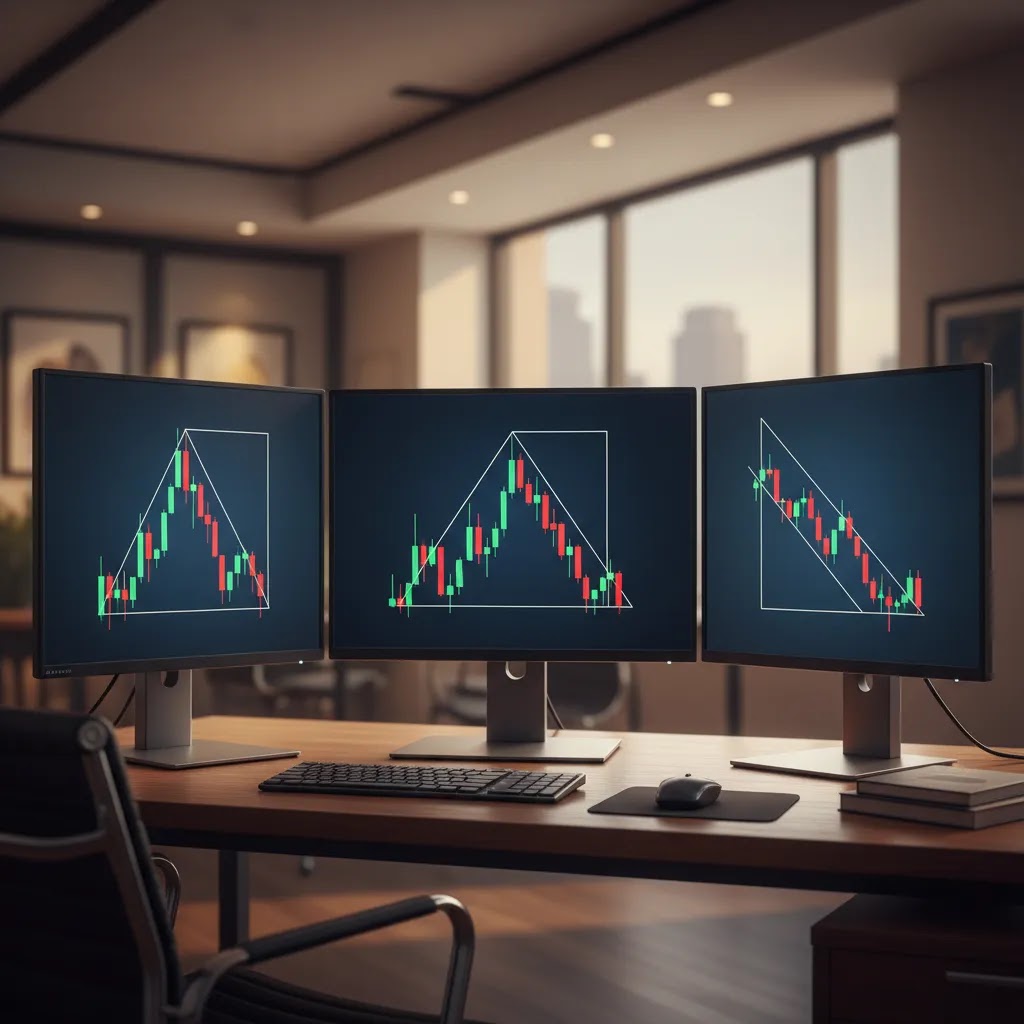
Continuation patterns appear when price pauses after a strong move but has not yet clearly reversed. In most cases, traders read them as areas of consolidation where buying and selling pressure temporarily balance out before one side takes control again.
A flag pattern, triangle pattern, or wedge pattern does not guarantee continuation. It only suggests a structure that may lead to a breakout if volume, momentum, and broader trend conditions align. That distinction matters because many beginners treat chart formations as signals on their own, when they are usually more useful as part of a wider process.
For example, a bull flag often forms after a sharp move upward, followed by a mild pullback in a narrow channel. A bear flag is the opposite, appearing after a sharp decline and then a modest upward correction. Triangles and wedges can also act as continuation patterns, but their shape and breakout behavior are slightly different.
If you are building pattern recognition skills, it may help to review a broader library of chart patterns so you can distinguish continuation setups from reversal structures.
How flag patterns work
In flag pattern trading, the structure usually has two parts. First comes the flagpole, which is the sharp directional move. Second comes the flag itself, which is a short consolidation that typically slopes slightly against the prior trend.
Bull flag
A bull flag forms after a strong upward move. Price then drifts lower or sideways inside a small downward-sloping channel. Traders often watch for a breakout above the upper boundary, especially when the larger trend remains bullish.
The idea is simple. Buyers may be taking profits, but they are not giving back much ground. If the pause remains controlled and price breaks higher, some traders see that as evidence that demand is still present.
Bear flag
A bear flag forms after a strong downward move. Price then rebounds slightly in a narrow rising channel. A break below the lower boundary may signal that sellers are regaining control.
Bear flags can be useful in weak markets, but they also carry risk. Short-lived rebounds can turn into deeper recoveries, especially around major support levels or during news-driven volatility.
What traders usually check before acting
- A clear and strong move before the flag forms
- A relatively short consolidation rather than a long, messy range
- Trend lines that contain the pause cleanly
- A breakout with enough momentum to avoid immediate failure
- Logical stop placement below or above the pattern structure
Because entries are often based on price escaping consolidation, many traders connect flag analysis with breakout trading principles such as confirmation candles, retests, and false-breakout filtering.

How to set entries, stops, and targets for flag patterns
Here’s the thing about flag pattern trading. Spotting the pattern is only the first step. The bigger challenge is turning it into a repeatable execution plan that accounts for false breakouts, spread, and normal price noise. Trading involves risk, especially with leveraged products, so it helps to think in terms of scenarios rather than certainties.
Common entry approaches and when they may help
Most flag entries fall into three categories, and each one tends to trade off between early entry and higher confirmation.
- Breakout entry: entering as price breaks the flag boundary. This can capture more of the move if the breakout runs quickly, but it can also expose you to more fakeouts where price pokes through the line and snaps back.
- Close-confirmation entry: waiting for a candle to close beyond the flag boundary. From a practical standpoint, this may filter out some shallow wicks, but it can also mean a worse price and a wider stop if the breakout candle is large.
- Retest entry: waiting for price to break out, then pull back to test the broken boundary before entering. This approach may reduce some false breakout risk, but it is not guaranteed, because strong breakouts do not always retest, and retests can also fail.
Consider this. A clean bull flag in a strong uptrend may break and go without looking back, which can favor earlier entries. A choppy market, or a flag sitting near major support or resistance, may benefit from confirmation or retest logic to avoid getting trapped in a quick reversal.
A simple stop-loss framework tied to structure
Stops for flags are often best placed where the pattern idea is clearly invalidated, not where the stop is simply small. Tight stops often get hit in flags because the consolidation phase is where price typically whipsaws, even when the trend later continues.
- Other side of the flag: for a bull flag, a stop below the lower flag boundary can make sense. For a bear flag, a stop above the upper boundary is the equivalent. This ties risk to the structure you are trading.
- Beyond the most recent swing: another common method is placing the stop beyond the last swing low inside a bull flag, or beyond the last swing high inside a bear flag. This can help avoid being stopped out by a routine test of the channel line.
- Volatility-based buffer: some traders add a small buffer based on recent volatility so the stop is not sitting exactly on an obvious line where many orders may cluster. The goal is not to widen risk randomly, but to account for normal fluctuations and spread.
Whatever method you use, the key is consistency. Your position size is typically what adjusts for a wider stop, not the other way around. If your stop needs to be wider than your plan allows, that is often a signal the setup may not be worth trading.
Target logic: measured moves and realistic management
The classic target framework for flags is the flagpole measured move. Traders measure the flagpole length, then project that distance from the breakout point to estimate a potential target. This is a guideline, not a promise. Markets may stall early, overshoot, or reverse.
What many people overlook is that flags can break out late, after much of the consolidation has already consumed time and momentum. If the breakout happens very close to the end of the channel, projecting a full flagpole target may be less realistic in many cases. Some traders respond by taking partial profits at nearer structure levels, then leaving a remaining position to attempt a larger move if momentum stays strong.
Think of it this way. A flag gives you a map, not a destination. Your entries, stops, and targets should all connect back to the same idea: you are trading continuation only while price behavior supports it.
Triangle patterns explained
A triangle pattern forms when price compresses between converging boundaries. Unlike a standard flag, a triangle usually reflects a more balanced standoff between buyers and sellers, with volatility narrowing as the pattern develops.
Ascending triangle
An ascending triangle usually has a flat resistance line at the top and rising support underneath. This may indicate that buyers are becoming more aggressive, even though sellers are still defending the same price area. A breakout above resistance is often treated as the continuation trigger.
Descending triangle
A descending triangle has flat support and lower highs pressing down from above. In many cases, traders interpret that as increasing seller pressure. A break below support may suggest continuation to the downside.
Symmetrical triangle
A symmetrical triangle has both lower highs and higher lows. It does not lean bullish or bearish by shape alone. Traders often use the prior trend for context. If the market was trending higher before the compression began, a breakout upward may be seen as continuation. The reverse is true in a downtrend.
Triangle breakouts can be attractive because the pattern creates visible decision points. Still, they are prone to fake moves near the apex, especially if traders enter too early. Waiting for candle confirmation may reduce some noise, though it could also mean a later entry.
Wedge patterns and when they continue
A wedge pattern also uses converging lines, but both boundaries slope in the same direction. This is what separates it from most triangle formations.
Rising wedge
A rising wedge forms when price makes higher highs and higher lows, but the move tightens as it climbs. In many textbooks, the rising wedge is discussed as a bearish reversal pattern. Still, in some market conditions it can also appear as a continuation structure inside a broader downtrend. Context matters more than the label.
Falling wedge
A falling wedge shows lower highs and lower lows while both lines slope downward and converge. This is often associated with bullish reversals, but it may also act as continuation in an established uptrend after a pullback.
This is one reason wedge reversal and continuation discussions can become confusing. A wedge is not automatically bullish or bearish. Traders usually look at the larger trend, nearby support and resistance, and the quality of the breakout before assigning too much meaning to the shape alone.
Drawing accurate trend lines can make a major difference here. Poorly drawn boundaries may turn an ordinary pullback into a pattern that is not really there.

Flag vs pennant vs triangle vs wedge
A common question is the difference between a flag pattern and a pennant pattern. Both usually follow a strong move and are often treated as continuation patterns. The key difference is shape.
- Flag pattern: short parallel channel, often sloping against the prior trend
- Pennant pattern: small converging triangle after a sharp move
- Triangle pattern: broader compression structure that may form over longer periods
- Wedge pattern: converging structure with both lines sloping in the same direction
Flags and pennants are usually faster setups and often come after strong momentum bursts. Triangles can be more neutral and may need more context. Wedges can signal either continuation or reversal depending on where they appear.
In practical terms, the best approach is usually to stop asking what the pattern is called first and ask three questions instead:
- Was there a strong trend before the pattern formed?
- Is price compression clean and easy to define?
- Does the breakout align with the broader market structure?
If the answer to those questions is unclear, the pattern may be lower quality regardless of its textbook label.
Bull vs bear flags and how to avoid common lookalikes
If you are learning continuation patterns, one of the most common mistakes is mislabeling chart structures that look similar but trade differently. That mislabeling matters because it can lead to poor stop placement and unrealistic targets, especially if you assume you are trading a flag when price is actually compressing into a different shape.
The “triangle flag pattern” confusion
You will sometimes hear traders use phrases like “triangle flag pattern.” In most cases, they are describing a pennant, which is essentially a small triangle that forms after a strong flagpole move. The classification is usually simple.
- If the boundaries are roughly parallel, it is closer to a flag.
- If the boundaries are converging, it is closer to a pennant or a triangle.
Duration also helps. Flags and pennants are typically shorter pauses after an impulse move, while larger triangles often develop over more time and can reflect a more balanced market.
Quick ways to tell common lookalikes apart
What many people overlook is that not every pullback channel is a tradable flag. A flag is usually a controlled, relatively tight consolidation after a strong move, not a drifting range that has lost momentum.
- Pullback channel vs true flag: a true flag often shows a clear impulse, then an orderly pause. If price is swinging widely inside the “flag,” the structure may be a range rather than a continuation pattern.
- Triangle vs pennant size: a pennant is usually smaller and comes quickly after the flagpole. A broader triangle that takes longer to form may behave differently, including more false breaks near the apex.
- Wedge vs flag slope: wedges have converging lines that both slope in the same direction. Flags typically have parallel boundaries. Confusing the two can change where a logical stop belongs.
Think of it this way. If you have to force the lines to make the pattern “work,” the market is probably not offering a clean continuation setup. In those cases, waiting for clearer structure can be a form of risk control.
Pros and Cons
Strengths
- Flag, triangle, and wedge formations give traders a structured way to read pauses within a trend.
- These patterns can offer clear breakout levels, which may help with entry planning and stop placement.
- They work across multiple markets, including forex, indices, commodities, and stocks, depending on your broker and platform.
- They are relatively easy to combine with support, resistance, volume, and momentum tools.
- For disciplined traders, continuation patterns may improve consistency by encouraging rule-based trade selection.
Considerations
- False breakouts are common, especially in low-volume or news-driven conditions.
- Pattern labels are often subjective, so two traders may interpret the same chart differently.
- Wedges can act as either continuation or reversal formations, which may confuse less experienced traders.
- No chart pattern can remove market risk, and leveraged trading can magnify losses as well as gains.
Flag pattern accuracy, failure modes, and what “good” looks like
Many traders ask whether flag patterns are “high accuracy.” The reality is that a flag pattern is not high accuracy by default. It is a visual structure, and outcomes still depend on context, execution, and market conditions. If you trade from the UAE on leveraged CFDs, that uncertainty matters, because a small number of failed breakouts can have an outsized impact if risk is not controlled.
What tends to improve reliability in practice
Flags often work best when they are doing what they are supposed to do: pausing within an existing impulse, not trying to create a trend that is not there. In plain terms, traders often prefer flags that have:
- A strong, obvious flagpole rather than a gradual grind
- A clean channel with orderly candles instead of wide back-and-forth swings
- A relatively contained pullback that does not erase most of the prior move
- Signs of momentum returning on the breakout attempt, not just a single spike
Multi-timeframe alignment can also matter. A bull flag on a lower timeframe may be less meaningful if it is breaking directly into resistance on a higher timeframe. The reverse is true for bear flags running into major support.
Common ways flag breakouts fail
Flag failures are not random, and knowing the common failure modes can help you avoid lower-quality setups.
- Breakout without follow-through: price breaks the boundary, triggers entries, then stalls and falls back into the flag. This is where close-confirmation or retest logic may help, though it is never perfect.
- Breakout into nearby support or resistance: even a clean flag can fail if the breakout runs into a major level quickly. The market may simply not have room to move.
- Late-stage breakouts: if the breakout happens very late in the consolidation, momentum may be weaker and the setup can behave more like a range break than a continuation move.
- News-triggered spikes: sudden volatility around economic releases can blow through pattern lines and stops in either direction. That does not mean the pattern “did not work,” it means conditions changed.
A practical “quality filter” checklist
If you want a quick way to sanity-check a flag before treating it as tradable, here is a simple set of filters many traders use.
- Trend strength: was the move into the flag sharp and decisive?
- Pattern length: is it a short pause, or has it turned into a long, messy range?
- Slope and cleanliness: are the channel lines easy to draw without forcing them?
- Volatility contraction: is the pullback relatively controlled compared to the flagpole move?
- Room to run: is there space before major support or resistance?
- Timeframe alignment: does the higher timeframe support the continuation idea?
These filters do not guarantee results. They simply aim to reduce the number of low-quality trades you take, which can matter more than trying to find the “perfect” pattern.
Using continuation patterns on trading platforms
If you plan to trade continuation setups live, the platform you use matters almost as much as the pattern itself. You may need clean charting, responsive order entry, risk controls, and transparent pricing.
Business24-7 covers several brokers that may suit different pattern-trading styles. Pepperstone offers MT4, MT5, cTrader, and TradingView, with spreads from 0.0 pips on Razor and a $7 per lot commission, plus DFSA, FCA, ASIC, CySEC, and BaFin regulation. That combination may appeal to active traders who care about execution and advanced charting.
XTB offers xStation 5 and a mobile app, with spreads from 0.1 pips and DFSA, FCA, CySEC, and KNF regulation. Its educational resources may be useful if you are still learning how to spot a bull flag or triangle breakout. Capital.com has a low $20 minimum deposit, spreads from 0.6 pips, TradingView integration, and SCA, FCA, CySEC, and ASIC regulation, which may suit newer traders who want a simpler start.
For readers comparing charting and execution environments before opening an account, Business24-7 can help you narrow the field. You can browse our trading platforms and brokers resources, then check individual reviews to compare fees, regulation, and platform tools with a UAE-specific lens.
How to evaluate a broker for pattern trading
If continuation patterns are part of your process, your broker should support that style rather than work against it. Here are the main factors worth checking.
1. Regulation and local relevance
For UAE-based traders, regulation should come first. Brokers supervised by bodies such as the DFSA, SCA, or ADGM FSRA may provide a stronger trust framework than firms operating only from offshore jurisdictions. Regulation does not remove risk, but it may improve oversight, complaints handling, and client fund protections.
2. Pricing structure
Pattern traders often rely on precise entries and exits, so spreads and commissions matter. For example, Pepperstone lists spreads from 0.0 pips on Razor with a $7 per lot commission, while Plus500 uses spread-only pricing from 0.8 pips and applies overnight funding fees. Exness also offers raw pricing from 0.0 pips with a $3.50 per lot commission on Raw Spread accounts. The right structure depends on how often you trade and how long you hold positions.
3. Charting and order tools
You may want platforms that support trend lines, alerts, watchlists, and multi-timeframe charting. MT4, MT5, TradingView integration, cTrader, xStation 5, and proprietary web platforms can all work, but usability varies. A clean chart can make it easier to identify whether a setup is a flag pattern, pennant pattern, or a more ambiguous wedge.
4. Market coverage
Continuation patterns appear in many asset classes. If you trade forex, commodities, and indices, check whether the broker offers enough range. If you also want stocks or ETFs, multi-asset brokers such as eToro or Interactive Brokers may offer broader access, though their tools and account structure differ from pure CFD brokers.
5. Account fit and support
Minimum deposit, Islamic account availability, AED support, and customer service can all affect the real-world experience. Several brokers in Business24-7 coverage offer swap-free accounts, including eToro, AvaTrade, Pepperstone, Plus500, XTB, Capital.com, ADSS, and Exness. If Sharia-conscious trading is relevant to you, that may be a useful starting filter before comparing spreads and tools.
For more educational material before selecting a broker, you can browse our Technical Analysis section alongside platform research so strategy and broker choice stay aligned.
Frequently Asked Questions
Is a flag pattern always a continuation signal?
No. A flag pattern is usually treated as a continuation setup, but it can still fail. The prior trend, the shape of the consolidation, and the quality of the breakout all matter. Traders should usually wait for confirmation rather than assume that every bull flag or bear flag will continue in the expected direction.
What is the difference between a flag and a pennant?
A flag generally forms as a small parallel channel after a strong move, while a pennant pattern forms as a small converging structure. Both can act as continuation patterns. The practical difference is mostly about shape, though traders often analyze them in a very similar way when planning potential breakout trades.
Are triangle patterns better than flag patterns?
Not necessarily. Flag patterns may appear more quickly after momentum moves, while triangles can offer clearer compression over time. The better setup is usually the one that forms cleanly, aligns with the prior trend, and breaks with conviction. Market context often matters more than whether the pattern is a flag or triangle.
Can a wedge pattern be both continuation and reversal?
Yes. That is one reason wedge pattern analysis can be tricky for beginners. A rising wedge or falling wedge may behave differently depending on where it forms in the broader market structure. Traders often use trend direction, support and resistance, and momentum confirmation to reduce misreading.
Do I need volume to trade continuation patterns?
Volume can be useful, especially in stocks and some futures markets, because stronger breakouts often coincide with rising activity. In decentralized markets such as forex, volume data may be less complete, so traders often rely more on price structure, volatility, and candle confirmation. It helps, but it is not always essential.
Which brokers on Business24-7 may suit chart pattern traders?
Based on available platform data, Pepperstone may appeal to active traders who want MT4, MT5, cTrader, and TradingView with very low spreads on Razor. XTB may suit learners who value education and xStation 5. Capital.com may fit beginners looking for a lower $20 minimum deposit and a simpler mobile-first experience.
Are these brokers regulated in the UAE?
Some are. Pepperstone is listed with DFSA regulation, XTB with DFSA regulation, and Capital.com with SCA regulation. AvaTrade is listed with ADGM FSRA regulation, while ADSS is listed with SCA regulation. Regulation may improve oversight, but it does not remove trading risk or guarantee positive outcomes.
Should beginners trade breakout patterns with leverage?
Beginners should be cautious. Leverage can magnify both gains and losses, and false breakouts are common. It may be safer to practice on a demo account first, use smaller position sizes, and define stop-loss levels before entering. Capital is at risk, especially in leveraged CFD trading.
How do I reduce false breakout risk?
There is no perfect filter, but traders often wait for a candle close beyond the pattern boundary, use multiple timeframes, avoid major news periods, and check whether the setup aligns with the prior trend. Risk management still matters because even clean-looking triangle breakout or bull flag setups can fail.
What is a flag pattern in trading?
A flag pattern is a continuation-style chart structure that usually forms after a sharp directional move. After that impulse move, price consolidates in a relatively tight channel that often slopes slightly against the prior trend. Traders then watch for a breakout from the channel as a possible sign the trend may continue, while recognizing that breakouts can fail and risk controls still matter.
Are flags bullish or bearish?
Flags can be bullish or bearish depending on the direction of the flagpole and the broader trend context. A bull flag forms after an upward move and typically breaks upward. A bear flag forms after a downward move and often breaks downward. The label is less important than whether the prior impulse was strong and whether the breakout aligns with nearby support and resistance.
How accurate is the flag pattern?
There is no fixed accuracy level, because outcomes vary by market, timeframe, and how the pattern is traded. In general, flags tend to behave more reliably when they form after a strong impulse move, consolidate in a clean and controlled channel, and break with momentum and enough room before major support or resistance. Even then, false breakouts are common, so position sizing and stop placement are still essential.
Is flag pattern trading profitable?
It can be for some traders, but profitability is never guaranteed and depends on factors like execution quality, fees, discipline, and risk management. Flags are often attractive because they can provide clear structure for entries and exits, but they also fail often enough that controlling losses matters at least as much as finding winners. If you trade leveraged CFDs, small mistakes can be magnified, so many traders start with a demo account and focus on consistency before risking meaningful capital.
Key Takeaways
- Flag pattern trading focuses on spotting short pauses inside an established trend, not on predicting markets with certainty.
- Bull flags, bear flags, triangles, and wedges can all offer tradable breakout levels, but they need context and confirmation.
- Wedges are especially easy to misread because they may act as either continuation or reversal formations.
- Your broker choice matters if you trade patterns regularly, particularly for charting tools, spreads, order execution, and regulation.
- For UAE-based readers, brokers with DFSA, SCA, or ADGM FSRA oversight may deserve closer attention during platform selection.
Conclusion
Flag, triangle, and wedge formations can be useful continuation tools, but they work best when treated as part of a disciplined trading process rather than a shortcut to results. A clean pattern, a clear trend, and sensible risk management usually matter more than memorizing labels. If you are trading from the UAE, broker choice also deserves careful attention, especially around regulation, spreads, and charting quality. Business24-7 is built to help you evaluate those details with a practical regional perspective. After building your chart-reading skills, browse our broker research, compare trading platforms carefully, and return to our educational resources whenever you need a more grounded second look before making a decision.
Disclaimer: The content published on Business24-7 is intended for informational purposes only and does not constitute financial advice, investment recommendations, or an endorsement of any specific platform or financial product. Trading and investing carry significant risk, including the potential loss of capital. You should conduct your own research and, where appropriate, seek independent financial advice before making any investment decisions. Business24-7 does not accept responsibility for any financial losses incurred as a result of information published on this site.
Disclaimer
eToro is a multi-asset platform which offers both investing in stocks and cryptoassets, as well as trading CFDs.
Please note that CFDs are complex instruments and come with a high risk of losing money rapidly due to leverage. 61% of retail investor accounts lose money when trading CFDs with this provider. You should consider whether you understand how CFDs work, and whether you can afford to take the high risk of losing your money
This communication is intended for information and educational purposes only and should not be considered investment advice or investment recommendation. Past performance is not an indication of future results.
Copy Trading does not amount to investment advice. The value of your investments may go up or down. Your capital is at risk.
Crypto assets are complex and carry a high risk of volatility and loss. Trading or investing in crypto assets may not be suitable for all investors. Take 2 mins to learn more
eToro USA LLC does not offer CFDs and makes no representation and assumes no liability as to the accuracy or completeness of the content of this publication, which has been prepared by our partner utilizing publicly available non-entity specific information about eToro.

If you trade breakouts, continuation patterns may help you read whether a trend is pausing or potentially losing momentum. That matters even more if you are trading from the UAE, where many retail traders use leveraged CFD platforms and need a disciplined way to plan entries, stop-losses, and position size. In flag pattern trading, the goal is not to predict…