
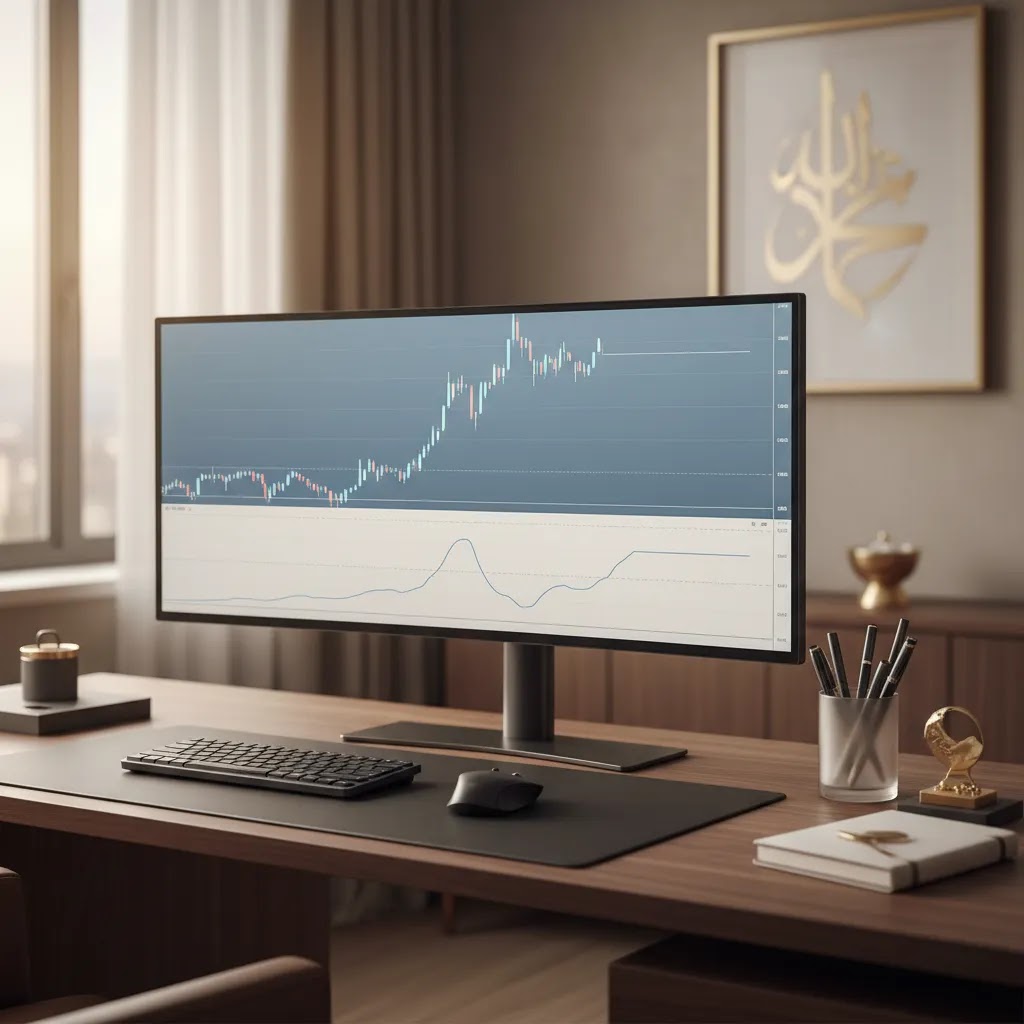
The rsi indicator, short for Relative Strength Index, is one of the most widely used momentum tools in trading. It is popular because it can help you spot when a market may be overbought, oversold, or losing momentum before a reversal. For UAE-based traders comparing strategies across forex, stocks, and indices, RSI can be useful, but only if you understand its limits. Used on its own, it may produce false signals, especially in strong trends. Used with price action, support and resistance, and a broader technical analysis guide, it can become far more practical. This article explains how RSI works, what RSI 14 means, how to interpret RSI divergence, and how traders may use it more carefully in real market conditions.
What the RSI indicator shows
The Relative Strength Index is a momentum oscillator that measures the speed and size of recent price movements. It is plotted on a scale from 0 to 100. In most cases, readings above 70 suggest a market may be overbought, while readings below 30 suggest it may be oversold.
That does not mean price must reverse immediately. A strong trend can stay overbought or oversold for longer than many beginners expect. This is why RSI is usually most effective as a context tool rather than a standalone buy or sell trigger.
In stock trading, forex, and CFD markets, traders often use RSI to assess momentum exhaustion, identify pullback opportunities, or confirm price action. If you are still building your chart-reading skills, browsing the broader Technical Analysis category may help you place RSI in the right context.
How RSI is calculated
RSI compares average gains to average losses over a selected number of periods. The default setting is 14, which is why you will often see the term RSI 14. On a daily chart, that means 14 days. On a one-hour chart, it means 14 hourly candles.
The formula is based on relative strength, then converted into a value between 0 and 100. You do not need to calculate it manually on most trading platforms, but it helps to know what the line reflects. A rising RSI usually means bullish momentum is increasing. A falling RSI usually means momentum is weakening.
This makes RSI especially useful for traders who want a quick read on whether recent price movement is gaining strength or fading. It is a momentum indicator, not a prediction tool.
From a practical standpoint, it helps to understand what is happening under the hood, even if you never touch the math. RSI starts by looking at each candle and separating it into gains and losses over your chosen period. It then calculates an average gain and an average loss, creates a relative strength value by dividing average gain by average loss, and finally converts that into the RSI number you see on the chart. In plain English, the line rises when recent gains are larger than recent losses, and it falls when losses outweigh gains.
Here is the thing: because RSI is built on recent price changes, unusual candles can distort readings. A single sharp candle, a gap in some stock markets, or a sudden volatility spike can push RSI toward an extreme level quickly, even if the broader trend has not changed. This can matter if you trade multiple markets. Forex tends to trade continuously, so gaps are less common, while stocks and indices can gap around earnings or macro news, which may create sudden RSI jumps that look like clean signals but are really just event-driven price moves.
What many people overlook is what RSI does not measure. It is not telling you whether a company is fundamentally strong or whether a currency is “healthy.” It measures momentum in the price itself, specifically the balance of recent gains versus losses. That is why RSI can look overbought in a strong uptrend and still stay elevated, because the underlying momentum may remain positive for longer than expected.
How to read overbought and oversold signals
The most common RSI interpretation uses the 70 and 30 levels. If RSI moves above 70, traders may describe the market as overbought. If it drops below 30, they may describe it as oversold. These zones can help you spot stretched conditions, but they are not automatic reversal signals.
For example, in a strong uptrend, RSI may remain above 70 while price keeps climbing. Selling too early can be costly. In a sharp downtrend, RSI may stay under 30 while losses continue. This is one reason many traders combine RSI with trend filters, candle structure, or other forex indicators.
A more careful approach is to treat RSI as an alert. If RSI reaches an extreme zone, then price action at support or resistance becomes more important. Some traders also adjust the thresholds to 80 and 20 in strong trends to reduce noise.
Risk matters here. No RSI setup eliminates the possibility of loss. Markets can stay irrational longer than a single indicator suggests, and capital is always at risk.
RSI signals beyond 70 and 30
Now, when it comes to using RSI in real charts, many traders look beyond overbought and oversold zones. Two common signal types that show up often are divergence and what is known as an RSI failure swing.
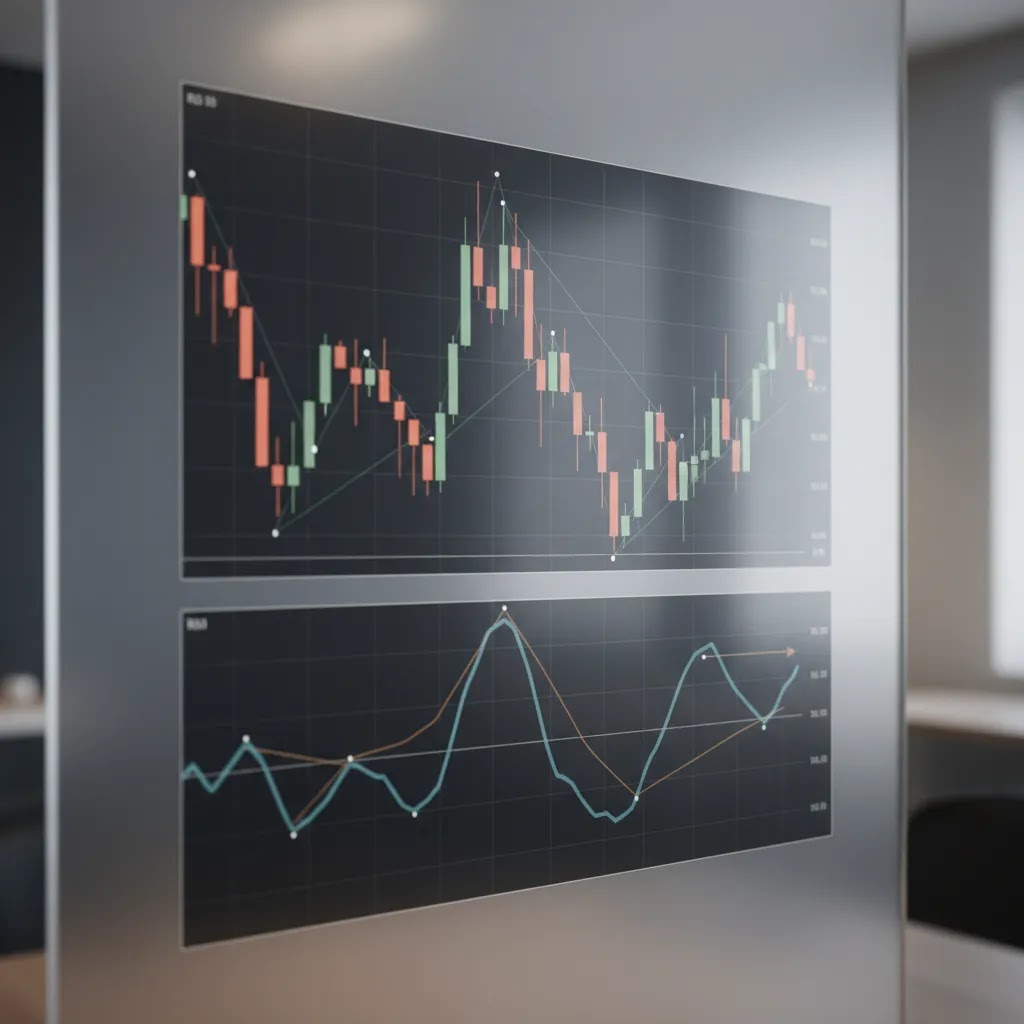
Divergence is already part of many RSI workflows, because it highlights a mismatch between price and momentum. A quick way to think about it is that price may still be pushing to a new high or low, but RSI is no longer confirming that push with a stronger reading. That can be a useful warning sign, but it is still not a guarantee of a reversal, especially during trending conditions.
An RSI failure swing is a separate pattern that focuses on RSI structure rather than price structure. In a typical bearish failure swing, RSI moves above 70, pulls back, then attempts to push back above the prior RSI peak but fails, and then breaks below its prior pullback level. A bullish failure swing is the mirror image around the 30 level: RSI drops below 30, bounces, fails to make a new RSI low on the next dip, then breaks above the prior RSI bounce level. Traders watch these patterns because they can suggest momentum has shifted even if price is still choppy.
Consider this: RSI can also act as a simple trend or regime filter, which may reduce sell-too-early mistakes. In many uptrends, RSI tends to hold above the midline near 50, and pullbacks often stall in the 40 to 50 zone before momentum returns. In many downtrends, RSI tends to hold below 50, with rallies often failing in the 50 to 60 area. This is not a rule, but it can be a helpful framework. Instead of treating every 70 reading as a sell, some traders treat an RSI that repeatedly holds above 50 as a clue that the path of least resistance may still be up.
The reality is that advanced RSI signals can still produce false positives. Divergence can persist while price continues trending. Failure swings can appear during range-bound noise. Confirmation still matters, and that usually means checking price structure, key levels, and whether the market is reacting where you would expect it to react. If RSI gives you an alert but price is not responding at a meaningful support or resistance area, it may be a lower quality setup.
Best RSI indicator settings for different trading styles
The default 14-period RSI remains the most common setting because it balances sensitivity and stability reasonably well. For many traders, it is the best place to start. Shorter settings, such as 7 or 9, may produce faster signals but also more false alerts. Longer settings, such as 21, may smooth the line but react more slowly.
There is no single best RSI setting for every market. A forex day trader may prefer a shorter setting for intraday momentum, while a swing trader in stocks may stick with RSI 14 on the daily chart. The right choice typically depends on timeframe, market volatility, and how much signal noise you can tolerate.
- RSI 14: Common default for general use
- RSI 7 or 9: Faster, more reactive, often noisier
- RSI 21: Slower, smoother, sometimes better for trend filtering
- 70/30 levels: Standard overbought and oversold zones
- 80/20 levels: Sometimes used in stronger trending markets
If you are new to indicators, it may be wise to avoid constant setting changes. Consistency usually makes testing more meaningful.
What RSI 6, 12, and 24 means
If you see settings like RSI 6, RSI 12, or RSI 24, the number is simply the lookback period used in the calculation, just like RSI 14. On any timeframe, it means the indicator is averaging gains and losses across that many candles. The main difference is sensitivity. Shorter periods respond faster to recent price changes, and longer periods smooth the line.
Think of it this way: RSI 6 will typically react quickly to short bursts of momentum, which may suit very short-term checks, such as fast intraday conditions where you want the oscillator to turn sooner. The trade-off is that it can generate more noise and more extreme readings that do not lead to meaningful price reversals.
RSI 12 sits closer to the default behavior but can still feel slightly more responsive than RSI 14 in some instruments. RSI 24 is slower and smoother, which may suit traders who want a steadier read on momentum and trend context, especially on higher timeframes where you are less concerned with every minor swing.
If you decide to test different periods, a simple framework is to keep it controlled. Use the same instrument and timeframe, keep your threshold logic consistent at first, and test over a meaningful sample of market conditions. Be careful about over-optimizing. It is easy to find a setting that looks perfect in hindsight and then breaks down when volatility shifts.
A practical RSI trading strategy
A simple RSI trading strategy often works best when it follows the direction of the broader trend. For example, if a market is trending upward, some traders wait for RSI to dip toward 40 or below, then look for bullish price confirmation before entering. In a downtrend, they may watch for RSI to bounce toward 60 or above, then fade if bearish structure returns.
This approach is often stronger than buying every oversold reading or selling every overbought reading. Trend alignment matters. So does market structure.
A practical process may look like this:
- Identify the broader trend on a higher timeframe.
- Mark key support and resistance zones.
- Wait for RSI to reach an area of interest.
- Look for price confirmation, such as a rejection candle or break of short-term structure.
- Define risk before entering the trade.
If you want to compare RSI with another momentum tool, our guide to the macd indicator can help highlight where each may fit better.
What RSI divergence can tell you
RSI divergence happens when price moves in one direction while RSI moves in another. A common bullish divergence appears when price makes a lower low, but RSI makes a higher low. A bearish divergence appears when price makes a higher high, but RSI makes a lower high.
This can suggest momentum is weakening, even if price has not reversed yet. Traders often use divergence as an early warning rather than a direct entry signal. On its own, divergence can persist for a while before the market turns.
That is why it is usually better to combine it with structure, trend context, and confirmation. If this concept interests you, our article on divergence trading explains how traders may use it more selectively.
RSI vs MACD
RSI and MACD both measure momentum, but they do it differently. RSI focuses on the speed of price changes and shows whether conditions may be stretched. MACD compares moving averages and tends to emphasize momentum shifts and trend direction.
In simple terms, RSI may be better for spotting overbought or oversold conditions. MACD may be better for confirming trend changes. Many traders use both, but too many overlapping indicators can create confusion rather than clarity.
If you are deciding between the two, think about your goal. If you want to spot momentum extremes, RSI may help. If you want to visualize trend momentum through moving averages, MACD may feel more intuitive. Either way, no indicator is reliable in every environment, especially during news-driven volatility.

Platforms and charting access for RSI users
Most major trading platforms available to UAE-based users include RSI as a standard chart indicator. What matters more is the quality of charting, market access, regulation, and pricing if you plan to trade based on technical analysis.
For example, Pepperstone offers MT4, MT5, cTrader, and TradingView, with spreads from 0.0 pips on Razor and a $7 per lot commission. It is regulated by the DFSA, FCA, ASIC, CySEC, and BaFin, and may suit traders who want advanced charting and low-spread execution.
XTB offers xStation 5 and a mobile app, with spreads from 0.1 pips and 0% commission stocks up to volume limits. It is regulated by the DFSA, FCA, CySEC, and KNF, and may appeal to traders who value education and a simpler interface.
Interactive Brokers offers TWS, IBKR Mobile, and Client Portal, with access to 150+ markets and spreads from 0.25 pips. It is regulated by the DFSA, SEC, FCA, and SFC, and may suit more experienced users who need broad market access and deeper research tools.
For readers evaluating where to apply an RSI-based process, Business24-7 can be a useful checkpoint. You can browse our Broker Reviews and review platform strengths, limitations, regulation, and fee structures before opening an account. That matters in the UAE, where oversight by bodies such as the DFSA and SCA may be an important trust filter.
Pros and Cons
Strengths
- RSI is easy to understand and available on nearly all major charting platforms.
- It can help identify overbought and oversold conditions quickly.
- It may be useful for spotting momentum weakness through divergence.
- The default RSI 14 setting is widely tested and easy to compare across markets.
- It can work across forex, stocks, indices, commodities, and CFDs.
Considerations
- RSI can produce false signals in strong trends.
- Overbought does not necessarily mean price will fall, and oversold does not guarantee a rebound.
- Shorter RSI settings may create excessive noise.
- Using RSI alone may lead to poor entries if market structure is ignored.
Who RSI may suit best
RSI may suit beginner to intermediate traders who want a straightforward way to measure momentum without cluttering their charts. It can be especially useful for traders who already understand basic support, resistance, and trend structure. If you are a UAE-based trader using regulated platforms and learning technical analysis step by step, RSI is often a sensible starting point.
It may be less suitable for anyone looking for automatic buy and sell signals without broader context. RSI works best as part of a method, not as a shortcut.
How Business24-7 can help you apply indicators more carefully
At Business24-7, the goal is not to present indicators or brokers as magic solutions. It is to help you compare tools, risks, and platform features more realistically. That editorial approach reflects the site’s educational focus and the market experience associated with Braden Chase, a former research specialist at Forex.com, as confirmed in the available brand data.
If you are learning RSI and also choosing where to trade, it helps to review the platform itself, not just the setup. Charting quality, spreads, commissions, account minimums, and local regulatory presence may all affect your experience. You can browse the Best Trading Platforms page or explore the Trading Fundamentals section before making a decision.

How to evaluate a platform if you plan to trade with RSI
If RSI is part of your trading process, the platform you choose still matters a great deal. An indicator is only one part of execution. Here are the main criteria worth checking.
1. Regulation and local relevance
For UAE readers, regulation should come first. Brokers regulated by bodies such as the DFSA or SCA may offer greater comfort than firms with weaker or unclear oversight. International regulators such as the FCA, ASIC, and CySEC can also add credibility, depending on the entity serving your account.
2. Charting and platform usability
RSI is simple, but your platform should still make it easy to change timeframes, add levels, compare instruments, and manage alerts. MT4, MT5, TradingView, xStation 5, and TWS all offer different experiences. A beginner may prefer a simpler interface, while an advanced trader may want more flexibility.
3. Costs and fee transparency
If you trade frequently, spreads and commissions matter. Pepperstone lists 0.0 pips on Razor with a $7 per lot commission. Plus500 uses spread-only pricing with overnight funding fees. Capital.com offers spread-only pricing on most instruments with no commissions on most markets. These differences may affect strategy performance, especially for short-term traders.
4. Asset range
RSI can be used on forex, stocks, ETFs, indices, and commodities. If you want flexibility, multi-asset brokers such as eToro, Interactive Brokers, or Saxo Bank may be worth comparing with more CFD-focused firms. Be aware that product availability, leverage, and fee treatment may vary by instrument.
5. Risk management features
Indicators do not reduce risk on their own. Platform features such as stop-loss tools, guaranteed stop-loss on some instruments, or risk controls like AvaProtect may be useful, depending on the broker and asset class. Even then, losses remain possible, and past performance never guarantees future results.
Frequently Asked Questions
What is RSI in stock trading?
RSI in stock trading is a momentum indicator that measures recent price gains versus losses over a chosen period, usually 14 candles. It helps traders judge whether a stock may be overbought or oversold. It does not guarantee reversals, so it is usually better used with price action and trend analysis.
How do you use RSI for buy and sell signals?
Many traders look for potential buy signals when RSI moves below 30 and then recovers, or potential sell signals when it rises above 70 and then turns lower. Those signals can be unreliable in strong trends, so confirmation from structure, support and resistance, or volume may improve decision-making.
What does RSI 14 mean?
RSI 14 means the indicator uses 14 periods in its calculation. On a daily chart, that means 14 days. On a 15-minute chart, it means 14 fifteen-minute candles. This is the standard setting on most platforms because it tends to balance sensitivity and stability reasonably well.
What are the best RSI indicator settings?
The default 14 setting is the most common starting point. Shorter settings like 7 or 9 may react faster but can create more false signals. Longer settings like 21 may smooth price movement but respond more slowly. The best choice usually depends on timeframe, asset class, and your trading method.
Does RSI work well in forex trading?
RSI can be useful in forex trading because currency markets often show momentum swings and trend pullbacks. It may help identify stretched conditions or momentum divergence. Still, forex can be highly volatile, especially around economic releases, so RSI signals should be treated carefully and never as certainty.
What is RSI divergence?
RSI divergence appears when price and the RSI line stop moving in sync. If price makes a higher high but RSI does not, momentum may be weakening. If price makes a lower low but RSI forms a higher low, selling pressure may be fading. It is usually an alert, not a complete trade setup.
Is RSI better than MACD?
Neither is universally better. RSI is often favored for spotting overbought and oversold conditions, while MACD is often used to evaluate trend momentum and crossovers. Some traders combine them, but using too many indicators can create conflicting signals. The better tool depends on how you read charts and manage trades.
Can beginners use the RSI indicator?
Yes, RSI is often beginner-friendly because it is visually simple and easy to interpret at a basic level. The challenge comes from context. Beginners may assume every overbought or oversold reading means an immediate reversal. In practice, it is safer to learn RSI alongside trend structure and risk management.
Which brokers offer platforms with RSI?
Most major brokers covered by Business24-7 offer RSI through platforms such as MT4, MT5, cTrader, TradingView, WebTrader, xStation 5, or proprietary apps. Examples from current platform data include Pepperstone, XTB, Interactive Brokers, AvaTrade, and Capital.com. Broker selection should also consider regulation, pricing, and platform fit.
What is a good RSI indicator reading?
A good RSI reading depends on what you are trying to measure. Many traders treat RSI around 50 as a neutral momentum zone, with readings above 50 suggesting bullish momentum may be stronger than bearish momentum, and readings below 50 suggesting the opposite. Overbought and oversold zones such as 70 and 30 can be useful alerts, but what counts as a “good” reading often depends on whether the market is trending or ranging and whether price is at a meaningful level.
Is RSI 70 a buy or sell signal?
RSI at 70 is usually interpreted as a possible overbought condition, which some traders treat as a potential sell alert. It is not automatically a sell signal. In strong trends, RSI can stay above 70 while price continues higher. Many traders look for confirmation, such as a break in structure, a clear resistance reaction, or a failure swing pattern in RSI, before treating it as actionable.
Is RSI 30 a buy or sell signal?
RSI at 30 is usually interpreted as a possible oversold condition, which some traders treat as a potential buy alert. It is not automatically a buy signal. In strong downtrends, RSI can stay below 30 longer than expected. Waiting for price confirmation or signs that selling pressure is fading may reduce false entries, but there is still no certainty and losses remain possible.
What does RSI 6, 12, and 24 mean?
RSI 6, 12, and 24 refer to the number of periods used in the RSI calculation. RSI 6 uses 6 candles and reacts faster, RSI 12 uses 12 candles and is moderately responsive, and RSI 24 uses 24 candles and is smoother and slower. Shorter settings may suit very short-term momentum checks but can be noisier, while longer settings may suit trend context but can react late. The most reliable approach is usually to test settings consistently on the same instrument and timeframe instead of changing them frequently.
Key Takeaways
- The RSI indicator measures momentum on a 0 to 100 scale and is commonly used to spot overbought and oversold conditions.
- RSI 14 is the default setting and a sensible starting point for most traders.
- Overbought and oversold readings are alerts, not guaranteed reversal signals.
- RSI divergence may help identify weakening momentum before price turns.
- For UAE traders, strategy and broker choice both matter, especially regulation, charting tools, and fee transparency.
Conclusion
The RSI indicator remains popular because it is simple, flexible, and widely available across trading platforms. It can help you read momentum, spot stretched markets, and identify possible divergence, but it works best with context rather than in isolation. If you are trading from the UAE or broader MENA region, pairing indicator knowledge with careful broker evaluation is usually the smarter approach. Regulation, fees, charting quality, and risk tools may shape your real trading experience just as much as any setup. If you are comparing platforms before putting RSI into practice, return to Business24-7 to browse our broker reviews, platform comparisons, and educational resources designed to help you make a safer, more informed decision.
Disclaimer: The content published on Business24-7 is intended for informational purposes only and does not constitute financial advice, investment recommendations, or an endorsement of any specific platform or financial product. Trading and investing carry significant risk, including the potential loss of capital. You should conduct your own research and, where appropriate, seek independent financial advice before making any investment decisions. Business24-7 does not accept responsibility for any financial losses incurred as a result of information published on this site.
Disclaimer
eToro is a multi-asset platform which offers both investing in stocks and cryptoassets, as well as trading CFDs.
Please note that CFDs are complex instruments and come with a high risk of losing money rapidly due to leverage. 61% of retail investor accounts lose money when trading CFDs with this provider. You should consider whether you understand how CFDs work, and whether you can afford to take the high risk of losing your money
This communication is intended for information and educational purposes only and should not be considered investment advice or investment recommendation. Past performance is not an indication of future results.
Copy Trading does not amount to investment advice. The value of your investments may go up or down. Your capital is at risk.
Crypto assets are complex and carry a high risk of volatility and loss. Trading or investing in crypto assets may not be suitable for all investors. Take 2 mins to learn more
eToro USA LLC does not offer CFDs and makes no representation and assumes no liability as to the accuracy or completeness of the content of this publication, which has been prepared by our partner utilizing publicly available non-entity specific information about eToro.

The rsi indicator, short for Relative Strength Index, is one of the most widely used momentum tools in trading. It is popular because it can help you spot when a market may be overbought, oversold, or losing momentum before a reversal. For UAE-based traders comparing strategies across forex, stocks, and indices, RSI can be useful, but only if you understand…