
The stochastic oscillator is one of the most widely used momentum tools in trading, but many beginners still misuse it by treating every overbought or oversold reading as a buy or sell signal. If you trade forex, indices, commodities, or CFDs from the UAE, understanding how this indicator behaves in trending and ranging markets may help you avoid some common mistakes. In this guide, we explain what the stochastic oscillator measures, which settings traders commonly use, and how to build a practical signal framework around it. If you need broader context first, our technical analysis guide covers the core chart-reading concepts that usually matter before you apply any momentum indicator to a live market.
What the Stochastic Oscillator Measures
The stochastic oscillator is a momentum indicator that compares the current closing price to an asset’s recent price range over a selected number of periods. In simple terms, it asks whether price is closing near the top, middle, or bottom of its recent range.
The indicator usually appears as two lines, called %K and %D, moving between 0 and 100. Readings above 80 are typically described as overbought, while readings below 20 are often described as oversold. Those labels can be useful, but they should not be treated as automatic reversal signals.
In strong trends, a market may stay overbought or oversold for longer than newer traders expect. That is why many traders combine stochastic readings with trend context, support and resistance, or other tools such as the rsi indicator or the macd indicator.
For UAE-based retail traders using regulated brokers under bodies such as the DFSA or SCA, the indicator itself is standard across most major charting packages. What often matters more is how clearly the platform displays it, how easily you can adjust settings, and whether your broker provides stable execution if you are trading short-term signals.
Stochastic Oscillator Formula and Calculation
Here’s the thing: stochastic is easy to use on a chart, but it becomes much easier to interpret when you understand what it is actually measuring under the hood. The oscillator is built around a simple idea. In an up move, price often closes near the top of its recent range. In a down move, price often closes near the bottom of its recent range.
The main line, %K, is calculated by comparing the current close to the highest high and lowest low over the lookback window (often 14 periods). In plain English, it is measuring where the close sits inside that recent high to low range. If the close is right at the highest high of the lookback, %K will be near 100. If the close is near the lowest low, %K will be near 0.
The second line, %D, is a moving average of %K (often a 3-period average). Think of %D as the signal line that smooths %K so you can see momentum shifts without reacting to every small fluctuation.
What many people overlook is why the indicator is always bounded between 0 and 100. The calculation is essentially a normalized range position. It is not measuring “how much” price moved, it is measuring “where” price closed relative to a recent range. That distinction matters in real trading because a tight range can produce sharp stochastic swings even if price movement looks small on the chart.
Now, when it comes to the settings, changes to the math have predictable effects. A shorter lookback (for example, 9 instead of 14) usually makes %K more sensitive because the recent range changes more quickly. More smoothing (for example, increasing the averaging periods) typically reduces whipsaws, but it can also make signals arrive later.
Consider this: stochastic can stay pinned near 80 to 100 in an uptrend, or near 0 to 20 in a downtrend, because closes keep occurring near the edge of the rolling range. That does not automatically imply reversal. It often just means momentum is strong. This is why traders who treat overbought or oversold as an automatic entry can get caught fading a trend repeatedly, especially in leveraged forex and CFD markets where risk management is critical.
Common Stochastic Settings
The default stochastic settings on many platforms are 14, 3, 3. This means the indicator looks back over 14 periods, then smooths the %K and %D lines over 3 periods each. For many traders, this is a reasonable starting point because it balances responsiveness with some noise reduction.
There are two common variations:
- Fast stochastic: more sensitive and quicker to react, but may produce more false signals.
- Slow stochastic: more smoothed and often easier to read, especially for newer traders.
A faster setup may appeal to day traders on lower time frames, while a slower setup may suit swing traders who want fewer but more filtered signals. Neither is automatically better. The right choice often depends on the asset, time frame, and your tolerance for noise.
Some traders also compare stochastic with stochastic RSI. Although the names sound similar, they are not the same tool. Stochastic RSI applies the stochastic formula to RSI values rather than directly to price. That usually makes it even more sensitive, which may help aggressive short-term traders but could also create extra noise.
If you are still building your indicator framework, it may help to review broader forex indicators so you can see where stochastic fits relative to trend, volatility, and momentum tools.
Fast vs Slow vs Full Stochastic (and what 14-3-3 means)
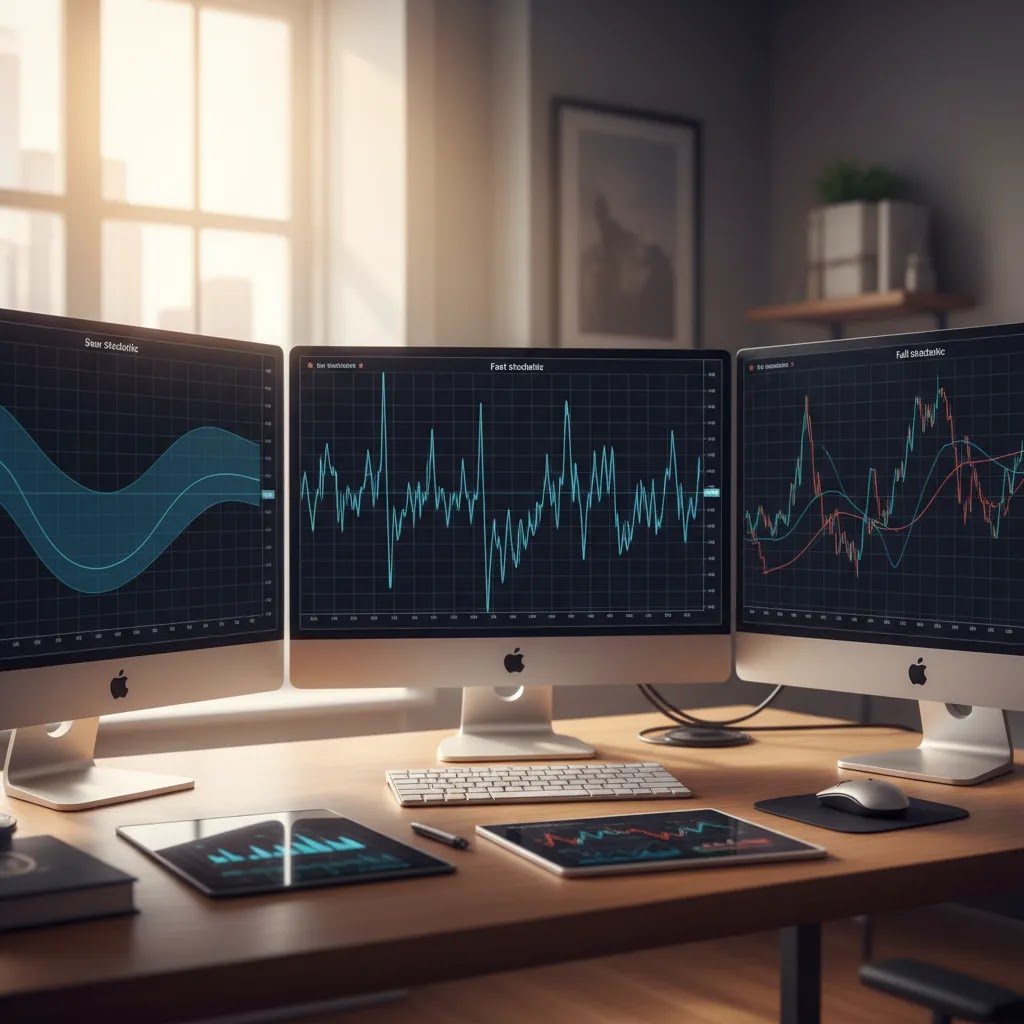
Fast and slow are the terms most traders hear first, but many charting platforms also include a “full stochastic” option. The differences come down to smoothing. More smoothing typically means fewer signals and less noise, while less smoothing typically means faster reactions and more false positives.
Fast stochastic is the rawest version. %K reacts directly to where price closes within the lookback range, and %D is usually a moving average of that fast %K. It can be useful if you are watching very short-term momentum shifts, but it can also be too reactive in volatile instruments.
Slow stochastic is typically a smoothed version of fast stochastic. On many platforms, what they call “slow %K” is actually a moving average of the fast %K, and then %D is a moving average of that smoothed line. From a practical standpoint, slow stochastic is often easier to trade because crossovers and extremes are less jumpy.
Full stochastic is a flexible version where you can control the lookback and both smoothing steps separately. Think of it as a customizable framework that can replicate fast or slow behavior depending on how you set the smoothing inputs.
So what does “14-3-3” usually mean? In most trading platforms, it refers to a 14-period lookback for the range calculation, then a 3-period smoothing for %K, and a 3-period moving average for %D. The exact naming can vary by platform, which is why it is worth checking whether your chart settings label these as %K period, slowing, and %D period, or something similar.
Think of it this way: if you trade higher time frames, or you prefer fewer signals you can evaluate carefully, slow or full stochastic with more smoothing may be easier to manage. If you trade lower time frames, a faster version may show shifts earlier, but it can also pull you into overtrading.
Common mistakes tend to show up when traders adjust too many parameters at once. If you change the lookback and both smoothing values together, it becomes hard to know what improved or worsened the signal quality. Another pitfall is optimizing settings to past price data and assuming the same parameters will keep working. Markets change, and curve fitting can create a false sense of precision unless you forward test and manage risk realistically.
How to Read Stochastic Signals
There are four signals traders usually watch most closely.
1. Overbought and oversold zones
Readings above 80 may suggest price is trading near the top of its recent range. Readings below 20 may suggest it is near the bottom. This does not mean price must reverse. In a strong uptrend, overbought conditions may simply reflect healthy momentum. In a strong downtrend, oversold conditions may persist.
2. Stochastic crossover
A bullish crossover happens when %K crosses above %D. A bearish crossover happens when %K crosses below %D. Traders often pay more attention when the crossover happens near the 20 or 80 zones, because it may indicate that momentum is shifting from an extreme.
3. Centerline behavior
Although stochastic is less often used this way than MACD, movement above or below the mid-zone may still help you gauge whether momentum is improving or fading. This is usually more useful as a supporting clue than a standalone entry trigger.
4. Stochastic divergence
Divergence appears when price makes a new high or low but the indicator does not confirm it. For example, if price makes a higher high while stochastic makes a lower high, momentum may be weakening. Divergence can be helpful, but it often appears early, so confirmation from price structure is usually important.
Because no indicator is reliable in every market condition, many traders combine stochastic signals with trend analysis, horizontal support and resistance, or candlestick confirmation rather than acting on a single crossover alone.
Stochastic vs RSI vs MACD
What many people overlook is that these indicators are answering different questions. If you treat them as interchangeable, you can end up stacking signals that all reflect the same idea, which rarely improves decision-making.
Stochastic is best understood as range-position momentum. It tells you where the close sits relative to a recent high to low range. That often makes it useful for timing in ranges, or for spotting pullbacks that may be resetting momentum within a broader trend.
RSI is a relative strength and velocity-style momentum measure. It tends to look smoother in many markets and can be easier to interpret as a broader momentum gauge, particularly if you are using it to confirm direction or to spot momentum shifts that develop over more than a few candles. If you want a deeper breakdown, our rsi indicator guide covers common RSI signals and mistakes.
MACD is a trend-following momentum tool built from moving averages. It is often used to confirm trend direction and momentum changes rather than to call short-term turning points. That is why it can feel less “twitchy” than stochastic in choppy ranges, but it may also react later to quick pullbacks. Our macd indicator guide explains how traders use MACD lines and histograms in practice.
Is stochastic better than MACD? Not in a general sense. Stochastic often shines as a timing tool, particularly in range-bound markets or during pullbacks where you want to judge whether price is closing near the bottom or top of a recent range. MACD may be clearer for trend confirmation because it is tied to moving-average behavior. The right choice depends on what you need the indicator to do, and on the market condition you are trading.
A practical way to combine them, without redundancy, is to use one tool as a trend filter and another as a timing tool. For example, MACD or higher time frame structure can help you define the likely direction, while stochastic can help you time pullbacks. You can also pair RSI with stochastic, but be careful. Both are momentum indicators, so you want each to play a specific role rather than duplicating the same signal and increasing confidence without increasing accuracy.
No combination removes risk. Indicators can help you structure decisions, but they can still fail during news-driven volatility, low-liquidity conditions, or sharp trend accelerations, which is especially relevant for leveraged forex and CFD traders.
A Simple Stochastic Oscillator Strategy
A basic stochastic oscillator strategy may work best when it is built around market context rather than a single rule.
- Identify trend direction on a higher time frame.
- Mark clear support or resistance on the trading chart.
- Wait for stochastic to move into oversold territory in an uptrend, or overbought territory in a downtrend.
- Look for a crossover back in the direction of the trend.
- Use price action confirmation before entering.
For example, in an uptrend, a trader may wait for price to pull back into support while stochastic drops below 20. If %K then crosses above %D and price starts holding support, that combination may be more meaningful than the oscillator reading alone.
This kind of approach is often more stable than trying to short every overbought reading or buy every oversold reading. Risk management still matters. A stop-loss, position sizing plan, and realistic expectations are essential because no momentum setup can remove market risk. Capital is at risk, especially in leveraged forex and CFD trading.
Platforms That Offer Stochastic Tools
Most serious charting platforms include a stochastic indicator, but the trading experience around that tool can vary. Based on Business24-7 platform data, several brokers available to UAE readers provide charting environments where stochastic analysis is commonly used.
Pepperstone supports MT4, MT5, cTrader, and TradingView, with spreads from 0.0 pips on Razor accounts and a $7 per lot commission on Razor pricing. It is regulated by the DFSA, FCA, ASIC, CySEC, and BaFin, and may appeal to more active traders who want flexible charting options.
AvaTrade offers MT4, MT5, AvaTradeGO, and WebTrader, with spreads from 0.9 pips and a $100 minimum deposit. It is regulated by ADGM FSRA, CBI, ASIC, and FSA Japan. The platform may suit readers who want education tools and a more guided environment.
XTB provides xStation 5 and mobile trading, with spreads from 0.1 pips and no minimum deposit. It is regulated by the DFSA, FCA, CySEC, and KNF. Its education offering may help newer traders learning indicators such as stochastic.
Capital.com offers web, mobile, and MT4 access, with spreads from 0.6 pips and a low $20 minimum deposit. It is regulated by the SCA, FCA, CySEC, and ASIC. For UAE readers, SCA regulation may be particularly relevant when comparing local access and oversight.
Plus500 provides a simple web and mobile platform with spreads from 0.8 pips and a $100 minimum deposit. It is regulated by the DFSA, FCA, CySEC, ASIC, and MAS. Its interface may be easier for beginners, though simpler platforms can sometimes offer less customization than advanced charting environments.
Business24-7 covers these brokers in more detail through its broker education and review resources. If you are comparing platforms rather than just learning the indicator itself, you may want to browse the Technical Analysis section alongside the broader Trading Fundamentals category before opening an account.

Pros and Cons
Strengths
- The stochastic oscillator is easy to understand visually, which may make it approachable for beginners.
- It can help highlight momentum shifts, especially in range-bound markets.
- Default settings such as 14, 3, 3 are available on most trading platforms, so it is widely accessible.
- It can be combined with trend tools, support and resistance, or other indicators for a more complete trading process.
- Most regulated brokers covered by Business24-7 provide charting platforms where stochastic is available by default.
Considerations
- Overbought and oversold readings do not guarantee a reversal.
- Fast settings may create too many signals in volatile markets.
- In strong trends, the indicator may stay near extremes for extended periods.
- Divergence can appear early and may not lead to immediate price turns.
- Using stochastic alone, without risk management or market context, may lead to poor trade quality.
How Business24-7 Suggests You Use It
At Business24-7, our editorial approach is to treat indicators as decision-support tools rather than prediction machines. That fits the background of Braden Chase, whose experience as a former research specialist at Forex.com informs a practical, evidence-based style focused on market structure, risk control, and platform evaluation.
For most readers, the stochastic oscillator may be most useful as part of a checklist. Start with trend direction. Add key price levels. Then use stochastic to judge whether momentum is stretched or resetting. This usually creates a more disciplined framework than reacting to every crossover.
If you are still narrowing down which broker or platform fits your trading style, explore Business24-7 comparison resources and detailed platform reviews before making a decision. That may be especially valuable for UAE traders who care about SCA or DFSA oversight, fee transparency, Islamic account availability, platform usability, and minimum deposit requirements.
How to Choose a Trading Platform for Indicator-Based Trading
If you plan to use stochastic as part of your trading process, the platform matters almost as much as the indicator. Here are the main criteria worth checking.
1. Regulation and local relevance
For UAE-based traders, regulation should usually come first. Brokers regulated by bodies such as the DFSA, SCA, or ADGM FSRA may offer stronger oversight than firms operating only through offshore entities. International regulators such as the FCA, ASIC, and CySEC can also add credibility, but you should still confirm which entity will hold your account.
2. Platform quality and charting flexibility
If you use stochastic frequently, look for platforms with adjustable indicator settings, multiple time frames, clear charts, and drawing tools. MT4 and MT5 remain widely used, while cTrader, TradingView, and proprietary platforms such as xStation 5 may offer a more modern charting experience for some traders.
3. Costs and fee structure
Even a solid trading method can be weakened by poor cost control. Compare spreads, commissions, overnight funding charges, and inactivity fees. For example, Pepperstone lists Razor commissions of $7 per lot, AvaTrade notes an inactivity fee after 3 months, and Plus500 applies overnight funding fees. Those details matter if you trade actively or hold positions longer.
4. Minimum deposit and account type
Newer traders may prefer lower entry thresholds. Capital.com starts from $20, Exness from $10, and XTB has no minimum deposit listed. A lower starting point may reduce pressure while you test your process. You should also check whether an Islamic account is available if that matters to your requirements.
5. Education and support
Indicators are easier to use well when your broker provides solid education. AvaTrade and XTB both highlight educational resources, while eToro is known for social and copy trading tools that may help newer users observe how markets move. Support in Arabic, AED funding options, and local service availability may also improve the experience for UAE residents.
No broker can remove trading risk, and no platform feature guarantees better outcomes. Your goal should be to find a regulated, transparent environment where you can apply your method consistently and understand the real costs involved.
Frequently Asked Questions
What is the stochastic oscillator used for?
The stochastic oscillator is mainly used to measure momentum by comparing the latest closing price to a recent trading range. Traders often use it to spot possible overbought or oversold conditions, crossovers, and divergence. It may be most useful when combined with trend analysis and support or resistance rather than used by itself.
What does a stochastic oscillator tell you?
It tells you where the current close sits relative to the recent high to low range over the lookback period. A reading near 100 means price is closing near the top of that range, and a reading near 0 means it is closing near the bottom. This can be a helpful way to judge momentum and potential timing, but it can also stay elevated or depressed during strong trends, so it is usually best used with market context and risk management.
What are the best stochastic settings?
There is no universal best setting for every market. Many traders start with 14, 3, 3 because it is the default on most platforms and offers a balanced signal speed. Faster settings may react sooner but create more noise, while slower settings may filter more false moves at the cost of later entries.
What is stochastic 14-3-3?
On most platforms, 14-3-3 refers to a 14-period lookback for the stochastic range calculation, then a 3-period smoothing for the %K line, and a 3-period moving average for the %D signal line. It is a common default because it tends to balance responsiveness with some noise reduction, although results can still vary by instrument and time frame.
What is the difference between fast stochastic and slow stochastic?
Fast stochastic reacts more quickly to price movement, so it may suit very short-term traders, but it can also produce more false signals. Slow stochastic uses more smoothing, which often makes the lines easier to interpret. For many beginners, slow stochastic may be easier to manage in real trading conditions.
Does stochastic work well in forex trading?
It can work well in forex when it is matched to the right market condition. In ranging markets, stochastic may help identify momentum swings between support and resistance. In strong trends, it can stay overbought or oversold for extended periods, so traders often use it as a pullback tool rather than a reversal tool.
Is stochastic better than RSI?
Not necessarily. The two indicators measure momentum differently and may suit different trading styles. Stochastic is often more sensitive to short-term price movement, while RSI may appear smoother in some conditions. Many traders compare both before deciding which fits their system, and our guide to the rsi indicator can help clarify the differences.
Is stochastic better than MACD?
Not by default. Stochastic is often used for timing because it reacts to where price closes within a recent range, which can be useful in ranges or during pullbacks. MACD is often used for trend and momentum confirmation because it is built from moving averages, which can make it easier to read in sustained trends. Many traders use one as a trend filter and the other as a timing tool, rather than expecting either indicator to be “better” in all market conditions.
What is stochastic divergence?
Stochastic divergence happens when price makes a new high or low but the indicator does not confirm that move. This may suggest momentum is weakening. It can be a useful warning sign, but it does not confirm a reversal on its own. Price structure and risk control still matter before acting on divergence.
Can beginners use the stochastic oscillator?
Yes, many beginners start with stochastic because it is visually simple and widely available. The main challenge is learning not to overreact to every signal. Newer traders may benefit from using it on higher time frames first, where market noise is lower, and combining it with a structured trade plan.
Which brokers support stochastic charts for UAE traders?
Many brokers covered by Business24-7 support stochastic through MT4, MT5, TradingView, cTrader, or proprietary platforms. Examples from current platform data include Pepperstone, AvaTrade, XTB, Capital.com, and Plus500. When comparing brokers, look beyond the indicator itself and check regulation, costs, execution, and account terms.
Should I use stochastic alone for entries?
In most cases, that would be risky. Stochastic may help with timing, but it is usually stronger when paired with trend direction, price levels, or confirmation from other tools. Relying on a single indicator can increase false entries, particularly in volatile or strongly trending markets where momentum readings may stay extreme.
Key Takeaways
- The stochastic oscillator measures where price closes relative to its recent range, not whether a reversal is guaranteed.
- Default settings of 14, 3, 3 are a common starting point, while fast and slow versions change signal sensitivity.
- Overbought, oversold, crossover, and divergence signals work best when combined with trend and price structure.
- Platform choice matters, especially for UAE traders comparing regulation, spreads, charting tools, and account minimums.
- Risk management remains essential because trading forex and CFDs can lead to capital loss.
Conclusion
The stochastic oscillator remains a useful momentum tool because it is simple to read, widely available, and flexible across different markets. Its real value, though, usually comes from context. If you use it alongside trend analysis, support and resistance, and disciplined risk management, it may help you refine timing rather than chase random signals. For UAE-based readers comparing platforms that support chart-based trading, Business24-7 aims to be a practical reference point with independent broker reviews, platform comparisons, and educational guides. Before choosing a broker, it is worth reviewing regulation, fee structure, platform quality, and the specific tools you plan to use every day.
Disclaimer: The content published on Business24-7 is intended for informational purposes only and does not constitute financial advice, investment recommendations, or an endorsement of any specific platform or financial product. Trading and investing carry significant risk, including the potential loss of capital. You should conduct your own research and, where appropriate, seek independent financial advice before making any investment decisions. Business24-7 does not accept responsibility for any financial losses incurred as a result of information published on this site.
Disclaimer
eToro is a multi-asset platform which offers both investing in stocks and cryptoassets, as well as trading CFDs.
Please note that CFDs are complex instruments and come with a high risk of losing money rapidly due to leverage. 61% of retail investor accounts lose money when trading CFDs with this provider. You should consider whether you understand how CFDs work, and whether you can afford to take the high risk of losing your money
This communication is intended for information and educational purposes only and should not be considered investment advice or investment recommendation. Past performance is not an indication of future results.
Copy Trading does not amount to investment advice. The value of your investments may go up or down. Your capital is at risk.
Crypto assets are complex and carry a high risk of volatility and loss. Trading or investing in crypto assets may not be suitable for all investors. Take 2 mins to learn more
eToro USA LLC does not offer CFDs and makes no representation and assumes no liability as to the accuracy or completeness of the content of this publication, which has been prepared by our partner utilizing publicly available non-entity specific information about eToro.

The stochastic oscillator is one of the most widely used momentum tools in trading, but many beginners still misuse it by treating every overbought or oversold reading as a buy or sell signal. If you trade forex, indices, commodities, or CFDs from the UAE, understanding how this indicator behaves in trending and ranging markets may help you avoid some common…