
If you have ever opened a forex platform and seen price quotes moving by tiny decimals, you are not alone if it felt confusing at first. Many new traders in the UAE understand the big idea of buying one currency and selling another, but the actual pricing language can feel harder than expected. Terms like forex pips, spread, bid and ask, micro lot, and standard lot show up everywhere, yet few beginner articles explain how they work together in a practical way.
That matters because these are not just technical words. They affect how much a trade costs, how much each price move is worth, and how quickly risk can build when leverage is involved. If you are still learning the basics, this article works well alongside our guide to trading for beginners. At Business24-7, the goal is to make platform and trading research easier for UAE readers who want facts before they commit funds. Here, you will learn what a pip is in forex, how spreads work, what lot sizes mean, and why these concepts matter before you place any real trade.
What forex pips actually mean
A pip is the standard unit used to measure a price move in most currency pairs. In many cases, one pip is the fourth decimal place in a forex quote. If EUR/USD moves from 1.1000 to 1.1001, that is a 1 pip move. If it moves from 1.1000 to 1.1010, that is 10 pips.
Think of it this way: a pip gives traders a common language for measuring movement. Instead of saying a currency pair rose by 0.0010, traders usually say it rose by 10 pips. That makes it easier to compare trades, discuss strategy, and calculate profit or loss.
Why some pairs look different
Not every currency pair uses four decimal places in the same way. Pairs involving the Japanese yen are commonly quoted to two decimal places for the pip measurement. So if USD/JPY moves from 150.20 to 150.21, that is usually 1 pip.
Many platforms also show a fractional pip, often called a pipette. This adds one extra decimal place for tighter pricing. For example, EUR/USD might appear as 1.10005. The last digit is a fraction of a pip, not a full pip.
Pip vs point vs pipette on trading platforms
If you have compared a few platforms, you might notice that traders talk about pips, while some platforms display costs in points, or they show an extra digit that makes the spread look different. Most of the time, the numbers are describing the same price movement, but the labeling can create confusion.
Here is the practical breakdown. A pip is typically the standard “full” unit of movement for the pair you are trading, usually 0.0001 for most major pairs and 0.01 for many JPY pairs. A pipette is one tenth of a pip, also called a fractional pip. It shows up when a quote adds an extra decimal place for tighter pricing, which is common on many modern forex platforms.
The term point is where it gets messy. On many forex platforms, point is used to mean a pipette, which is 0.00001 on a five-decimal EUR/USD quote. On other platforms, especially those offering CFDs across many asset classes, point can mean the minimum price increment for that instrument, which may or may not line up with a forex pip. This is why two traders can say “the spread is 15 points” and “the spread is 1.5 pips” and still be talking about the same thing.
Consider this example quote: EUR/USD at 1.10005. The fourth decimal place is the pip location (0.0001). The fifth decimal place is the pipette (0.00001). If the bid is 1.10005 and the ask is 1.10020, the difference is 0.00015, which equals 1.5 pips, or 15 pipettes. A platform that reports in points might show that spread as 15 points, while another platform might show it as 1.5 pips.
A simple rule of thumb that helps in real trading is to check the number of decimals in the quote. If the pair is quoted to five decimals, one pip is usually 10 “points” if the platform is using points to mean pipettes. If the pair is quoted to three decimals for a JPY pair, one pip is often 10 points for the same reason.
Why pips matter to beginners
If you are learning what is forex trading, understanding pips is one of the first real building blocks. Your stop-loss, take-profit, spread cost, and trade result are all often measured in pips. Without that basic unit, pricing on a trading screen can feel random when it is actually very structured.
How spreads work in real trading
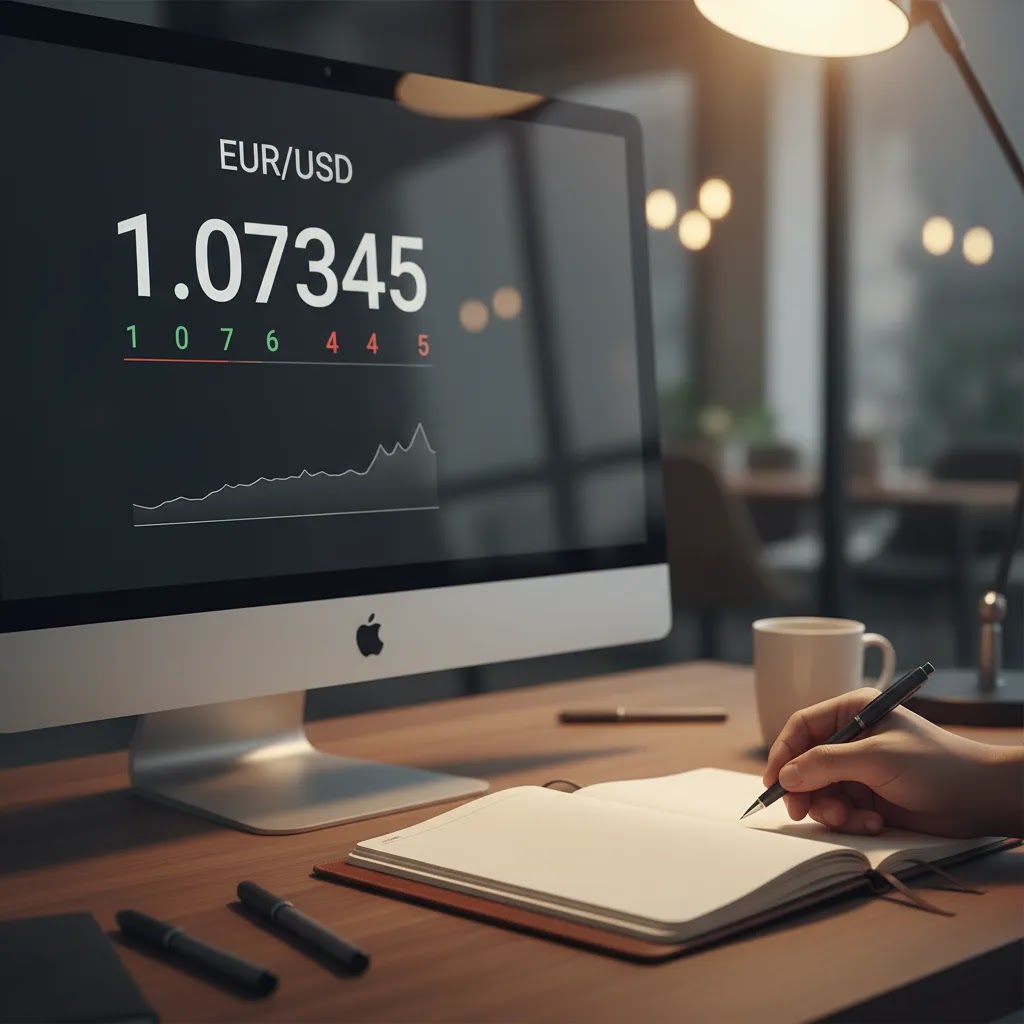
The spread is the difference between the bid price and the ask price. The bid is the price at which the market, or your broker, may buy from you. The ask is the price at which you may buy from the market. That small gap is a core trading cost in many forex accounts.
Here is a simple example. If EUR/USD shows 1.1000 bid and 1.1002 ask, the spread is 2 pips. If you enter a buy trade at the ask price, the trade usually starts slightly negative because you would need the market to move enough to cover the spread first.
What is a good spread in forex?
That depends on the pair, the account type, and market conditions. Major pairs such as EUR/USD often have lower spreads than exotic pairs because they usually have more liquidity, which means more active buyers and sellers. A spread that looks low during London or New York trading hours may widen during quiet periods, major news events, or market stress.
From a practical standpoint, a spread is only one part of the total cost. Some brokers offer very tight raw spreads but add a separate commission. Others use spread-only pricing. So if you are comparing platforms, you need to look at the full pricing model, not just the headline number.
Why spread matters more than many beginners expect
What many people overlook is that spreads can affect short-term trading far more than long-term trading. If you aim for very small moves, a 2 pip or 3 pip cost becomes significant. If you hold positions longer, that cost may matter less, though overnight fees or swap charges may then become more important.
Trading always involves risk of capital loss, and costs like spread can quietly erode results if you do not factor them in before placing a trade.
Commodity pips: how pips work on gold (XAU/USD) and other non-forex instruments
If you trade beyond major currency pairs, you will quickly notice that “pip rules” are not always universal. Gold (XAU/USD), oil, indices, and many CFD products are often quoted with different minimum price increments. Traders might still casually say “pips” when they mean “ticks” or “points,” but the platform’s contract specifications are what define the real value of each movement.
For example, XAU/USD is commonly shown with two decimals on many platforms, such as 2325.40 to 2325.60. In that case, the smallest visible move might be 0.01 or 0.10 depending on the broker and the product setup. Some platforms may refer to those increments as points rather than pips. The important part is not the label, it is the minimum price fluctuation and the contract size you are trading.
Think of it this way: forex pips are a convention for currency pairs, but CFDs are defined by contract specs. Before you assume that “10 pips” means the same thing on gold as it does on EUR/USD, check the instrument details inside the platform. Most platforms include a contract specification panel showing the tick size (minimum price movement), contract size (how much one lot represents), and sometimes the value per tick. That is the fastest way to avoid misreading your exposure.
This also affects costs. Spreads on commodities and indices can behave differently than forex spreads, and overnight financing is often a meaningful cost on CFD positions held longer than a day. Before trading any non-forex instrument, it is worth verifying the spread, any commission, and typical overnight charges in the product’s info screen so you understand the full cost of holding the position. As always, none of this removes market risk, it just helps you measure it more accurately.
Understanding lot sizes without the jargon
A lot is the standardized trade size used in forex. This is where many beginners get surprised, because the price movement measured in pips only becomes meaningful once you know how large the position is.
Standard lot, mini lot, and micro lot
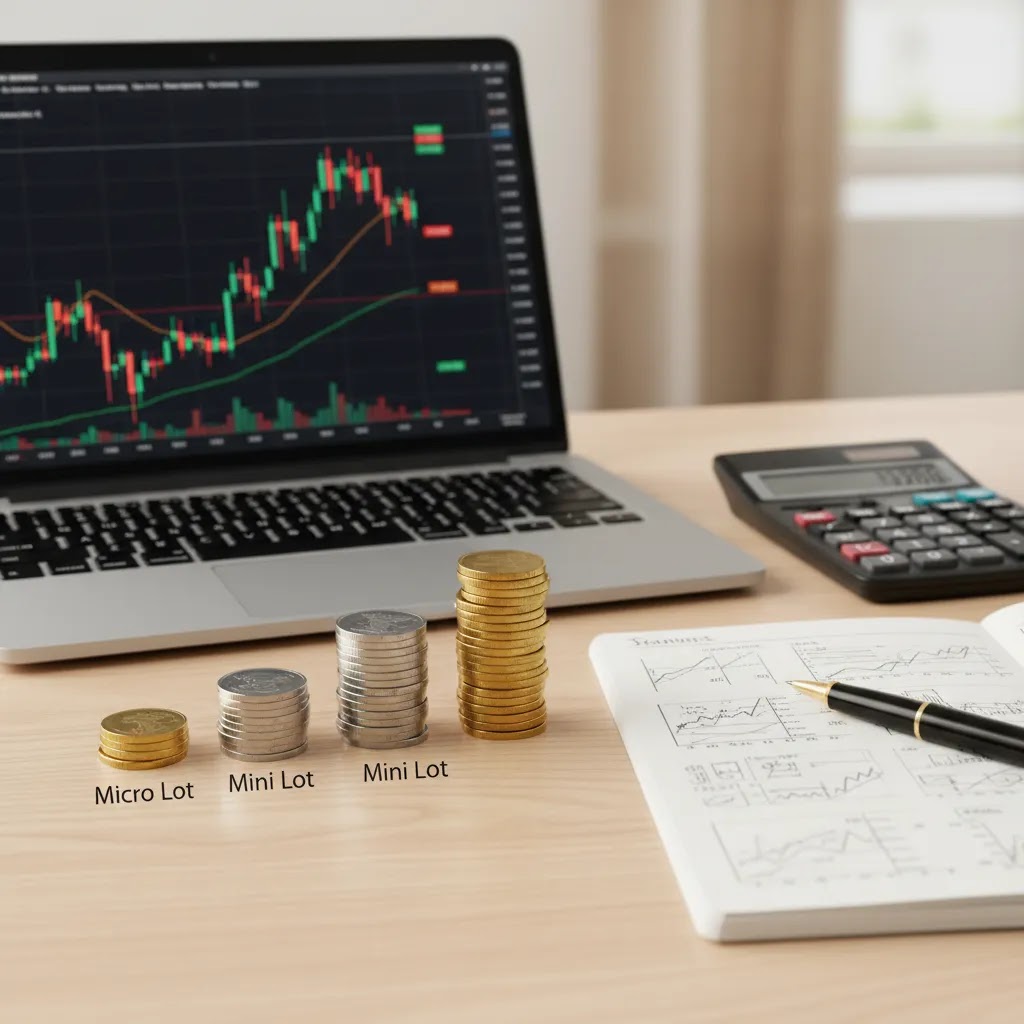
- Standard lot: 100,000 units of the base currency
- Mini lot: 10,000 units of the base currency
- Micro lot: 1,000 units of the base currency
So if you trade one standard lot of EUR/USD, you are controlling 100,000 units of the base currency, which is the euro in this pair. If you trade one micro lot, you are controlling 1,000 units. The larger the lot, the more each pip is worth, and the faster profit or loss can change.
This is also where leverage and margin become relevant. Leverage allows you to control a larger position with a smaller deposit, but it also increases risk. In the UAE, traders may see brokers regulated by the Securities and Commodities Authority (SCA), the Dubai Financial Services Authority (DFSA), or the Abu Dhabi Global Market Financial Services Regulatory Authority (ADGM FSRA), and each regulated environment may set different expectations around client protection, disclosures, and product access. Regulation does not remove risk, but it may help you assess whether a broker is operating under a recognized framework.
Why smaller lots help beginners
For a new trader, micro lots and mini lots can be useful because they reduce the cash impact of each pip. That gives you more room to learn how the market moves and how platform costs work without taking on oversized risk from the start.
How to calculate pips and pip value
Once you know what a pip is and how big your lot size is, you can estimate how much each pip may be worth. This is the part many traders search for when they ask, “How much is 1 pip in forex?”
A simple pip calculation example
If EUR/USD moves from 1.1050 to 1.1065, the difference is 15 pips. That part is straightforward. The next question is what those 15 pips mean in dollar terms, and that depends on your lot size.
Typical pip value guide
- 1 standard lot, often about $10 per pip on many USD-quoted major pairs
- 1 mini lot, often about $1 per pip
- 1 micro lot, often about $0.10 per pip
These figures are common examples, not fixed universal values. The exact pip value may vary depending on the currency pair, your account currency, and the current exchange rate. Many traders use a pip value calculator or lot size calculator built into a broker platform, but you should still understand the logic behind the number shown.
Why account currency matters
If your trading account is in USD and you trade a USD-quoted major pair, calculations are often simpler. If your account is in another currency, or you trade a cross pair that does not include USD, the pip value may need conversion. In practice, this means a platform calculator can save time, but you should not rely on the tool blindly without understanding the trade size and exposure involved.
How much is 1 pip in dollars? A quick pip value formula and examples
If you want to translate pips into a cash amount, the key variables are the pip size, the position size (lot size), and whether your account currency matches the quote currency of the pair.
For a USD-quoted major pair such as EUR/USD, a plain-English way to estimate pip value is: pip value in USD is approximately the pip size (0.0001 for most major pairs) multiplied by the position size in units. So if you are trading 100,000 units, 0.0001 x 100,000 equals about $10 per pip. That is where the common shortcut comes from: on many USD-quoted majors, one standard lot is often about $10 per pip, one mini lot (10,000 units) is often about $1 per pip, and one micro lot (1,000 units) is often about $0.10 per pip.
Now apply that to a question traders ask constantly: “How much is 50 pips worth in dollars?” If you trade 50 pips on a standard lot of a USD-quoted major pair, it is often about 50 x $10, which is about $500. On a mini lot, it is often about 50 x $1, which is about $50. On a micro lot, it is often about 50 x $0.10, which is about $5. These are rough illustrations, not guaranteed values, because pricing and conversion can change with the exchange rate and the instrument’s contract specs.
Here is why the shortcut does not always apply. If you trade a cross pair where USD is not the quote currency, or your trading account is not denominated in USD, the pip value typically needs a conversion step. The platform may convert the profit and loss into your account currency automatically, but the same 50 pip move can show a different cash result depending on the pair and the exchange rate at the time. This ties directly back to why account currency matters. Pips are a consistent way to measure movement, but cash value depends on the structure of the pair and the currency your account uses.
Why these terms matter when choosing a broker
Here’s the thing: pips, spreads, and lots are not just trading theory. They are part of how you evaluate a broker. A platform may advertise low spreads, but if it uses a dealing structure that does not match your style, or if commission and overnight financing are high, your real cost could be very different from what the home page suggests.
For example, Business24-7 reviews several brokers available to UAE traders using a structured research approach that looks at regulation, pricing, platform tools, and account features. Based on the available review data, Pepperstone lists spreads from 0.0 pips on its Razor account with a $7 per lot commission, while Capital.com uses spread-only pricing with spreads from 0.6 pips on many instruments. AvaTrade lists spreads from 0.9 pips, and Plus500 uses a spread-based model with overnight funding fees applying on many CFD positions. Those differences may matter depending on whether you trade frequently, hold positions overnight, or want simpler pricing.
Now, when it comes to safety, your first step should not be the lowest spread. It should be whether the broker operates under recognized oversight such as the SCA, DFSA, or ADGM FSRA in the UAE, or other internationally recognized regulators like the Financial Conduct Authority (FCA), Cyprus Securities and Exchange Commission (CySEC), or Australian Securities and Investments Commission (ASIC). Regulation may provide clearer rules around disclosures, complaints handling, and client money protections, though it does not remove market risk.
If you want to compare brokers after learning the basics, the Trading Platforms and Brokers section and the Trading Fundamentals category are useful next steps for structured research.
Common beginner mistakes with pips, spreads, and lots
Most early mistakes do not come from misunderstanding charts. They come from misunderstanding trade mechanics.
Using lot sizes that are too large
A trader may think a 20 pip stop-loss sounds small, then realize too late that on a standard lot the cash amount at risk is much larger than expected. This is one reason position sizing matters so much. Learning basic risk management may help you avoid putting too much capital at risk on a single trade.
Ignoring spread during volatile conditions
Spreads often widen during major economic releases, low-liquidity hours, or sudden market stress. If you place a trade without checking current pricing conditions, your entry cost may be much higher than usual.
Confusing pips with cash value
Ten pips is not automatically a big move or a small one. The cash impact depends on the lot size and pair traded. A 10 pip move on a micro lot is very different from the same move on a standard lot.
Focusing only on leverage
High leverage can look attractive to beginners because it reduces the money needed to open a position. The reality is that it also magnifies losses. Some brokers available in the region advertise very high leverage under certain conditions, but higher leverage does not mean lower risk. In many cases, it means the opposite.
Frequently Asked Questions
What is a pip in forex in simple terms?
A pip is a small unit of price movement in a currency pair. For most major pairs, it is the fourth decimal place. If EUR/USD moves from 1.1000 to 1.1001, that is 1 pip. For Japanese yen pairs, a pip is usually the second decimal place. Traders use pips because they make price changes easier to discuss and calculate. Once you know your lot size, you can estimate how much each pip may be worth in cash terms.
How much is 1 pip worth in forex?
There is no single answer for every trade. The value of 1 pip depends on the currency pair, your lot size, and your account currency. On many USD-quoted major pairs, 1 pip is often worth about $10 for a standard lot, about $1 for a mini lot, and about $0.10 for a micro lot. These are common approximations, not fixed rules. Your platform’s pip value calculator may help, but you should still understand what trade size you are using.
How much is 50 pips worth in dollars?
It depends on the lot size and the pair, but you can estimate it on a USD-quoted major pair like EUR/USD using common pip value shortcuts. On one standard lot, 50 pips is often about $500 (50 x about $10 per pip). On one mini lot, it is often about $50 (50 x about $1 per pip). On one micro lot, it is often about $5 (50 x about $0.10 per pip). These are approximations, and the cash value can differ on cross pairs or if your account currency is not USD because conversion rates can affect the result.
What is 100 pips in forex?
In most major currency pairs quoted to four decimals, 100 pips is a move of 0.0100 in the exchange rate. For example, a move in EUR/USD from 1.1000 to 1.1100 is 100 pips. In yen pairs quoted to two decimals for pips, 100 pips is usually a move of 1.00, such as USD/JPY moving from 150.20 to 151.20. What 100 pips is worth in cash terms depends on your lot size, your account currency, and the specific pair traded.
Is 1 pip the same as 1 point?
Not always, because platforms use the word point in different ways. In many forex platforms that show fractional pips, 1 point is often 1 pipette, which is one tenth of a pip. In that common setup, 10 points equals 1 pip. Some CFD platforms use point to mean the minimum price increment of an instrument, which may not match forex pip conventions. A practical way to confirm is to check how many decimals are shown in the quote and how the platform defines point in its product specifications.
How much is 1 pip in forex (in dollars)?
For a USD-quoted major pair, a common shortcut is that 1 pip is often about $10 on a standard lot (100,000 units), about $1 on a mini lot (10,000 units), and about $0.10 on a micro lot (1,000 units). These figures are not fixed. If the pair does not have USD as the quote currency, or your account is not denominated in USD, the platform typically converts the profit and loss into your account currency, and the pip value can change with exchange rates.
What is spread in forex?
The spread is the difference between the bid price and the ask price. It is one of the main trading costs in forex. If the bid is 1.1000 and the ask is 1.1002, the spread is 2 pips. This means your trade usually starts with a small cost built in. In spread-only accounts, this may be the main visible fee. In other account types, you may also pay a commission or overnight financing charge.
What is a good spread in forex for beginners?
A good spread depends on what you trade and when you trade it. Major pairs such as EUR/USD often have tighter spreads than less liquid pairs. For a beginner, consistency and transparency usually matter more than chasing the absolute lowest number. A slightly wider spread from a well-regulated broker may be preferable to unclear pricing from a less transparent firm. You should also check whether the broker adds commission, swap charges, or withdrawal fees before deciding that one spread figure tells the whole story.
What is the difference between a micro lot, mini lot, and standard lot?
A standard lot is 100,000 units of the base currency, a mini lot is 10,000 units, and a micro lot is 1,000 units. The larger the lot size, the more each pip is worth. This is why lot size is directly linked to risk. A small price move can have a modest effect on a micro lot but a much larger effect on a standard lot. Many beginners start by learning with smaller lot sizes because it may help them understand market movement with less financial exposure.
How do I calculate pips on a forex trade?
To calculate pips, subtract the opening price from the closing price and count the movement in pip units. For most major pairs, a change of 0.0001 equals 1 pip. So if EUR/USD moves from 1.1000 to 1.1015, that is 15 pips. On yen pairs, a change of 0.01 is usually 1 pip. Many platforms do this automatically, but understanding the math can help you read charts, place stops, and measure whether a trade idea fits your risk tolerance.
Do UAE traders need to think about regulation when comparing spreads?
Yes, they should. Pricing matters, but regulation matters first. If you are based in the UAE, it is sensible to check whether a broker is supervised by bodies such as the Securities and Commodities Authority (SCA), Dubai Financial Services Authority (DFSA), or Abu Dhabi Global Market Financial Services Regulatory Authority (ADGM FSRA). International regulators such as the FCA, CySEC, and ASIC can also be relevant depending on the entity serving your account. Regulation may support transparency and client protection, though trading risk still remains.
Can low spreads make trading less risky?
Low spreads may reduce trading costs, but they do not make trading safe. Market prices can still move against you, especially if you use leverage or trade during volatile periods. A low-spread account can still lead to significant losses if the position size is too large or if risk controls are weak. Cost matters, but it is only one piece of the decision. Your strategy, leverage, lot size, and discipline often matter just as much, if not more.
Why do spreads widen sometimes?
Spreads often widen when liquidity drops or uncertainty increases. This may happen during major economic news, market openings, holidays, or unexpected geopolitical events. In those moments, brokers and liquidity providers may price in greater uncertainty, which can result in a larger gap between the bid and ask. For you as a trader, this means a higher entry cost and potentially more slippage. It is wise to watch market conditions, not just the chart direction, before placing trades.
Where can I learn the basics before comparing brokers?
If you are still at the early learning stage, start with clear educational material before comparing account types and fees. Business24-7 has beginner-friendly resources that break down core concepts in plain language, including what is forex trading and foundational guides around leverage, costs, and platform research. That approach usually leads to better decisions than jumping straight to promotions or headline spread claims from broker ads.
Key Takeaways
- A pip is the standard unit of price movement in forex, usually the fourth decimal place for major currency pairs.
- The spread is the difference between the bid and ask price, and it is a core trading cost that can affect short-term strategies significantly.
- Lot size determines how much each pip is worth, which means it directly affects your risk exposure on every trade.
- Low headline spreads do not tell the full story, you also need to check commissions, overnight fees, and broker regulation.
- For UAE traders, checking recognized oversight such as SCA, DFSA, or ADGM FSRA may be just as important as comparing pricing.
Conclusion
Once you understand forex pips, spreads, and lot sizes, the trading screen starts to make much more sense. These terms are the foundation of how forex pricing works. They help you measure movement, estimate costs, and understand how much a position may gain or lose from even a small market change.
Consider this your baseline knowledge before you compare brokers or fund an account. A tight spread can look appealing, but it should always be viewed alongside regulation, commissions, overnight fees, and the position size you plan to trade. For readers who want to continue their research, Business24-7 offers educational guides and broker reviews designed to explain those trade-offs clearly rather than push a quick decision. If you are weighing platforms next, explore the site’s comparison and review sections and keep building from the fundamentals. The more clearly you understand the mechanics, the more confidently you can assess risk and make informed decisions for yourself.
The content on Business24-7 is intended for informational and educational purposes only. It does not constitute personalized financial or investment advice. Trading financial instruments involves significant risk, and you may lose some or all of your invested capital. Always conduct your own research and consider seeking advice from an independent, licensed financial advisor before making any investment decisions. Business24-7 does not endorse or guarantee the performance of any financial platform or service mentioned in this content.
Disclaimer
eToro is a multi-asset platform which offers both investing in stocks and cryptoassets, as well as trading CFDs.
Please note that CFDs are complex instruments and come with a high risk of losing money rapidly due to leverage. 61% of retail investor accounts lose money when trading CFDs with this provider. You should consider whether you understand how CFDs work, and whether you can afford to take the high risk of losing your money
This communication is intended for information and educational purposes only and should not be considered investment advice or investment recommendation. Past performance is not an indication of future results.
Copy Trading does not amount to investment advice. The value of your investments may go up or down. Your capital is at risk.
Crypto assets are complex and carry a high risk of volatility and loss. Trading or investing in crypto assets may not be suitable for all investors. Take 2 mins to learn more
eToro USA LLC does not offer CFDs and makes no representation and assumes no liability as to the accuracy or completeness of the content of this publication, which has been prepared by our partner utilizing publicly available non-entity specific information about eToro.

If you have ever opened a forex platform and seen price quotes moving by tiny decimals, you are not alone if it felt confusing at first. Many new traders in the UAE understand the big idea of buying one currency and selling another, but the actual pricing language can feel harder than expected. Terms like forex pips, spread, bid and…