

If you are new to financial markets, forex can seem confusing at first. Prices move quickly, currency symbols look unfamiliar, and many platforms make the market sound simpler than it really is. In plain terms, forex trading means buying one currency while selling another, usually through an online broker. For UAE-based readers, understanding the basics matters before opening an account, especially if you are comparing platforms, fees, and regulatory protections. This guide explains what the forex market is, how forex pairs work, why prices move, and the main risks beginners should understand. If you want a broader starting point first, see our trading for beginners resource. As with any leveraged market, capital is at risk, and forex trading may not suit every investor.
What forex trading means
Forex is short for foreign exchange. It is the global market where currencies are exchanged. If you have ever converted AED into USD for travel, you have already taken part in a basic currency exchange transaction. Forex trading takes that same concept and turns it into a speculative market where traders try to benefit from exchange rate movements.
In most cases, you trade currency pairs such as EUR/USD or GBP/USD. The first currency is called the base currency, and the second is the quote currency. When EUR/USD rises, it means the euro has strengthened against the U.S. dollar. When it falls, the dollar has strengthened against the euro.
For readers looking for regional context, our guide to forex trading uae covers how this market is commonly accessed by traders in the UAE and what regulation may matter most.
How the forex market works
The forex market is decentralized. Unlike stocks, which are typically traded through centralized exchanges, forex is generally traded over the counter through banks, liquidity providers, and brokers. Retail traders usually access it through a regulated broker platform.
Your broker provides a trading interface such as MT4, MT5, WebTrader, or a proprietary app. Through that platform, you can speculate on whether one currency will rise or fall against another. Most beginner traders use contracts for difference, or CFDs, rather than exchanging physical currencies.
Leverage is also common in forex. Retail leverage from the product data typically reaches up to 1:30 at many regulated brokers, though some platforms advertise much higher leverage under different conditions or client classifications. Leverage can increase gains, but it can also magnify losses. That is one reason beginners should treat forex as a high-risk market, not a shortcut to returns.
Price changes are measured in pips. If that term is new to you, our explainer on pips spreads lots can help you understand the basic units behind forex pricing and position size.

Why most beginners trade forex via CFDs (not spot FX)
Here is the thing: when most people say they “trade forex” through an online broker, they are usually not doing a traditional currency exchange like you would at a bank or money exchange. In banking terms, spot FX means exchanging one currency for another, typically for settlement. That is common for travel, business payments, and hedging, but it is not how most retail platforms operate.
Instead, many retail brokers offer forex as a CFD. A CFD is a contract that tracks the price of a currency pair without you taking ownership of the underlying currencies. You are trading the movement in EUR/USD, for example, rather than buying euros and holding them in a bank account. From a practical standpoint, that is why many platforms can offer quick order entry, short selling, and a broad list of pairs within one account.
CFD pricing typically mirrors the underlying market through the broker’s pricing feed, with your trading costs coming from spreads, commissions, and overnight financing (depending on the account). The key feature that changes your risk profile is margin and leverage. When you trade a forex CFD, you usually post a fraction of the position value as margin, and the rest is effectively financed within the product structure. That is why even small price moves can have an outsized impact on your account balance.
The reality is that leveraged CFDs can lead to rapid losses, especially during volatile periods such as interest rate decisions, inflation releases, or unexpected geopolitical headlines. Price can gap, spreads can widen, and stop-loss orders may not always fill at the exact level you expect in fast markets. None of this means forex CFDs are automatically unsuitable, but it does mean you should treat them as complex, leveraged products and size risk accordingly.
Forex pairs explained
Forex pairs are usually grouped into three broad categories:
- Major currency pairs: These usually include the U.S. dollar and some of the most heavily traded currencies, such as EUR/USD, GBP/USD, USD/JPY, and USD/CHF.
- Minor currency pairs: These are pairs that do not include the U.S. dollar, such as EUR/GBP or EUR/JPY.
- Exotic pairs: These combine a major currency with a smaller or emerging market currency. They may have wider spreads and lower liquidity.
Major pairs tend to have the highest trading volume and, in many cases, tighter spreads. That can make them easier for beginners to follow. Minor and exotic pairs may move differently and could carry higher transaction costs depending on the broker.
Exchange rates move for many reasons, including central bank decisions, inflation data, employment reports, interest rate expectations, geopolitical events, and general market sentiment. This is why forex trading blends economics, risk management, and technical analysis rather than simple prediction.
Forex market hours
The forex market runs 24 hours a day during the business week because major financial centers open in sequence across time zones. Activity generally follows the Sydney, Tokyo, London, and New York sessions.
That around-the-clock schedule is one reason forex appeals to UAE professionals who may want to trade outside standard office hours. Even so, not every hour is equally active. Liquidity and volatility often rise when London and New York overlap. During quieter sessions, spreads may widen and price action can become less efficient.
Beginners often assume a 24-hour market means more opportunity. It can also mean more temptation to overtrade. A better approach may be to focus on a small number of sessions, a few major pairs, and a defined trading plan.

Costs and risks beginners should know
Forex trading is not free, even when a broker advertises commission-free pricing. In practice, your costs may include spreads, commissions, overnight financing, and inactivity fees depending on the broker and account type.
Based on current Business24-7 product data, examples include:
- Pepperstone offers spreads from 0.0 pips on Razor, with a $7 per lot commission.
- AvaTrade lists spreads from 0.9 pips and may charge an inactivity fee after 3 months.
- Plus500 uses spread-only pricing from 0.8 pips, with overnight funding fees applying.
- Capital.com uses spread-only pricing from 0.6 pips with no commissions on most instruments.
- Exness offers Raw Spread pricing from 0.0 pips with a $3.50 per lot commission.
Those differences matter because low advertised spreads do not always mean low total cost. You need to look at the full pricing model and whether it fits your trading frequency and position size.
The bigger issue, though, is risk. Currency markets can react sharply to data releases and central bank announcements. Losses can happen quickly, especially with leverage. Past performance does not guarantee future results, and no broker or strategy can remove market risk entirely.
Common beginner misconceptions (and what typically causes early losses)
What many people overlook is how much of beginner forex content online is built around myths. Forex is accessible, but it is not automatically easy, and trading more often does not necessarily improve results. If you want a realistic starting point, it helps to separate marketing-friendly narratives from how leveraged trading usually plays out in practice.
One common myth is that forex is “simple” because it is just two currencies. In reality, currency pairs reflect interest rate expectations, macro data, risk sentiment, and cross-border capital flows. Even if you use technical analysis, you are still trading a market that can change quickly around news and liquidity shifts.
Another misconception is that more trades equals more profit. More activity usually means more exposure to spreads, commissions, and slippage. It can also increase the chance that emotional decisions creep in, especially after a loss. For many beginners, fewer trades with clearer rules can be easier to manage than constant participation.
You will also see an oversimplified “90% rule” shared online, usually stated as “90% of traders lose 90% of their money.” Consider this as a common internet claim, not a verified statistic you can rely on across brokers, regions, and time periods. Still, the popularity of that line points to something real: a lot of new traders underestimate leverage, overestimate how quickly skill develops, and trade without consistent risk limits.
From a practical standpoint, early losses often come from a few predictable issues: using oversized leverage for the account size, trading without a defined entry and exit plan, ignoring costs such as overnight financing on positions held for multiple days, and making reactive decisions during volatility. Beginners can also run into trouble by jumping between too many pairs and time zones, which makes it harder to learn what is actually driving price movement.
Without turning this into personal advice, there are some reasonable guardrails many cautious beginners use. A demo account can help you test order types and platform behavior before risking real money. Smaller position sizing can reduce the impact of normal market fluctuations. Focusing on a handful of major pairs and one or two sessions can make it easier to build a repeatable routine. Predefining risk per trade and sticking to it can also help prevent a single bad decision from snowballing, which matters in leveraged CFD markets where drawdowns can accelerate quickly.
Examples of forex brokers available to UAE-based traders
Once you understand what forex is, the next step is choosing where to trade it. The right platform depends on your experience level, preferred tools, fee sensitivity, and regulatory comfort level. Below are a few examples from current Business24-7 platform data. These are not one-size-fits-all recommendations, and each has trade-offs.
AvaTrade is a forex/CFD broker rated 4.5/5, with a $100 minimum deposit, spreads from 0.9 pips, and platforms including MT4, MT5, AvaTradeGO, and WebTrader. Its regulation includes ADGM FSRA, CBI, ASIC, and FSA Japan. UAE-specific features include ADGM regulation and AED accounts. Its education offering may appeal to newer traders, though the inactivity fee after 3 months is worth noting.
Pepperstone is rated 4.5/5 and has a $0 minimum deposit. It offers MT4, MT5, cTrader, and TradingView, with spreads from 0.0 pips on Razor and a $7 per lot commission. Regulation includes DFSA, FCA, ASIC, CySEC, and BaFin. For intermediate traders focused on execution and charting, this may be attractive, but commission-based pricing requires careful cost comparison.
XTB is rated 4.0/5, has a $0 minimum deposit, and offers spreads from 0.1 pips through xStation 5 and its mobile app. It is regulated by DFSA, FCA, CySEC, and KNF. The platform is known for strong education, which could make it easier for first-time traders to learn before risking significant capital.
Capital.com is rated 4.0/5 with a low $20 minimum deposit and spreads from 0.6 pips. It is regulated by the SCA, FCA, CySEC, and ASIC. UAE readers who want a low starting threshold may find this accessible, but they should still assess whether CFD trading fits their risk tolerance.
If you are comparing providers, browse our forex brokers uae resource and the wider Trading Fundamentals section before opening an account.
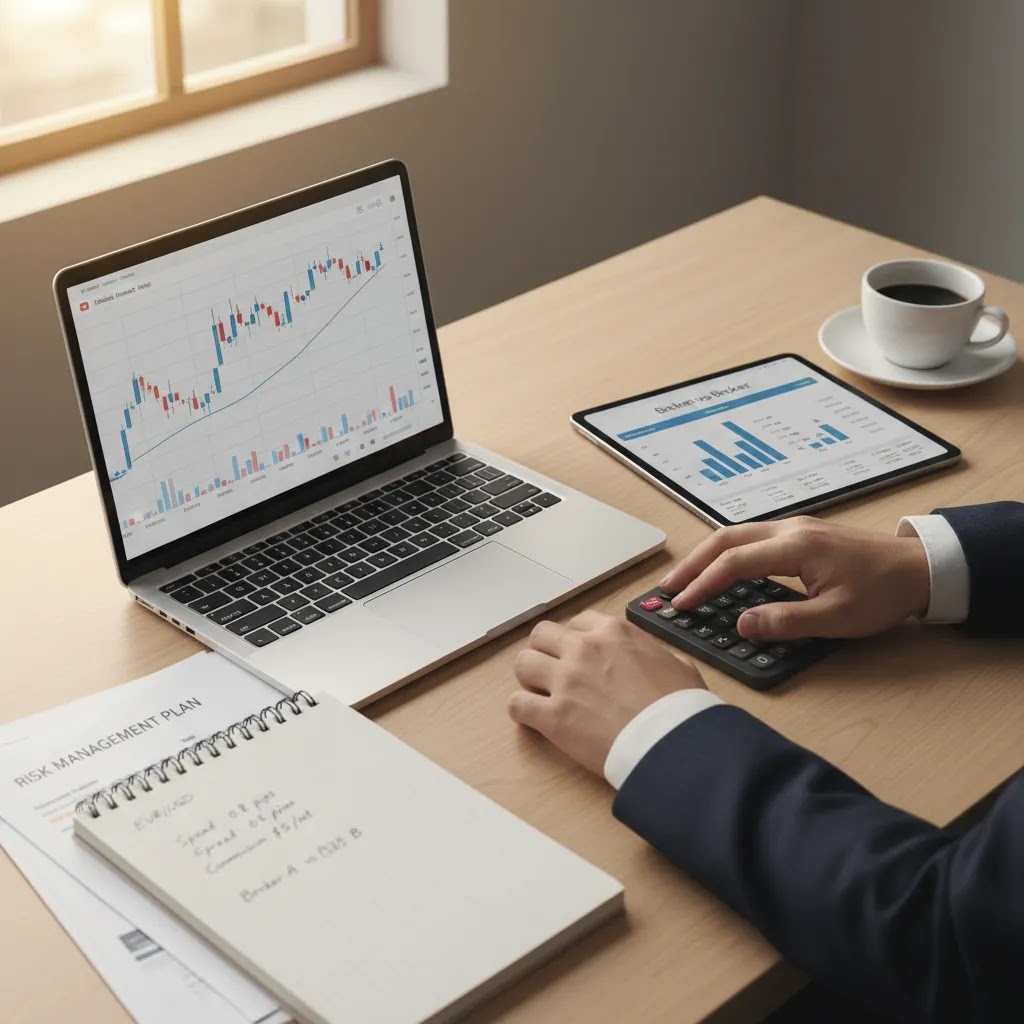
How to choose a forex broker as a beginner
Once you understand the forex market, choosing a broker becomes less about marketing claims and more about practical fit. These are the key criteria worth checking.
1. Regulation and local relevance
For UAE readers, regulation should come first. Depending on the broker, you may see oversight from the DFSA, SCA, ADGM FSRA, FCA, ASIC, or CySEC. Regulation does not remove trading risk, but it may improve standards around client money handling, disclosures, and conduct.
2. Fee transparency
Look beyond headline spreads. Check whether the account includes commissions, overnight fees, inactivity charges, or conversion costs. A broker with slightly wider spreads may still be competitive if the rest of the pricing is simpler.
3. Platform usability
Beginners usually benefit from a platform that makes order entry, chart reading, and risk controls easy to understand. If you expect to use indicators, study our guide to forex indicators so you know what tools actually matter before choosing a platform based on features alone.
4. Product range
Some traders want forex only. Others may later want stocks, ETFs, commodities, or indices. For example, Interactive Brokers and Saxo Bank offer broad multi-asset access, while several others focus more heavily on forex and CFDs.
5. Beginner support and risk tools
Education, demo accounts, stop-loss tools, and responsive support can make a real difference early on. This matters even more if you are balancing trading with a full-time job and need a platform that is simple to navigate under pressure.
Business24-7 aims to help you compare these factors objectively. If you are already narrowing down options, the Trading Platforms and Brokers category is a practical next step.
Islamic accounts and “is forex halal?” considerations in the UAE
UAE and wider MENA readers often have an extra layer of consideration: whether a broker offers an Islamic (swap-free) account, and how forex trading fits within Islamic finance principles. Brokers may market these accounts heavily, but the details matter more than the label.
An Islamic account is typically a swap-free version of a CFD account, meaning the broker does not apply the standard overnight financing swap that is commonly associated with interest. In practice, some brokers replace swaps with other charges, such as a fixed administration fee, wider spreads, or a time-limited swap-free period after which fees apply. That is why it is important to read the broker’s account terms and fee schedule closely, especially if you plan to hold positions overnight.
As for the question “is forex halal?”, there is not one universal answer that applies to every trader and every product structure. Scholarly views can differ based on factors such as whether there is riba through swaps or financing, how leverage is structured, whether the activity is speculative versus hedging a real exposure, and whether the contract mechanics meet requirements around possession and settlement. Forex through CFDs adds complexity here because it is a derivative contract rather than direct currency exchange.
Consider this: if faith-based compliance is important to you, focus on what you can verify before funding an account. Look for clear documentation of how swap-free pricing works, what fees replace swaps (if any), and whether the broker is overseen by credible regulators relevant to the UAE such as the DFSA, SCA, or ADGM FSRA. Regulation does not determine religious compliance, but it can improve disclosures and reduce the risk of unclear pricing. If anything in the account terms is vague, it is usually better to pause and seek clarification rather than assume “swap-free” means there are no holding costs or that the structure fits your requirements.
Pros and Cons
Strengths
- The forex market is highly liquid, especially in major currency pairs such as EUR/USD and GBP/USD.
- Trading runs 24 hours during the business week, which may suit UAE-based readers who need flexible market access.
- Many regulated brokers offer low minimum deposits, including $0 at Pepperstone and XTB, and $20 at Capital.com.
- Beginners can access educational tools, mobile apps, and demo-style learning environments on many mainstream platforms.
- Some brokers provide UAE-relevant support such as AED accounts, Arabic support, DFSA regulation, SCA regulation, or ADGM oversight.
Considerations
- Forex trading is high risk, and leverage can magnify losses as well as gains.
- Costs may be less straightforward than they first appear because spreads, commissions, overnight fees, and inactivity charges can all apply.
- Not all brokers have the same regulatory structure, so UAE traders need to verify whether a platform is regulated by bodies such as the DFSA, SCA, or ADGM FSRA.
- The 24-hour nature of the market may encourage overtrading, especially for beginners without a plan.
Frequently Asked Questions
What is forex trading in simple terms?
Forex trading means speculating on the price movement between two currencies. You buy one currency and sell another as part of a pair, such as EUR/USD. If the exchange rate moves in your favor, you may make a profit. If it moves against you, you may lose money. Capital is always at risk.
How does forex work for beginners?
Most beginners access forex through an online broker that offers currency trading, usually via CFDs. You choose a currency pair, decide whether you think it will rise or fall, and place a trade. Your result depends on the size of the move, your position size, and trading costs such as spreads or commissions.
What are major currency pairs?
Major currency pairs are the most actively traded pairs and typically include the U.S. dollar. Common examples include EUR/USD, GBP/USD, USD/JPY, and USD/CHF. These pairs often have stronger liquidity and, in many cases, tighter spreads than minor or exotic pairs, which may make them easier for beginners to follow.
Is forex trading legal in the UAE?
Forex trading may be accessed in the UAE through brokers operating under relevant regulatory frameworks. Depending on the provider, you may see regulation from the DFSA, SCA, or ADGM FSRA, as well as international regulators such as the FCA, ASIC, or CySEC. Beginners should always verify the broker entity and licensing details before funding an account.
Is forex riskier than stocks?
It can be, especially when leverage is involved. Forex markets often use leveraged products, which can increase both gains and losses. Stocks also carry risk, but forex may feel faster and more volatile to new traders because positions can change quickly around economic news, interest rate decisions, and market sentiment shifts.
How much money do you need to start forex trading?
Minimum deposits vary by broker. Based on current Business24-7 data, some platforms start at $0, while others require $20, $100, or more. A lower minimum deposit may make access easier, but it should not be the only factor in your decision. Regulation, fees, and platform quality usually matter more over time.
Is $100 enough to start forex?
$100 can be enough to open an account with some brokers, and based on our current platform data there are providers with $100 minimum deposits (and some with lower). The more important question is whether $100 is enough for you to manage risk responsibly given typical position sizing, spreads, and the way leverage can magnify both gains and losses. Many beginners use small sizes and treat early trading as a learning phase, often starting with a demo account before risking real funds.
What is the 90% rule in forex?
The “90% rule” is a popular online saying that claims most traders lose, often phrased as “90% of traders lose 90% of their money.” It is best treated as a simplified internet claim rather than a verified statistic that applies consistently across brokers and time periods. Still, it reflects a real risk: many beginners underestimate leverage and costs, trade without a plan, and make emotional decisions that can compound losses.
What is forex trading strategy?
A forex trading strategy is a set of rules for how you enter and exit trades, what pairs and times you focus on, and how you manage risk. A basic strategy usually includes a market condition you are looking for (such as trend or range), an entry trigger, a predefined exit plan (profit target and stop-loss), and rules for position sizing. No strategy can remove market risk, but a clear process can help reduce impulsive decision-making.
Is forex trading halal?
Views can differ, and the answer may depend on the product structure and how it is used. Common concerns raised include riba through overnight swaps or financing, the use of leverage, and whether the contract mechanics align with Islamic finance principles around exchange and settlement. Some brokers offer Islamic (swap-free) accounts, but traders should verify what fees replace swaps, whether conditions apply, and whether disclosures are clear. If this is important to you, consider reviewing the broker’s documentation carefully and seeking qualified guidance that fits your personal circumstances.
What is the best time to trade forex?
There is no single best time for everyone. Many traders focus on high-liquidity periods, especially when London and New York overlap. Those hours may offer tighter spreads and more active price movement. Still, higher volatility can also increase risk, so beginners may benefit from trading fewer sessions rather than chasing constant activity.
Can beginners make money in forex?
It is possible to make gains, but losses are also common, especially early on. Forex should not be treated as a guaranteed income source. Most beginners need time to understand pricing, risk controls, and trading psychology. A careful approach with small position sizes and realistic expectations is usually more responsible than aiming for fast results.
What should I check before choosing a forex broker?
Start with regulation, then compare fees, platform usability, risk management tools, product range, and customer support. UAE readers may want to prioritize brokers regulated by the DFSA, SCA, or ADGM FSRA where available. It also helps to compare minimum deposits, spread structure, and whether Islamic accounts or AED support are offered.
Key Takeaways
- Forex trading means buying one currency and selling another through a currency pair.
- Major pairs usually offer stronger liquidity and may be easier for beginners to track than exotic pairs.
- Trading costs can include spreads, commissions, overnight funding, and inactivity fees.
- Regulation matters, especially for UAE readers comparing brokers under the DFSA, SCA, or ADGM FSRA.
- Forex can be flexible and accessible, but it remains a high-risk market where capital is at risk.
Conclusion
Forex trading is simply the buying and selling of currencies, but trading it well usually takes more than learning a few definitions. You need to understand currency pairs, trading costs, leverage, market hours, and the risks that come with fast-moving global markets. For UAE-based beginners, broker selection matters almost as much as market knowledge, especially where regulation and fee transparency are concerned. Business24-7 is built to help readers sort through that decision carefully and without hype. Before you commit funds, compare regulated options, review platform fees, and read independent platform breakdowns so you know what you are signing up for. If you are ready for the next step, start with our broker comparisons and detailed forex platform resources.
Disclaimer: The content published on Business24-7 is intended for informational purposes only and does not constitute financial advice, investment recommendations, or an endorsement of any specific platform or financial product. Trading and investing carry significant risk, including the potential loss of capital. You should conduct your own research and, where appropriate, seek independent financial advice before making any investment decisions. Business24-7 does not accept responsibility for any financial losses incurred as a result of information published on this site.
Disclaimer
eToro is a multi-asset platform which offers both investing in stocks and cryptoassets, as well as trading CFDs.
Please note that CFDs are complex instruments and come with a high risk of losing money rapidly due to leverage. 61% of retail investor accounts lose money when trading CFDs with this provider. You should consider whether you understand how CFDs work, and whether you can afford to take the high risk of losing your money
This communication is intended for information and educational purposes only and should not be considered investment advice or investment recommendation. Past performance is not an indication of future results.
Copy Trading does not amount to investment advice. The value of your investments may go up or down. Your capital is at risk.
Crypto assets are complex and carry a high risk of volatility and loss. Trading or investing in crypto assets may not be suitable for all investors. Take 2 mins to learn more
eToro USA LLC does not offer CFDs and makes no representation and assumes no liability as to the accuracy or completeness of the content of this publication, which has been prepared by our partner utilizing publicly available non-entity specific information about eToro.

If you are new to financial markets, forex can seem confusing at first. Prices move quickly, currency symbols look unfamiliar, and many platforms make the market sound simpler than it really is. In plain terms, forex trading means buying one currency while selling another, usually through an online broker. For UAE-based readers, understanding the basics matters before opening an account,…