

If you are considering a forex trading course, the real question is not just whether education matters. It does. The better question is whether a paid course is likely to give you value beyond what you can already learn through free material, demo practice, and hands-on platform experience. For many UAE-based readers, that decision can feel harder than it should because the market is crowded with online academies, mentors, bootcamps, and signal sellers making broad promises. A worthwhile course may help you build structure, risk awareness, and discipline. A weak one may simply repackage free information at a high price. Before paying for any training, it helps to build a solid base with trading for beginners resources and understand what a course can realistically do for you.
Are forex trading courses worth paying for?
A forex trading course may be worth the money if it helps you avoid expensive beginner errors, builds a realistic understanding of risk, and gives you a structured process for practice. It may not be worth paying for if it relies on vague success stories, pushes signals instead of education, or presents trading as a shortcut to income.
For most new traders, the biggest value of a course is structure. Free videos and articles are widely available, but they are often fragmented. A good course can organize the learning path into core topics such as market structure, order types, position sizing, psychology, and journaling. That said, no course can remove trading risk, and no educator can guarantee results.
If you are still at the stage of learning basic terminology, start with a clear explanation of what is forex trading before paying for advanced instruction. In many cases, people buy education too early, before they even know whether they enjoy the process or can tolerate the risk involved in leveraged markets.
In the UAE context, safety also matters. Any course that funnels you toward opening an account with a broker should be viewed carefully. You should independently check whether that broker is regulated by authorities such as the UAE SCA or DFSA, or internationally recognized regulators such as the FCA, ASIC, or CySEC where relevant.
What a forex trading course should actually give you
A worthwhile forex trading course should give you more than market jargon and chart screenshots. It should help you understand how trading works in practice and what responsible preparation looks like.
- A structured curriculum covering forex basics, trade planning, risk management, and review habits.
- Clear risk education explaining drawdowns, leverage, stop-loss use, and why capital preservation matters.
- Practice frameworks such as journaling templates, scenario planning, and demo exercises.
- Realistic expectations rather than claims about easy profits, passive income, or high win rates.
- Transparent teaching scope so you know whether the course focuses on beginner concepts, technical analysis, swing trading, or day trading.
What it should not do is imply that education alone will make you profitable. Trading skill usually develops through repeated practice, emotional control, and careful review over time. A course may shorten the learning curve, but it cannot replace experience.
It also helps if a course encourages low-risk practice first. For example, using paper trading can help you test ideas without risking real money. That may sound basic, but it is one of the clearest signs that an educator takes risk seriously.
How much does it cost to learn forex, and what are you really paying for?
Pricing is one of the most confusing parts of the forex education market because courses are often sold as outcomes, not as a clear list of deliverables. From a practical standpoint, most traders will come across three broad tiers, and the value comes down to how much structure and feedback you are actually getting.
At the low end, you will see free courses, free webinars, and broker education libraries. These can be enough to learn basics like market structure, chart navigation, and common order types. The trade-off is that free content is rarely organized into a single process, and you usually will not get personalized feedback on your decision-making or risk control.
Then there are lower-cost paid courses, which can range from one-time purchases to monthly memberships. What many people overlook is what is included. In a lot of cases, you are paying for recorded lessons, a community chat, and occasional Q and A sessions. That can be useful if the course is well structured, but it is not the same as having your trades reviewed or having someone correct your position sizing mistakes in real time.
Premium programs and mentorships are typically the highest cost tier, and they often add live sessions, direct feedback, small-group coaching, or structured assignments. The best versions of these programs can offer accountability and faster error correction. The reality is that price still does not guarantee quality. Some expensive programs simply bundle the same content with more marketing and access.
Here is the thing: the tuition is not always the full cost of learning. Many course pages downplay the extra expenses that may come with serious practice. That can include market data or charting subscriptions, trading tools, books, and even better hardware if you are running multiple charts. If the course is in-person, travel and time off work can become the real cost, especially for UAE-based professionals with limited flexibility.
Time is another cost that deserves honesty. Learning forex is typically less about watching content and more about repetition. You will spend hours testing ideas, reviewing mistakes, and building consistency. Even if the course itself is affordable, the opportunity cost of those hours is real.
A simple value test is to separate what paid education can realistically buy from what it cannot. A good course may buy you structure, a clearer learning path, and feedback that helps you spot blind spots. It cannot buy profit certainty, remove drawdowns, or eliminate the psychological pressure that comes with leverage. If a course is priced as if it can remove those risks, that is usually a sign to slow down and ask tougher questions.
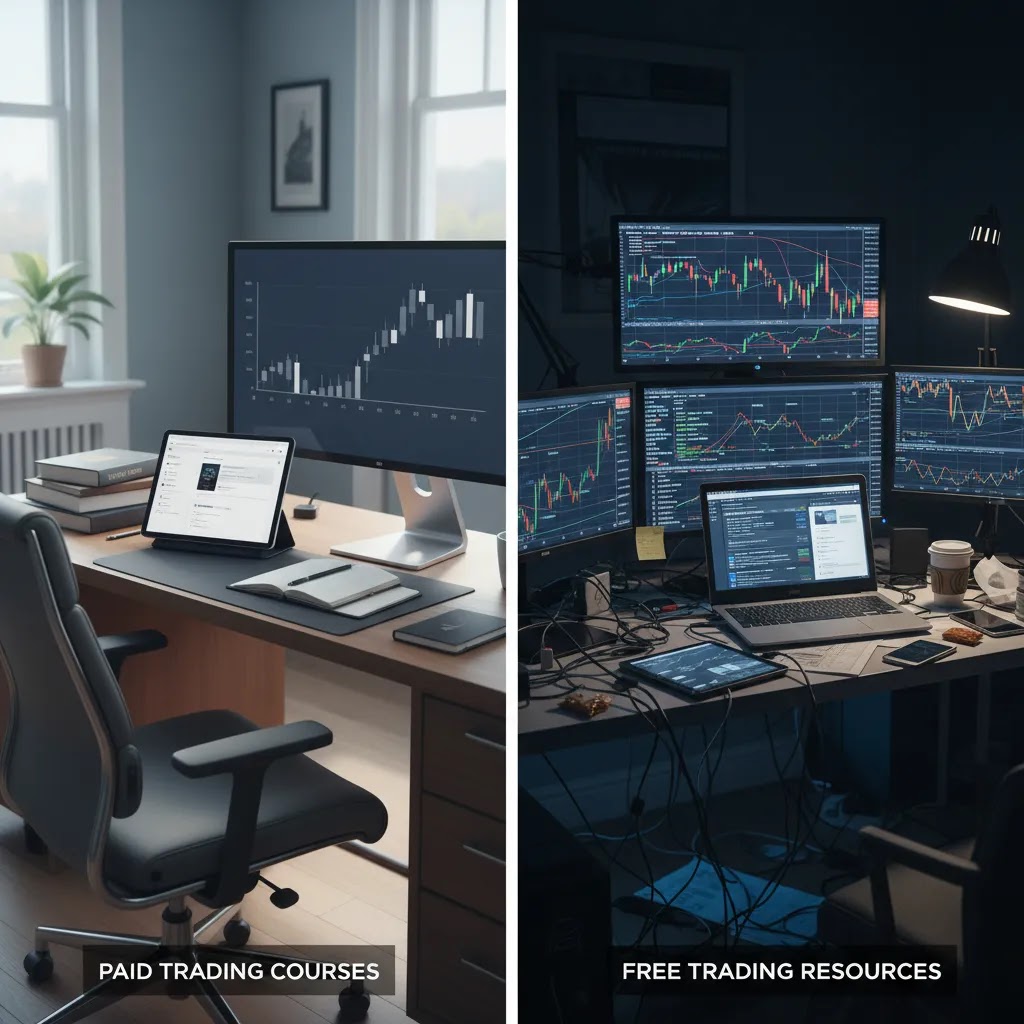
Paid vs free trading courses
Free trading education can be enough for many beginners. It is especially useful if your goal is to understand market basics, platform navigation, and whether forex is even the right market for you. Paid education tends to make more sense when you want a guided learning path, accountability, or live feedback.
The problem is that many paid programs are not materially better than free ones. Some reuse public information, dress it up with branding, and add community access as the main selling point. That does not automatically make them bad, but it does mean you should judge them on substance, not price.
A practical way to compare paid vs free trading courses is to ask:
- Does the paid course save you time through better organization?
- Does it explain risk better than free material?
- Does it include feedback, mentorship, or trade review?
- Does it offer a repeatable process rather than one-off setups?
- Could you learn most of the same concepts from broker education centers and market practice?
If the answer to most of these is no, paying may not be necessary yet. Many beginners would benefit more from spending time on practice and from avoiding common beginner trading mistakes than from buying an expensive course too soon.
Course format and duration: what most beginners underestimate
Many beginners underestimate how long it takes to turn information into a repeatable skill. A forex trading course might be marketed as a weekend class or a fast-track program, but skill-building usually happens over weeks and months because you need repetition across different market conditions.
Short courses can be useful for orientation, terminology, and platform basics. The risk is that the pacing can create false confidence. You may understand the concepts on Sunday and still struggle to execute them calmly on Wednesday when price moves quickly and you feel pressure to act. Longer programs tend to give more time for practice and review, which is where most of the learning happens, assuming the course is actually structured to support that.
Format matters as much as duration. Self-paced courses are flexible, which may suit UAE-based working professionals who need to study around long days, commuting, or travel. The trade-off is accountability. Many people buy self-paced education and never finish it, or they finish it without enough practice.
Cohort-based courses, where you move through the curriculum with a group over a set timeline, can help with routine and momentum. They may suit readers who learn better with deadlines and scheduled sessions. The downside is scheduling. If live sessions are held at fixed times, they may not fit shift workers or those with unpredictable calendars.
One-to-one mentoring is often positioned as the fastest path to improvement because feedback is direct. Think of it this way: it can help you identify mistakes earlier, especially around risk sizing and emotional decision-making. The limitation is cost, and the quality varies widely based on how transparent and process-focused the mentor is.
If you want a simple framework to set expectations, focus on process rather than any income target. Many learners do better with a consistent weekly routine, even if the hours are modest. That might include studying course material, doing focused demo sessions to rehearse the rules, and keeping a basic journal of what you did, why you did it, and what happened. A weekly review habit is often where patterns become obvious, including overtrading, moving stop-losses, or taking setups that do not match the plan.
None of this guarantees results, and it does not remove trading risk. It does help you avoid the common trap of consuming education without building execution skill. If a course is not designed to support practice and review, the timeline becomes irrelevant because you are paying for information, not improvement.

What broker education can and cannot replace
Some regulated brokers already provide meaningful educational tools, so a separate forex trading course may not always be your first priority. Based on Business24-7 product data, several brokers available to UAE readers include educational or beginner-friendly features that may reduce the need for paid training at an early stage.
AvaTrade has a $100 minimum deposit, spreads from 0.9 pips, and is regulated by ADGM FSRA, CBI, ASIC, and FSA Japan. Its listed features include comprehensive education and AvaProtect risk management. For a beginner, that education offering may be more useful than buying a separate course immediately, though the inactivity fee after 3 months is still worth noting.
XTB has no minimum deposit, spreads from 0.1 pips, and is regulated by DFSA, FCA, CySEC, and KNF. Its feature set includes extensive education and a platform that may suit learners who want integrated learning and execution. It also offers 0% commission stocks up to volume, though forex and CFDs still involve spread costs and trading risk.
eToro has a $200 minimum deposit and is regulated by CySEC, FCA, ASIC, and ADGM. Its social and copy trading features may help users observe market behavior, but observation is not the same as learning a method. Social features can create false confidence if you copy others without understanding risk.
Plus500 and Capital.com may also appeal to newer traders because of simple interfaces and lower barriers to entry. Plus500 is DFSA regulated and begins from $100, while Capital.com is SCA regulated in the UAE with a low $20 minimum deposit and spreads from 0.6 pips. Simplicity, however, should not be confused with education depth.
Broker education can help you get started, but it usually does not replace a high-quality, structured trading curriculum with feedback. If you want more chart practice, a tradingview guide may be more practical than paying for motivational course material.
| Platform | Education or beginner feature | Minimum deposit | Regulation | Fee note |
|---|---|---|---|---|
| AvaTrade | Comprehensive education, AvaProtect risk management | $100 | ADGM FSRA, CBI, ASIC, FSA Japan | Competitive spreads; inactivity fee after 3 months |
| XTB | Extensive education, beginner-friendly platform | $0 | DFSA, FCA, CySEC, KNF | Spreads from 0.1 pips; no commission on real stocks up to volume |
| eToro | Copy trading, social trading, Smart Portfolios | $200 | CySEC, FCA, ASIC, ADGM | No commission on real stocks; spreads on CFDs |
| Capital.com | AI-powered insights, mobile-first usability | $20 | SCA, FCA, CySEC, ASIC | Spread-only; no commissions on most instruments |
| Plus500 | Simple interface, risk management tools | $100 | DFSA, FCA, CySEC, ASIC, MAS | Spread-only pricing; overnight funding fees apply |
How to evaluate a course before you spend money
If you are comparing forex trading courses in Dubai or online programs marketed to UAE residents, use a checklist before paying anything.
- Check for realistic claims. Be cautious if a course emphasizes luxury lifestyles, win rates without context, or fast income. Responsible educators usually focus on process, risk, and skill development.
- Review the curriculum in detail. You should be able to see exactly what is covered. A vague promise to teach “institutional trading” is not enough.
- Look for risk management content. If position sizing, leverage control, and trade review are barely mentioned, the course may be incomplete.
- Separate education from broker promotion. If the real goal seems to be driving signups to one platform, treat the course carefully and verify the broker’s regulation yourself.
- Test the teacher’s transparency. Do they explain limitations, losses, and strategy conditions, or only show winning examples?
- Use free material first. Many readers should study free basics, practice on demo, and review regulated broker resources before moving to paid instruction.
If a course provider pushes you straight into live trading, that is a concern. A careful path usually starts with education, then demo execution, then small real-money exposure only if you understand the risks. You can also browse Business24-7’s Trading Fundamentals content and Trading Platforms and Brokers resources to compare education options against actual platform tools.
For UAE readers, regulation matters at the platform level even if the educator is independent. If a course recommends a broker, check whether it is overseen by bodies such as the SCA or DFSA locally, or by the FCA, ASIC, or CySEC internationally. Regulation does not eliminate risk, but it may improve accountability and consumer protections in most cases.
Common course “rules” and myths (including the 3-5-7 rule)
Course marketing often leans on simple-sounding “rules” that feel like shortcuts. You might hear numbered frameworks, proprietary naming, or slogans that claim to simplify trading into a few steps. Sometimes these are harmless teaching heuristics. Sometimes they are marketing hooks designed to make a strategy feel exclusive.
The 3-5-7 rule is a good example of why you should pause and ask for definitions. There is no single universal 3-5-7 rule in forex. Different educators use the phrase to mean different things, such as a sequence of timeframes, a checklist of confirmations, or a risk framework. Without a clear definition, it is not a method. It is a label.
Now, when it comes to proprietary rules, the right question is not whether they sound professional. The question is whether they are explained in a way that you can test and apply responsibly. If an educator mentions a special rule or system, ask what it actually does in terms of entries, exits, and risk control. Ask what market conditions it is designed for and where it tends to struggle. A strategy that works in a trending market may fail in a range, and any honest educator should be able to explain that.
Consider this: a credible course should also explain how results are measured. That includes losing periods, drawdowns, and how risk is controlled when trades do not work. If the only evidence shown is a highlight reel of wins or screenshots without context, you are not being shown a process. You are being shown marketing.
There are also recurring myths that deserve immediate skepticism because they encourage poor risk behavior. Daily income targets are one of the most common. Forex does not pay a salary, and pushing for a fixed amount each day can lead to overtrading and excessive leverage. Another red flag is the promise that you can turn a small account into full-time income quickly. Small accounts can be especially fragile because spread costs, slippage, and normal drawdowns can represent a larger percentage of the balance.
A good forex trading course should make you more cautious, not more impulsive. If a rule or slogan makes trading sound effortless, it is worth asking whether the course is designed for education or for selling confidence.

Pros and Cons
Strengths
- A good forex trading course may give beginners a structured path instead of forcing them to piece together random lessons from videos and forums.
- Paid education may help you understand risk management earlier, which could reduce avoidable mistakes with leverage and position sizing.
- Some courses include accountability, feedback, or live walkthroughs, which free resources often do not provide.
- Courses can save time if they are well organized and focused on practical skill-building rather than theory alone.
- For nervous beginners, a clear framework may improve confidence and make demo practice more productive.
Considerations
- Many expensive courses repeat information that is already available for free through broker education centers, articles, and demo practice.
- No course can guarantee trading success, and paying for education does not reduce market risk or protect your capital from loss.
- Some course sellers use performance claims, lifestyle marketing, or broker partnerships that may blur the line between education and promotion.
- Beginners often buy advanced strategy courses before mastering the basics, which can lead to confusion and overtrading.
Who paid forex education may suit
A paid forex trading course may suit you if you already understand the basics, know that forex interests you, and want a more organized learning path. It may also suit traders who value mentorship, routine, and structured review.
It may be less suitable if you are still deciding whether trading fits your temperament, schedule, or risk tolerance. In that case, free education, demo trading, and broker learning centers may be enough for now. Many first-time traders in the UAE are better served by learning slowly and verifying broker regulation before spending on either education or live trading.
Business24-7 editorial view
At Business24-7, our approach is to treat trading education the same way we treat brokers and platforms: with caution, evidence, and a focus on user safety. The site is built for readers who want clear, unbiased guidance before committing capital or paying for services, and that includes educational products. Braden Chase’s background as a former research specialist at Forex.com supports that research-first approach.
Our view is simple. A forex trading course can be worth the money, but only if it gives you genuine structure, realistic expectations, and practical risk education. It should not replace your own due diligence. If a course leads you toward opening a live account, compare the broker carefully, check regulatory coverage, and review fee structures before you proceed. For that next step, you can browse our broker resources, compare platform features, and read individual reviews to see how regulated options differ for UAE-based traders.
Frequently Asked Questions
Is a forex trading course necessary to start trading?
No. Many people begin with free educational resources, demo accounts, and broker learning centers. A paid course may help if you want more structure or feedback, but it is not a requirement. What matters more is understanding risk, learning platform basics, and avoiding the jump into real-money trading before you are prepared.
Are forex trading courses in Dubai better than online courses?
Not always. In-person courses may offer direct interaction, but quality depends on the curriculum and instructor, not the location alone. Online programs can be just as useful if they are transparent, well structured, and realistic about risk. Before paying, compare content depth, support, and whether the course pushes any specific broker or product.
How can I tell if a forex course is trustworthy?
Look for a clear curriculum, realistic claims, and strong risk management coverage. Be cautious if marketing focuses on luxury, easy income, or guaranteed success. Trustworthy educators usually explain losses, uncertainty, and the limits of any strategy. If a broker is recommended, check that broker’s regulation separately through recognized authorities.
Can a paid course make me profitable faster?
It may improve your learning process, but it cannot guarantee profitability. Trading performance depends on practice, discipline, market conditions, and risk control. A useful course may help you avoid some common mistakes, though you should still expect a learning curve and the possibility of losses even after training.
Should beginners start with free trading education first?
In many cases, yes. Free education can help you learn terminology, understand how forex works, and decide whether trading suits you. If you still feel committed after that stage, a paid course may make more sense. Starting free also helps you judge whether a paid program offers anything meaningfully better.
What is the biggest red flag in a forex trading course?
The biggest red flag is any promise of easy or consistent profits with little emphasis on risk. Other warning signs include vague teaching outlines, pressure to sign up quickly, and heavy reliance on screenshots instead of process-based instruction. Courses that push broker referrals without transparency also deserve extra caution.
Can broker education replace a forex trading school?
Sometimes, especially for beginners. Brokers such as AvaTrade and XTB list educational features in Business24-7 product data, which may be enough for building a basic foundation. Still, broker education is often designed to support platform use, so it may not offer the same depth, mentorship, or independent perspective as a dedicated course.
What should I learn before paying for a forex trading class?
You should understand currency pairs, leverage, spread costs, order types, and basic risk management. It also helps to practice on demo first so you know how charts and execution work. If you have not reached that stage yet, a paid course may be premature and harder to evaluate properly.
Do regulated brokers make trading safer for UAE residents?
Regulation may improve oversight and consumer safeguards, but it does not remove trading risk. For UAE residents, it helps to look for brokers supervised by bodies such as the SCA or DFSA, or internationally recognized regulators like the FCA, ASIC, or CySEC where relevant. Your capital can still be lost in trading even with a regulated provider.
Is it possible to make $1000 a day in forex?
It is possible for some traders to have days with large gains, but it is not a realistic expectation to treat $1000 per day as consistent income. Forex outcomes vary widely based on account size, leverage, strategy, market volatility, and risk limits. Chasing a fixed daily number often leads to overtrading and taking oversized risk. Even experienced traders can have losing streaks, and past performance does not predict future results.
Is $100 enough to start forex?
$100 can be enough to start learning the mechanics of placing trades if your broker allows it, and some platforms list minimum deposits around that level. The limitation is that small balances are sensitive to spread costs, overnight fees, and normal drawdowns, so risk management becomes harder. Many beginners are better served using a demo account first, then moving to small live sizing only after they understand leverage and have a process for limiting losses.
What is the 3 5 7 rule in forex trading?
There is no single standard definition. Different educators use “3 5 7” to describe different frameworks, such as a multi-timeframe checklist, a confirmation sequence, or a risk rule. If a course promotes a 3 5 7 rule, ask for the exact definition, when it is supposed to work, how risk is controlled, and how results are tracked during losing periods. Without those details, it is a slogan, not a tested method.
How much does it cost to learn forex?
It can range from free to expensive, depending on how you learn. Many people start with free broker education, articles, and demo practice. Paid courses may cost anywhere from a low monthly membership to higher-priced mentorship programs with live feedback. Beyond tuition, consider extra costs like charting tools, data subscriptions, books, and the time commitment required to practice and review consistently. Paying more may buy structure and feedback, but it cannot remove trading risk or guarantee profitability.
Key Takeaways
- A forex trading course may be worth paying for if it offers structure, risk education, and practical support beyond free resources.
- Many paid programs are overpriced for what they deliver, so review the curriculum and marketing claims carefully.
- Broker education from regulated platforms such as AvaTrade, XTB, eToro, Capital.com, and Plus500 may be enough for many beginners at first.
- Always separate education quality from broker promotion, and verify regulation independently through bodies such as the SCA, DFSA, FCA, ASIC, or CySEC where relevant.
- Trading involves risk, and no course, teacher, or platform can guarantee profits or remove the possibility of capital loss.
Conclusion
A forex trading course can be a sensible investment in your knowledge, but only if it helps you build skill and judgment rather than false confidence. The strongest programs usually teach process, discipline, and risk management. The weakest ones often sell excitement. If you are based in the UAE, take your time, compare education sources carefully, and check any broker recommendation against real regulatory and fee data before moving forward. Business24-7 exists to make that research easier. If you are weighing platforms after your education phase, browse our broker comparison resources, review platform features, and use our guides as a reference point before making a final decision.
Disclaimer: The content published on Business24-7 is intended for informational purposes only and does not constitute financial advice, investment recommendations, or an endorsement of any specific platform or financial product. Trading and investing carry significant risk, including the potential loss of capital. You should conduct your own research and, where appropriate, seek independent financial advice before making any investment decisions. Business24-7 does not accept responsibility for any financial losses incurred as a result of information published on this site.
Disclaimer
eToro is a multi-asset platform which offers both investing in stocks and cryptoassets, as well as trading CFDs.
Please note that CFDs are complex instruments and come with a high risk of losing money rapidly due to leverage. 61% of retail investor accounts lose money when trading CFDs with this provider. You should consider whether you understand how CFDs work, and whether you can afford to take the high risk of losing your money
This communication is intended for information and educational purposes only and should not be considered investment advice or investment recommendation. Past performance is not an indication of future results.
Copy Trading does not amount to investment advice. The value of your investments may go up or down. Your capital is at risk.
Crypto assets are complex and carry a high risk of volatility and loss. Trading or investing in crypto assets may not be suitable for all investors. Take 2 mins to learn more
eToro USA LLC does not offer CFDs and makes no representation and assumes no liability as to the accuracy or completeness of the content of this publication, which has been prepared by our partner utilizing publicly available non-entity specific information about eToro.

If you are considering a forex trading course, the real question is not just whether education matters. It does. The better question is whether a paid course is likely to give you value beyond what you can already learn through free material, demo practice, and hands-on platform experience. For many UAE-based readers, that decision can feel harder than it should…