

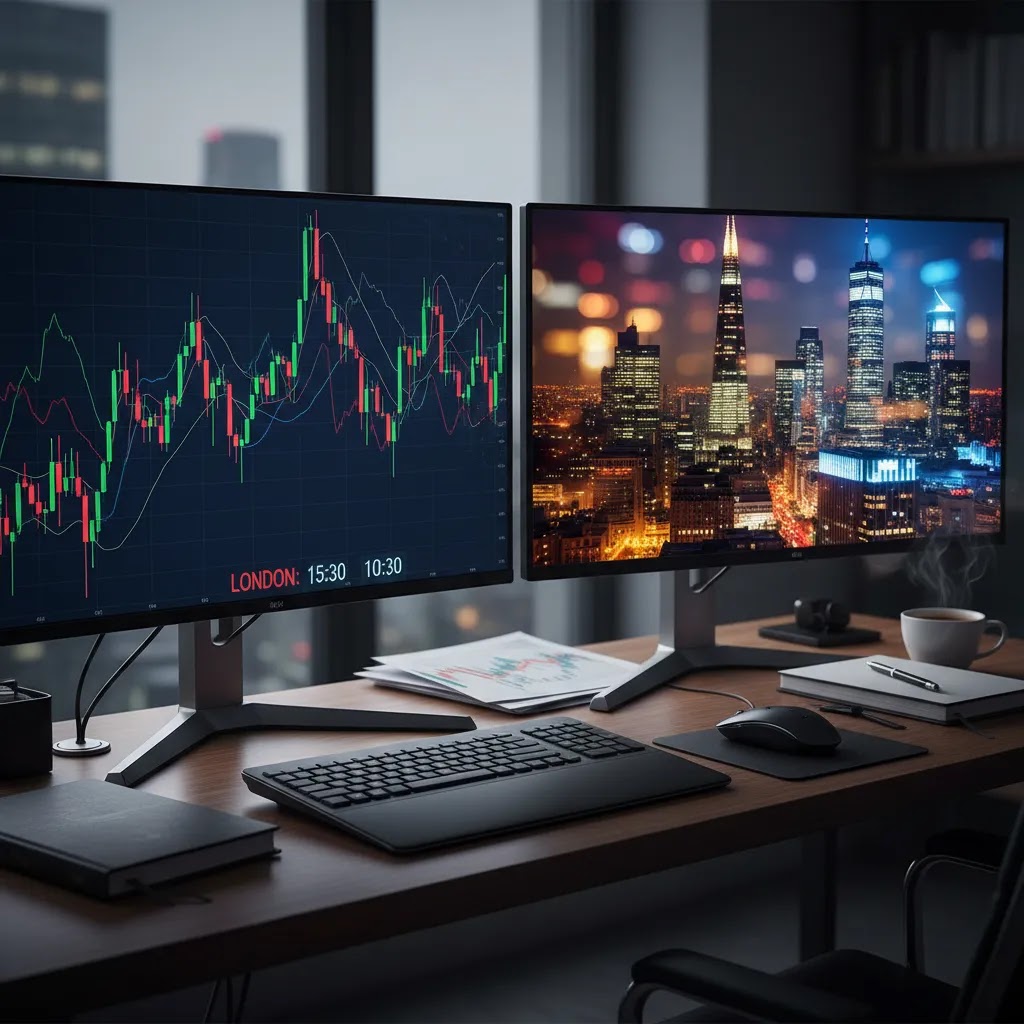
If you are learning forex, timing matters almost as much as the currency pair you choose. The market runs 24 hours a day during the trading week, but price behavior often changes sharply depending on which global session is open. For UAE-based traders, understanding forex trading sessions may help you avoid quiet periods, recognize when volatility typically rises, and build a more realistic routine around work or family life. If you are still building core knowledge, start with our trading for beginners guide first. In this article, you will see the main forex market sessions in UAE time, how the London and New York overlap tends to affect activity, and what beginners should watch before placing any trade. Trading carries risk, and active hours can increase both opportunity and potential loss.
What forex trading sessions mean
Forex does not trade through one centralized exchange. Instead, it moves across major financial centers as business hours shift from one region to another. That is why traders usually talk about the Sydney session, Tokyo session, London session, and New York session.
These session labels matter because liquidity, spreads, and volatility may change depending on who is active in the market. A quiet Asian session can look very different from the London open or the London-New York overlap. If you are new to the basics, our guide on what is forex trading explains how currency trading works before you focus on timing.
For UAE traders, session timing is especially practical. Dubai and Abu Dhabi residents often want to know whether they need to trade late at night, early in the morning, or during the workday. The answer depends on the currency pairs you follow, your risk tolerance, and whether you are looking for calmer or more active conditions.
More active sessions do not automatically mean better outcomes. Higher volatility may create more trading setups, but it could also increase slippage, sudden reversals, and emotional decision-making.
Forex market sessions in UAE time
The UAE typically operates on Gulf Standard Time, which makes it relatively convenient to follow both the Asian and European trading day. Session hours can shift slightly during daylight saving changes in some countries, so you should always confirm your broker’s platform clock.
| Session | Approximate UAE Time | Typical Character |
|---|---|---|
| Sydney session | 1:00 a.m. to 10:00 a.m. | Often quieter, early weekly positioning |
| Tokyo session | 3:00 a.m. to 12:00 p.m. | Often active in JPY and Asia-linked pairs |
| London session | 11:00 a.m. to 8:00 p.m. | Usually strong liquidity and broader market participation |
| New York session | 4:00 p.m. to 1:00 a.m. | Often active in USD pairs and U.S. data releases |
The london session forex time in uae is usually the most convenient for many local traders because it starts late morning and runs into the evening. The new york session forex time in uae begins in the late afternoon, which may also fit traders who work regular office hours.
The Asian session, including Tokyo, may suit early risers or traders focused on yen pairs. The Sydney session tends to be quieter, although it can still matter after major weekend news or at the start of the trading week.

How daylight saving time changes forex session times in the UAE
Here is the thing: UAE time is fixed on Gulf Standard Time (GST). The UAE does not switch in and out of daylight saving time. London and New York often do, which means the “same” session can appear to shift by about one hour on your UAE clock during parts of the year.
From a practical standpoint, this is where many traders get caught. You might build a routine around the London open or the London-New York overlap, then notice that the market feels different, liquidity arrives earlier or later, or your alerts do not line up with the most active window. In many cases, it is not the market changing, it is the clock relationship changing.
Consider this: the London session is often the most sensitive for UAE readers because the UK switches between standard time and daylight saving time seasonally. The New York session can also shift because the U.S. changes clocks, and the U.S. and UK do not always switch on the same date. That creates short periods where overlaps start earlier or later than you expect in Dubai or Abu Dhabi.
What many people overlook is that “UAE session times” published online are typically approximations. The most reliable approach is to check today’s session timing directly inside your trading setup. Most brokers show a server time on the platform (often on MT4 or MT5), and many charts display a market watch clock or timestamps that can be compared against your phone’s UAE time. If your platform server time is different from your local time, you will want to understand that offset first before you plan trades around opens and overlaps.
Think of it this way: if you trade the overlap because spreads are typically tighter and movement is more consistent, being one hour early can put you in a thinner transition period. Being one hour late can mean you miss the most liquid part of the window. Trading carries risk either way, but checking the session schedule on the day may help you avoid avoidable execution issues.
Best times to trade forex from the UAE
The best time to trade forex depends on your strategy, not just the clock. Most beginners often do better during periods with stronger liquidity and clearer price movement rather than very thin overnight conditions.
For many UAE-based retail traders, the London session may be the most practical starting point. It often brings tighter pricing in major pairs and more consistent movement than the very early hours. The New York session can also be relevant, especially if you follow U.S. economic releases or pairs such as EUR/USD, GBP/USD, and USD/JPY.
The most watched period is usually the london new york overlap, which tends to run from 4:00 p.m. to 8:00 p.m. UAE time. This overlap often sees high participation, stronger liquidity, and sharper reactions to news. That can be useful for active traders, but it may also be challenging for beginners who are still learning risk control.
If your goal is slower decision-making, you may prefer parts of the Tokyo session. If your goal is faster intraday movement, London and the overlap typically attract more attention. Understanding timing also helps when comparing forex to other instruments, so our article on stock market hours may be useful if you trade across multiple markets.
Which forex session is open now? A quick UAE-time method
If you are trying to trade consistently, a simple utility question matters: which session is open right now? You do not need a separate website for this if you understand the UAE time blocks and then confirm them against your broker’s platform clock.
In typical conditions, you can think in UAE time blocks like this. Early morning is usually Tokyo-led activity, late morning through afternoon is typically London-led activity, and late afternoon into the evening is where London and New York overlap tends to be most active. Late evening is often New York-led trading, and the quietest stretch for many major pairs can appear after New York winds down and before Asia builds back up.
Overlaps are what make this more than a simple map. London and New York overlap is usually the key window for many major pairs, while the Sydney-Tokyo overlap is often less dramatic and can feel more pair-specific, such as AUD/JPY or NZD/JPY. The overlap does not guarantee “better” trades, but it often changes how price moves and how orders get filled.
Now, when it comes to real-world execution, your broker may display market hours differently. Some platforms show server time rather than your local UAE time, and that can create confusion when you read session times online. A quick cross-check is to look at the current time shown on your platform charts, compare it to the time on your phone, and then map that to the session you believe is active. If the offset is not what you expected, adjust your routine around the platform clock, not around memory.

How market overlap affects volatility
Market overlap happens when two major forex sessions are open at the same time. This is important because more banks, institutions, funds, and retail traders are active together, which may increase volume and price movement.
The most important overlap for many traders is London and New York. During this window, major USD and EUR pairs may see their highest intraday activity. Spreads can sometimes remain competitive on regulated brokers, but fast moves can also trigger stop-loss orders quickly. Market session volatility is not automatically favorable if your position size is too large.
There is also some overlap between Sydney and Tokyo, though this is usually less dramatic. That period may matter more for AUD/JPY, NZD/JPY, and related pairs.
Economic calendars matter as much as session clocks. A quiet London session can suddenly become active after inflation data, central bank comments, or U.S. payrolls. Session awareness should be one part of your planning, not the whole strategy.
For readers specifically researching the regional setup, our forex trading uae guide explains broker access, regulation, and practical considerations for local residents.
What happens at session opens and closes
Session overlap explains a lot, but session transitions are often where beginners feel the difference most clearly. Around the London open and New York open, liquidity often changes quickly as more participants come online, orders hit the market, and price can reprice faster than it did minutes earlier.
What many people overlook is that spreads can widen briefly during these handoffs, even with well-regulated brokers and even on major pairs. This does not automatically mean a broker is doing something wrong. It is often a reflection of how underlying liquidity providers quote prices as the market adjusts to a new wave of orders.
It also helps to separate “more volatility” from “tradable conditions.” Volatility simply means price is moving. Tradable conditions usually mean you can enter and exit with execution quality that matches your plan, including acceptable spreads and manageable slippage. Slippage is the difference between the price you expect and the price you actually get filled at, and it can be more noticeable during fast moves, thin moments, or major news releases.
For beginners, a simple, risk-aware habit is to treat the first part of a major open as a higher-uncertainty period. Some traders prefer to observe the first 15 to 30 minutes after London or New York opens before committing size, especially if they are still learning how their broker fills orders during active conditions. This is not a guarantee of better results, but it may reduce avoidable surprises while you build experience with execution.
The reality is that session opens and closes are also common times for breakouts and false breakouts. If you are using tight stops, market orders, or high leverage, these moments can magnify both gains and losses. Timing is useful, but risk control still does the heavy lifting.
Platforms that may suit session-based forex traders
If you plan to trade around session opens or market overlap, platform stability, spread structure, and regulation often matter more than marketing claims. Based on available Business24-7 product data, a few brokers stand out for different session-trading needs.
Pepperstone has a 4.5/5 rating, offers MT4, MT5, cTrader, and TradingView, and lists spreads from 0.0 pips on Razor with a $7 per lot commission. It is regulated by DFSA, FCA, ASIC, CySEC, and BaFin. For UAE-based traders, the DFSA regulation and $0 minimum deposit may appeal to active traders who want flexibility.
AvaTrade also holds a 4.5/5 rating and is regulated by ADGM FSRA, CBI, ASIC, and FSA Japan. Spreads start from 0.9 pips, the minimum deposit is $100, and the platform lineup includes MT4, MT5, AvaTradeGO, and WebTrader. Its education offering and AvaProtect risk management feature may be useful for newer traders learning session volatility.
Capital.com has a 4.0/5 rating, a low minimum deposit of $20, spreads from 0.6 pips, and regulation that includes the UAE SCA alongside FCA, CySEC, and ASIC. For beginners who prefer a simple app-based experience and lower funding threshold, it may be easier to start with than a more advanced platform.
XTB has a 4.0/5 rating, no minimum deposit, spreads from 0.1 pips, and DFSA regulation. Its xStation 5 platform and strong education resources may suit traders trying to understand how different forex market sessions affect price action.
If you are evaluating brokers before opening an account, Business24-7 can help you compare platforms side by side using real fee and regulation data. Our coverage is built for UAE readers who want a safer way to filter options before committing funds. You can browse the Trading Platforms and Brokers section, review platform-specific breakdowns such as Pepperstone, AvaTrade, Capital.com, or XTB, and return to Business24-7 whenever you need an independent reference point before making a decision.
Pros and Cons
Strengths
- Understanding forex trading sessions may help UAE traders focus on the hours when liquidity is typically stronger.
- The London session and London-New York overlap often fall at practical times for traders in Dubai and Abu Dhabi.
- Several brokers in Business24-7 data offer UAE-relevant regulation, including DFSA, SCA, and ADGM-linked oversight.
- Options such as Pepperstone and XTB offer low or no minimum deposit barriers, which may help cautious beginners start smaller.
- Session planning can support risk management by helping traders avoid random entries during thin market conditions.
Considerations
- Session times may shift slightly because of daylight saving changes outside the UAE, so platform clocks should be checked regularly.
- Higher volatility during overlap periods can increase both opportunity and risk, especially for inexperienced traders.
- Low spreads shown by brokers may depend on account type, such as commission-based Razor or Raw structures.
- Not every broker fits every trader, and regulation, fees, tools, and account features can differ significantly.
Who session-based trading suits
Session-based trading may suit UAE residents who want a structured routine rather than watching charts all day. It can be practical for professionals who are only available during the late-morning London open or the late-afternoon move into New York.
It may also suit beginners who want to reduce randomness by focusing on one repeatable time window. That said, very active sessions are not automatically easier. If you are still learning execution, order sizing, or stop placement, a calmer session could be a better training ground.
Traders who prefer long-term swing positions may care less about exact session opens than intraday traders do. Your strategy, availability, and emotional discipline should guide your schedule.
How to choose a broker if you trade by session
If your trading decisions depend on session timing, your broker choice deserves careful attention. A platform that feels fine in quiet hours may behave very differently during major overlap periods or data releases.
- Check regulation first. For UAE-based readers, regulation by bodies such as the DFSA, SCA, or ADGM FSRA may provide stronger reassurance than vague offshore claims. In the broader market, FCA, ASIC, and CySEC are also commonly recognized regulators in Business24-7 broker data.
- Look at spreads and commissions together. A broker advertising 0.0 pips may charge a commission, while a spread-only model could be simpler but more expensive in some conditions. Pepperstone lists 0.0 pips on Razor with a $7 per lot commission. Exness lists 0.0 pips on Raw with a $3.50 per lot commission, but its regulation set does not include a UAE regulator in the provided data.
- Review platform tools. Session traders often want fast charting, alerts, mobile access, and possibly TradingView, MT4, or MT5 compatibility. Pepperstone supports MT4, MT5, cTrader, and TradingView. AvaTrade supports MT4 and MT5, while XTB uses xStation 5.
- Consider your minimum deposit and account style. Capital.com starts at $20, AvaTrade at $100, and some brokers such as Pepperstone and XTB list $0 minimum deposits. A lower entry point may help beginners test execution quality without overcommitting capital.
- Think about support and local relevance. UAE-specific features such as AED deposits, Arabic support, or local regulatory presence may matter if you are funding from the region. eToro, AvaTrade, ADSS, and others in the product data include UAE-focused features that could improve day-to-day usability.
If you want to build knowledge before comparing brokers in detail, the Trading Fundamentals category is a good next step. Once you are ready to assess platforms more closely, you can move into broker reviews and side-by-side comparisons.
Frequently Asked Questions
What are the main forex trading sessions in UAE time?
The main sessions are Sydney, Tokyo, London, and New York. In UAE time, these are typically 1:00 a.m. to 10:00 a.m. for Sydney, 3:00 a.m. to 12:00 p.m. for Tokyo, 11:00 a.m. to 8:00 p.m. for London, and 4:00 p.m. to 1:00 a.m. for New York. Times may shift slightly during daylight saving changes in other countries.
What is the London session forex time in UAE?
The London session usually runs from about 11:00 a.m. to 8:00 p.m. UAE time. For many traders in Dubai or Abu Dhabi, this is one of the easiest sessions to follow because it begins late morning and continues into the evening. It is often associated with stronger liquidity in major currency pairs.
What is the New York session forex time in UAE?
The New York session typically runs from around 4:00 p.m. to 1:00 a.m. UAE time. This session may be especially relevant if you trade USD pairs or monitor major U.S. economic releases. It overlaps with London for several hours, which often creates one of the busiest periods in the forex market.
What is the best time to trade forex from the UAE?
For many retail traders, the London session or the London-New York overlap may offer the most active conditions. Still, the best time depends on your strategy, preferred pairs, and risk tolerance. More movement can mean more opportunity, but it can also increase losses if your trade management is weak.
What is the London-New York overlap in UAE time?
The London-New York overlap is usually about 4:00 p.m. to 8:00 p.m. UAE time. This period often brings higher liquidity and stronger price movement because two major financial centers are active at once. Many day traders watch this window closely, but beginners should be careful because markets can move quickly.
Is the Asian session good for beginner forex traders?
The Asian session may suit some beginners because price action can sometimes be calmer than during London or New York. It is often more relevant for yen pairs and Asia-Pacific currencies. Still, calmer conditions do not always mean easier trading, especially if spreads widen or your chosen pair lacks momentum.
Do forex brokers in the UAE offer good access to active sessions?
Many brokers available to UAE traders provide access throughout forex market hours, but the quality of execution, spreads, and tools can differ. Business24-7 product data includes brokers regulated by DFSA, SCA, and ADGM FSRA, such as Pepperstone, Capital.com, AvaTrade, XTB, and ADSS. Regulation may matter as much as session access.
Which broker features matter most for session trading?
Session traders often prioritize regulation, stable platform performance, competitive spreads, and useful charting tools. Depending on your style, MT4, MT5, cTrader, TradingView integration, or mobile alerts may all matter. You should also check commissions, minimum deposits, and whether the broker supports AED funding or local customer service.
Can I trade forex safely during volatile sessions?
No trading session is fully safe. More volatile periods may offer clearer intraday movement, but they can also magnify slippage, stop-outs, and emotional decisions. Risk management, position sizing, and broker quality are essential. Capital is at risk, and session timing alone does not improve a strategy that lacks discipline.
What is the 3 5 7 rule in forex?
The “3 5 7 rule” is not a universal forex market rule, and different educators use it in different ways. In many cases, it is presented as a simple risk and process framework, such as limiting how much you risk per trade, how many trades you take in a day, or how many setups you focus on in a week. If you see it referenced, treat it as a personal discipline guideline rather than a proven market edge, and make sure any risk limits match your own account size and tolerance for loss.
Is it possible to make $1000 a day in forex?
It may be possible for some traders under some conditions, but it is not a realistic baseline expectation for most retail accounts. Making $1000 per day consistently would typically require a large account size, substantial risk-taking, or both, and losses can occur just as quickly as gains, especially during volatile session overlaps. Past performance does not guarantee future results, and focusing on process, risk limits, and consistency is usually more sustainable than focusing on a daily dollar target.
Which forex session is open now?
You can identify the active session by checking your current UAE time and matching it to the typical session windows, then confirming it against your broker’s platform server time. As a general reference, early morning UAE time is usually Tokyo-led trading, late morning through afternoon is typically London-led trading, and late afternoon into evening is where London and New York overlap often brings the most activity. Because daylight saving time changes in the UK and U.S. can shift these windows relative to the UAE, it is smart to verify “today’s” timing on your platform before planning trades around an open.
What are the forex trading sessions in EST time?
In U.S. Eastern Time (EST or EDT depending on the season), the commonly referenced session windows are roughly: Sydney evening into early morning, Tokyo evening into early morning, London early morning into early afternoon, and New York morning into late afternoon. Exact clocks can vary by broker and can shift with daylight saving time, so traders typically confirm session hours using their platform time and a current market-hours reference. If you are in the UAE, the simplest approach is to plan in UAE time first and only convert to EST if you need to follow U.S.-timed news releases.
Key Takeaways
- Forex trading sessions help UAE traders understand when market activity is typically quiet or active.
- The London session usually runs from 11:00 a.m. to 8:00 p.m. UAE time, while New York usually runs from 4:00 p.m. to 1:00 a.m.
- The London-New York overlap is often the busiest trading window, but it may also bring higher risk.
- Broker regulation, spreads, platform tools, and minimum deposit all matter if you plan to trade specific sessions regularly.
- Business24-7 is most useful as a research step before choosing a broker, not as a substitute for your own due diligence.
Conclusion
Understanding forex trading sessions can give you a more practical view of when the market may be calm, active, or unusually volatile from the UAE. For many local traders, the London session and the London-New York overlap are the most convenient windows to monitor, but convenience should never replace risk control. The right session depends on your strategy, the currency pairs you trade, and your comfort with fast-moving markets. If your next step is choosing a broker, use Business24-7 as a reference point before you commit funds. You can browse our educational resources, compare regulated platforms, and review fees, tools, and minimum deposits in one place so your decision is based on evidence rather than hype.
Disclaimer: The content published on Business24-7 is intended for informational purposes only and does not constitute financial advice, investment recommendations, or an endorsement of any specific platform or financial product. Trading and investing carry significant risk, including the potential loss of capital. You should conduct your own research and, where appropriate, seek independent financial advice before making any investment decisions. Business24-7 does not accept responsibility for any financial losses incurred as a result of information published on this site.
Disclaimer
eToro is a multi-asset platform which offers both investing in stocks and cryptoassets, as well as trading CFDs.
Please note that CFDs are complex instruments and come with a high risk of losing money rapidly due to leverage. 61% of retail investor accounts lose money when trading CFDs with this provider. You should consider whether you understand how CFDs work, and whether you can afford to take the high risk of losing your money
This communication is intended for information and educational purposes only and should not be considered investment advice or investment recommendation. Past performance is not an indication of future results.
Copy Trading does not amount to investment advice. The value of your investments may go up or down. Your capital is at risk.
Crypto assets are complex and carry a high risk of volatility and loss. Trading or investing in crypto assets may not be suitable for all investors. Take 2 mins to learn more
eToro USA LLC does not offer CFDs and makes no representation and assumes no liability as to the accuracy or completeness of the content of this publication, which has been prepared by our partner utilizing publicly available non-entity specific information about eToro.

If you are learning forex, timing matters almost as much as the currency pair you choose. The market runs 24 hours a day during the trading week, but price behavior often changes sharply depending on which global session is open. For UAE-based traders, understanding forex trading sessions may help you avoid quiet periods, recognize when volatility typically rises, and build…