
If you trade forex or CFDs with leverage, understanding a margin call is not optional. It is one of the most important risk concepts for protecting your account balance, especially if you are new to leveraged markets in the UAE. A margin call usually happens when your account equity falls too close to the broker’s required margin, leaving too little free margin to support open positions. If you are still building your foundation, start with trading for beginners before using leverage. In this guide, you will learn the margin call meaning, how margin call levels work, how margin call in trading differs from a stop out, and practical ways to reduce the chance of forced liquidation. Since trading can lead to losses, not gains, this topic matters to every retail trader.
What a margin call actually means
A margin call is a warning that your trading account no longer has enough equity relative to the margin required to keep your open trades running. In simple terms, losses have reduced the cushion in your account, and your broker may require you to deposit more funds, reduce exposure, or accept that positions could be closed automatically.
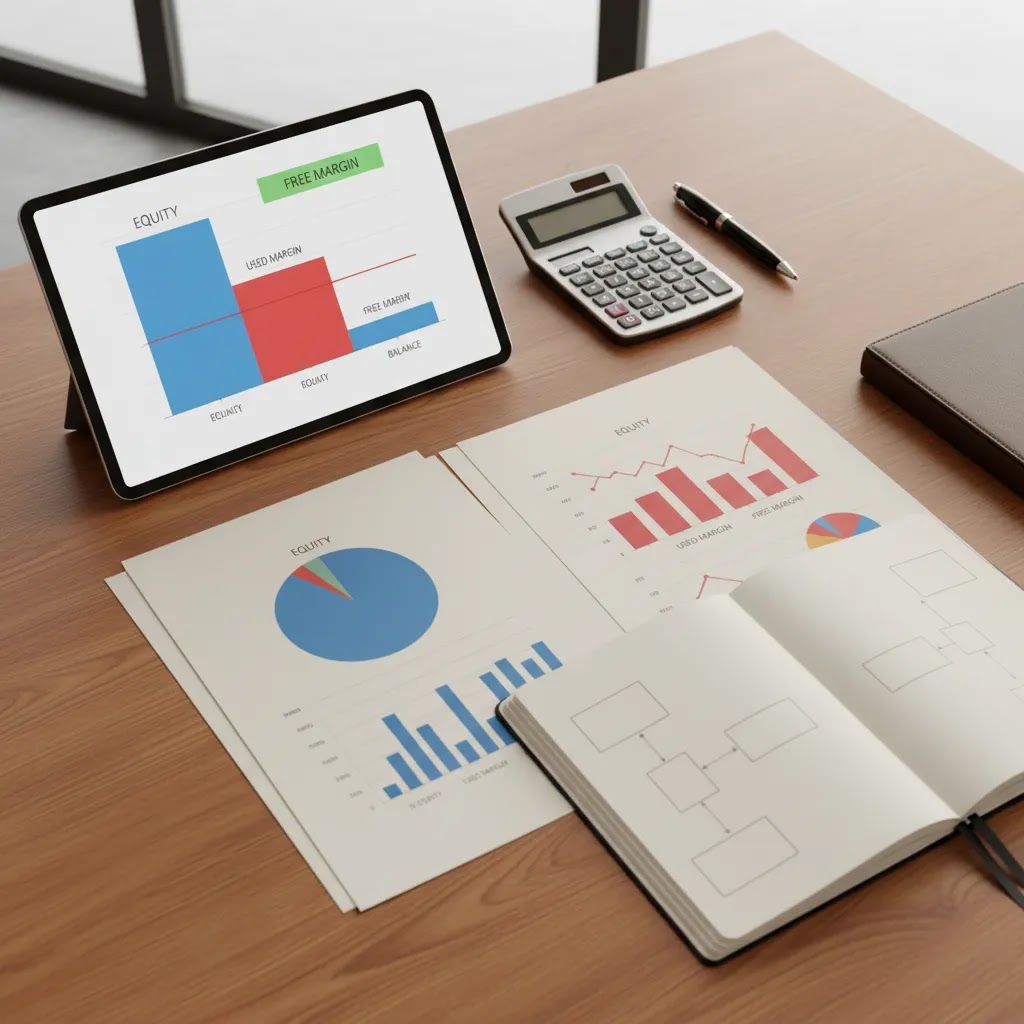
To understand this properly, you need four core terms:
- Balance: the cash in your account excluding current open profit or loss.
- Equity: your balance plus or minus unrealized profit and loss.
- Used margin: the amount locked by the broker to maintain your open leveraged positions.
- Free margin: equity minus used margin, which is the amount still available to absorb losses or open new trades.
A margin call does not necessarily mean your account is gone. It means the account is under pressure. If losses continue and you do nothing, the next stage could be a stop out, where positions are closed by the broker to limit further losses.
For readers learning the wider mechanics of leverage and margin, this is the point where borrowing buying power can start working against you just as quickly as it once expanded your market exposure.
Margin Call vs the movie “Margin Call” (and why traders should not confuse the terms)
If you searched “margin call” and saw results about a film, you are not imagining it. “Margin Call” is also the title of a well-known 2011 drama set inside an investment bank during a sudden crisis, which is why search results often blend entertainment and trading education under the same keyword.
Here’s the thing: the movie title uses the term because it sounds urgent and financial, but a real margin call is not a cinematic event. In trading, it is a risk-management threshold based on your account equity, used margin, and the broker’s margin rules. It is typically shown in your platform metrics as margin level and free margin, and if losses keep rising it can progress to a stop out where positions may be closed automatically.
So if you are here for trading, focus on the mechanics in this guide: margin level, margin call vs stop out, and how leverage can tighten your room for error. That is what determines whether a retail account receives warnings, restrictions, or forced liquidation.
Is a margin call based on a true story? What “real events” it is often compared to
The film “Margin Call” is fictional, not a documented true story. That said, it is widely viewed as inspired by themes associated with the 2008 financial crisis, including leverage, liquidity stress, rapid de-risking, and forced selling during fast market moves.
From a practical standpoint, that connection can be useful for traders if you treat it as a concept, not a rulebook. When markets gap, spreads widen, or volatility spikes, leveraged positions can deteriorate quickly. In retail forex and CFD accounts, that often shows up as falling equity, shrinking free margin, and a margin level that approaches the broker’s margin call and stop out thresholds.
Consider this: a movie narrative is not a substitute for your broker’s margin policy, product-specific requirements, or regulated risk disclosures. Margin rules vary by firm and jurisdiction, and your platform’s liquidation process is defined by account terms, not by what happens in a dramatized storyline.
Is “Margin Call” a good movie? (Why this question appears and how to refocus on trading risk)
Many readers land on this page while researching the film, so questions like “Is Margin Call a good movie?” show up frequently around this keyword. The movie is generally discussed as a tense, dialogue-driven financial drama, but whether it is “good” depends on what you like and it is not the point of a trading margin call explanation.
If you are here to learn trading risk, what matters is the real account math and the broker rules: margin level, stop out, leverage caps, and whether negative balance protection is offered for your account type and entity. These factors can shape how quickly losses may translate into restrictions or automatic position closures. Trading can lead to losses, and volatile markets can move faster than many new traders expect.
Think of it this way: the film dramatizes a fast institutional response to risk, while a retail margin event is usually more mechanical. Your platform continuously recalculates equity and margin level, and during sharp moves you might see margin pressure build in real time. That is why understanding the numbers and planning exits is more useful than relying on general impressions from entertainment content.
How a margin call works
Most brokers monitor your account using a margin level formula:
Margin level = (equity ÷ used margin) × 100
If this percentage drops to a specified threshold, the broker may issue a margin call. If it falls even further to the broker’s stop out level, one or more positions may be closed automatically. The exact thresholds vary by firm, product, and jurisdiction, so you should always read the broker’s account terms carefully.
A practical sequence often looks like this:
- You open a leveraged trade.
- The market moves against you.
- Your unrealized loss reduces account equity.
- Your free margin shrinks.
- Your margin level falls toward the broker’s margin call level.
- If losses continue, you may face forced liquidation at the stop out level.
This is why margin call explained in plain language usually comes down to one idea: too much exposure, too little remaining account cushion.
In most cases, brokers regulated by bodies such as the DFSA, SCA, FCA, ASIC, or CySEC provide clearer client documentation on margin requirements and account protections than firms with weaker oversight. That does not remove trading risk, but it may improve transparency.

Margin call example
Here is a simplified margin call example using round numbers.
You deposit $1,000 into a trading account and open a leveraged forex or CFD position requiring $200 in used margin.
- Account balance: $1,000
- Used margin: $200
- Initial equity: $1,000
- Initial free margin: $800
- Initial margin level: 500%
If the trade moves against you and your unrealized loss reaches $700:
- Equity becomes $300
- Used margin remains $200
- Free margin falls to $100
- Margin level becomes 150%
If the loss deepens to $850:
- Equity becomes $150
- Used margin remains $200
- Free margin becomes negative
- Margin level becomes 75%
If your broker’s margin call level were 100%, you could already be receiving warnings. If its stop out level were 50%, the platform might begin closing positions if losses kept increasing.
This is also why position sizing matters so much. A smaller trade size usually gives your account more room to withstand normal market swings before margin pressure builds.
Margin call in forex and CFDs
Margin call forex scenarios are especially common among newer traders because forex and CFDs are often offered with leverage, and small market moves can have an outsized effect on account equity. The same basic principle applies across asset classes, but speed and volatility may differ.
In forex, price moves are often measured in pips, and even tight spreads can be overshadowed by poor risk control. In CFDs, overnight funding costs, wider moves around news events, and gaps in volatile markets may also increase pressure on free margin.
If you trade with a broker that offers higher-risk products, you should pay close attention to:
- Margin requirements by instrument
- Retail leverage caps
- Stop out level rules
- Negative balance protection, where available
- Overnight financing or swap costs
Retail leverage is commonly capped at 1:30 with many regulated brokers serving UAE clients, though conditions may differ by asset or client classification. Higher leverage may sound attractive, but it usually reduces the distance between a normal market loss and a margin event.
That is why a broader risk management framework is more important than simply finding the lowest spread or the highest leverage advertisement.
How to avoid a margin call
If you are asking how to avoid margin call situations, the answer is usually not one setting or one platform feature. It is a combination of sensible trade sizing, lower leverage, and disciplined exit planning.
1. Use less leverage than the maximum allowed
Just because a broker allows a certain leverage ratio does not mean you should use it fully. Lower leverage may reduce the speed at which losses affect your free margin.
2. Keep more unused cash in the account
Maintaining a larger cash cushion may help your account absorb temporary drawdowns. Trading with almost all available margin used is one of the fastest ways to trigger margin stress.
3. Set exits before you enter
Using predefined risk limits could reduce the chance that one losing trade becomes an account-level problem. A planned stop loss take profit structure may be more effective than trying to manage risk emotionally in real time.
4. Size each position conservatively
Many traders focus on entry points and ignore how much they are risking. Position size should reflect account size, volatility, and acceptable loss on a single trade.
5. Monitor margin level, not just profit and loss
Some traders watch only the trade result. It is often better to watch equity, used margin, and free margin together. A trade can still be open while the account is getting dangerously close to a margin call level.
6. Be careful around major market events
Central bank decisions, inflation data, and geopolitical headlines can trigger sharp moves. Slippage or gaps may cause losses to expand quickly, especially in leveraged products.
7. Understand broker-specific rules
Margin call calculation and stop out rules differ by broker. Before opening an account, review how the firm defines margin level, whether it issues warnings, and how automatic liquidation works.
If you are still learning account mechanics, returning to trading for beginners can help reinforce the basics before risking capital in leveraged markets.
Platforms and margin risk tools to compare
A margin call is not just about trader behavior. Platform design, fees, and regulation also matter. Some brokers may offer better transparency, clearer risk tools, or account structures that suit cautious traders more than others. Business24-7 covers several regulated options relevant to UAE-based readers.
Here are a few examples based on available platform data:
- AvaTrade has a $100 minimum deposit, spreads from 0.9 pips, and features AvaProtect risk management. It is regulated by ADGM FSRA, CBI, ASIC, and FSA Japan, with AED accounts available.
- Pepperstone has no minimum deposit, spreads from 0.0 pips on Razor, and offers MT4, MT5, cTrader, and TradingView. It is regulated by DFSA, FCA, ASIC, CySEC, and BaFin. Razor includes a $7 per lot commission.
- Plus500 has a $100 minimum deposit, spreads from 0.8 pips, and includes risk management tools plus guaranteed stop-loss availability. It is regulated by DFSA, FCA, CySEC, ASIC, and MAS, though overnight funding fees apply.
- Capital.com has a $20 minimum deposit, spread-only pricing from 0.6 pips, and is regulated by the SCA, FCA, CySEC, and ASIC. For UAE readers, SCA regulation may be particularly relevant.
- XTB has no minimum deposit, spreads from 0.1 pips, and strong educational support. It is regulated by DFSA, FCA, CySEC, and KNF.
No platform can remove the risk of a margin call if you overuse leverage. Still, risk tools, transparent pricing, and strong regulation may make it easier to manage exposure responsibly. If you are comparing providers, browse Business24-7’s Trading Fundamentals resources and its UAE Regulation and Tax coverage before making a decision.
Business24-7’s editorial approach is built around helping UAE readers compare platforms with a safety-first mindset. That means looking beyond marketing claims and focusing on regulation, real fee structures, leverage policies, and risk controls. Braden Chase’s background as a former research specialist at Forex.com informs that approach, but the goal is still practical education, not sales language. If you later move from learning about margin to evaluating brokers, compare platforms side by side on Business24-7, read the full review before you open an account, and use the site as a reference point when checking how different firms handle leverage, spreads, and liquidation rules.
Pros and Cons
Strengths
- Understanding margin call mechanics may help you recognize account stress before positions are liquidated.
- Tracking free margin and margin level can improve decision-making beyond simply watching unrealized profit or loss.
- Learning margin call vs stop out differences helps you respond earlier, before forced liquidation becomes likely.
- Using regulated brokers with clear disclosures from authorities such as the DFSA, SCA, FCA, ASIC, or CySEC may improve transparency around margin rules.
- Risk tools offered by some platforms, such as guaranteed stop-loss features or educational resources, may support better trading discipline.
Considerations
- Margin call levels and stop out rules vary by broker, so there is no single universal formula that applies everywhere.
- Even with strong planning, volatile markets may move quickly enough to trigger losses and forced liquidation.
- Higher leverage increases both opportunity and risk, and many new traders underestimate how fast equity can fall.
- Fees such as spreads, commissions, and overnight funding can gradually reduce equity and contribute to margin pressure.
Frequently Asked Questions
What is margin call in simple terms?
A margin call is a warning that your account equity has dropped too close to the amount needed to support your open leveraged trades. It usually means you need to add funds, close positions, or reduce risk. If nothing changes and losses continue, the broker may start closing trades automatically at the stop out level.
What is the difference between a margin call and a stop out?
A margin call is generally the warning stage, while a stop out is the action stage. At margin call level, your broker may alert you that your account is under pressure. At stop out level, the broker may automatically close one or more positions to prevent losses from growing further. Exact rules depend on the broker.
How is margin call calculation done?
In most cases, brokers use margin level, calculated as equity divided by used margin, multiplied by 100. If that percentage falls below a certain threshold, a margin call may be triggered. Since each broker may define these terms slightly differently, it is important to review the account documentation before trading.
What causes a margin call in forex trading?
A margin call forex event usually happens when a leveraged currency position moves against you and reduces your account equity. Large position sizes, high leverage, poor risk control, or major market volatility can all contribute. Overnight costs and multiple losing trades at the same time may also reduce free margin faster than expected.
Can a stop-loss order prevent a margin call?
A stop-loss order may reduce the chance of a margin call by limiting losses earlier, but it does not guarantee protection in every market condition. During fast moves or price gaps, execution may occur at a worse price than expected. It is still one of the more practical risk tools available to many retail traders.
Is margin trading legal and regulated in the UAE?
Margin trading may be available through brokers operating under relevant regulatory frameworks, including the DFSA or SCA in the UAE, depending on the entity and service offered. International regulators such as the FCA, ASIC, and CySEC may also apply to firms serving UAE residents. You should verify the exact licensed entity before opening an account.
How much free margin should I keep?
There is no universal number that fits every strategy, but keeping a healthy buffer of free margin is generally safer than trading close to your limit. Traders who use most of their account as used margin leave little room for volatility. Conservative position sizing and lower leverage usually provide more flexibility.
What happens if I do not meet a margin call?
If you do not add funds or reduce exposure, and losses continue, your broker may begin liquidating open positions once the stop out level is reached. This process is often automatic. The exact order in which trades are closed depends on the broker’s policy, so reading the terms in advance is essential.
Which broker features matter most for margin risk?
Clear margin disclosures, strong regulation, transparent fee structures, reliable platform stability, and practical risk tools are all important. Features such as guaranteed stop-loss availability, educational resources, and easy access to margin data on the platform may help. They cannot remove trading risk, but they may support better risk awareness.
Is Margin Call based off a true story?
The movie “Margin Call” is fictional, although it is often compared to themes from the 2008 financial crisis. If you are researching trading rather than the film, remember that real margin calls are defined by your broker’s margin level rules and your account equity, not by a storyline.
Is Margin Call a good movie?
“Good” is subjective, but the film is commonly described as a tense financial drama focused on risk and decision-making during a crisis. For trading education, the useful takeaway is simpler: leverage can accelerate losses, and your platform’s margin level and stop out rules determine when positions may be liquidated.
What is the famous line from Margin Call?
The film is known for several quoted lines that reflect pressure and risk inside a financial firm. For retail traders, the safer approach is not to rely on quotes at all, and instead focus on your broker’s documented margin policy, your platform’s margin level, and your risk limits.
Is Margin Call on Netflix?
Availability changes by country and over time, and streaming catalogs in the UAE may differ from other regions. If you are trying to watch the film, check the current listing inside your streaming apps. If you are here for trading, the key topic is how margin level and stop out rules can affect leveraged positions during volatility.
Key Takeaways
- A margin call means your account equity is getting too close to the margin required to maintain open leveraged positions.
- Free margin, used margin, equity, and margin level are the core figures you need to monitor.
- Margin call vs stop out is an important distinction: one is the warning, the other may involve forced liquidation.
- Lower leverage, better position sizing, and disciplined stop-loss planning may reduce the chance of a margin call.
- Broker regulation and transparent margin policies matter, especially for UAE-based traders comparing leveraged platforms.
Conclusion
A margin call is one of the clearest reminders that leverage can magnify losses as quickly as it magnifies exposure. If you understand margin requirements, track free margin carefully, and control position size, you may reduce the odds of your account reaching a forced liquidation stage. For UAE-based readers, it also makes sense to compare how regulated brokers explain margin rules, fees, and risk tools before opening an account. Business24-7 is built to help you make that comparison with more confidence and less guesswork. As you continue your research, explore our educational guides, review broker-specific terms closely, and return to Business24-7 whenever you want a clearer, more balanced view of trading platforms and risk management topics.
Disclaimer: The content published on Business24-7 is intended for informational purposes only and does not constitute financial advice, investment recommendations, or an endorsement of any specific platform or financial product. Trading and investing carry significant risk, including the potential loss of capital. You should conduct your own research and, where appropriate, seek independent financial advice before making any investment decisions. Business24-7 does not accept responsibility for any financial losses incurred as a result of information published on this site.
Disclaimer
eToro is a multi-asset platform which offers both investing in stocks and cryptoassets, as well as trading CFDs.
Please note that CFDs are complex instruments and come with a high risk of losing money rapidly due to leverage. 61% of retail investor accounts lose money when trading CFDs with this provider. You should consider whether you understand how CFDs work, and whether you can afford to take the high risk of losing your money
This communication is intended for information and educational purposes only and should not be considered investment advice or investment recommendation. Past performance is not an indication of future results.
Copy Trading does not amount to investment advice. The value of your investments may go up or down. Your capital is at risk.
Crypto assets are complex and carry a high risk of volatility and loss. Trading or investing in crypto assets may not be suitable for all investors. Take 2 mins to learn more
eToro USA LLC does not offer CFDs and makes no representation and assumes no liability as to the accuracy or completeness of the content of this publication, which has been prepared by our partner utilizing publicly available non-entity specific information about eToro.

If you trade forex or CFDs with leverage, understanding a margin call is not optional. It is one of the most important risk concepts for protecting your account balance, especially if you are new to leveraged markets in the UAE. A margin call usually happens when your account equity falls too close to the broker’s required margin, leaving too little…