

If you have ever found a trade setup you liked but were unsure how much to buy or sell, position sizing is the step that protects your account from guesswork. For UAE-based traders comparing strategies, brokers, and platform tools, this matters just as much as entry timing. A trade idea may be reasonable, but the wrong trade size can turn a manageable loss into a serious setback. Position sizing helps you define risk first, then calculate how large the trade should be based on your account balance and stop-loss distance. It sits at the center of disciplined trading strategies, and it is one of the clearest differences between casual trading and structured decision-making.
What position sizing means
Position sizing is the process of deciding how much capital to allocate to a single trade based on a predefined risk limit. In plain terms, it answers one question: if the trade fails, how much are you willing to lose?
Most cautious retail traders use risk based position sizing. That means they set a percentage of account equity to risk per trade, often 0.5% to 2% depending on their experience, volatility tolerance, and strategy. Then they calculate the correct position size from the stop-loss distance.
This is closely tied to risk management. Without a position sizing strategy, traders often size too large after a winning streak and too small after losses, which may create emotional inconsistency. A position size calculator or lot size calculator can help, but it only works if your stop loss and risk amount are realistic.
For forex traders, you also need to understand pip value and lot size. If that area still feels unclear, reviewing pips, spreads, and lots usually makes the formula much easier to apply.
The basic position sizing formula
The most common position sizing formula is:
Position Size = Account Risk ÷ Trade Risk
To break that down:
- Account Risk is the dollar amount you are prepared to lose on one trade.
- Trade Risk is the loss per unit, share, or lot if price reaches your stop loss.
Here is the step-by-step version most traders use:
- Find your total account size.
- Choose your risk percentage per trade.
- Calculate the dollar amount at risk.
- Measure the stop-loss distance.
- Divide the dollar risk by the risk per unit.
Example account risk calculation:
- Account balance: $10,000
- Risk per trade: 1%
- Dollar risk: $100
If your stop loss is $2 away from entry on a stock trade, your position size would be:
$100 ÷ $2 = 50 shares
In forex, the same logic applies, but the trade risk depends on the pip distance and pip value. If your stop is 25 pips and each pip is worth $4 at your chosen size, your risk is $100. That would be your correct position size for that setup.
This is also why position sizing and risk reward ratio should be viewed together. A well-sized trade with a poor reward profile may still be unattractive. Good risk control and good trade structure usually need both.
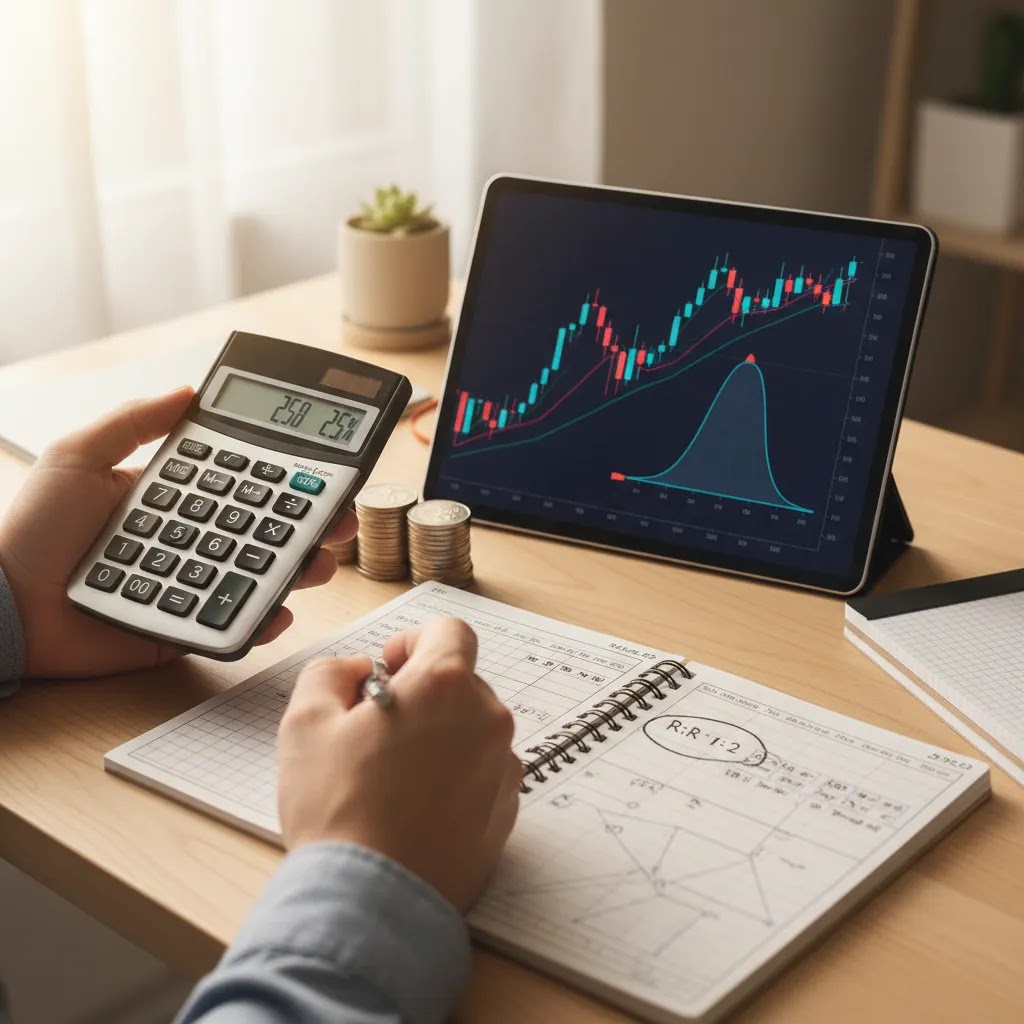
How to calculate position size step by step (with a simple template)
Here is the thing: most sizing mistakes happen because one input is missing or misunderstood. A calculator can be helpful, but you still want a repeatable checklist you can run through every time, especially if you trade different markets (stocks, forex, or CFDs) where the “value per point” can change.
A simple inputs checklist looks like this:
- Account equity right now (not last month)
- Your risk percentage for this trade
- Entry price
- Stop-loss price (set this first, even if you adjust later)
- Instrument specifics: pip value, tick value, contract size, or how $ P&L is calculated per 1 unit
From a practical standpoint, you can treat almost every market with the same structure:
- Account Risk ($) = Account Equity x Risk %
- Stop Distance (in price terms) = |Entry Price – Stop Price|
- Trade Risk per 1 unit ($) = Stop Distance x $ value per 1 unit of movement
- Position Size (units) = Account Risk ($) ÷ Trade Risk per 1 unit ($)
In stocks, the “$ value per 1 unit of movement” is usually straightforward. One share typically moves $1 in P&L for every $1 move in price. So trade risk per share is often just entry minus stop. In CFDs and forex, you usually have one extra step: convert stop distance into dollars using pip value, tick value, or contract size.
Think of it this way: your stop is what turns a chart idea into a defined number. Once you know how many dollars you lose per 1 unit if the stop is hit, the rest is simple division.
Common pitfalls that cause wrong position sizing are usually very specific:
- Forex pip value confusion, especially on JPY pairs where the quote format changes and pip size is often 0.01 instead of 0.0001
- Not accounting for contract size on CFDs, which can turn “1 lot” into a much larger exposure than expected
- Rounding issues on micro-lots or fractional shares, where your “perfect” size is not executable and you need to round down to keep risk within your limit
- Measuring stop distance incorrectly, such as using the candle’s high/low instead of your actual stop-loss order level, or forgetting to convert the stop distance into pips or points correctly
If you are unsure about any of these inputs, the safer approach is usually to size smaller until the calculation is clear. Trading always involves risk, and even correct sizing cannot prevent losses, but it can help keep losses within a range you planned for.
Worked examples for forex and stocks
A formula becomes useful only when you can apply it quickly. Below are simple examples that show how to calculate position size in common trading situations.
Forex example
Assume you have a $5,000 account and risk 1% per trade. Your maximum loss is $50. You want to trade EUR/USD with a 20-pip stop loss.
- Account size: $5,000
- Risk percentage: 1%
- Dollar risk: $50
- Stop loss: 20 pips
- Allowed risk per pip: $50 ÷ 20 = $2.50 per pip
Your trade size should be the lot size that produces about $2.50 per pip. A position size calculator may do this instantly, but the logic is the same even if you calculate it manually.
Stock example
Assume you have a $20,000 account and want to risk 0.75% on one trade. Your maximum loss is $150. You plan to buy a stock at $50 with a stop loss at $47.
- Entry: $50
- Stop: $47
- Risk per share: $3
- Dollar risk allowed: $150
- Position size: $150 ÷ $3 = 50 shares
That means your total position value would be $2,500, but your defined risk remains $150 if the stop is honored.
Why leverage does not replace position sizing
Some brokers allow high leverage, but leverage changes exposure, not risk discipline. For example, ADSS lists leverage up to 1:500 for professional clients, and Exness advertises unlimited leverage under conditions. Those figures may sound attractive, but they do not reduce the need for strict trade sizing. In most cases, higher leverage makes correct sizing even more important because losses can accelerate quickly.
Trading always involves risk, and capital is at risk. Past performance does not guarantee future results.
Risk and reward: how position sizing connects to risk-reward and win rate
What many people overlook is that position sizing is only one part of a complete trade plan. Your size is based on the stop loss, but your overall results are driven by how your stop loss, take profit, and win rate work together over a large number of trades. You can size perfectly and still have disappointing performance if the trade structure is incoherent.
One way traders simplify this is by thinking in “R,” which is your risk unit per trade. If you risk $100 on a trade, that trade is 1R. If you hit a take profit that is $200 away (with the same position size), that is +2R. If you stop out, that is -1R. Tracking performance in R multiples helps you focus on process rather than the emotional impact of dollar swings, especially as your account size changes.
This also makes the link to win rate clearer. A strategy could theoretically have a lower win rate but still be viable if the average win is larger than the average loss, measured in R. Another strategy could win more often but only by taking small profits while allowing occasional large losses. Position sizing supports both styles, but it cannot fix an approach where losses are not kept under control.
Consider this: a common hidden mistake is widening stops just so you can trade a bigger position or avoid being stopped out. On paper, traders may tell themselves the risk is unchanged because they lowered size, but in real markets wider stops can change the trade’s probability profile. You might be holding through more adverse movement, paying more spread and potentially more overnight funding on some products, and exposing yourself to larger gaps in fast markets. That is not guaranteed to be bad, but it should be a deliberate decision, not a workaround.
Volatility is the other key piece. In higher-volatility periods, price swings are larger, so a technically reasonable stop often needs to be wider. If you keep the same risk percentage, that usually means your position size must be smaller. This is one of the most practical ways position sizing protects accounts: it adapts exposure to the market environment instead of forcing a fixed lot size in all conditions.

Broker and platform tools that may help with position sizing
Position sizing is a strategy topic, but platform choice still matters. Some brokers make risk control easier through platform design, charting, or beginner-focused education. Based on Business24-7 product data, these are notable examples readers may want to research further:
| Platform | Starting Costs | Platforms | Regulation | Useful for |
|---|---|---|---|---|
| AvaTrade | Min deposit $100, spreads from 0.9 pips | MT4, MT5, AvaTradeGO, WebTrader | ADGM FSRA, CBI, ASIC, FSA Japan | Education and risk management features such as AvaProtect |
| Pepperstone | $0 minimum, spreads from 0.0 pips on Razor, $7/lot commission | MT4, MT5, cTrader, TradingView | DFSA, FCA, ASIC, CySEC, BaFin | Low spreads and advanced charting for active traders |
| XTB | $0 minimum, spreads from 0.1 pips | xStation 5, Mobile App | DFSA, FCA, CySEC, KNF | Education and a straightforward platform layout |
| Capital.com | Min deposit $20, spreads from 0.6 pips | Capital.com Web, Mobile App, MT4 | SCA, FCA, CySEC, ASIC | Low minimum deposit and mobile-friendly access |
If you are still comparing brokers, browsing Business24-7’s Trading Strategies resources alongside platform reviews can help you separate trade execution features from marketing claims. For broker-specific research, the site also maintains educational coverage in Trading Fundamentals.
Pros and Cons
Strengths
- Position sizing creates a repeatable framework for controlling risk on every trade.
- It may reduce emotional decision-making because the trade size is defined before entry.
- It works across forex, stocks, ETFs, commodities, and CFDs with only minor formula adjustments.
- It helps traders compare setups more objectively by linking trade size to stop-loss distance.
- It supports better long-term account preservation, especially during volatile market periods.
- It can be combined with platform tools such as MT4, MT5, TradingView, or broker calculators for faster execution.
Considerations
- It depends on using a realistic stop loss. If the stop is arbitrary, the position size may still be flawed.
- Manual calculation errors are common, especially in forex pairs with changing pip values.
- Very small accounts may produce position sizes that are difficult to execute precisely.
- High leverage can make traders feel safer than they are, even when the size calculation is poor.
- Position sizing does not improve a weak strategy by itself. It controls damage, but it does not create an edge.
Practical tips for applying position sizing consistently
The reality is that position sizing works best when it is part of a repeatable routine, not a one-off calculation. Many traders understand the formula but apply it inconsistently when markets move fast, or after an emotional win or loss.
A simple pre-trade routine that tends to reduce errors looks like this:
- Place the stop-loss level first, based on structure or invalidation, not on the position size you want.
- Calculate the position size from your account risk and that stop distance.
- Confirm total exposure: margin used, total portfolio risk if multiple trades hit stops, and any correlated positions that could move together.
Now, when it comes to calculators, they can save time, especially in forex where pip value changes across pairs and account currencies. The trade-off is that calculators are only as accurate as the inputs you enter. Manual calculation is sometimes safer as a double-check, especially if you are trading an instrument with a contract size you do not use often. One typo in stop distance or pip value can change the risk meaningfully.
Volatility is where consistent sizing is most tested. If markets become more volatile and your stop needs to be wider to stay realistic, forcing the same lot size often increases risk even if the trader does not intend it. A cleaner adjustment is usually to reduce your risk percentage for that period, then recalculate size normally. This helps avoid “revenge sizing,” where traders increase size after losses to try to recover quickly. That behavior can compound drawdowns because losses may cluster during unstable conditions.
If you take one practical rule from this section, it is this: keep the risk decision stable, and let the position size change. That is the core purpose of risk based position sizing, and it is what helps many traders stay in the game long enough to learn.
Who this approach suits
Position sizing suits almost any self-directed trader, but it is especially useful for beginners who need structure and intermediate traders trying to become more consistent. If you are in the UAE and comparing regulated brokers under bodies such as the DFSA, SCA, FCA, ASIC, or CySEC, position sizing gives you a practical filter for platform selection. You may want a broker that shows margin clearly, supports custom stop-loss orders, and provides stable execution on platforms like MT4, MT5, cTrader, TradingView, or a well-designed proprietary app. It is also valuable for time-constrained professionals who cannot monitor every trade constantly and need risk limits to be defined in advance.
Business24-7 editorial view
At Business24-7, position sizing is one of the first habits we encourage readers to build before increasing trade frequency or trying more complex strategies. The site is designed to help UAE-based traders evaluate platforms and tools with a safety-first mindset, and that includes asking whether a broker actually supports disciplined risk control rather than simply offering high leverage or promotional features.
That is where platform research becomes useful. For example, Pepperstone may appeal to experienced traders who want low spreads and advanced charting, while XTB and AvaTrade may suit readers who value education and a more guided learning curve. Capital.com may be worth a look for newer traders because of its low $20 minimum deposit and SCA regulation in the UAE. If you are comparing options, check the full reviews before opening an account and use Business24-7 as a reference point for fees, regulation, and platform fit.
How to choose a platform if position sizing matters to you
Not every broker supports disciplined trade management equally well. If position sizing is part of your money management approach, these are the main areas to evaluate.
1. Regulation and local relevance
Start with regulation. UAE readers may prefer brokers regulated by the DFSA, SCA, or ADGM FSRA, or internationally recognized regulators such as the FCA, ASIC, or CySEC. Regulation does not remove market risk, but it may improve client protection standards, disclosure, and oversight. Examples from Business24-7 data include Pepperstone and XTB under DFSA, Capital.com under SCA, and AvaTrade under ADGM FSRA.
2. Platform clarity
A good position sizing workflow depends on seeing entry price, stop loss, margin use, and exposure clearly. Brokers using MT4, MT5, cTrader, TradingView, or well-designed proprietary platforms may make this easier. Pepperstone offers MT4, MT5, cTrader, and TradingView, while XTB uses xStation 5. Simpler interfaces, such as Plus500 WebTrader, may help beginners, but they should still verify how stops and total exposure are displayed.
3. Trading costs
Frequent traders should pay close attention to spreads and commissions because they affect real trade risk. Pepperstone’s Razor account starts from 0.0 pips with a $7 per lot commission. AvaTrade starts from 0.9 pips. Capital.com uses spread-only pricing from 0.6 pips on most instruments. Overnight funding fees, inactivity fees, and commission structures may all influence the true cost of implementing a position sizing strategy over time.
4. Minimum deposit and account flexibility
If your account is small, minimum deposit requirements matter because they affect how flexibly you can size trades. Capital.com starts at $20, Exness at $10, AvaTrade at $100, and Pepperstone at $0. Lower entry requirements may help beginners practice risk based position sizing with smaller exposure, although smaller accounts can still run into practical sizing limits.
5. Education and risk tools
Newer traders often benefit from brokers that support learning as well as execution. AvaTrade highlights comprehensive education and AvaProtect. XTB also emphasizes extensive education. These features do not guarantee outcomes, but they may support more disciplined behavior while you are learning how to calculate position size correctly.
Frequently Asked Questions
What is position sizing in trading?
Position sizing is the method of calculating how large a trade should be based on your account size, risk tolerance, and stop-loss distance. Its purpose is to keep potential losses within a predefined limit. It is used in forex, stocks, and CFD trading, and it is a core part of structured money management.
How do I calculate position size?
Start by deciding how much of your account you are willing to risk on one trade, such as 1%. Convert that to a dollar amount, then divide it by the distance between your entry and stop loss. In forex, you also need pip value. A position size calculator may speed this up, but the method stays the same.
What is a good risk percentage per trade?
Many retail traders use 0.5% to 2% of account equity per trade, depending on strategy and experience. There is no universal figure that fits everyone. Lower risk percentages may help protect newer traders during learning periods, especially in volatile markets. The key is consistency rather than choosing an aggressive number.
Is position sizing important in forex?
Yes. Position sizing forex trades correctly matters because leverage can amplify both gains and losses. A trader may have a good setup but still take unnecessary damage if the lot size is too large. Understanding pip value, lot size, and stop-loss distance is central to correct forex trade sizing.
Can I use the same position sizing formula for stocks and forex?
Yes, the underlying logic is the same. You divide the amount you are willing to lose by the risk per share, contract, or pip-based position. The difference is mainly in how that risk is expressed. Stocks usually use dollar risk per share, while forex uses pips and pip value.
Does leverage change the correct position size?
Leverage changes your exposure and margin requirement, but it should not replace disciplined risk calculation. In most cases, leverage makes position sizing more important, not less. Even if a broker offers high leverage, your maximum acceptable loss should still determine the trade size.
Which platforms may help with position sizing?
Platforms that show stop-loss levels, margin, and exposure clearly may make position sizing easier. Based on Business24-7 data, AvaTrade, Pepperstone, XTB, and Capital.com are worth researching because they combine recognizable platforms, regulated status, and features that may support structured trading workflows.
Is position sizing enough to make a strategy profitable?
No. Position sizing manages downside risk, but it does not create profitable signals on its own. A weak entry strategy may still lose money even if trade size is controlled. Position sizing should be combined with a tested approach, realistic stop-loss placement, and a clear understanding of market conditions.
Why do beginners struggle with position sizing?
Beginners often focus on the setup and ignore the math behind risk. Others change their trade size emotionally after wins or losses. Forex calculations can also feel confusing because of pips, lots, and leverage. Using a clear formula and repeating the same process on every trade may help build consistency.
What is an example of position sizing?
A simple example is a $10,000 account risking 1% per trade. That means the trader risks $100. If a stock entry is $50 and the stop loss is $48, the risk per share is $2, so position size is $100 ÷ $2 = 50 shares. The key point is that the trade size comes from the stop-loss distance and predefined risk, not from guessing.
What is the 3-5-7 rule in trading?
The “3-5-7 rule” is often mentioned as a simple risk control guideline, but it is not a universal industry standard and it can mean different things depending on who is using it. In many cases, it refers to keeping risk small on any single trade and limiting total losses over a day or week (for example, stopping trading after a certain percentage drawdown). If you see a broker, educator, or community referencing it, treat it as a general guardrail rather than a proven rule, and define the exact percentages and time period clearly before relying on it.
How much money do day traders with $10,000 accounts make per day on average?
There is no reliable “average” daily profit figure that applies to most retail day traders, and many traders lose money, especially early on. Results vary widely based on skill, costs, slippage, strategy, and risk taken, and higher risk can produce larger swings in both directions. If you are evaluating day trading, it is usually more realistic to focus on process metrics you can control, such as risk per trade, risk-reward structure, and consistency, rather than expecting a fixed daily income.
Key Takeaways
- Position sizing helps define trade size based on acceptable loss, not emotion.
- The core formula is account risk divided by trade risk.
- Forex traders must factor in pip value and lot size, not just stop-loss distance.
- Regulated brokers and clear platforms may make disciplined risk control easier to apply.
- Position sizing limits damage, but it does not remove market risk or guarantee profits.
Conclusion
Position sizing is one of the simplest concepts in trading, but it often has the biggest effect on survival and consistency. If you know how much you are willing to lose before entering a trade, you are already making a more structured decision than many retail traders. For UAE readers comparing brokers, this topic also highlights what to look for in a platform: clear order controls, transparent costs, and regulation under bodies such as the DFSA, SCA, ADGM FSRA, FCA, ASIC, or CySEC where relevant. If you are refining your trading process, browse Business24-7’s strategy guides and detailed broker reviews before making platform decisions. It is a practical way to connect risk control principles with the tools you actually use.
Disclaimer: The content published on Business24-7 is intended for informational purposes only and does not constitute financial advice, investment recommendations, or an endorsement of any specific platform or financial product. Trading and investing carry significant risk, including the potential loss of capital. You should conduct your own research and, where appropriate, seek independent financial advice before making any investment decisions. Business24-7 does not accept responsibility for any financial losses incurred as a result of information published on this site.
Disclaimer
eToro is a multi-asset platform which offers both investing in stocks and cryptoassets, as well as trading CFDs.
Please note that CFDs are complex instruments and come with a high risk of losing money rapidly due to leverage. 61% of retail investor accounts lose money when trading CFDs with this provider. You should consider whether you understand how CFDs work, and whether you can afford to take the high risk of losing your money
This communication is intended for information and educational purposes only and should not be considered investment advice or investment recommendation. Past performance is not an indication of future results.
Copy Trading does not amount to investment advice. The value of your investments may go up or down. Your capital is at risk.
Crypto assets are complex and carry a high risk of volatility and loss. Trading or investing in crypto assets may not be suitable for all investors. Take 2 mins to learn more
eToro USA LLC does not offer CFDs and makes no representation and assumes no liability as to the accuracy or completeness of the content of this publication, which has been prepared by our partner utilizing publicly available non-entity specific information about eToro.

If you have ever found a trade setup you liked but were unsure how much to buy or sell, position sizing is the step that protects your account from guesswork. For UAE-based traders comparing strategies, brokers, and platform tools, this matters just as much as entry timing. A trade idea may be reasonable, but the wrong trade size can turn…