

Divergence trading is a popular technical analysis method used to spot momentum shifts before price fully turns. For UAE-based traders comparing strategies as carefully as they compare brokers, it can be useful because it adds structure to reversal analysis instead of relying on instinct alone. The key idea is simple: price makes one move, while an indicator such as RSI or MACD tells a slightly different story. That mismatch may signal weakening momentum, but it does not guarantee a reversal. If you are still building your chart-reading skills, start with our technical analysis guide and treat divergence as one tool within a broader risk-managed trading plan. In most cases, confirmation from trend context, support and resistance, and candle structure matters just as much as the divergence itself.
What divergence trading means
Divergence meaning, in trading terms, refers to a disagreement between price action and an indicator that measures momentum. If price reaches a new high but the indicator does not, momentum may be fading. If price drops to a new low while the indicator holds a higher low, selling pressure may be weakening.
Most traders use divergence to identify two broad possibilities. The first is a possible reversal. The second is a possible continuation after a pullback. This is why you will often hear about regular divergence and hidden divergence as separate concepts.
Used well, divergence trading strategy ideas can help you slow down and wait for evidence. Used poorly, divergence can tempt traders to call tops and bottoms too early. That is a real risk in fast-moving forex, indices, crypto, and commodity markets where momentum can stay strong longer than expected.
If you want to build a more complete read on chart structure, it helps to combine indicator signals with price action trading concepts such as swing highs, swing lows, rejection candles, and breakout failures.
Regular and hidden divergence
Regular divergence is usually associated with a possible reversal.
- Bullish divergence: Price makes a lower low, but the indicator makes a higher low. This may suggest that bearish momentum is weakening.
- Bearish divergence: Price makes a higher high, but the indicator makes a lower high. This may suggest that bullish momentum is weakening.
Hidden divergence is usually associated with trend continuation rather than a full reversal.
- Hidden bullish divergence: Price makes a higher low, while the indicator makes a lower low. This may support the case for an existing uptrend continuing.
- Hidden bearish divergence: Price makes a lower high, while the indicator makes a higher high. This may support the case for an existing downtrend continuing.
This distinction matters. Many new traders learn divergence examples that only focus on reversal setups. In practice, hidden divergence can be just as valuable because it may help you trade with the trend instead of constantly trying to fade it.
The third divergence type many traders track: exaggerated divergence
What many people overlook is that some traders also use a third label: exaggerated divergence. This typically describes a situation where price forms what looks like a double top or double bottom, but the indicator prints a clearer momentum difference on the second test.
In an exaggerated bullish setup, price tests a low again and holds roughly the same level (a double bottom), while RSI or MACD makes a higher low. In an exaggerated bearish setup, price retests a high (a double top), while the indicator makes a lower high. Traders often reference this type in range-bound markets or around a second test of a well-defined support or resistance area.
From a practical standpoint, exaggerated divergence is different from regular divergence because price is not making a new extreme. It is also different from hidden divergence because the focus is not on a pullback within a trend, it is on a retest that could precede a turn or a range continuation.
To avoid mislabeling it, think of a true double test as two swing points that are close enough to be meaningfully “the same level,” with a clear reaction in between. If price grinds higher into the second top without a real pullback, or if it prints a clean new swing high or low, you are usually looking at regular divergence or no divergence at all, not an exaggerated setup.
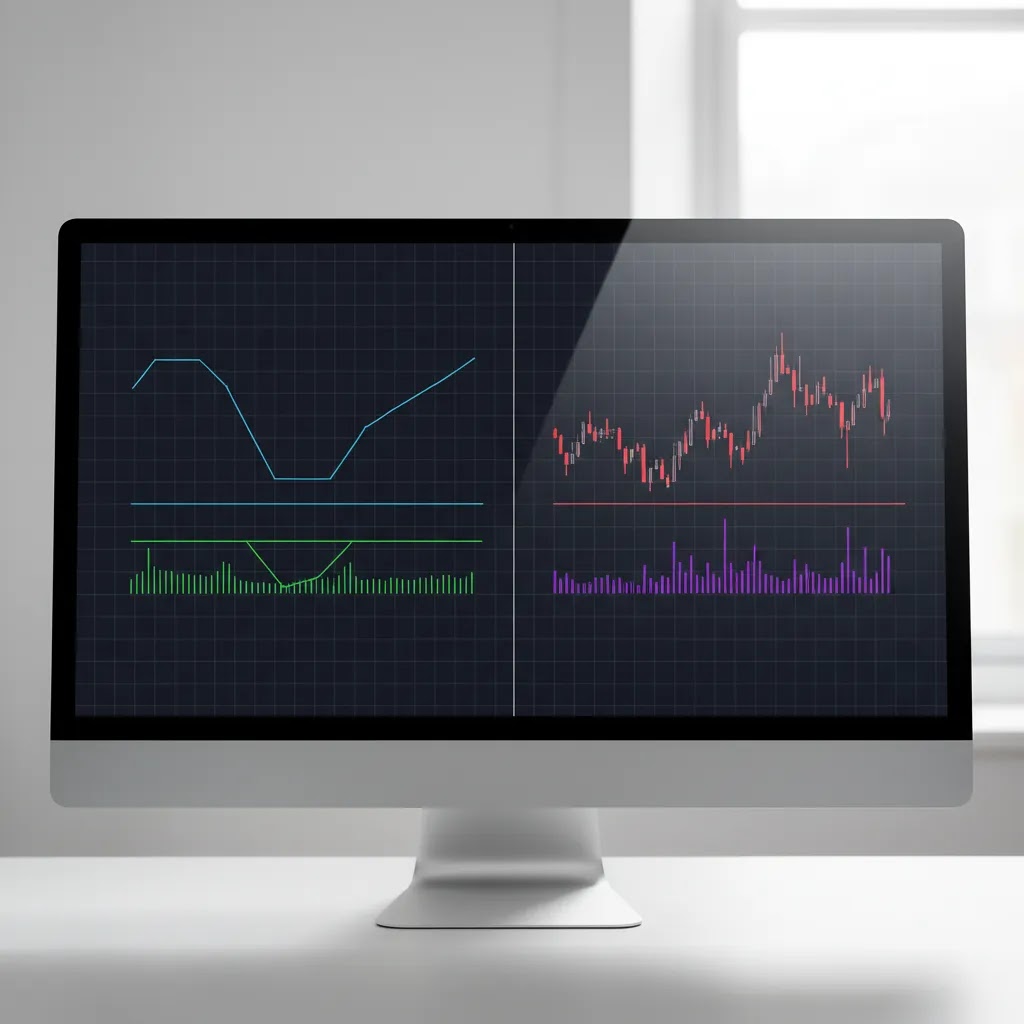
How to use RSI and MACD for divergence
The two most common tools for spotting divergence are RSI and MACD. Each has strengths and limitations, so your choice often depends on your chart style and the markets you trade.
RSI divergence
RSI compares the speed and magnitude of recent price movements. Many traders like it because the signal is visually clean. A lower low in price paired with a higher low in RSI can be easier to spot than on more complex indicators. If you want a refresher on settings and interpretation, see our guide to the rsi indicator.
RSI divergence may work well in ranging markets or after extended directional moves. It can, however, produce early signals. In strong trends, RSI may diverge several times before price actually turns.
MACD divergence
MACD is built from moving averages, so it tends to reflect trend and momentum together. A mismatch between price highs or lows and the MACD line or histogram may help you identify fading momentum. Our overview of the macd indicator explains the mechanics in more detail.
MACD divergence is often favored by traders who want slightly more smoothing than RSI. The tradeoff is that signals may appear later. That delay can reduce false alarms, but it may also mean entering after part of the move has already happened.
Which one is better?
There is no universal winner. RSI may feel more responsive. MACD may feel more stable. In most cases, what matters more is whether you define swing points consistently, use the same timeframe logic, and wait for confirmation before entering. Divergence on its own is rarely enough.
Entry and exit rules traders use with RSI and MACD divergence
Consider this: most divergence losses are not caused by “wrong divergence,” they come from vague execution. Traders see the signal, then improvise the entry and exit. Having a repeatable framework can make it easier to review performance, even though it cannot remove market risk.
One common entry approach is structure-based confirmation. After bullish divergence, some traders wait for a break of the most recent minor swing high, or a close back above a level that had been acting as resistance. After bearish divergence, they may wait for a break below a minor swing low, or a close back below a support zone that price failed to hold. The basic logic is that price should prove it can shift structure, not just show indicator disagreement.
Another entry trigger is a trendline break on the trading timeframe. Traders draw a simple trendline across the corrective leg, then look for a candle close through it. Some will enter on the close, while others wait for a retest of the broken line or the broken swing level to see whether it holds as new support or resistance.
On the risk side, many divergence traders use invalidation-based stops tied to the swing that created the divergence. For bullish divergence, that often means the stop is placed below the divergence low or below the support area that should hold if the idea is correct. For bearish divergence, the stop is commonly set above the divergence high or above the resistance area. This does not guarantee protection, especially in volatile markets, but it keeps risk tied to a clear chart level rather than an arbitrary distance.
Exits are handled a few different ways. Some traders look to take partial profits as price approaches prior structure, such as a previous swing high after bullish divergence or a previous swing low after bearish divergence. Others trail the position using swing lows and swing highs, or a moving average, so the exit adapts if the move extends. The key is consistency. If your exit rule changes trade to trade, it becomes difficult to judge whether divergence is helping your decision-making.
Timeframe selection matters as well. Divergence on higher timeframes like the 4H or daily can reflect a larger shift in momentum, but it may take longer to play out and can include deeper pullbacks. Divergence on very low timeframes can produce more signals, but it also tends to include more noise. Problems often show up when traders mix timeframes without a plan, such as spotting a divergence on a 5-minute chart while placing stops and targets based on a 4-hour structure. You can use multi-timeframe analysis, but your entry, stop, and exit logic usually needs to be aligned to the same timeframe decision.
How traders apply divergence in real chart work
A practical way to trade divergence forex or CFD markets is to follow a simple sequence:
- Identify the market structure and trend direction on the higher timeframe.
- Mark clear swing highs or lows on the trading timeframe.
- Check whether RSI or MACD confirms or disagrees with those swings.
- Wait for confirmation, such as a break of a minor trendline, a support or resistance reaction, or a candle close back into structure.
- Define risk before entry, including where the setup is invalidated.
For example, bullish divergence could appear after a sharp selloff into support. Price posts a fresh low, but RSI forms a higher low. That may suggest the sellers are losing momentum. A trader might still wait for a higher low or bullish candle close before entering, rather than buying immediately.
Bearish divergence works the same way in reverse. Price pushes into resistance and marks a higher high, while MACD forms a lower high. That may hint at buyer exhaustion. Even then, a cautious trader would usually wait for confirmation because strong trends can keep running.
Divergence examples are most useful when they are selective. If you try to label every small mismatch on every chart, the method becomes noisy very quickly.
How accurate is divergence, and why it fails in real markets
Here’s the thing: divergence is a probabilistic signal, not a reliable predictor. It can highlight that momentum is not keeping pace with price, but it cannot tell you when a reversal will happen, or whether it will happen at all. This is why traders often experience “early divergence,” especially in strong trends where price can keep pushing while indicators start to flatten out.
In real markets, divergence tends to fail in a few common ways. One is forcing swing points. If you can draw three different versions of the same swing high or low, you will also “find” three different divergence signals. Another is ignoring trend context. Regular bearish divergence inside a powerful uptrend can appear multiple times before price meaningfully pulls back, and a trader who treats it as an immediate short signal may take repeated losses.
Low-liquidity conditions can also distort the picture. Thin sessions, sudden spread widening, and fast moves driven by a single candle can create a divergence that is more about short-term pricing mechanics than a genuine momentum shift. News spikes are similar. A single data release can create an extreme swing in price and an indicator reaction that looks meaningful on the chart, but the follow-through may be unpredictable. None of this means divergence is useless, it just means context matters.
Confusing indicator noise for structure is another frequent issue. Indicators constantly move, so small “mismatches” are always present. Divergence becomes more actionable when it lines up with a clear structural idea, such as a second test of a key level, a visible swing sequence, or a failed breakout that returns into the prior range.
Some practical filters may improve signal quality in many cases, without promising results. Traders often start by aligning with the higher timeframe trend, so they are not repeatedly fading a dominant move. They also tend to require clear swing structure, meaning the highs and lows you compare should be obvious to most chart readers, not micro swings inside a single candle cluster. Waiting for price confirmation, such as a break of structure or a candle close back into a prior zone, can also help reduce “early” entries. Many traders also avoid taking new divergence setups right into major scheduled news windows, because volatility can invalidate the clean logic the setup is based on.
Divergence trading is still trading, so losses are always possible. The goal of filters is not to eliminate risk, it is to help you take fewer low-quality signals and make your decision-making easier to review over time.

Pros and Cons
Strengths
- Helps you assess momentum rather than relying only on price direction.
- Can highlight possible reversals before they become obvious to the broader market.
- Works with widely available indicators such as RSI and MACD on most trading platforms.
- Can be used across forex, stocks, indices, commodities, and crypto markets.
- Hidden divergence may help trend traders find continuation setups after pullbacks.
- Pairs well with support and resistance, candlestick confirmation, and broader market structure.
Considerations
- Divergence does not guarantee a reversal, especially in strong trends.
- Signals can appear early, leading to premature entries or repeated false starts.
- Different traders may draw swing points differently, which can reduce consistency.
- Using divergence without stop-loss planning may expose capital to unnecessary risk.
Platforms that may suit divergence traders
If you plan to use divergence regularly, platform quality matters. You may want responsive charts, mobile access, clear indicator settings, and transparent pricing. Based on available Business24-7 platform data, several brokers stand out for different reasons.
| Platform | Starting Costs | Platforms | Regulation | Why it may suit divergence traders |
|---|---|---|---|---|
| Pepperstone | From 0.0 pips on Razor, $7/lot commission | MT4, MT5, cTrader, TradingView | DFSA, FCA, ASIC, CySEC, BaFin | Broad charting access and no minimum deposit may appeal to active technical traders. |
| XTB | From 0.1 pips | xStation 5, Mobile App | DFSA, FCA, CySEC, KNF | Its education offering may help traders still refining divergence setups. |
| AvaTrade | From 0.9 pips | MT4, MT5, AvaTradeGO, WebTrader | ADGM FSRA, CBI, ASIC, FSA Japan | Strong educational focus and ADGM regulation may reassure UAE-based readers. |
| Capital.com | From 0.6 pips | Capital.com Web, Mobile App, MT4 | SCA, FCA, CySEC, ASIC | Low $20 minimum deposit and SCA regulation may suit newer traders. |
Each of these platforms has trade-offs. Pepperstone may appeal to experienced traders focused on low spreads and advanced charting, but commission charges on Razor accounts need to be understood. XTB offers a strong learning environment, though its platform style may not suit everyone. AvaTrade is notable for ADGM FSRA oversight and education, but it charges an inactivity fee after three months. Capital.com has a low minimum deposit and SCA regulation, though spread-only pricing still needs to be assessed instrument by instrument.
For broader platform research, you can browse Business24-7 sections on Technical Analysis and Trading Strategies before deciding how strategy and platform fit together.
How to choose a platform if divergence is part of your strategy
A strategy can look sound on paper but still be difficult to execute if your platform is not a good fit. For divergence trading, these criteria usually matter most:
1. Regulation and account safety
For UAE-based readers, regulatory oversight should come first. Depending on the broker, relevant supervision may include the DFSA, SCA, or ADGM FSRA, alongside international regulators such as the FCA, ASIC, or CySEC. Regulation does not remove market risk, but it may improve standards around client money handling, disclosures, and conduct.
2. Charting flexibility
Divergence depends on clean chart work. Platforms that support multiple timeframes, indicator customization, and clear visual layouts may be easier to use. MetaTrader, cTrader, TradingView integrations, and proprietary platforms can all work, but you should test whether swing highs and lows are easy to read on your preferred device.
3. Cost structure
If you trade frequently, spreads and commissions can shape overall cost. Pepperstone lists spreads from 0.0 pips on Razor with a $7/lot commission, while XTB starts from 0.1 pips and Capital.com from 0.6 pips. These figures may look attractive, but actual trading costs can vary by instrument, session, and account type.
4. Market access
Divergence can be applied to forex, indices, commodities, and stocks. If you want flexibility, consider whether the broker covers the markets you actually trade. AvaTrade, for instance, offers forex, stocks, ETFs, commodities, crypto, bonds, and options, while Capital.com covers 6,000+ markets according to Business24-7 product data.
5. Education and risk tools
Newer traders may benefit from brokers that support learning and risk management. AvaTrade highlights comprehensive education and AvaProtect risk management. XTB is also noted for strong educational resources. These features may help you develop discipline, but they should support a strategy, not replace one.
Business24-7 approaches platform research with a safety-first lens shaped by Braden Chase’s background as a former research specialist at Forex.com. If you are comparing brokers for chart-based trading, it may help to review platform regulation, fee structure, and usability side by side before opening an account.

Frequently Asked Questions
What is divergence trading in simple terms?
Divergence trading looks for disagreement between price and a momentum indicator such as RSI or MACD. If price makes a new high or low but the indicator does not confirm it, momentum may be weakening. That may point to a reversal or continuation setup, depending on the context. It should be treated as a signal to investigate further, not as proof that price will turn.
Is RSI divergence better than MACD divergence?
Not necessarily. RSI divergence is often easier to spot and may react faster, while MACD divergence may appear smoother and more trend-focused. In most cases, the better tool is the one you use consistently within a tested process. Many traders compare both and then rely on price structure to decide whether the setup is credible.
What is bullish divergence?
Bullish divergence happens when price makes a lower low while the indicator makes a higher low. This may suggest that downside momentum is weakening. Traders often look for it near support or after a strong selloff. Even then, confirmation matters because price can continue falling before any bounce or reversal develops.
What is bearish divergence?
Bearish divergence happens when price makes a higher high while the indicator makes a lower high. This may indicate that buying momentum is fading. Traders often watch for it near resistance or after extended rallies. It is not a guaranteed short signal, especially in strong uptrends where momentum can remain positive longer than expected.
What is hidden divergence?
Hidden divergence is typically used to support trend continuation rather than reversal. In an uptrend, hidden bullish divergence may appear when price makes a higher low while the indicator makes a lower low. In a downtrend, hidden bearish divergence may appear when price makes a lower high while the indicator makes a higher high.
What are the three types of divergence?
Many traders group divergence into three categories: regular divergence (often associated with potential reversals), hidden divergence (often used for potential trend continuation), and exaggerated divergence (often discussed around double tops or double bottoms where the indicator shows clearer momentum change on the second test). The labels are not official market rules, so what matters is that you define them clearly and apply them consistently.
Is divergence a good strategy?
It can be a useful strategy component, but it is rarely a complete strategy on its own. Divergence highlights a momentum mismatch, but entries and exits still need a process, such as structure confirmation, defined invalidation points, and risk control. Readers should consider their own experience level and whether they can apply the same swing and timeframe rules repeatedly before risking real capital.
How accurate are divergences?
There is no fixed accuracy rate because outcomes depend heavily on market condition, timeframe, and execution rules. Divergence can be early in strong trends, and it can be distorted by low liquidity or news-driven spikes. Many traders try to improve reliability by filtering for clear swing structure, aligning with the higher timeframe trend, and waiting for price confirmation rather than trading the signal alone.
What is the 3 6 9 rule in trading?
The “3 6 9 rule” does not have one universally accepted definition across all trading styles. In some communities it refers to time-based routines, in others it is used as a loose framework for risk or trade management. If you see it referenced in a divergence context, treat it carefully and look for a precise rule set that defines what the numbers mean, which timeframe is used, and how risk is controlled. Without that clarity, it is hard to test or apply consistently.
Does divergence work well in forex markets?
Divergence forex traders use can be effective, but results vary by market condition, timeframe, and risk control. It may be more useful around clear swing points than in erratic conditions. In trending currency pairs, divergence can appear early, so traders often combine it with structure, support and resistance, and disciplined stop placement.
Can beginners use divergence trading?
Beginners can use it, but it usually works best after learning basic market structure first. If you cannot clearly identify trends, pullbacks, and swing points, divergence may become confusing. Starting with a small watchlist, one indicator, and one timeframe approach can help keep the process more consistent and easier to review.
Which brokers may suit divergence traders in the UAE?
Based on available Business24-7 product data, Pepperstone, XTB, AvaTrade, and Capital.com may be worth reviewing for divergence-focused traders because they offer charting access, defined fee structures, and relevant regulation such as DFSA, ADGM FSRA, or SCA oversight. The right choice depends on your preferred markets, platform style, and cost sensitivity.
Is divergence enough to enter a trade on its own?
Usually not. Divergence is better viewed as a warning that momentum may be changing. Many traders wait for added confirmation, such as a break of structure, a rejection candle, or a retest level. That extra filter may reduce false entries, although it can also mean entering later and with a wider stop.
Key Takeaways
- Divergence trading compares price movement with RSI or MACD to identify possible momentum shifts.
- Regular divergence is often used for reversal analysis, while hidden divergence is often used for continuation setups.
- RSI may provide faster visual signals, while MACD may offer smoother trend-focused confirmation.
- Divergence is most reliable when combined with price structure, support and resistance, and risk management.
- For UAE-based traders, platform choice should include regulation, charting quality, costs, and educational support.
Conclusion
Divergence trading can be a useful way to read momentum, but it works best as part of a broader decision process rather than a standalone trigger. Whether you prefer RSI divergence, MACD divergence, or a blend of both, the goal is not to predict every reversal. It is to recognize when price and momentum stop moving in sync, then look for confirmation and manage risk carefully. That cautious approach matters even more for UAE-based traders navigating a wide range of platforms and regulatory standards. If you are refining a chart-based strategy, Business24-7 can help you compare broker features, understand costs, and assess regulation before you commit funds. Browse our platform reviews and comparison resources whenever you want a clearer, more grounded second opinion.
Disclaimer: The content published on Business24-7 is intended for informational purposes only and does not constitute financial advice, investment recommendations, or an endorsement of any specific platform or financial product. Trading and investing carry significant risk, including the potential loss of capital. You should conduct your own research and, where appropriate, seek independent financial advice before making any investment decisions. Business24-7 does not accept responsibility for any financial losses incurred as a result of information published on this site.
Disclaimer
eToro is a multi-asset platform which offers both investing in stocks and cryptoassets, as well as trading CFDs.
Please note that CFDs are complex instruments and come with a high risk of losing money rapidly due to leverage. 61% of retail investor accounts lose money when trading CFDs with this provider. You should consider whether you understand how CFDs work, and whether you can afford to take the high risk of losing your money
This communication is intended for information and educational purposes only and should not be considered investment advice or investment recommendation. Past performance is not an indication of future results.
Copy Trading does not amount to investment advice. The value of your investments may go up or down. Your capital is at risk.
Crypto assets are complex and carry a high risk of volatility and loss. Trading or investing in crypto assets may not be suitable for all investors. Take 2 mins to learn more
eToro USA LLC does not offer CFDs and makes no representation and assumes no liability as to the accuracy or completeness of the content of this publication, which has been prepared by our partner utilizing publicly available non-entity specific information about eToro.

Divergence trading is a popular technical analysis method used to spot momentum shifts before price fully turns. For UAE-based traders comparing strategies as carefully as they compare brokers, it can be useful because it adds structure to reversal analysis instead of relying on instinct alone. The key idea is simple: price makes one move, while an indicator such as RSI…