

If you trade forex, indices, commodities, or stock CFDs, the economic calendar is one of the most useful planning tools you can keep open. It helps you see when high-impact events such as inflation data, GDP releases, and central bank decisions could trigger sharp volatility. For UAE-based traders, this matters because major U.S., European, and regional announcements often influence global markets during active local trading hours. If you are still building your market framework, start with our technical analysis guide and use the calendar alongside price action, not in isolation. The goal is not to predict every spike. It is to understand when risk may rise, when spreads may widen, and when a disciplined plan matters more than a fast reaction.
What an economic calendar actually tells you
An economic calendar is a schedule of upcoming data releases, policy announcements, and official speeches that could affect financial markets. In forex, it is especially relevant because currencies respond quickly to interest rate expectations, inflation trends, labor data, and growth readings. That is why traders often search for terms like economic calendar forex, us economic calendar, or economic calendar today before the trading session begins.
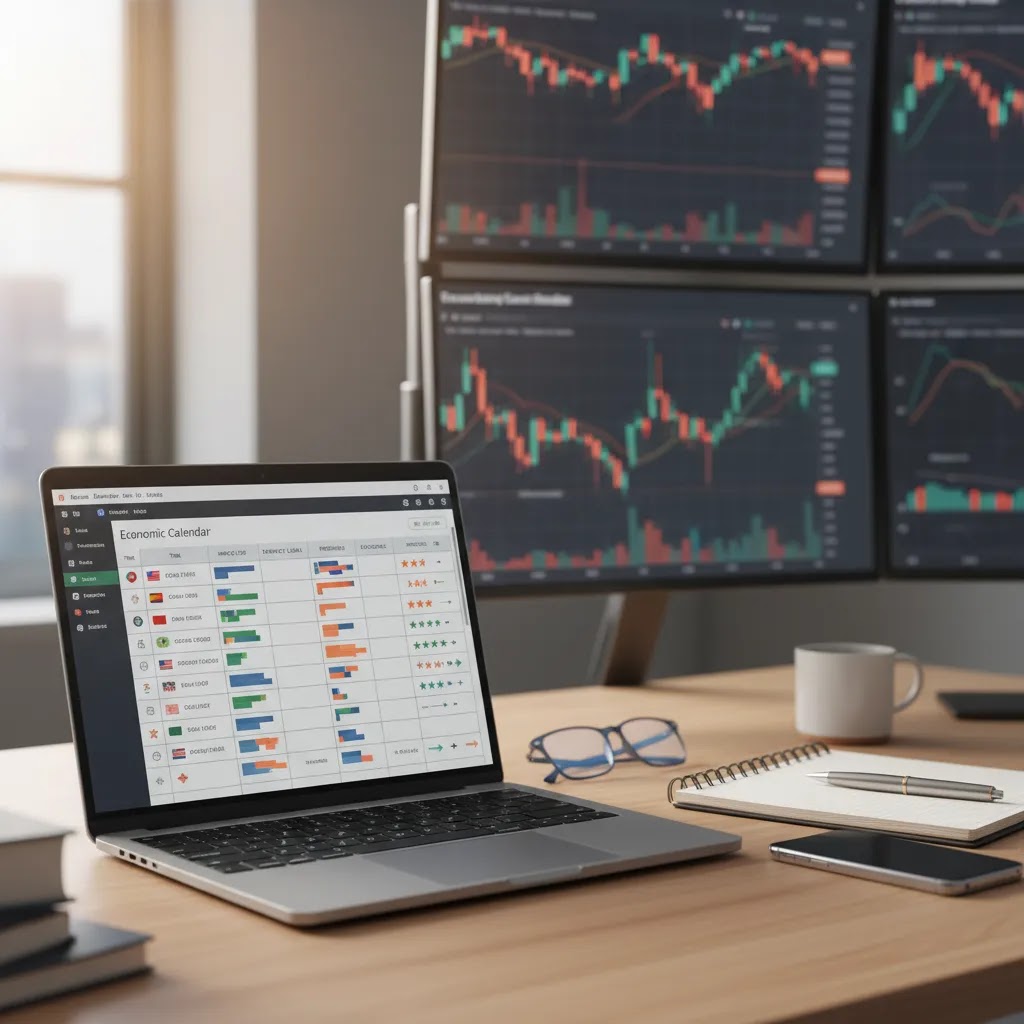
A typical calendar shows the event name, scheduled time, country, expected impact, previous reading, forecast, and actual result once released. This structure helps you compare what the market expected against what was actually published. That gap often drives price movement.
The calendar is most useful when paired with fundamental analysis. For example, if inflation has been trending higher and the market expects a hawkish central bank response, a CPI release could matter more than usual. The same number can have a different effect depending on the wider macro picture.
For beginners, the main benefit is preparation. For experienced traders, the advantage is context. In both cases, the calendar may help you avoid entering positions just before a major release without understanding the risk.
How to set up and customize an economic calendar
Here’s the thing: most traders do not need more events. They need fewer events, filtered to the ones that can realistically affect what they trade. A calendar is only helpful if you can narrow it down quickly and keep the timing accurate.
Use filters to reduce noise
Most economic calendars let you filter by country or region, impact level, and event category. From a practical standpoint, this is where you turn a long list of releases into a usable plan.
If you primarily trade USD pairs, for example, filtering to U.S. events can be more useful than scanning every release globally. If you trade EURUSD or DAX-style indices, you may want a combined U.S. and Eurozone view. If you trade gold, you will often care about U.S. inflation, jobs, and Federal Reserve communication because those can shift rate expectations and the U.S. dollar, which may influence gold pricing. None of this guarantees a specific market move, but it helps you focus on the events that tend to matter most for your instruments.
Impact filters are another fast win. Many calendars label events as low, medium, or high impact. If you are building a weekly plan, start by showing high impact only. Then add medium impact events if they are relevant to your pairs or if the market is already sensitive to that theme, such as inflation or growth.
Some calendar tools also include non-macro categories such as corporate earnings, dividends, or IPO-related events. Those matter more for stock trading than for pure FX, but they can still be relevant if you trade stock CFDs or indices that are sensitive to large company results. If your calendar offers these categories, treat them as optional layers you can switch on only when they match what you are actually trading.
Get the time zone right for UAE trading
Calendar timing errors are more common than people admit, especially around daylight saving time changes. Many economic calendars default to GMT, UTC, London time, or New York time. You want the calendar to display events in your local time so you do not place or manage trades at the wrong moment.
UAE traders typically want the calendar aligned to Gulf Standard Time (GST), which is UTC+4. The challenge is that the U.S., UK, and much of Europe may switch into or out of daylight saving time on different dates. That means the same headline event, like U.S. CPI or NFP, can appear to shift by an hour in your local schedule depending on the time of year. Consider this: if you notice a major U.S. release looks one hour earlier or later than you remember, double-check whether the calendar is showing your preferred time zone and whether DST changes are in effect for the release country.
A simple habit that helps is to confirm the time zone label inside the calendar settings at the start of each week. If you also use phone alerts or platform notifications, make sure those alerts follow the same time zone as your calendar view.
Build a weekly workflow you can repeat
Most traders benefit from switching between a “today” view for execution decisions and a “this week” view for planning. The weekly view helps you identify clusters, such as a CPI release followed by a central bank decision, where volatility could stay elevated for multiple sessions.
If your calendar supports alerts, set them with enough lead time to make calm decisions. A reminder 30 to 60 minutes before a high-impact event is often more useful than a notification one minute before the number hits. Another practical approach is a mini watchlist of events that directly affect your instruments. For example, if you trade GBP pairs, keep Bank of England decisions and top UK labor and inflation releases in your filtered view, and keep everything else secondary. This keeps your plan focused and reduces the temptation to trade every red-flag item.
How to read the calendar before a trade
Reading the calendar properly is less about spotting headlines and more about filtering what matters. Start with five basic checks:
- Event time: Confirm the release in your local time zone so you do not confuse London or New York timings with UAE market hours.
- Impact level: High-impact events usually deserve the most attention because they may trigger stronger price swings and wider spreads.
- Forecast versus previous: This shows what the market is already pricing in.
- Actual result: Once released, compare the actual figure with the forecast, not just the previous number.
- Current market positioning: If traders are heavily leaning one way, even a modest surprise could cause a sharp reversal.
Suppose the market expects a rate cut, but the central bank holds rates steady and sounds cautious about inflation. That may support the currency even if the rate itself did not change. The market often reacts more to forward guidance than to the headline figure.
This is one reason traders should understand what is forex trading before attempting a news trading strategy. Currency prices reflect expectations, relative economic strength, and policy outlooks, not just raw data points.
Which news events move markets most
Not every release deserves equal attention. In most cases, the largest market-moving events are those that shift expectations around interest rates, inflation, employment, and growth.
Interest rate decisions
Central bank announcements are among the most watched events on any forex economic calendar. A U.S. Federal Reserve decision, ECB meeting, or Bank of England update may move currencies, indices, gold, and bond yields within seconds. Traders often focus on the statement and press conference as much as the rate itself. Terms such as fomc meeting and interest rate decision matter because policy guidance may reshape the path of future rates.
Inflation releases
A CPI release can strongly affect markets because inflation influences central bank policy. If CPI comes in hotter than forecast, traders may expect tighter policy. If it misses significantly, rate cut expectations may rise. That is why inflation numbers often cause volatility in USD pairs, equity indices, and gold.
Labor market data
U.S. nonfarm payrolls, often shortened to NFP, are a classic example of high impact news forex traders track closely. NFP trading attracts attention because labor data may alter expectations about economic strength and interest rates. Wage growth and unemployment can sometimes matter just as much as the payroll number itself.
Growth and demand data
A GDP report, retail sales figures, and purchasing managers’ indexes may affect risk sentiment and currencies tied to growth expectations. These releases may not always create the same immediate spike as NFP or FOMC, but they can shape medium-term direction.
No event guarantees a clean move. Markets may whipsaw if the release is mixed, already priced in, or overshadowed by other concerns.
How to read the details behind each event
What many people overlook is that the calendar line item is only the headline. The market reaction is often driven by how the data compares with expectations, how the details look under the surface, and whether anything was revised.
Forecast vs actual vs previous, and why “good” can still sell off
Most calendars show three numbers for a release: previous, forecast, and actual. Traders tend to focus on actual versus forecast because that is where the surprise factor comes from. If the market was positioned for a strong number and the data merely meets expectations, price may still fade because there is no new information to justify further repricing.
Revisions can complicate this further. Some releases are revised after the first print, and markets sometimes react to the revision as much as the new number. Think of it this way: if the current month beats, but the prior month is revised down sharply, the overall message may be mixed.
This is also why a headline that looks positive in isolation can still trigger a risk-off move. If expectations were even higher, or if the market was priced for a more aggressive central bank path, a “good” number can disappoint. None of this is predictable in a clean way, but it is a more realistic lens than assuming strong data always means one direction.
Event-specific nuances that often matter more than the headline
Interest rate decisions are a good example. The rate itself is only one part of the event. Traders often react to the statement language, any published projections, and the tone in the press conference. A hold decision can still be hawkish or dovish depending on guidance about inflation, growth, and the likely timing of future moves.
Jobs reports are another. With NFP, the market often looks at the unemployment rate and wage growth alongside the payroll change. Wage growth can matter because it may feed inflation pressure, which can feed rate expectations. If payrolls are strong but wages cool, or if unemployment rises unexpectedly, the message can be less straightforward than the headline suggests.
Inflation releases can have similar layers. Markets may pay attention to core inflation measures more than the headline rate, depending on what central banks are signaling. If energy prices are driving the headline but core is stable, the reaction may differ from a broad-based inflation acceleration.
Connecting an event to markets, without assuming certainty
From a practical standpoint, it helps to know which markets are most sensitive to a given event, even though reactions can vary. Central bank decisions and inflation surprises often show up quickly in FX and bond yields. Those moves can then spill into indices and gold through risk sentiment and the implied path of interest rates.
If you trade multiple assets, scenario thinking can be more useful than prediction. For example, a hotter-than-expected inflation print could support the local currency in many cases because it may lift rate expectations, while pressuring rate-sensitive indices. A weaker print could do the opposite. The reality is that the market can still do something different if positioning, guidance, or other headlines dominate. Your calendar work is about preparation and risk awareness, not certainty.

Three practical ways to trade the news
There is no single correct way to trade major announcements. The right approach depends on your experience, your platform, and your tolerance for fast-moving conditions.
1. Avoid the release and trade the aftermath
This is often the most sensible approach for newer traders. Instead of placing trades seconds before a release, wait for the initial spike to settle. Then assess whether price is accepting a new direction or fading the move. This may reduce slippage risk, though it does not remove it.
2. Trade breakout levels
Some traders mark key support and resistance before the event and look for a confirmed breakout after the release. This method usually works better when the news creates a decisive surprise and volume follows through.
3. Trade mean reversion after an overreaction
If price spikes sharply into a major technical level and quickly stalls, some traders look for a reversal setup. This approach can be effective in choppy conditions, but it is also risky if the market is repricing a major macro shift.
Whichever method you use, your first job is risk control. A fast market may produce slippage, rejected orders, or sudden spread expansion. Reviewing core risk management principles before trading news is usually more important than finding a clever entry trigger.
Common news-trading pitfalls around major releases
Consider this: a strategy can look clean in a backtest and still struggle live during news because real execution costs show up most when the market moves fastest. That does not mean news trading cannot work, but it does mean you should plan for the things that can go wrong.
What can happen to pricing and execution during fast markets
Around high-impact releases, spreads may widen and liquidity can thin out. That can increase the chance of slippage, where your order is filled at a worse price than expected. Some traders also experience requotes or rejected orders, depending on the broker and platform model. Even if you are not trading the release directly, a stop-loss can be triggered during a temporary spike and filled at a different level than your chart suggests.
This is one reason “paper” results can be misleading. Backtests often assume ideal fills and stable spreads. Live conditions during NFP, CPI, or rate decisions can be different, especially in the seconds around the release.
Order types can behave differently than you expect
Market orders prioritize getting filled, not getting a specific price. In fast markets, that can mean unexpected entry or exit levels. Stop orders can also slip, because once the stop level is touched, it typically becomes a market order. Limit orders give you more price control, but they may not fill at all if the market gaps past your level.
What many people overlook is that “guaranteed fills” are generally not realistic in many news conditions. Even when a platform offers certain protections on specific products, you should still read the broker’s terms carefully and assume execution can deteriorate when volatility spikes.
A practical do-not-do checklist
If you are trying to reduce avoidable mistakes, these habits tend to cause the most damage during news:
- Entering seconds before a major release because you feel you will miss the move.
- Oversizing positions to “make the event worth it,” which can amplify losses if price whipsaws.
- Moving stops impulsively once volatility hits, instead of following a pre-defined plan.
- Trading every high-impact event, rather than focusing on the few releases that actually affect your instruments.
These points are not about being overly cautious. They are about accepting that news trading carries real risk, including losses, and building a process that can survive imperfect fills and unpredictable price behavior.
Platforms that may suit news-focused traders
The economic calendar itself is only part of the equation. If you plan to trade around major releases, platform choice matters because execution speed, spreads, charting, and regulatory standing all affect your experience. Business24-7 reviews brokers using criteria that include trust, fees, platform tools, market access, support, and usability. Based on currently available product data, several names may be worth shortlisting for further review.
| Platform | Spreads From | Minimum Deposit | Regulation | Notable Points |
|---|---|---|---|---|
| Pepperstone | 0.0 pips (Razor) | $0 | DFSA, FCA, ASIC, CySEC, BaFin | MT4, MT5, cTrader, TradingView; $7/lot Razor commission |
| AvaTrade | 0.9 pips | $100 | ADGM FSRA, CBI, ASIC, FSA Japan | AvaProtect, MT4, MT5, WebTrader; inactivity fee after 3 months |
| XTB | 0.1 pips | $0 | DFSA, FCA, CySEC, KNF | xStation 5, strong education, 0% commission stocks up to volume |
| Capital.com | 0.6 pips | $20 | SCA, FCA, CySEC, ASIC | 6,000+ markets, MT4, TradingView integration, low entry threshold |
Pepperstone may appeal to active traders who want multiple platforms and very low raw spreads, though commission costs on Razor accounts still need to be factored in. AvaTrade may suit readers who value risk-management features and ADGM FSRA oversight in the UAE context. XTB may fit traders who want education and a simple platform with no minimum deposit. Capital.com may interest traders looking for a low starting deposit and SCA regulation in the UAE.
If you are comparing providers before trading major releases, browse the Technical Analysis section for strategy context and the Trading Fundamentals section for broader market education. Read the full broker review before opening an account, especially if you expect to trade during volatile sessions.
Pros and Cons
Strengths
- An economic calendar helps you prepare for high-impact events instead of being surprised by sudden volatility.
- It provides a structured view of forecasts, previous data, and actual results, which may improve decision-making.
- It is useful across markets, not only forex. Indices, commodities, bonds, and some stocks also react to major releases.
- Used properly, it may help you avoid poor timing, such as opening a position just before NFP or a rate decision.
- It works well with both technical analysis and macro-focused trading plans.
Considerations
- News trading can be risky because spreads may widen and slippage may increase around major announcements.
- A stronger or weaker data print does not always lead to an obvious price move if expectations were already priced in.
- Beginners may overtrade the calendar by reacting to every red-flag event instead of focusing on the few that matter most.
- Even with a good calendar, execution quality depends on the broker, platform stability, and available risk controls.
Who this approach suits
Using an economic calendar suits traders who want a more structured and risk-aware way to approach market volatility. It may be especially useful for forex traders, gold traders, and index traders who know that macro releases often drive short-term price movement. Beginners can use it as a filter to stay out of unstable conditions. Intermediate traders may use it to build a more deliberate news trading strategy around CPI, NFP, and central bank events.
It is less suitable for anyone looking for constant action or instant signals. The calendar is a planning tool, not a shortcut to profit. In most cases, it works best for traders who are willing to wait, compare expectations with reality, and manage exposure carefully.
How to choose a broker if you plan to trade the news
If economic indicators trading is part of your plan, broker selection deserves as much attention as the strategy itself. A strong-looking setup may still produce a poor outcome if execution or pricing deteriorates during volatile moments.
1. Check regulation first
For UAE-based readers, local or regional oversight may add an extra layer of confidence. Depending on the broker, you may see regulation from the DFSA, SCA, or ADGM FSRA, along with international regulators such as the FCA, ASIC, or CySEC. Regulation does not remove trading risk, but it may improve standards around client protection, disclosures, and operational conduct.
2. Understand the fee model
News traders should look beyond headline spreads. A broker advertising very low spreads may also charge commission, overnight funding, or inactivity fees. For example, Pepperstone lists 0.0 pips from its Razor account with a $7/lot commission, while AvaTrade uses competitive spreads with an inactivity fee after 3 months. Cost transparency matters because high-volatility conditions can already increase trading friction.
3. Review platform choice and execution tools
If you trade news, platform responsiveness matters. Brokers in Business24-7’s current coverage offer tools such as MT4, MT5, cTrader, TradingView integration, proprietary web platforms, and mobile apps. Think about your own process. Do you need fast order entry, charting depth, mobile monitoring, or access to guaranteed stop-loss tools where available?
4. Match the broker to your experience level
A beginner may prefer a simpler interface and stronger education. An active trader may prioritize low spreads and advanced charts. XTB stands out for education, while Capital.com offers a low $20 minimum deposit and broad market access. There is no universal fit. The right platform depends on how you trade, how often you trade, and how much complexity you can realistically manage.
5. Test risk controls and funding terms
Before live trading, review stop-loss functionality, margin requirements, and account funding details. Some brokers offer AED support or local relevance for UAE users. eToro, for example, supports AED deposits and Arabic support, while ADSS is UAE-headquartered and SCA regulated. These details may matter if convenience and regional access are part of your decision.
Business24-7 is most useful at this stage as a research checkpoint. Explore our broker resources, compare reviews side by side, and confirm fees, regulation, and platform features before committing funds. That process may help you avoid selecting a broker based only on a low advertised spread or a single popular feature.
Frequently Asked Questions
What is the economic calendar in forex?
The forex economic calendar is a schedule of upcoming economic releases and policy events that may affect currency prices. It usually includes inflation, employment, GDP, and central bank announcements. Traders use it to prepare for potential volatility, not to guarantee market direction.
What does high impact mean on an economic calendar?
High impact usually means the event has a stronger history of moving markets. Examples include nonfarm payrolls, CPI, and interest rate decisions. That does not mean price will always trend cleanly after the release, but volatility, slippage, and spread changes may become more likely.
Is trading the news good for beginners?
In most cases, beginners should be cautious. Major releases can create sharp price swings and unpredictable execution. A safer starting point may be to observe how markets react, wait for the first move to settle, and focus on learning how expectations are priced before risking capital.
Which events matter most on the U.S. economic calendar?
The U.S. economic calendar is often dominated by Federal Reserve meetings, CPI releases, nonfarm payrolls, GDP reports, retail sales, and core inflation data. These events can affect the U.S. dollar, stock indices, gold, and broader risk sentiment across global markets.
How do I trade NFP?
NFP trading typically involves preparing key levels before the release, understanding the market forecast, and deciding whether you will trade the immediate breakout or wait for confirmation after the first spike. Because conditions can be unstable, position sizing and stop placement deserve extra attention.
Why do spreads widen during news events?
Spreads may widen because liquidity conditions can change quickly when large numbers of orders hit the market at once. Brokers and liquidity providers may adjust pricing to reflect uncertainty. This is one reason a strategy that looks profitable on paper may behave differently during live news conditions.
Can I rely only on the economic calendar to make trades?
No. The calendar is a planning tool, not a complete trading system. It works better alongside technical levels, broader macro context, and disciplined risk rules. A surprise data release may create noise rather than a lasting directional move, especially if the market was already positioned for it.
What should UAE traders check before using a broker for news trading?
UAE traders should check regulation, pricing structure, platform stability, and any region-specific support such as AED funding or local oversight. Depending on the broker, relevant regulators may include the DFSA, SCA, ADGM FSRA, FCA, ASIC, or CySEC. Confirm details in the broker’s current review.
Is a lower spread always better for trading the news?
Not necessarily. A low advertised spread may come with commission charges or may not reflect conditions during major events. You should look at the full cost structure, platform reliability, and execution quality. For news trading, consistency can matter as much as the headline spread figure.
How do I read an economic calendar (previous vs forecast vs actual)?
Previous is the last reported figure, forecast is what the market expects for the new release, and actual is the number published at the release time. Traders often watch the gap between actual and forecast because that surprise may be what forces the market to reprice. Some events also include revisions to prior data, which can change the overall message even if the new headline looks strong.
What time zone is the economic calendar in, and how do I convert it to UAE time?
It depends on the calendar. Many default to UTC, GMT, London time, or New York time, but most let you change the setting. UAE time is usually Gulf Standard Time (UTC+4). Be careful around daylight saving time changes in the U.S., UK, and Europe, because those can shift the local UAE release time by an hour at different points in the year.
What does “high impact” mean on an economic calendar?
High impact is a label used by many calendars to indicate an event that often triggers larger moves or higher volatility compared to routine releases. It is not a promise of direction or a guarantee that price will trend, but it can signal that spreads, slippage, and whipsaws may be more likely around the release.
How can I set up an economic calendar for the week (or next week) and customize it?
Start by switching the calendar view from “today” to “this week” so you can see clusters of major events. Then filter by the countries linked to your traded instruments and keep high-impact events visible. If your calendar supports alerts, set reminders far enough ahead to plan calmly, and confirm your time zone setting so the schedule matches UAE trading hours.
Key Takeaways
- The economic calendar helps you prepare for volatility around data releases, not predict profits.
- Focus on high-impact events such as CPI, NFP, GDP, and central bank rate decisions.
- Compare actual results with forecasts, because market expectations usually matter more than the previous reading alone.
- News trading may work best when paired with technical levels and strict risk controls.
- Broker choice matters, especially for regulation, spread structure, platform quality, and execution during volatile conditions.
Conclusion
The economic calendar is one of the simplest tools for improving trading discipline because it tells you when market conditions may change quickly. Used well, it can help you time your decisions more carefully, avoid unnecessary exposure, and understand why a currency pair or index is suddenly moving. What it cannot do is remove risk or replace a complete trading plan. If you are comparing brokers before trading major releases, Business24-7 can help you evaluate regulation, spreads, tools, and platform fit with a UAE-focused lens. Browse our broker resources, check detailed platform reviews, and return to Business24-7 whenever you want a clearer, more balanced view before making your next decision.
Disclaimer: The content published on Business24-7 is intended for informational purposes only and does not constitute financial advice, investment recommendations, or an endorsement of any specific platform or financial product. Trading and investing carry significant risk, including the potential loss of capital. You should conduct your own research and, where appropriate, seek independent financial advice before making any investment decisions. Business24-7 does not accept responsibility for any financial losses incurred as a result of information published on this site.
Disclaimer
eToro is a multi-asset platform which offers both investing in stocks and cryptoassets, as well as trading CFDs.
Please note that CFDs are complex instruments and come with a high risk of losing money rapidly due to leverage. 61% of retail investor accounts lose money when trading CFDs with this provider. You should consider whether you understand how CFDs work, and whether you can afford to take the high risk of losing your money
This communication is intended for information and educational purposes only and should not be considered investment advice or investment recommendation. Past performance is not an indication of future results.
Copy Trading does not amount to investment advice. The value of your investments may go up or down. Your capital is at risk.
Crypto assets are complex and carry a high risk of volatility and loss. Trading or investing in crypto assets may not be suitable for all investors. Take 2 mins to learn more
eToro USA LLC does not offer CFDs and makes no representation and assumes no liability as to the accuracy or completeness of the content of this publication, which has been prepared by our partner utilizing publicly available non-entity specific information about eToro.

If you trade forex, indices, commodities, or stock CFDs, the economic calendar is one of the most useful planning tools you can keep open. It helps you see when high-impact events such as inflation data, GDP releases, and central bank decisions could trigger sharp volatility. For UAE-based traders, this matters because major U.S., European, and regional announcements often influence global…