

If you have ever opened a trading app in Dubai or Abu Dhabi and wondered why currencies are moving at all hours, you are not alone. Many first-time traders hear that forex is the largest financial market in the world, yet the basics often feel oddly unclear. Who is actually buying and selling? Why does the market never seem to sleep? And how can a market with no single central exchange still function smoothly? Those are reasonable questions, especially if you are trying to separate useful education from marketing noise.
This article explains the forex market in plain English, including its size, the main participants, how pricing works, and why structure matters to retail traders in the UAE. If you are still building your foundation, our guide to trading for beginners can help you connect the big picture to practical next steps. Business24-7 focuses on research-driven financial education, so the goal here is not to push you toward a trade. It is to help you understand what you are looking at before you risk real money, because trading always involves the possibility of capital loss.
What the forex market actually is
The forex market, short for foreign exchange market, is where currencies are bought and sold against each other. Instead of buying a single asset in isolation, you trade one currency relative to another. That is why prices appear as pairs such as EUR/USD or USD/JPY.
Think of it this way, if you believe the euro may strengthen against the U.S. dollar, you may buy EUR/USD. If you believe the opposite, you may sell it. This is the core idea behind the forex market, and it is one reason beginners often start by learning what is forex trading before they look at platform features or broker fees.
Unlike stock markets that usually trade through centralized exchanges, the forex market is a decentralized market. That means there is no single global exchange building one universal order book for every participant. Prices are formed across a network of banks, financial institutions, brokers, liquidity providers, and electronic trading systems.
In practice, this means pricing can be highly efficient in the most traded pairs, but execution quality may still vary depending on the broker or platform you use. For retail traders, that matters because spreads, slippage, and overnight charges may affect trading costs even when the underlying market is very liquid.
What moves the forex market today: core drivers you should watch
When people search for what is moving the forex market today, they are usually looking for a simple explanation of why a pair is trending, spiking, or suddenly reversing. The reality is that forex prices often respond to expectations before headlines become “official.” A currency can move not just on a data release, but on how that release compares to forecasts, and what it may imply for interest rates and capital flows.
Interest rates and central bank expectations tend to sit at the center of many currency moves. Think of it this way, if markets start expecting higher rates in one country relative to another, that may change the appeal of holding that currency. This is one reason pairs like EUR/USD or USD/JPY can be sensitive to central bank speeches, meeting minutes, and inflation data, even when there is no immediate rate change.
Economic data is another major driver, especially inflation releases, employment reports, wage growth, and GDP. These indicators can shift expectations about growth and policy. For example, a stronger-than-expected jobs report may lead traders to price in tighter policy, while weak growth data may push expectations in the opposite direction. None of this is a guarantee of direction, but it helps explain why volatility can increase around scheduled releases.
Risk sentiment also matters because currencies are tied to global capital movement. In risk-on conditions, markets may favor growth-linked currencies, while risk-off periods can sometimes support safe-haven demand. Geopolitical events can feed into this quickly by changing energy prices, trade routes, or investor confidence. Commodities play a role too, especially for currencies linked to major exporters, where oil or metals prices may affect the broader economic outlook.
For UAE-based readers, it also helps to understand the local context: the UAE dirham is pegged to the U.S. dollar. That means AED itself is typically stable versus USD by design, but USD strength or weakness can still matter indirectly. It may influence the pricing of imports, travel spending, and global asset valuations, and it can shape how USD-based pairs behave during major macro cycles. If you trade forex through USD-quoted pairs, shifts in U.S. rate expectations can become a recurring theme in the background.
How big the forex market is
The forex market size is one of the first things that attracts new traders. It is widely regarded as the largest financial market in the world by daily trading volume. When people ask, “how big is the forex market,” they are usually referring to total global currency turnover across spot, forwards, swaps, and options transactions.
The commonly cited figure for forex daily volume is in the trillions of dollars per day. Exact totals vary by reporting period and source, but the important point is that currency trading volume is far larger than what most retail investors first imagine. This scale is driven by governments, banks, multinational companies, hedge funds, asset managers, and retail traders all interacting in the same broader market structure.
Here’s the thing, large size does not automatically make trading safer for you. A huge market may offer deep liquidity in major pairs such as EUR/USD, GBP/USD, and USD/JPY, but risk remains very real. Prices may move sharply during economic releases, central bank announcements, or geopolitical events, and leveraged products such as contracts for difference, or CFDs, may increase losses as well as gains.
What many people overlook is that size mainly helps explain why the forex market can support 24-hour activity and relatively tight pricing in heavily traded instruments. It does not remove the need for careful broker selection, risk controls, or an understanding of how different forex currency pairs behave.
Who trades forex
When you hear about forex market players, it helps to picture layers rather than one crowd acting for the same reason. Different participants enter the market with very different objectives.
Central banks and governments
Central banks forex activity is among the most closely watched parts of the market. Institutions such as the U.S. Federal Reserve, the European Central Bank, and regional monetary authorities influence currencies through interest rate decisions, liquidity operations, and policy guidance. They may also intervene directly in currency markets in certain circumstances.
For traders in the UAE, central bank decisions matter because they may affect USD-linked pricing, regional capital flows, and broader market sentiment. Even if you never trade around news releases, these institutions often shape the background trend.
Commercial and investment banks
The forex interbank market refers to the network where major banks trade currencies with one another. This is the institutional core of the market. These banks provide liquidity, quote prices, manage their own exposure, and facilitate client transactions.
From a practical standpoint, retail traders do not usually access the interbank market directly. Instead, your broker may source pricing from banks and other liquidity providers. That is one reason broker execution policies and regulation matter.
Institutional investors and hedge funds
Institutional traders include hedge funds, pension funds, insurers, and large asset managers. Some trade forex for speculation, while others use it to hedge currency exposure tied to global portfolios. A hedge, in simple terms, is a position designed to offset possible losses somewhere else.
These participants can move meaningful size, especially during major macroeconomic shifts. Still, no single group controls the whole market on a consistent basis because forex is so broad and globally distributed.
Corporations and import-export businesses
Many large companies trade forex not to speculate, but because they operate across borders. A UAE business paying suppliers in euros or receiving revenue in dollars may need to convert currencies or manage exchange-rate risk. This commercial flow is a major part of the market’s real-world function.
Retail traders
Retail traders are individuals using online brokers to access currency markets. This is the group most readers will identify with. Retail participation is much smaller than institutional flow, yet it has become more visible because online platforms make forex widely accessible.
Business24-7 often highlights this distinction in educational content because many beginners wrongly assume the market is mostly other app users placing small trades. The reality is that retail sits at the edge of a much larger institutional ecosystem.
How the forex market works day to day
The forex market explained simply is this, participants exchange one currency for another at an agreed price, and that price changes continuously as supply and demand shift. Those shifts may reflect interest rates, inflation expectations, trade flows, political developments, and changes in risk appetite.
Spot, forwards, and derivatives
The spot market is where currencies are exchanged at current market prices. Retail traders often access forex through spot-style pricing or through CFDs that track underlying currency movements. Large institutions may also use forwards, swaps, and options to manage future exposure.
If you are new, do not assume every forex product works the same way. A broker may offer leverage, swaps, or different margin rules depending on the instrument. Margin is the capital you must set aside to open a leveraged position, and it can magnify losses if price moves against you.
Bid, ask, and spread
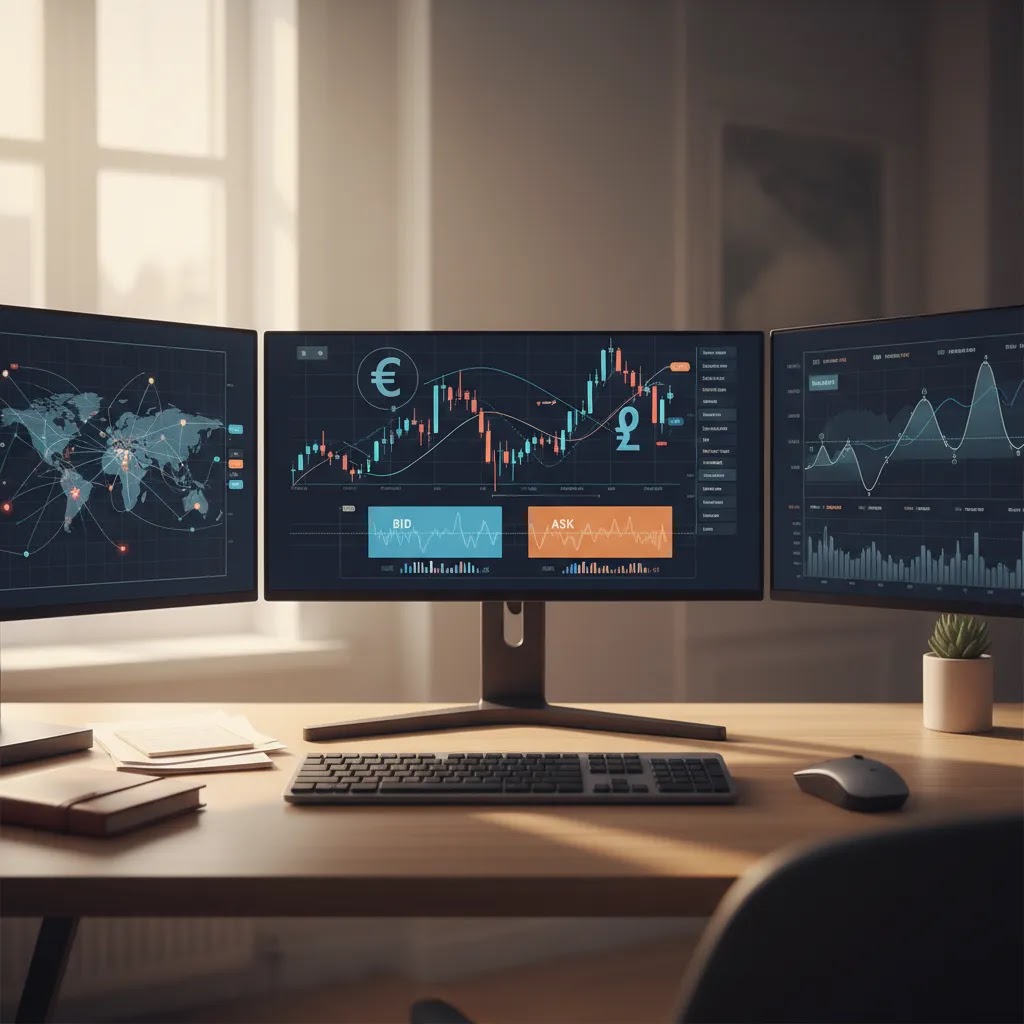
Every forex quote has a bid price and an ask price. The bid is the price at which the market buys from you, and the ask is the price at which the market sells to you. The difference is called the spread, and it is one of the most common trading costs.
In more liquid pairs, spreads may be narrow. In less liquid pairs or volatile conditions, they may widen. That is why the market structure itself and the broker’s pricing model both matter to your experience.
Why there is no single official price
Because the forex market is decentralized, there is no single global exchange publishing one final price for everyone. Prices are formed through connected liquidity venues and broker feeds. Most of the time, quotes across reputable providers are very close in major pairs, but they may not be identical at every moment.
Consider this, if two platforms show slightly different EUR/USD prices, that does not automatically mean one is dishonest. It may reflect different liquidity arrangements, markups, or timing. Still, if pricing is consistently poor or opaque, that is a reason to investigate further.

Forex market price and live charts: what “live” really means
Many beginners understand that forex is decentralized, but then get confused when they look at a “forex market live” quote page and see slightly different prices across platforms. Here’s the thing, the “forex market price” you see is typically derived from a stream of bid and ask quotes coming from liquidity providers, often banks and other market makers, routed through a broker’s pricing engine. Depending on the broker and account type, the broker may add a markup to the raw spread, charge a separate commission, or both.
Unlike an exchange-traded stock where a consolidated tape may publish a last traded price, forex is usually quote-driven. That means what you see most of the time is the best available bid and ask in that provider’s network at that moment, not one universal last trade for the entire world. Two reputable feeds can be “right” while still being a fraction of a pip apart because they are looking at different pools of liquidity, or because one updates a split second earlier than the other.
Now, when it comes to live forex charts, it is important to know what you are actually seeing. Many charting pages use indicative pricing, aggregated data, or a synthetic midpoint built from bid and ask. Some feeds also apply a small delay, or they smooth data to make charts easier to read. Your execution price may differ from the chart price because trades are filled on bid or ask, not on the midpoint, and because fast markets can create slippage. Slippage is when your order fills at a different price than expected, which can happen during volatility or thin liquidity.
From a practical standpoint, a forex market graph is most useful when you treat it as context rather than a promise. Timeframe selection matters. A one-minute chart will naturally look noisy, while a daily chart can hide intraday swings that still affect stop losses. Spreads also change the feel of a chart, especially in volatile conditions. You may see what looks like a clean breakout, but if spreads widen during a news spike, your real entry and exit levels can be less favorable than the candle suggests.
What many people overlook is that gaps can occur around session transitions, weekend reopenings, or sudden news. Forex trades nearly 24 hours during the week, but liquidity is not uniform, and some pairs can “jump” when activity returns. That does not mean the market is broken. It means the market is reacting to new information with limited pricing depth at that moment. If you are using charts to plan trades, it is usually wise to factor in the bid-ask spread, the possibility of slippage, and the fact that a chart is not the same thing as an executable quote.
Why forex market hours matter
One of the most distinctive parts of the forex market is that it operates nearly 24 hours a day during the trading week. Activity rotates through major financial centers, typically associated with the Asia, Europe, and North America sessions.
This matters because liquidity and volatility are not constant. During session overlaps, especially London and New York, major pairs often see heavier volume and tighter spreads. During quieter hours, movement may slow or spreads may widen.
If you are based in the UAE, timing can be especially relevant. Many traders fit research and execution around work hours, family commitments, or local market routines. Knowing the active windows may help you understand why a pair behaves differently in the morning versus late evening. For a fuller breakdown, see our article on forex trading sessions.
Trading during active hours does not remove risk. It may improve liquidity, but major data releases and central bank announcements can still trigger fast moves, slippage, and wider costs than expected.
What UAE traders should keep in mind
If you are learning about the forex market from the UAE, market structure is only part of the picture. You also need to think about the platform or broker that gives you access to it. A well-regulated broker may offer better transparency around client money handling, complaints procedures, and operational oversight, though regulation does not eliminate trading risk.
Relevant local authorities may include the Securities and Commodities Authority (SCA), the Dubai Financial Services Authority (DFSA), and the Financial Services Regulatory Authority (FSRA) in Abu Dhabi Global Market (ADGM). International regulators such as the Financial Conduct Authority (FCA), Cyprus Securities and Exchange Commission (CySEC), and Australian Securities and Investments Commission (ASIC) may also be relevant depending on the broker entity serving your account.
The reality is that many new traders spend weeks studying charts but only a few minutes checking regulation, fee schedules, and execution terms. That is backwards. Before you commit funds, it is worth reviewing educational resources in the Trading Fundamentals section and broader regulatory reading in UAE Regulation and Tax.
If you later compare forex brokers, you may notice meaningful differences in minimum deposit, spreads, platform tools, and local regulation. For example, Business24-7 covers firms with different UAE-relevant regulatory footprints, including brokers regulated by the SCA, DFSA, or ADGM FSRA. That kind of comparison is useful only after you understand the underlying market, because a trading platform is simply your access point to a much larger global system.
Starting small in forex: realistic expectations, minimums, and risk limits
A common beginner question is whether $100 is enough to start forex. It may be possible to open an account with that amount at some brokers, but the constraints are real. With a small balance, spreads and fees can take up a larger percentage of your capital, and even modest price moves can create outsized swings in your account if you use high leverage. That is not a reason to avoid learning. It is a reason to approach small-account trading with realism and tight risk limits.
Think of it this way, if you can only afford to risk a small amount per trade, your position sizing has to be very small to stay within a sensible risk range. In leveraged products, margin requirements and floating losses can also trigger stop-outs faster than many beginners expect. This is why “minimum deposit” is not the same thing as a comfortable starting balance. A platform might allow a low minimum, but trading conditions can still be challenging if you do not have room for normal volatility.
You will also see high-intent searches like “how to turn $100 into $1,000 in forex” or “is it possible to make $1,000 a day in forex.” The reality is that targets like that usually imply very high risk, very high leverage, or both. In real markets, leverage magnifies losses as well as gains, and aggressive compounding assumptions can break down quickly during a normal losing streak. If someone is promoting fast results as a planning framework, that is a red flag, not a strategy.
From a practical standpoint, a safer starting point for many UAE retail traders is to focus on process rather than profit goals. Use a demo account first to understand how spreads, swaps, and execution behave. Learn exactly how margin works on your platform, and what triggers a margin call or liquidation. Review the broker’s fee schedule, including spreads, commissions if applicable, overnight financing charges, and withdrawal costs. Most importantly, verify regulation and the exact entity serving your account, whether that is SCA, DFSA, ADGM FSRA, or a major international regulator like FCA, CySEC, or ASIC. None of these steps remove market risk, but they can reduce avoidable surprises before you put real money at risk.
Frequently Asked Questions
Is the forex market really the largest financial market in the world?
It is widely described that way because global currency trading volume is measured in trillions of dollars per day. That volume includes activity from banks, central banks, corporations, institutional investors, and retail traders. The key takeaway is not just that the market is huge, but that its size supports continuous global trading and deep liquidity in major currency pairs. Even so, a large market does not make trading safe by default. You still face market risk, broker risk, and the possibility of losing capital, especially if you use leverage.
Who are the biggest forex market players?
The biggest forex market players are typically major banks, central banks, institutional funds, large corporations, and multinational financial firms. Retail traders are active, but they represent a much smaller share of total global volume. Banks form the core of the forex interbank market, which is where much of the institutional pricing and liquidity originates. Central banks matter because interest rate policy and currency intervention can influence pricing across the market. For most retail traders, understanding these players helps explain why macroeconomic events can move prices quickly.
How does the forex market work if there is no central exchange?
The forex market works through a network of banks, brokers, liquidity providers, and electronic trading systems rather than one centralized exchange. That is why it is called a decentralized market. Prices are quoted across this network, and retail brokers usually stream those prices to clients through their trading platforms. In normal conditions, major pairs often have very similar pricing across reputable providers, but quotes may still differ slightly. This structure is efficient, though it also means broker quality and execution policies can influence the prices and trading conditions you actually receive.
What is the forex interbank market?
The forex interbank market is the institutional layer where large banks trade currencies directly with one another and provide pricing to the wider market. It is not usually something retail traders access in a pure form. Instead, your broker may connect to banks or other liquidity sources and then deliver pricing to your platform, sometimes with a markup or commission structure. Understanding this helps you see why not all brokers offer identical spreads or execution speeds. It also highlights why regulation and transparency matter when choosing a provider.
What are forex market hours?
Forex market hours generally run 24 hours a day during the business week, opening in the Asia-Pacific region and moving through European and North American sessions. The market does not operate with the same intensity all day. Volume often increases when major sessions overlap, especially London and New York. For UAE-based traders, this can affect when spreads are tighter and when price movement is more active. If you want a practical timing breakdown, you can read more about forex trading sessions and how they affect liquidity.
Do central banks trade forex?
Yes, central banks do participate in currency markets, although not always for the same reasons as private traders. They may manage reserves, influence monetary conditions, or intervene to stabilize their currency under specific circumstances. More often, their indirect impact comes from interest rate decisions and policy signals, which shape expectations across global markets. For retail traders, central bank meetings can be high-risk periods because volatility may increase sharply. If you trade during those events, the possibility of slippage and rapid losses may rise as well.
Is forex trading suitable for beginners in the UAE?
It may be accessible, but accessibility should not be confused with simplicity. Forex trading can look straightforward on an app, yet price movements are influenced by macroeconomic data, interest rates, liquidity, and leverage rules. If you are new, start by learning the basics of market structure, risk, and order costs before opening positions. A resource like trading for beginners can help you build that foundation. You should also verify whether a broker is regulated by the SCA, DFSA, ADGM FSRA, or another recognized authority relevant to your account.
What currencies are traded most often in the forex market?
The most traded currencies are usually the U.S. dollar, euro, Japanese yen, British pound, and several other major global currencies. These form the basis of what traders call major pairs, such as EUR/USD and USD/JPY. Major pairs typically have the deepest liquidity and narrower spreads than many exotic pairs. If you are learning how price behavior differs across instruments, reviewing forex currency pairs is a useful next step. Pair selection matters because volatility, trading costs, and news sensitivity can vary widely.
Why do retail traders need to understand forex market structure?
Market structure affects how your orders are priced, when spreads widen, and why some trading conditions feel easier than others. If you understand that the forex market is decentralized and driven by overlapping institutional and retail flows, platform behavior starts to make more sense. You are less likely to confuse normal market mechanics with a platform issue, and more likely to spot genuine red flags such as unexplained fees or unclear execution practices. This knowledge also helps you ask better questions before choosing a broker or risking real money.
What is the forex market?
The forex market is the global market where currencies are exchanged against each other, usually quoted in pairs such as EUR/USD or USD/JPY. It is decentralized, meaning pricing comes from a network of banks, liquidity providers, and brokers rather than a single exchange. For retail traders, this structure helps explain why spreads exist, why quotes can differ slightly across platforms, and why execution quality depends partly on the broker you use.
Is $100 enough to start forex?
It may be enough to open an account with some brokers, but it can be a difficult amount to trade with in a controlled way. With a small balance, spreads and other fees can represent a larger share of your capital, and leverage can cause losses to build quickly if the market moves against you. Many new traders find it more realistic to start with a demo account first, then move to live trading only after they understand margin, costs, and the risks involved.
How to turn $100 into $1000 in forex?
Most approaches that claim to turn $100 into $1,000 quickly rely on taking very high risk, often through high leverage or oversized positions. The problem is that leverage magnifies losses as well as gains, and a normal drawdown can wipe out a small account. If you are learning forex, it is usually more productive to focus on risk limits, position sizing, and consistent process rather than setting aggressive short-term targets that may encourage poor decisions.
Is it possible to make $1000 a day in forex?
Some traders may have days with large gains, but aiming for a fixed daily income is typically unrealistic for most retail accounts and can encourage excessive risk-taking. Forex markets do not pay a salary, and results can vary widely due to volatility, spreads, and slippage, especially when using leverage. If you trade, it is important to treat it as a high-risk activity, plan for losing periods, and avoid assumptions that any daily outcome is repeatable.
Key Takeaways
- The forex market is a decentralized global market where currencies trade in pairs rather than as standalone assets.
- Its daily volume is measured in trillions of dollars, but size does not remove the risk of capital loss.
- Major forex market players include central banks, banks, institutions, corporations, and retail traders.
- Forex market hours matter because liquidity and spreads change across trading sessions and news events.
- For UAE traders, understanding broker regulation through bodies such as the SCA, DFSA, and ADGM FSRA is just as important as understanding the market itself.
Conclusion
The forex market can seem mysterious at first because it is huge, fast-moving, and spread across institutions rather than one central exchange. Once you break it down, the logic becomes much clearer. Currencies trade in pairs, prices are shaped by global supply and demand, and the biggest participants often have very different goals from retail traders. That context matters because it helps you interpret price moves, session behavior, and broker pricing more realistically.
If you are still early in your learning process, focus on understanding structure before strategy. Learn who trades, when liquidity tends to be strongest, how costs appear in practice, and what regulation may mean for your protection as a customer. Business24-7 is designed to support that research process with plain-English trading education, broker reviews, and comparison resources for UAE readers. The better informed you are before opening an account or placing a trade, the more confident and disciplined your decisions may become.
The content on Business24-7 is intended for informational and educational purposes only. It does not constitute personalized financial or investment advice. Trading financial instruments involves significant risk, and you may lose some or all of your invested capital. Always conduct your own research and consider seeking advice from an independent, licensed financial advisor before making any investment decisions. Business24-7 does not endorse or guarantee the performance of any financial platform or service mentioned in this content.
Disclaimer
eToro is a multi-asset platform which offers both investing in stocks and cryptoassets, as well as trading CFDs.
Please note that CFDs are complex instruments and come with a high risk of losing money rapidly due to leverage. 61% of retail investor accounts lose money when trading CFDs with this provider. You should consider whether you understand how CFDs work, and whether you can afford to take the high risk of losing your money
This communication is intended for information and educational purposes only and should not be considered investment advice or investment recommendation. Past performance is not an indication of future results.
Copy Trading does not amount to investment advice. The value of your investments may go up or down. Your capital is at risk.
Crypto assets are complex and carry a high risk of volatility and loss. Trading or investing in crypto assets may not be suitable for all investors. Take 2 mins to learn more
eToro USA LLC does not offer CFDs and makes no representation and assumes no liability as to the accuracy or completeness of the content of this publication, which has been prepared by our partner utilizing publicly available non-entity specific information about eToro.

If you have ever opened a trading app in Dubai or Abu Dhabi and wondered why currencies are moving at all hours, you are not alone. Many first-time traders hear that forex is the largest financial market in the world, yet the basics often feel oddly unclear. Who is actually buying and selling? Why does the market never seem to…